
Tyrannosaurus – T-Rex
Tyrannosaurus Rex: The jaw that shattered bones
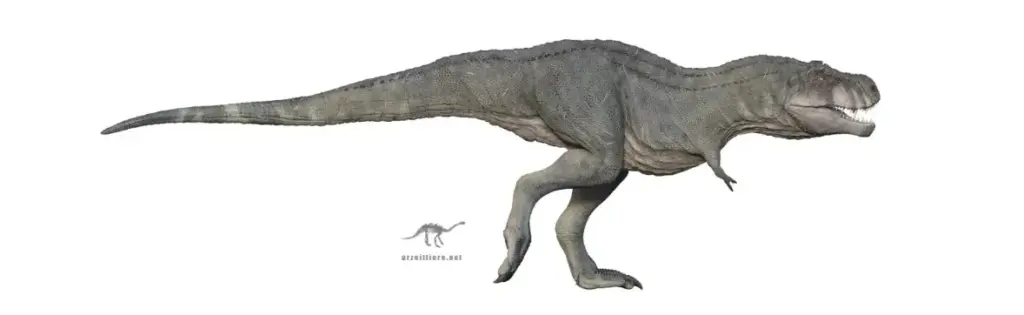
Twelve to thirteen meters long. A bite force that effortlessly crushed bones. Arms that barely reached its own jaw. No dinosaur shapes our image of prehistoric times as much as Tyrannosaurus Rex. Recent research shows that it suffered from diseases and occasionally ate members of its own species. It grew to its colossal size in a single, dramatic growth spurt.
At a glance
| feature | Value |
|---|---|
| length | up to 13 meters (record specimen “Scotty”) |
| Weight | 6-8.8 tons |
| Bite force | up to 57,000 Newtons |
| Top speed | approx. 19–27 km/h |
| Location | North America, especially the Hell Creek Formation |
| age | Late Cretaceous period, approximately 68–66 million years ago |
| Food | Carnivore – apex predator and scavenger |
A colossus on two legs
The T-Rex walked on two powerful hind legs. It carried its body horizontally, using its long tail as a counterweight to its massive head. At the hips, it reached 3.7 to 4 meters. That's about the height of a basketball hoop.
The largest known specimen is nicknamed "Scotty." It was recovered in Saskatchewan, Canada. According to a Analysis of the University of Alberta During its lifetime, it weighed more than 8.8 tons. That's more than any other known land-dwelling carnivore in Earth's history. About six times the weight of an African elephant bull.
A biting force like a wrecking ball
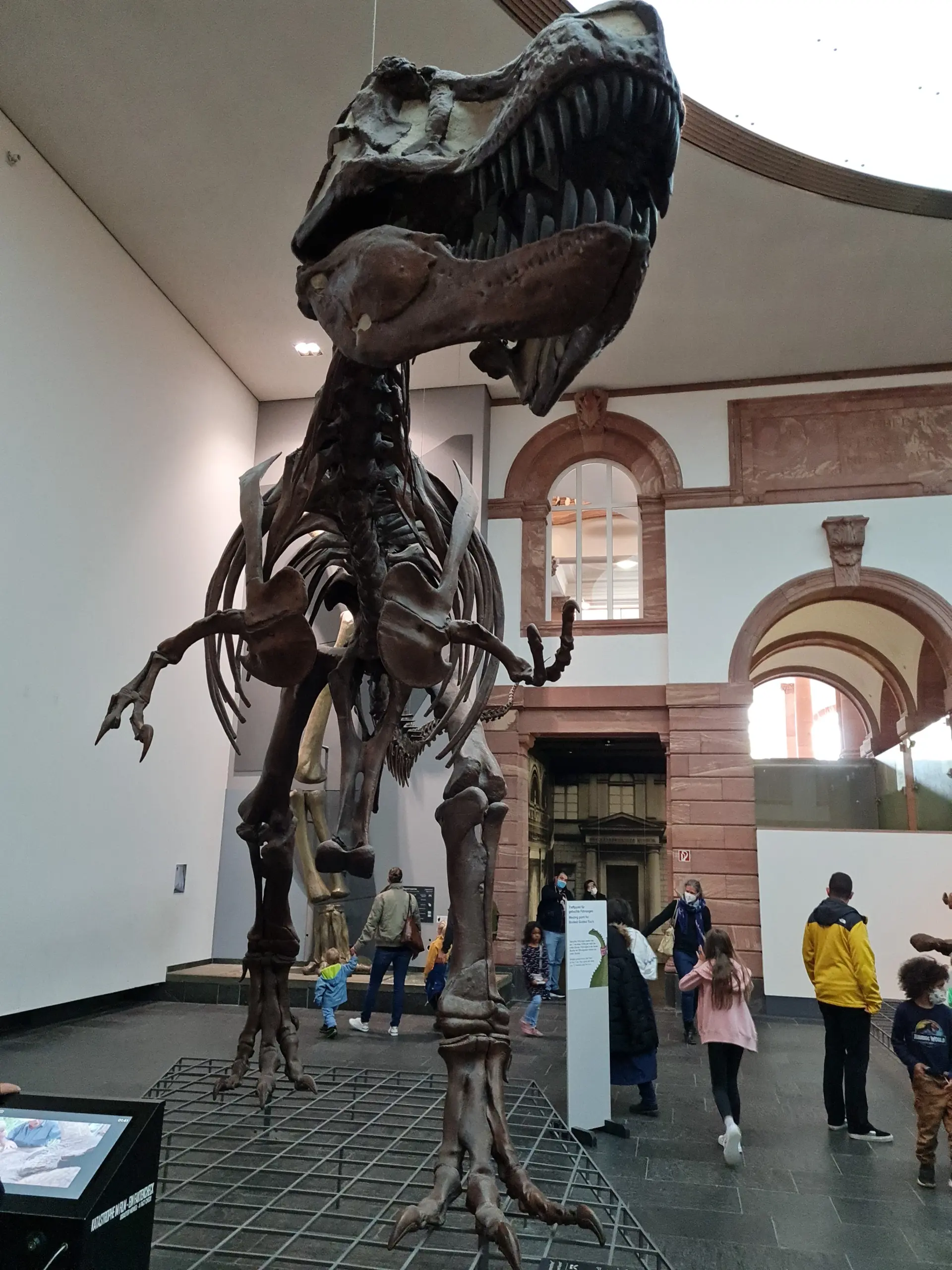
When the T-Rex bit, bones shattered. Researchers at University of Liverpool They scanned the skull with a laser. Their findings: A single molar could generate forces of up to 57,000 Newtons. That's roughly 5.7 tons on a single tooth tip. An adult human only exerts 700 to 1,000 Newtons when biting. The T-Rex's bite was therefore about 60 times harder.
There is even a specific technical term for the deliberate eating of bones: OsteophagyCrushed bone fragments have been repeatedly found in fossilized T-Rex dung. This is solid evidence that it actually used this strength. In this way, it gained access to nutrient-rich bone marrow, which was unavailable to other carnivores.
How he did it is revealed in a 2017 study by Paul Gignac and Gregory Erickson. Reptiles, with their loosely fitting teeth, can usually barely damage bones. Mammals can only do so because their teeth meet precisely when they bite. The T-Rex found a third way. Depending on the tooth and the depth of the bite, he applied varying degrees of force. Between 8,500 and around 34,500 Newtons of force were exerted on the bone. With the most powerful bites, the weight of a small van rested on a single tooth tip. The extent of this is evident in an examined pelvic bone. He simply bit away about 17 percent of the crest in this way.
How fast could the T-Rex really run?
Previous estimates suggested speeds of up to 53 km/h. That would be a racehorse's pace. University of Manchester study Since 2017, the results paint a sobering picture. The finding: only about 19 km/h. Faster movements would have overloaded the leg bones. An analysis by the University of Maryland arrives at a figure of around 27 km/h. That's slightly higher.
Both values point in the same direction. The T-Rex was more of a marathon runner than a sprinter. In reality, it was about as fast as a human sprinting. It just maintained that speed over much longer distances.
A simulation by William Sellers and his team shows just how close this limit was. Ignoring the bones' resilience, the model arrived at a high value. Theoretically, this amounted to speeds of up to 28 km/h. However, this only applies if one accepts the risk of bone fractures. When the team incorporated a realistic stress limit, the T-Rex was left with only walking. A true running stride with a flight phase was no longer possible. A second, independent study uses the vibration physics of its tail for this purpose. Its result: a preferred walking speed of only 4.6 km/h, roughly a leisurely stroll. This is the speed at which it presumably expended the least energy.
Short arms, big mystery
In animals measuring twelve to thirteen meters in length, the arms measured only about one meter – barely longer than a human arm. Yet they were not useless. Powerfully built, they were reportedly capable of lifting over 100 kilograms. Their exact purpose remains a subject of debate among researchers.
One theory suggests that the arms were used to hold prey on the ground. Another proposes a function when rising from a prone position. In any case, they didn't reach the mouth. The T-Rex primarily hunted with its jaws. Powerful neck muscles and rapid head movements assisted it in this.
The paleontologist Kevin Padian This brings a third, unusual explanation into play. The short arms might simply have been out of the way. When several large tyrannosaurs feed together on a carcass, things get crowded. Long forelegs can easily get in the way of their own kind. A nudge with the powerful jaws of a rival would have been dangerous. It could have easily severed an outstretched arm. Short arms, held close to the body, therefore, may have reduced the risk of injury. This helped when feeding together on the carcass. Carnotaurus The arms were even more atrophied. They were hardly of any use.
Despite its size: How agile was it?
Running in a straight line was clearly not its forte. However, a T-Rex could turn surprisingly quickly. A comparative study by Eric Snively and his team examined several giant predatory dinosaurs, including... Acrocanthosaurus and AllosaurusLeg muscles and moments of inertia were compared. The result: Relative to their size, they had stronger leg muscles and lower rotational inertia. This allowed a T-Rex to turn around its own axis more quickly. Other large carnivores of comparable size were slower. This helped in pursuing prey that abruptly changed direction.
Scales or feathers?
For a long time, it was considered likely that the T-Rex also had feathers. Close relatives such as the Chinese Yutyrannus huali They were demonstrably feathered. At around 1,500 kilograms, it is the largest known feathered dinosaur to date. Study by Phil Bell and colleagues However, this assumption was refuted for adult animals. Fossil skin impressions of T-Rex showed exclusively small, scaly structures. This also applied to relatives such as Albertosaurus. Gorgosaurus and Tarbosaurus.
It is likely that large tyrannosaurs lost their feathers during the course of evolution. A massive body retains heat better, and an additional insulating layer would have been more of a hindrance at that size. However, an insulating downy coat remains conceivable for newly hatched young, though this has not been proven.
Blood vessels after 66 million years – a controversial issue
In 2005, a discovery caused a sensation that continues to spark expert discussions to this day. Mary Schweitzer And her team discovered soft, flexible structures in the thigh bone of a T-Rex. They looked like blood vessels and cells. Virtually impossible after such a long time. Not all experts were convinced. Thomas Kaye And colleagues came to a sobering conclusion in 2008. They argued that these were biofilms, i.e., deposits of modern bacteria. These bacteria happen to mimic the shape of blood vessels.
However, more recent studies support the original interpretation. A team led by Jennifer Anné In 2023, researchers examined the exact same fossil using X-ray technology. They found a distribution pattern of sulfur, calcium, and zinc. Such a pattern also arises during bone remodeling in modern bird bones. This pattern was completely absent in a herbivore examined for comparison. Whether such structures are truly remnants of blood tissue, however, remains a case-by-case matter. A flawless-looking bone does not guarantee preserved biochemistry – and vice versa.
How old did a T-Rex get?
Paleontologists estimate the age at death based on growth rings in fossil bones. Most of the individuals studied reached 20 to 28 years of age. "Scotty," the oldest known specimen, lived to be around 30 years old. Less than half of all hatchlings even survived their first year.
One Revision published in PeerJ in January 2026 This view is now being challenged. Holly Woodward, Nathan Myhrvold, and Jack Horner examined 17 individuals histologically. Their conclusion: The T-Rex grew significantly slower than previously thought. It likely only reached its full size at 35 to 40 years of age – around 15 years later than earlier models assumed.
From chick to colossus: a transformation in two acts
Rare hatchling bones reveal just how small a T-Rex once was. A newly hatched animal weighed around 2.5 kilograms. That was less than one percent of its eventual adult weight. Hardly heavier than a Chihuahua. Researchers use the size of the leg bones to estimate the clutch size: 20 to 30 eggs.
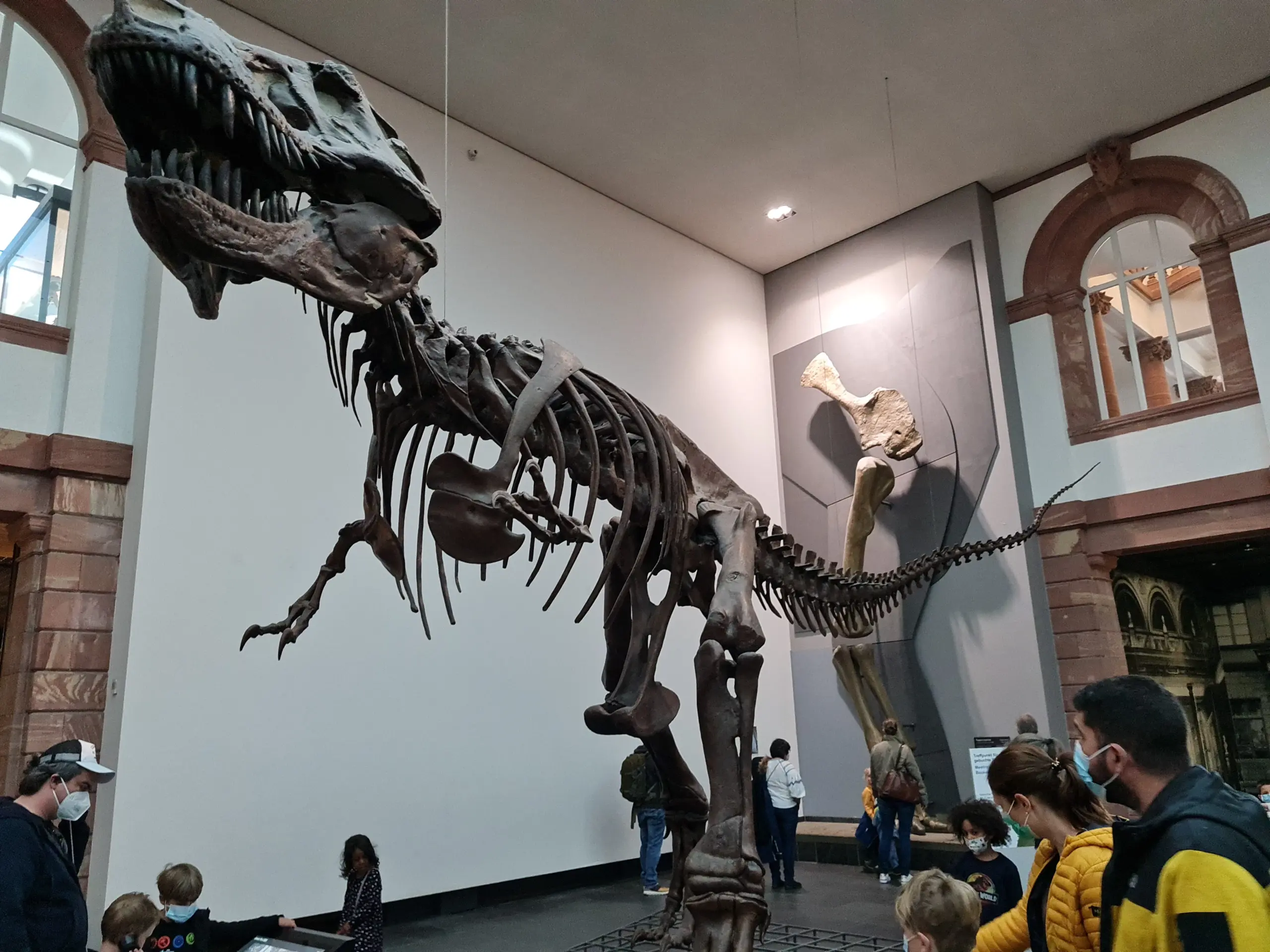
The growth itself was not uniform, but rather occurred in a veritable leap. The paleontologist Thomas Carr Carr divides the development of a T-Rex into five growth stages. The most striking transformation occurred between the ages of 13 and 15. The previously flat juvenile skull changed dramatically within just a few years, becoming the deep, massive skull of an adult. Carr compares this abrupt transformation to the metamorphosis of some fish upon reaching sexual maturity.
For a long time, an idea persisted: smaller fossils like "Jane" and "Petey" were thought to belong to a separate dwarf species called "Nanotyrannus". A bone examination of Holly Woodward and her team This refutes that. Both animals, at over 13 and over 15 years old respectively, were clearly not yet fully grown. They grew at a rate typical for T-Rex – simply young animals, not a separate species. Apparently, juveniles occupied a different ecological niche than their parents for many years. They were more slender, presumably faster, and specialized in hunting different prey.
Cannibals with medical records
A T-Rex's life wasn't always characterized solely by growth spurts. Apparently, disease and violence among members of the species also played a role. This was found in four examined skeletons. Nicholas Longrich and his team found bite marks. They clearly came from other tyrannosaurs. This is direct proof: T-Rex at least occasionally ate its own kind.
Some individuals also suffered from illnesses. The famous specimen “Sue” a research team led CA Hamm In 2023, a CT scan revealed bone inflammation in the fibula and tail vertebrae of "Sue." A second examination found severe holes in the lower jaw of "Sue" and another specimen. Such holes are caused by a parasitic infection called... TrichomonosisThis disease still affects birds of prey today. "Sue" suffered a particularly severe case. Researchers suspect the bird starved to death. The growths in her jaw prevented her from eating properly.
The end of an era
The T-Rex lived exclusively in western North America. This was at the end of the Cretaceous period, about 68 to 66 million years ago. The landscape was subtropical, with floodplains, swamps, and open woodlands. There it encountered herbivores such as... Triceratops and Edmontosaurus.
Its habitat ended abruptly. An asteroid struck the Yucatán Peninsula, marking the Cretaceous-Paleogene boundary. Around three-quarters of all species on Earth became extinct as a result. The last T-Rex population also disappeared forever.
The species was first discovered in 1902. Fossil hunter Barnum Brown found the first skeleton in the Hell Creek Formation in Montana. Six years later, another specimen was found at Big Dry Creek. This specimen was significantly more complete, with a nearly intact skull. It bears the catalog number AMNH 5027. To this day, it is housed in the American Museum of Natural History in New York. The name Tyrannosaurus rex literally means "King of the tyrant lizards"It is composed of the Greek words for 'tyrant' and 'lizard'. To this is added the Latin word for 'king"A new description of the type skull published in 2025 by Thomas Carr This corrected a long-held misconception. Several characteristics had long been considered typical of youth. Upon closer examination, they proved not to be age-dependent.
Who was really the most dangerous dinosaur?
Among carnivores, the T-Rex is considered by many to be the most dangerous of all. The reason lies in the combination of its size and bite force. With up to 57,000 Newtons per tooth tip, it achieved the strongest bite force ever calculated for a land animal. This was in addition to its weight of up to 8.8 tons. Prey animals like Triceratops or Edmontosaurus had little to counter this force.
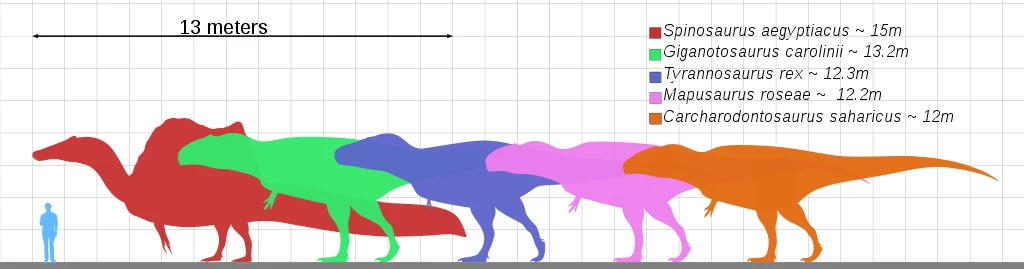
The title is not entirely uncontested, however. According to current estimates, Spinosaurus is even longer. But it weighed less and had a significantly weaker bite force. Giganotosaurus from early South America came close to T-Rex in length and weight. Nevertheless, it lagged far behind in bite force. The South American Carnotaurus They were already relying on a different concept: lighter construction, but presumably significantly faster.
Was the T-Rex as intelligent as a baboon?
In 2023, a study by the brain researcher caused Suzana Herculano-Houzel for headlines. Using brain casts, she estimated the number of nerve cells in the T-Rex's forebrain. Her result: over three billion, comparable to that of baboons. Her conclusion: Large predatory dinosaurs could They may have been similarly intelligent and long-lived as today's primates..
An international research team strongly contradicted this in 2024. A recalculation using more conservative assumptions about nerve cell density revealed a different picture. The researchers arrived at considerably lower values. Their criticism: Herculano-Houzel's model directly transfers cell densities from warm-blooded animals to the T-Rex. However, its metabolism was probably more similar to that of modern reptiles. The T-Rex was likely still intelligent in the sense of being adaptable. But based on this counter-finding, it was probably not a baboon with teeth.
The fossil trade threatens our own research.
Ironically, the popularity of the T-Rex is proving to be its scientific downfall. In 2025, paleontologist Thomas Carr counted how many known T-Rex fossils were still publicly accessible. Of 132 documented finds, only 61 are in public collections. 71 are privately owned. Commercial fossil collectors now find new specimens twice as often as museum teams.
Particularly troubling is the fact that a striking number of juvenile specimens are found among privately held fossils. This growth phase is precisely what is most revealing for research. Complete T. rex skeletons now fetch prices at auctions ranging from $1.55 million to nearly $38.7 million. Every fossil that permanently disappears into private hands is practically lost to science.
Tyrannosaurus Rex compared to other predatory dinosaurs
Even though Tyrannosaurus Rex is considered the best-known predatory dinosaur, it was not in every respect the largest carnivore in Earth's history. Spinosaurus, for example, is classified as longer according to current estimates, but weighed less and had a significantly lower bite force.
| Dinosaurs | length | Weight | Bite force | Lifetime |
|---|---|---|---|---|
| Tyrannosaurus rex | up to 13 m | up to 8.8 t | up to N57,000 | Late Cretaceous, North America |
| Spinosaurus | approx. 14-15 m | approx. 7 tons | significantly lower (semiaquatic hunter) | Middle Cretaceous, North Africa |
| Giganotosaurus | approx. 12-13 m | approx. 8 t | lower than T-Rex | Early Upper Cretaceous, South America |
You can read more about Spinosaurus in our Spinosaurus profile. Also the North African one Carcharodontosaurus was one of the T-Rex's biggest competitors for the title of largest carnivore.
The movie T-Rex and the real T-Rex
In movies, the T-Rex often appears faster and more agile than it probably ever was. The models reach speeds of 19 to 27 km/h. Many film scenes suggest a significantly higher speed. Hollywood also gets it wrong when it comes to skin. The scaly, smooth, completely featherless film version is true for adult animals. However, it ignores the fact that close relatives like Yutyrannus huali demonstrably wore feathers.
Nevertheless, the T-Rex remains one of the most influential dinosaurs in pop culture. It appears in the Jurassic Park series, the Jurassic World trilogy, and survival games like ARK: Survival Evolved. In these games, it can even be tamed.
Frequently asked questions about Tyrannosaurus Rex
More information on this topic can be found at urzeittiere.net
- Triceratops – the herbivorous contemporary from the same formation that the T-Rex probably also hunted.
- Carnotaurus – the South American carnivore of the same era, lighter in build and designed for speed rather than raw power.
- Acheroraptor – a smaller, sickle-clawed raptor that lived in the same place at the same time.
Sources: American Museum of Natural History, scinexx.de, National Geographic Deutschland, forschung.de, PeerJ (Woodward, Myhrvold & Horner, 2026).
Image sources: KoprX, CC BY-SA 4.0 https://creativecommons.org/licenses/by-sa/4.0, via Wikimedia Commons