
Spinosaurus
Spinosaurus Profile: Size, Weight & Facts
Spinosaurus is considered one of the most fascinating and mysterious dinosaurs to ever inhabit our planet. With its distinctive dorsal sail and impressive size, it has captured the imagination of researchers and dinosaur fans alike since its discovery. But what makes this giant reptile so special? Modern research has fundamentally changed our understanding of this extraordinary predatory dinosaur, revealing a picture more fascinating than anything we could previously imagine.
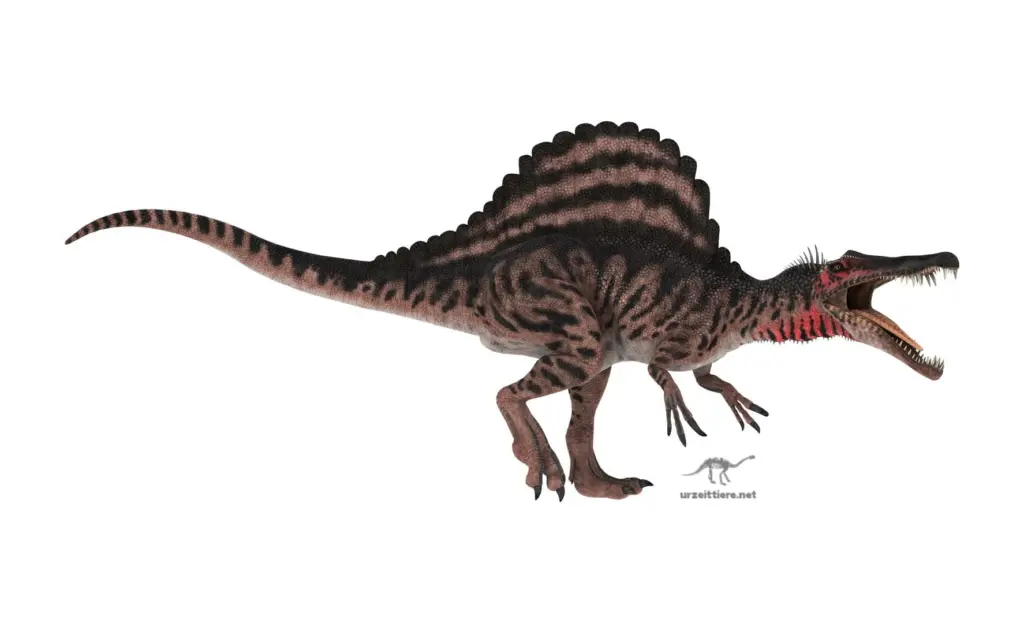
Spinosaurus
| scientific name | Spinosaurus aegyptiacus |
| Estimated size | Length: 14.4 meters Height: 3.5 meters Weight: 6.5 tons |
| geological era | Upper Cretaceous |
| Locations | Baharija, Kem Kem Beds, Continental Intercalaire |
| Order | Ornithischia |
| Subordination | Theropoda |
Physical characteristics
| anatomy | Elongated, low trunk with short, powerful hind legs and a massive, crocodile-like skull |
| Special features | Meter-long spinous processes on the back formed a sail-like dorsal sail |
| locomotion | Two-legged |
| Skin texture | Probably covered in scales, similar to today's crocodiles |
| Coloring | Unknown, but probably camouflage colored (brownish/greenish) for a semi-aquatic lifestyle |
discovery
| Explorer | Stromer from Reichenbach |
| Discovery date | 1915 |
| Meaning of the name | “Thorny lizard” (from Latin spina = thorn + saurus = lizard) |
| Significant fossil finds | Several incomplete skeletons and numerous associated bones. |
In paleontology, the ratio of brain to body size, the so-called Encephalization quotient (EQ), used as a rough guide to relative intelligence.
| Intelligence (EQ) | Low, typical of theropods - estimated to be similar to today's crocodiles (EQ approx. 0.3-0.5) |
| Social behavior | Probably solitary, similar to today's crocodiles |
| Predators | As an adult it probably had no natural enemies |
Spinosaurus at a glance: The king of the rivers of prehistoric times
Spinosaurus aegyptiacus, whose scientific name means "Egyptian thorny lizard", belongs to the family Spinosauridae and was first discovered in 1915 by the German paleontologist Ernst Stromer von Reichenbach described. This extraordinary dinosaur lived about 112 to 93 million years ago during the middle Cretaceous period and was believed to be the longest carnivorous dinosaur of all time.
The Spinosauridae family includes several species, but Spinosaurus aegyptiacus stands out for its impressive size and unique anatomy. This group of dinosaurs evolved evolutionarily separate from other large theropods and specialized in a semi-aquatic lifestyle - a characteristic that distinguishes them from all other known predatory dinosaurs.
Ernst Stromer's original fossil finds from Egypt were lost in bombing raids on Munich during World War II, making research on Spinosaurus difficult for decades. Only with recent discoveries in Morocco and Egypt have scientists been able to draw a clearer picture of this remarkable creature.
The taxonomic classification of Spinosaurus within theropods shows a fascinating evolutionary development. Unlike other large predatory dinosaurs such as Tyrannosaurus or Allosaurus, the spinosaurids developed features that made them perfectly adapted to life in and around water. This specialization makes them one of the most interesting dinosaur groups for modern paleontology.
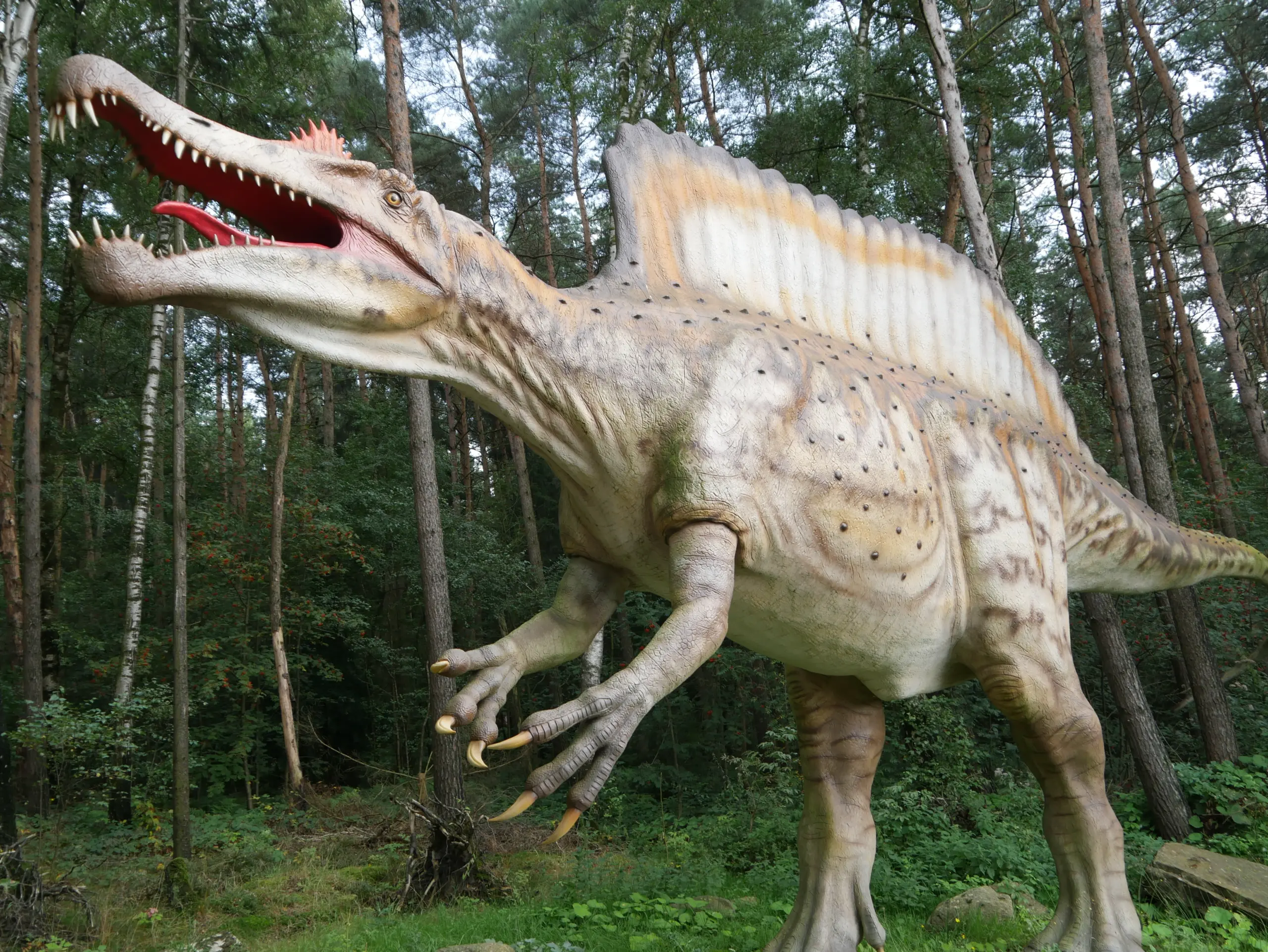
Spinosaurus skeleton and fossil finds
The exploration of the Spinosaurus skeleton is a story of loss and rediscovery. The first fossils found by Ernst Stromer in Egypt were destroyed in a bombing raid on Munich in 1944. This made the Spinosaurus became a mystery for decades because only Stromer's drawings and descriptions existed. Only new discoveries from Morocco were made in 2014 by an international team of researchers Nizar Ibrahim described provided a more detailed picture.
These new fossils, including parts of the skull, spine, limbs and an almost complete tail, confirmed a unique anatomy. The Spinosaurus skull was long and crocodile-like, ideal for catching fish. Its conical, non-serrated teeth (Spinosaurus tooth) were also designed to hold onto slippery prey. The most notable Spinosaurus fossil of recent years is the paddle-like tail, described in 2020, which served as the main propulsion organ in the water. Nevertheless, most reconstructions continue to be based on incomplete skeletons, making accurate reconstruction difficult.
Size and Weight: How Big Was Spinosaurus Really?
Determining the exact body dimensions of Spinosaurus is a major challenge for paleontologists due to incomplete fossil finds. Current scientific estimates suggest a body length of between 15 and 18 meters, measured from the tip of the snout to the tip of the tail. These impressive dimensions make it the longest carnivorous dinosaur discovered to date.
Weight estimates vary significantly between different reconstructions, ranging from 6.4 to 20.9 tons. These large differences result mainly from the different approaches to reconstructing the body structure. While earlier models depicted the Spinosaurus as a land-dwelling predatory dinosaur modeled on the T-Rex, more recent research shows a significantly different body structure.
In a direct size comparison with other large theropods, the uniqueness of the Spinosaurus becomes clear. An adult Tyrannosaurus Rex reached lengths of around 12-13 meters and a weight of 6-9 tons. The Giganotosaurus from South America measured around 13-14 meters in length. These comparisons show that although Spinosaurus was longer, it may not have been necessarily heavier than its more famous relatives due to its different body proportions.
The differences between older and more recent scientific estimates are dramatic. Early reconstructions from the 1980s and 1990s depicted Spinosaurus as an upright-walking land predator, similar to an enlarged one Dilophosaurus with back sail. Modern studies since 2014, however, paint a picture of a semi-aquatic hunter with shorter hind legs, denser bones and a completely different body structure.
These uncertainties are mainly due to the fact that only about 3-5% of the skeleton has been found so far. Most size estimates are based on comparisons of individual bones with more complete skeletons of related species. Each new find can therefore lead to significant revisions to existing reconstructions.
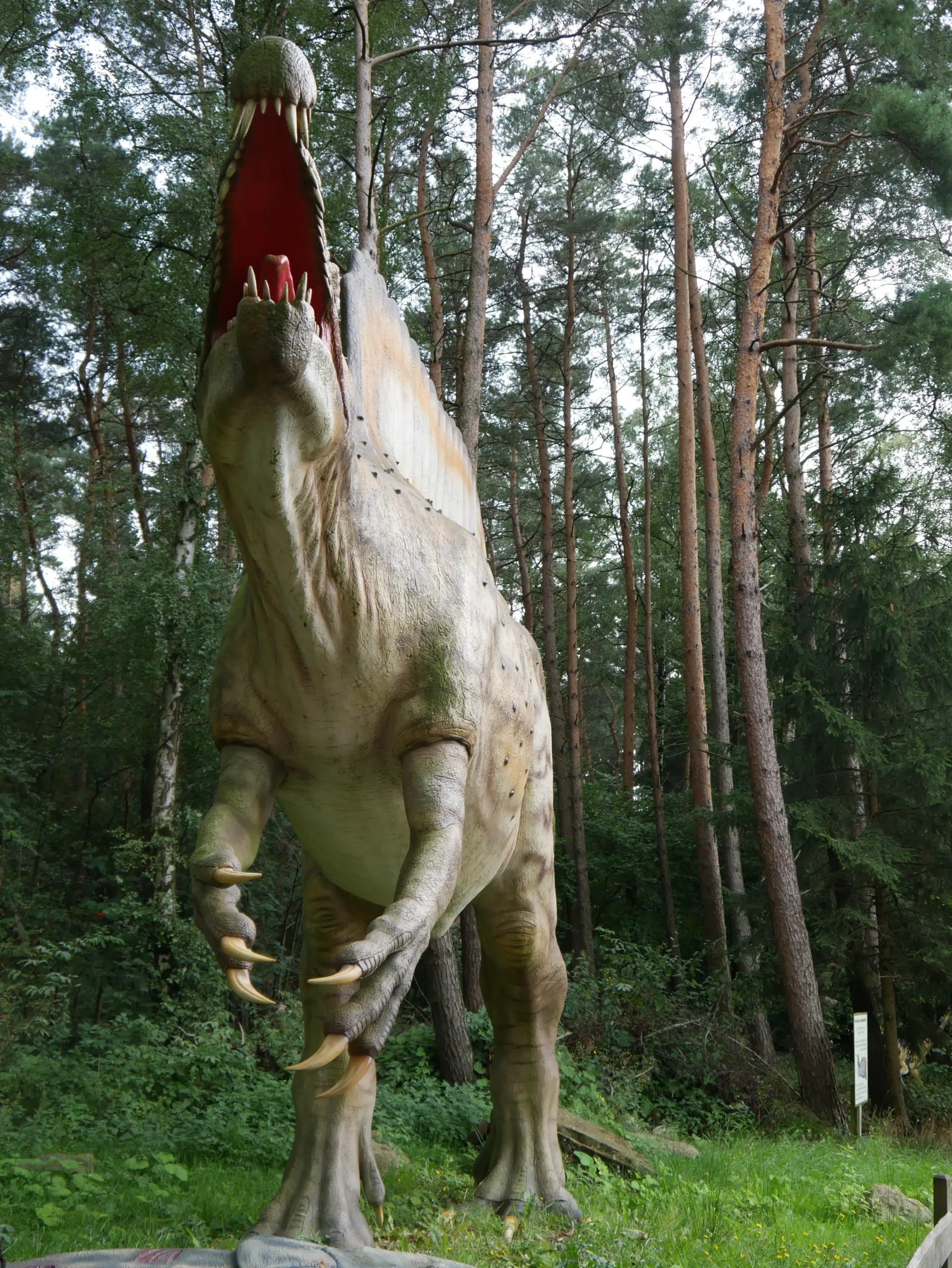
How big was Spinosaurus compared to other predatory dinosaurs?
With an estimated length of up to 18 meters, the exceeded Spinosaurus other large theropods like Tyrannosaurus Rex and Giganotosaurus clearly. This made it the longest, although not necessarily the heaviest, carnivorous dinosaurs. Comparisons show that the Spinosaurus size comparison positioned it as the undisputed longest among the predatory dinosaurs.
Size comparison of large theropods
| Dinosaurs | Length (approx.) | Weight (approx.) |
|---|---|---|
| Spinosaurus aegyptiacus | 15-18m | 6.4–7.5 tons |
| Tyrannosaurus Rex | 12-13 m | 8-9 tons |
| Giganotosaurus | 12-13 m | 6-8 tons |
The distinctive dorsal sail: What is special about Spinosaurus?
The most characteristic feature of Spinosaurus is undoubtedly the up to 1.8 meter high spinous processes along its spine, which formed an impressive dorsal sail. These elongated vertebral processes not only visually distinguish it from all other known theropods, but also raise fascinating questions about their function.
Scientists discuss various theories about the function of this dorsal sail. The Thermoregulation hypothesis states that the sail functioned like a heat exchanger, similar to the dorsal plates of the Stegosaurus. Orienting toward the sun allowed the dinosaur to warm its body, while facing sideways could help cool it. This theory is supported by the large blood vessel channels in the spinous processes.
An alternative theory sees the back sail as Fat storage, similar to the hump of camels. In this scenario, the sail would have helped the Spinosaurus survive extended periods without food—an important survival advantage in changing environments. This hypothesis would explain why the sail was so robustly constructed.
This is particularly interesting Communication and courtship hypothesis. The conspicuous dorsal sail could have served as a visual signaling instrument to recognize conspecifics, intimidate rivals or attract mates. It may even have the ability to change color or have bright patterns. This theory is supported by comparisons with modern animals such as sailing lizards and certain species of fish.
Comparison with other dinosaurs with back structures shows interesting evolutionary parallels. While Dimetrodon (an ancestor of mammals) also had a dorsal sail, different groups of dinosaurs independently developed similar structures. Ouranosaurus, a herbivore from the same region and time period as Spinosaurus, also had a smaller dorsal sail.
Recent biomechanical analyzes show that the dorsal sail likely served multiple functions. During thermoregulation and communication, it may also have served as a stabilization aid during swimming, supporting Spinosaurus' semi-aquatic lifestyle. This multifunctionality makes the dorsal sail one of the most fascinating anatomical features in dinosaur research.
Spinosaurus species: aegyptiacus and “mirabilis”
The officially recognized type species is Spinosaurus aegyptiacus, first described by Ernst Stromer in 1915. All well-documented finds that are clearly assigned to the genus Spinosaurus belong to this species. The family of Spinosauridae However, it is diverse and includes other genres such as Baryonyx from Europe and Irritator from South America.
The term “Spinosaurus mirabilis” appears frequently in online searches, and has been a scientifically recognized species since 2026. During excavations in 2019, 2020 and 2022 under the direction of paleontologist Paul Sereno were in the Farak Formation in Niger fossils of S. mirabilis recovered. In 2026, Sereno officially described Spinosaurus mirabilis.
The most obvious distinguishing feature of S. mirabilis opposite S. aegyptiacus is its characteristic, pointed crest. It is shaped like a scimitar. This ridge is curved upwards and backwards.
Habitat and era: Where and when did Spinosaurus live?
Spinosaurus populated the coastal regions of North Africa between 112 and 93 million years ago, at a time when this region looked completely different than it does today. During the mid-Cretaceous, the climate was significantly warmer and wetter than the present, and large parts of today's Sahara Desert consisted of tropical river systems and coastal regions.
The geographical distribution of Spinosaurus was mainly concentrated in present-day Egypt and Morocco. The most important fossil finds come from the Bahariya Formation in Egypt and the Kem Kem Formation in Morocco. At that time, these regions lay on the shores of the Tethys Sea, a warm tropical ocean that separated Africa from Europe and Asia.
The climatic conditions of the Cretaceous period created ideal living conditions for a semi-aquatic predatory dinosaur. The warm, moist Tethys Sea environment provided abundant food in the form of large freshwater and saltwater fish. Extensive river systems crisscrossed the landscape, creating a network of waterways in which the Spinosaurus could hunt.
The most important sites have significantly shaped our understanding of Spinosaurus. Ernst Stromer's original discoveries in the Bahariya Oasis laid the foundation for scientific description. The more recent finds from Morocco, especially the caudal vertebrae published in 2020, revolutionized our understanding of its anatomy and lifestyle.
A fascinating aspect is why Spinosaurus was never found on other continents, although related species did occur in South America and Europe. The geographical isolation of Africa during the Cretaceous and the specialized environmental conditions of the Tethys Sea created a unique ecosystem in which Spinosaurus was able to evolve.
The Kem Kem Formation in Morocco is now considered one of the richest sites for Spinosaurus fossils. Not only was the most complete skeleton to date discovered here, but also numerous teeth and bone fragments that provide insight into the variability within the species. These finds show that Spinosaurus lived successfully in this region for several million years.
Aquatic life: Did Spinosaurus hunt on land or water?
The question about the way of life of the Spinosaurus led to one of the most spectacular scientific U-turns in modern paleontology. Groundbreaking research results from 2020 and 2022 clearly demonstrate the semi-aquatic lifestyle of this extraordinary dinosaur, making it the first recorded swimming predatory dinosaur.
The evidence for aquatic life is overwhelming. Bone density measurements show that Spinosaurus' bones were significantly denser than those of other theropods - a characteristic feature of animals that spend a lot of time in water. This high bone density, similar to that of penguins or manatees, helped the massive animal submerge and control buoyancy.
The 2020 discovery of the paddle-like tail provided crucial evidence of swimming ability. Biomechanical studies showed that this tail could generate significant propulsion when flapped sideways - comparable to modern crocodiles or large fish. The caudal vertebrae were laterally flattened and had elongated spinous processes that formed a large, paddle-like surface.
The short hind legs of Spinosaurus, previously considered problematic for reconstruction, make perfect sense in an aquatic context. On land, the dinosaur probably moved on four legs or even crawled, similar to seals. In the water, however, the compact limbs offered less water resistance and enabled a streamlined posture.
Isotope studies of Spinosaurus teeth confirm life in freshwater environments. The chemical composition clearly shows that these animals spent much of their time in rivers and lakes, not in marine environments. This fits perfectly with the sites in former river systems.
Comparison with modern semi-aquatic predators such as crocodiles reveals surprising parallels. Like crocodiles, Spinosaurus was active both in water and on shores. It was probably able to stay underwater for long periods of time to hunt fish, but returned to land to breed and rest.
These findings led to all previous reconstructions being completely revised. Instead of an upright walking land predator, modern depictions show a streamlined water hunter with a completely different locomotor system. Museums around the world have had to adapt their Spinosaurus exhibits and develop new dioramas depicting life on and in water.
Diet and hunting behavior: What did Spinosaurus eat?
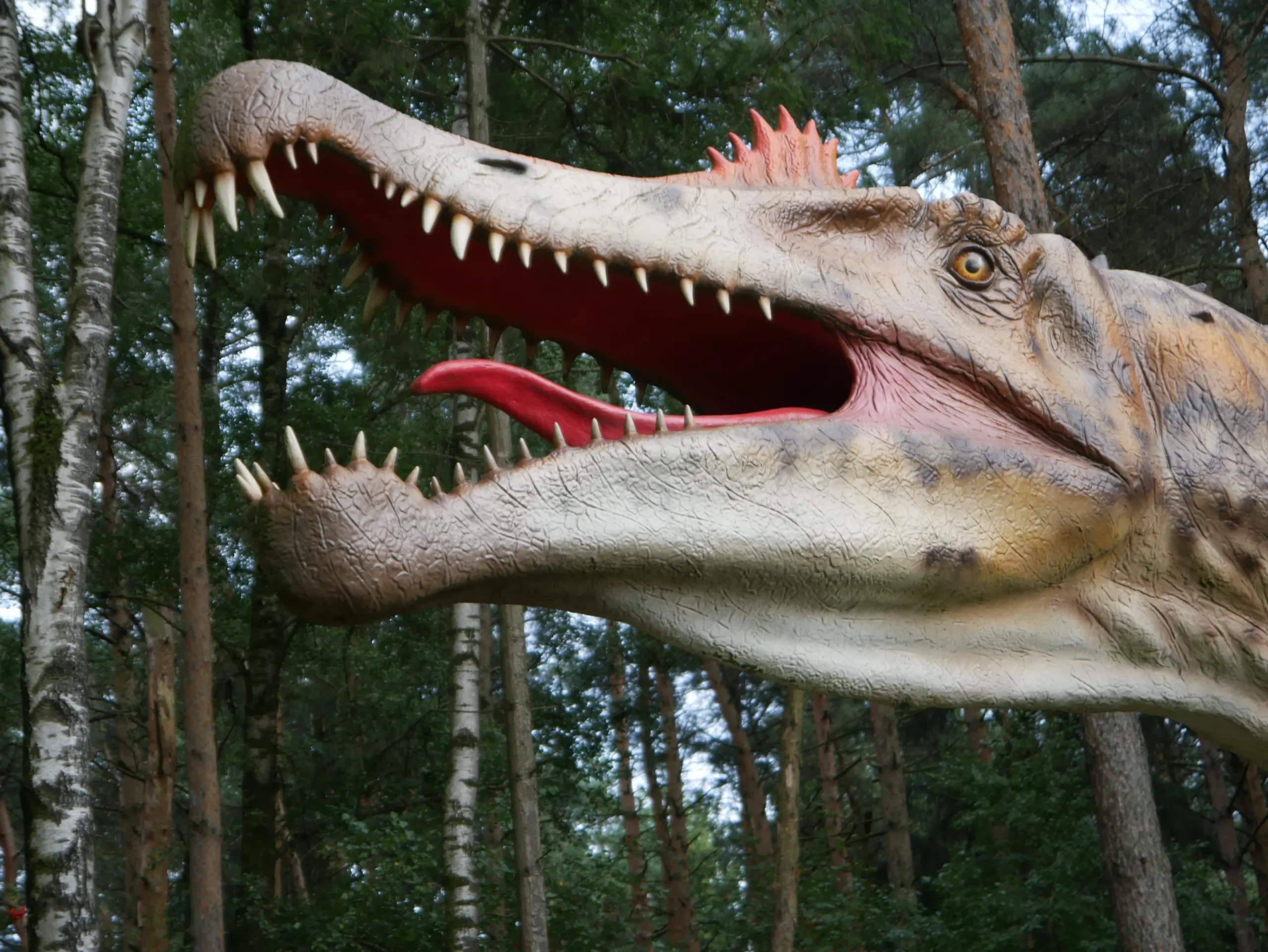
Spinosaurus' diet differed dramatically from that of other large theropods. While Tyrannosaurus and its relatives mainly hunted other dinosaurs, Spinosaurus specialized in one fish based diet specialized. The main prey consisted of large freshwater fish such as the up to 4 meters long Mawsonia and the saw-like one Onchopristis, a prehistoric ray.
The Spinosaurus' teeth were perfectly adapted to hunting fish. With 64 conical, backward-curved teeth, it was able to securely hold onto even the slipperiest prey. These teeth were optimized not for tearing flesh like the T-Rex, but for grasping and holding on to writhing fish. The cone-shaped shape prevented the prey from escaping again.
Spinosaurus' hunting strategy was probably similar to that of modern grizzly bears when catching salmon or large crocodiles. It probably lurked in shallow waters, using its long neck and crocodile-like snout to quickly snap at passing fish. The long front claws could also have served as fishing hooks.
The comparison with other fish-eating dinosaurs is interesting. Baryonyx and Suchomimus, smaller relatives of Spinosaurus, showed similar adaptations to hunting fish. This evolutionary convergence demonstrates the efficiency of this hunting strategy in aquatic environments.
In addition to fish, the diet likely included other aquatic animals such as smaller crocodiles, turtles and sharks. Fossil coprolites (fossilized excrement) from the region contain fish scales and bone remains that support this theory. Spinosaurus may also have supplemented its diet with land prey such as smaller dinosaurs when the opportunity arose.
The size of the potential prey was impressive. The Mawsonia reached lengths of over 4 meters and weights of several hundred kilograms. The fact that Spinosaurus was able to tackle such behemoths highlights its role as apex predator the Cretaceous waters of North Africa.
Spinosaurus vs. T-Rex: Who was stronger?
The popular comparison between Spinosaurus and Tyrannosaurus Rex has fascinated dinosaur fans for decades, especially after the dramatic battle scene in Jurassic Park III. However, scientific reality is more complex and interesting than any Hollywood portrayal.
In a size comparison, Spinosaurus was longer (15-18 meters vs. 12-13 meters), but T-Rex was significantly more massively built. Weighing up to 9 tons, Tyrannosaurus was a compact, muscular fighter, while the 6-8 ton Spinosaurus was optimized for a life in the water. These differences reflected their completely different ecological niches.
Bite force was a crucial factor. T-Rex had one of the strongest bite forces of any land animal, with an estimated 12,800 newtons per square centimeter. Its dagger-like teeth could crush bone. Spinosaurus, on the other hand, had a significantly weaker bite force that was optimized for grabbing fish, not fighting large dinosaurs.
T-Rex would have had clear advantages on land. His powerful hind legs, upright posture and massive musculature made him a formidable opponent. Spinosaurus, with its short legs and body adapted for aquatic life, would have been much more clumsy.
In the water, however, the situation was reversed. The swimming Spinosaurus, with its paddle-like tail and streamlined proportions, would have clearly been superior here. A T-Rex probably wouldn't have gone into deeper water in the first place.
The geographical and temporal separation makes a natural fight between the two species impossible. Spinosaurus lived in Africa 112-93 million years ago, while T-Rex existed in North America 68-66 million years ago. They shared neither time nor living space.
The Jurassic Park III depiction of Spinosaurus killing a T-Rex does not correspond to scientific reality. While the film made for dramatic effect, it was based on outdated reconstructions of both dinosaurs. Modern research shows two highly specialized predatory dinosaurs that thrived in completely different environments without directly competing with each other.
Conclusion
Spinosaurus remains one of the most fascinating dinosaurs in Earth's history. The revolutionary discoveries of recent years have fundamentally changed our understanding, revealing a highly specialized semi-aquatic hunter that thrived in Cretaceous waters. From its distinctive dorsal sail to its impressive size to its unique lifestyle as a swimming predator, Spinosaurus embodies the diversity and adaptability of life on Earth. Each new discovery brings us closer to understanding the secrets of this extraordinary giant.