
Yutyrannus
beautiful feathered bully
Yutyrannus is a mix of Latin and Mandarin and means something like “beautiful feathered bully“.
This dinosaur is a carnivorous theropod and an early relative of Tyrannosaurus Rex.
In the Chinese province of Liaoning, 3 specimens, one large and two small, almost completely preserved fossils were unearthed. They are 125 million years old, almost twice as old as the tyrannosaur dynasty.
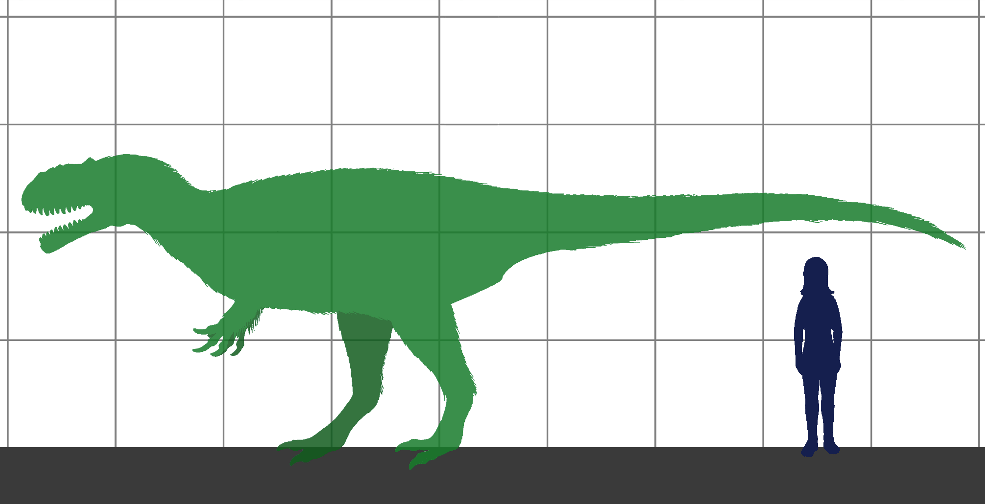
The large animal was around 9 meters long, around 3.5 meters high at the waist and weighed around 1.5 tons - making Yutyrannus one of the largest known feathered creatures of all.
This meant that it was only about a fifth as heavy as its infamous cousin and descendant Tyrannosaurus Rex, which weighed up to 8-9 tons.
| Profile | Yutyrannus |
|---|---|
| epoch | Lower Cretaceous |
| Order | Lizard-pelvis dinosaur (Saurischia) |
| Subordination | Theropoda |
| Family | Proceratosauridae |
| group | Tyrannosauroidea |
| genus | Yutyrannus |
| species | Yutyrannus huali |
| Height | 3.5 meters |
| length | 9 meters |
| Weight | 1.5 tons |
| Locations | China (Chinese Liaoning Province) |
The special thing about these excavated fossils is that feathers were clearly detected. This makes Yutyrannus the largest creature found so far that was feathered. This title of largest feather dinosaur was previously held Beipiaosaurus inside. However, Yutyrannus is 40 times heavier than Beipiaosaurus.
Discovery and naming
Yutyrannus was published in the journal in April 2012 by a Chinese research group led by paleontologist Xu Xing Nature scientifically described for the first time. The three almost completely preserved fossils come from the Yixian Formation in Liaoning Province, China.
The name Yutyrannus is, as mentioned at the beginning, a mishmash of two languages: the Mandarin word 羽 (yǔ) means “feather”, the Latin tyrannus stands for “tyrant” or “king”. The species name huali also comes from Mandarin (華麗) and means “magnificent” or “beautiful” — an allusion to the animal’s striking plumage.
What did Yutyrannus feed on?
Yutyrannus was a carnivorous theropod and probably an active hunter. As one of the largest predatory dinosaurs of its time and habitat, it was at the top of the food chain in the Early Cretaceous in what is now Liaoning Province, China. It probably fed on small and medium-sized dinosaurs that occurred in its habitat.
Protofeathers
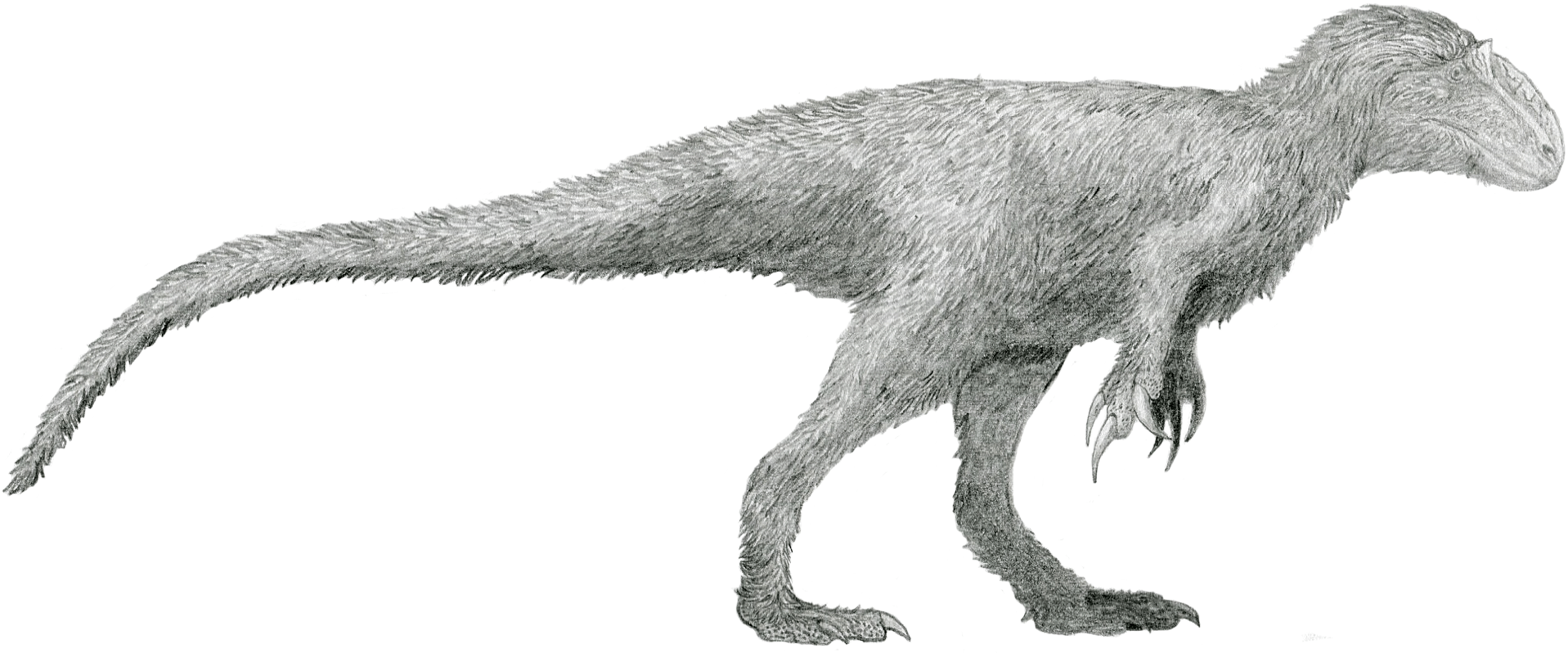
The feathers of Yutyrannus cannot be compared to the feathers of today's birds. These are simple filaments and were in no way suitable for flying. They can be compared to the fluffy down of a modern-day baby chick. They did not have the rigidity of flying birds alive today.
The feathers detected were around 15 to 20 cm long. They were found in fragments at various locations in the fossils. Scientists suspect that Yutyrannus' entire body was covered with these feathers.
What were Yutyrannus feathers good for?
Yutyrannus lived in the middle half of the Early Cretaceous. During this period of geological history, global temperatures were cooler than in the Late Cretaceous, when T. rex lived. Scientists assume temperatures will be 10 degrees cooler.
Although it is known that very large animals are forced to reduce their insulation to prevent overheating (elephants, rhinos), it is suspected that Yutyrannus needed its feathers for thermal insulation. (Example: mammoth)
It is also possible that the protofeathers of Yutyrannus had a different function. On the one hand, he could have used this feather fluff to keep the hatched eggs in the nest warm.
Another possibility that is being discussed is the use of feathers for camouflage or courtship.
Yutyrannus in ARK: Survival Evolved
Note: Yutyrannus is also known as a playable creature in the video game ARK: Survival Evolved/Ascended. The abilities and taming mechanics presented there are fictional and have no scientific connection to the real, extinct dinosaur.
Was T. Rex fuzzy too?
Based on these three fossils found, scientists see an increased likelihood that Tyrannosaurus Rex was also feathered. Even if the feathers may have disappeared in adult animals, they could have served as thermal insulation for the T-Rex young animals.
Yutyrannus
| scientific name | Yutyrannus huali |
| Estimated size | Length: 8.5 meters Height: 3.5 meters Weight: 1.5 tons |
| geological era | Lower Cretaceous |
| Locations | Yixian |
| Order | Saurischia |
| Subordination | Theropoda |
Physical characteristics
| anatomy | Large, bipedal tyrannosauroid with a length of ~9 m and a weight of approx. 1.5 t, three fingers per hand and a typical theropod foot |
| Special features | Dense, downy protofeather coat (filaments up to 20 cm long) and a high nasal crest along the midline of the skull |
| locomotion | Two-legged |
| Skin texture | Densely covered with filamentous protofeathers (down-like, no complex contour feathers), probably over the entire body |
| Coloring | Not fossilized; Researchers believe colorful coloring is possible for courtship |
discovery
| Explorer | Xu et al. |
| Discovery date | 2012 |
| Meaning of the name | “Feathered Tyrant” (Mandarin yǔ = feather, Latin tyrannus = tyrant); Species name huali = “beautiful/magnificent” |
| Significant fossil finds | 3 skeletons with skulls and feathers. |
In paleontology, the ratio of brain to body size, the so-called Encephalization quotient (EQ), used as a rough guide to relative intelligence.
| Intelligence (EQ) | No specific value published; as a basal tyrannosauroid probably in the lower to middle theropod range (below T. rex with ~2.0–2.4) |
| Social behavior | Three individuals of different ages were found together, which suggests that they lived in groups at least temporarily |
| Predators | As a large apex predator, probably no natural enemies; Competitors could have been other large theropods |
Image sources: Cover photo: by Durbed under Creative Commons Attribution-Noncommercial-No Derivative Works 3.0 License
Conty, CC BY-SA 3.0 https://creativecommons.org/licenses/by-sa/3.0, via Wikimedia Commons
Tomopteryx, CC BY-SA 4.0 https://creativecommons.org/licenses/by-sa/4.0, via Wikimedia Commons