Tarbosaurus
"The Fearsome Lizard"
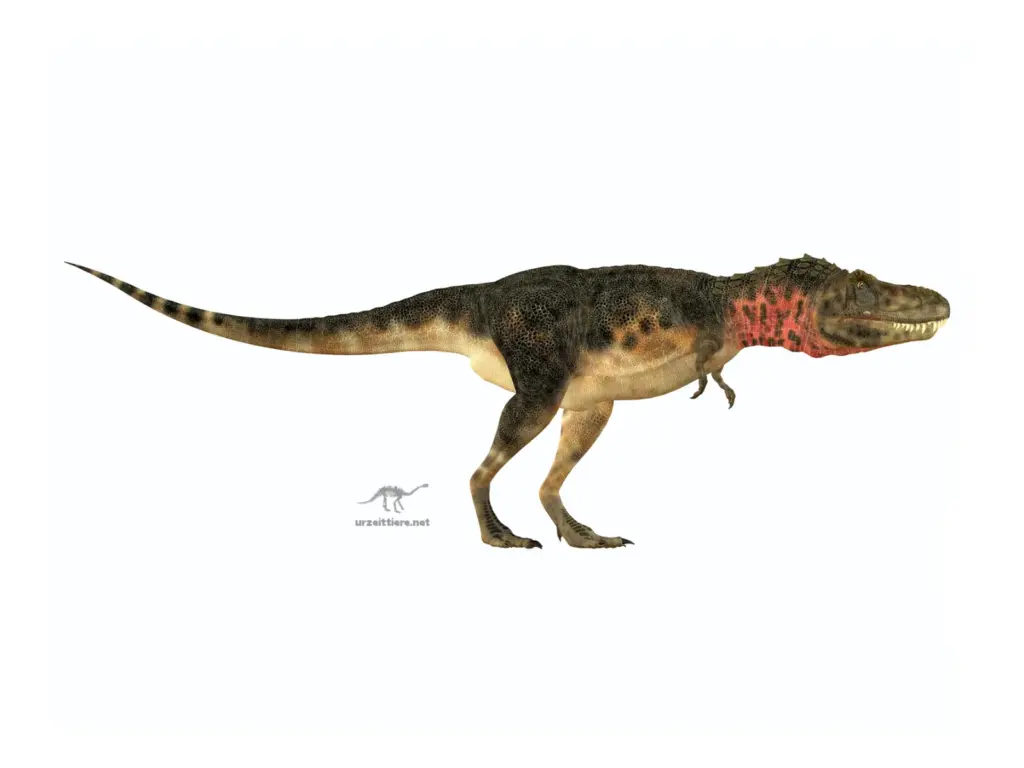
It looked like a T. rex, but lived in the Gobi Desert. Its brain was primarily a sensory center for smell and hearing. And even today, experts debate whether it deserves its own genus name. Tarbosaurus bataar was the great predator of Mongolia at the end of the Cretaceous period.
At a glance
| feature | Value |
|---|---|
| name | Tarbosaurus bataar |
| First description | Maleev, 1955, first as Tyrannosaurus bataar. The current combination comes from Rozhdestvensky, 1965 |
| length | 10–12 m (rule of thumb, not documented in the studies) |
| Weight | 4–5 t (rule of thumb, not documented in the studies) |
| Location | Mongolia, Gobi Desert |
| formation | Nemegt Formation |
| age | Upper Cretaceous, late Campanian to Maastrichtian |
| Nutrition | Carnivores |
| relationship | Tyrannosauridae (the family of T. rex) |
| Fossils | at least 30 animals, including partial skeletons and skulls |
How big was Tarbosaurus?
Most sources give a length of 10 to 12 metres and a weight of 4 to 5 tonnes. A fossil database lists 10.6 metres and 5 tonnes. That is about as long as a city bus, and about as heavy as a large African bull elephant.
The new studies on Tarbosaurus do not provide a total length. They examine the skull, brain, and teeth. The figures are therefore only estimates. The only certainty is that an adult Tyrannosaurus rex reached a growth stage that, according to researchers, the largest Tarbosaurus never reached (Hurum & Sabath 2003).
What is its correct name: Tarbosaurus or Tyrannosaurus bataar?
The origin of the name is convoluted. Maleev described a skeleton in 1955 as Tyrannosaurus bataar. In an almost simultaneous work, he made three more skeletons representatives of Tarbosaurus efremovi and two Gorgosaurus-species. In 1965, Rozhdestvensky recognized that all four animals were the same species. He introduced the name Tarbosaurus bataar for it (Yun et al. 2022).
Since then, there have been two camps. Some researchers consider Tarbosaurus to be a species of the genus Tyrannosaurus, because sister species should belong to the same genus. Many others see enough differences for a separate genus (Yun et al. 2022). Both camps agree on one point: There is only one species (Hurum & Sabath 2003).
What distinguishes Tarbosaurus from T. rex?
Both had deep skulls. The difference is visible from above. The T. rex skull is extremely wide at the back and narrows towards the snout.
The skull of Tarbosaurus is overall narrower, especially in the lower part. Its snout appears slimmer (Hurum & Sabath 2003).
The nasal bone is a striking feature. It arches upwards between the lacrimal bones and sits more loosely in the skull than in most tyrannosaurids. The authors attribute this to a specific feature that allows the animal to absorb the impact of a crushing bite. For this reason, the lower jaw was stiffer than in T. rex because the dentine and angle bones interlocked (Hurum & Sabath 2003).
The number of teeth also differs. Tarbosaurus had four teeth per side in the premaxilla, 12 to 13 in the upper jaw, and 15 in the lower jaw, rarely 14. The examined T. rex skull had 11 upper jaw teeth.
The crowns of Tarbosaurus grew up to 85 millimeters long, about the length of an index finger. In T. rex, they reached up to 100 millimeters (Hurum & Sabath 2003).
The researchers suspect that the similarities with T. rex arose independently. Both were the apex predators in their habitat and were under similar pressure (Hurum & Sabath 2003).

How good were Tarbosaurus's senses of smell and hearing?
A cast of the brain cavity is known. It is 23 centimeters long and holds 184 cubic centimeters, just under a glass of water. For comparison, a human brain has a volume of 1446 cubic centimeters. The brain probably weighed around 200 grams, about the same as two bars of chocolate (Saveliev & Alifanov 2007).
The olfactory bulbs were large and finely built. The researchers conclude from this that Tarbosaurus had a very good sense of smell. This allowed Tarbosaurus to track down food by scent trails.
The auditory nerve also indicates good hearing. The visual cortex was less developed. According to her estimate, the eyeball was at most 10 to 12 centimeters in size (Saveliev & Alifanov 2007).
A second olfactory organ was almost as large as the main organ.
The authors consider complex mating behavior possible. This is a hypothesis, not proof.
What did a young Tarbosaurus look like?
For a long time, only adults were known. Then a juvenile was found at Bugin Tsav. Its skull is only 290 millimeters long, about the length of a sheet of A4 paper. Two to three growth rings in the leg bones indicate that the animal died at two to three years of age (Tsuihiji et al. 2011).
The skull of the young animal was less robust. The nasal bones were smooth, the horn-like process behind the eye was missing, and the upper jaw was thinner. The researchers conclude that Tarbosaurus probably hunted different prey as it grew older (Tsuihiji et al. 2011). The number of teeth, however, remained the same as in adults.
The way the baby's teeth fell out was also different. A CT scan showed that every other tooth in the lower jaw fell out simultaneously. This is not seen in adults.
It may have disrupted food intake. The authors see this as a condition that disappeared with growth (Hanai & Tsuihiji 2019).
And the forehead? It became wider and deeper as the animal grew, but relatively shorter. This probably strengthened the skullcap to which the jaw muscles attach. A similar process occurred in T. rex (Yun et al. 2022).
Even small fossils confused researchers for a long time. In 1992, Carpenter set up the separate genus Maleevosaurus for specimen PIN 552-2. Carr, however, classified it in 1999 as a young Tarbosaurus. The skull lacks specialised features, and the rock layer and site fit Tarbosaurus. Carr explains that small skulls are slender and large ones robust by growth. He sees no evidence for small-bodied “dwarf tyrannosaurids”.
Hunter or scavenger?
A clue to this was found in another giant of the Nemegt Formation, the Deinocheirus. Bite marks sit on two ribs from its site. The grooves are 0.5 millimeters wide. Judging by the size of the teeth, among the predatory dinosaurs there only Tarbosaurus comes into question.
The bones did not heal. The bites therefore occurred after death or shortly before. The researchers interpret this as carrion feeding and suspect that one or more Tarbosaurus participated in dismembering the carcass (Bell et al. 2012).
This does not mean that it only ate carrion. Large tyrannosaurines in Asia and North America probably hunted large prey and also ate carrion. Horned dinosaurs like Triceratops did not exist in Asia. According to the authors, Tarbosaurus must have relied on sauropods, hadrosaurs, and perhaps ankylosaurs (Hurum & Sabath 2003).
What does Raptorex have to do with Tarbosaurus?
Raptorex was previously thought to be a small, early tyrannosaurid from the Early Cretaceous. A new study has led to a different conclusion: the animal was probably a juvenile of two to three years old. It was originally sold as a young Tarbosaurus from the Late Cretaceous of Mongolia.
Whether it belongs to Tarbosaurus bataar cannot be said with certainty. Without new evidence, Raptorex should be regarded as a doubtful name (nomen dubium), the authors say (Fowler et al. 2011).
Who else lived alongside Tarbosaurus?
During the same period, tyrannosaurids with long, flat snouts also lived in Asia. Were they perhaps just young Tarbosaurus? No.
Qianzhousaurus from southeastern China was significantly larger, and its skull is 35 percent longer than that of a Tarbosaurus with a femur of the same length. The authors suggest that the long-snouted and deep-skulled dinosaurs divided up habitats based on their body structure (Lü et al. 2014).
More information on this topic can be found at urzeittiere.net
You can find the most well-known relative in the article about Tyrannosaurus rex. Also the North American Daspletosaurus belongs to the family.


Image sources: “Tarbosaurus_and_Saurolophus_by_durbed”: Licensed under “the Creative Commons Attribution-Share Alike 3.0 Unported license”. Author: Durbed
Skull: Jordi Payà from Barcelona, Catalonia, CC BY-SA 2.0 https://creativecommons.org/licenses/by-sa/2.0, via Wikimedia Commons
Skeleton: Jordi Payà from Barcelona, Catalonia, CC BY-SA 2.0 https://creativecommons.org/licenses/by-sa/2.0, via Wikimedia Commons
Tarbosaurus skull from the front | ©urzeittiere.net