Giganotosaurus
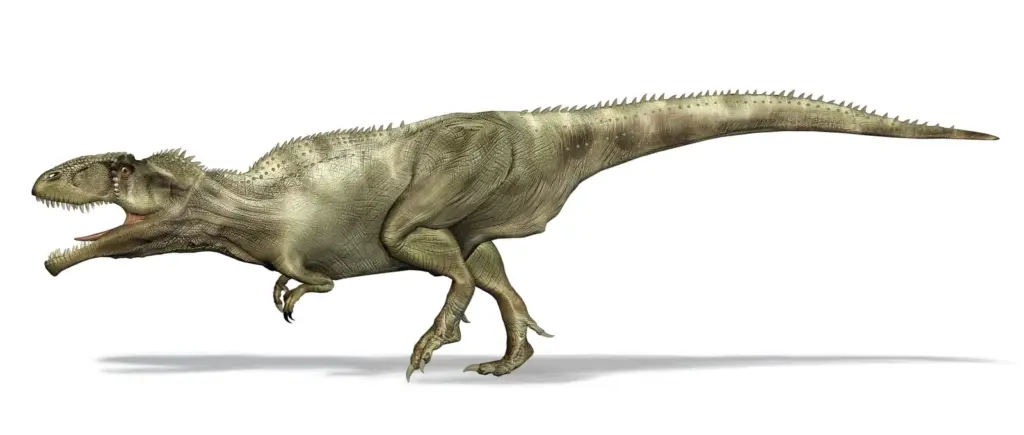
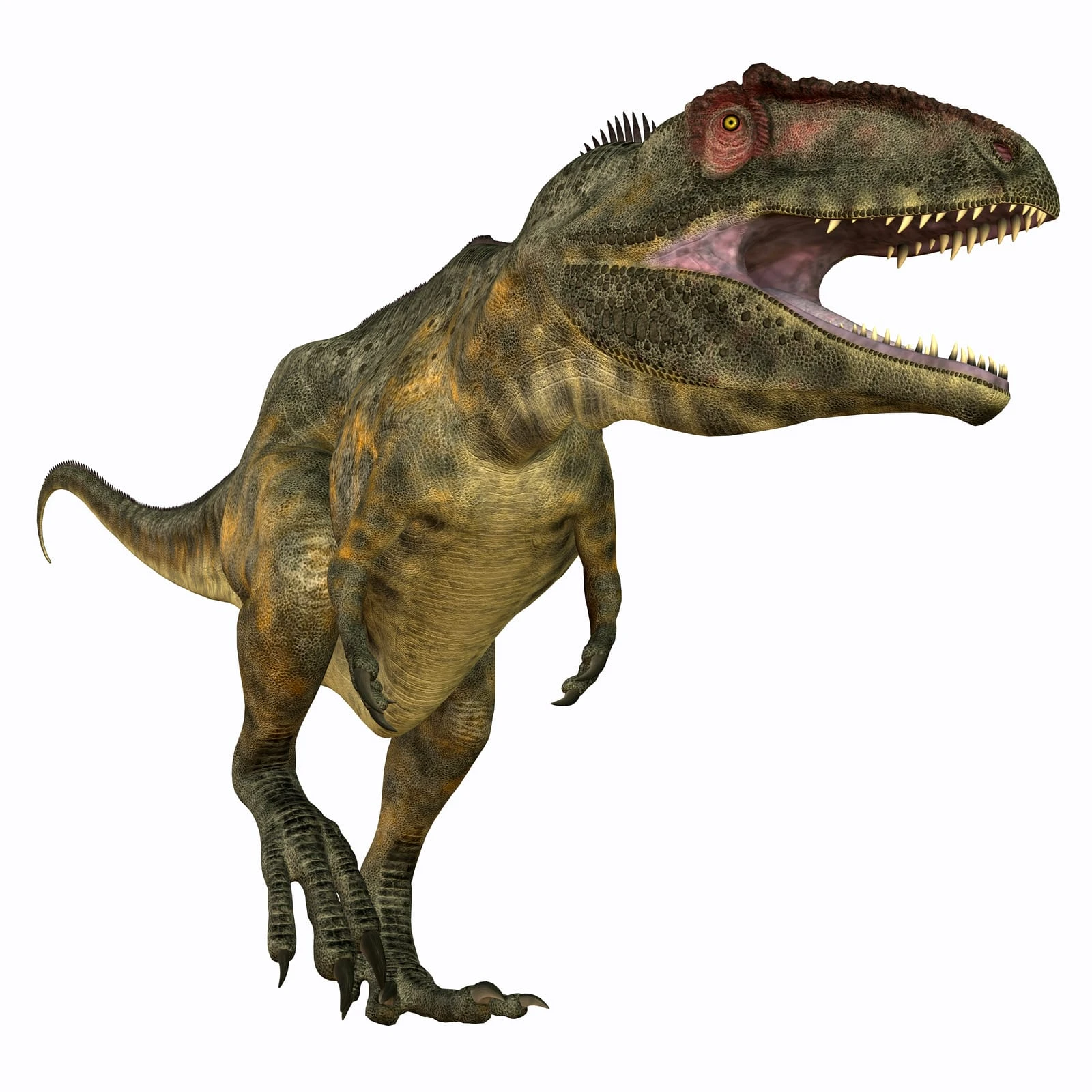
Its skull was up to 1.7 meters long, almost as long as an adult is tall. Its femur reached a human's chest. Giganotosaurus carolinii is among the largest predatory dinosaurs ever found. Whether it was the largest remains an open question. Even its weight can only be roughly estimated: from about 4 to 9 tons.
At a glance
| feature | Value |
|---|---|
| name | Giganotosaurus carolinii ("giant lizard of the south", named after its discoverer Rubén D. Carolini) |
| First description | Coria & Salgado 1995 |
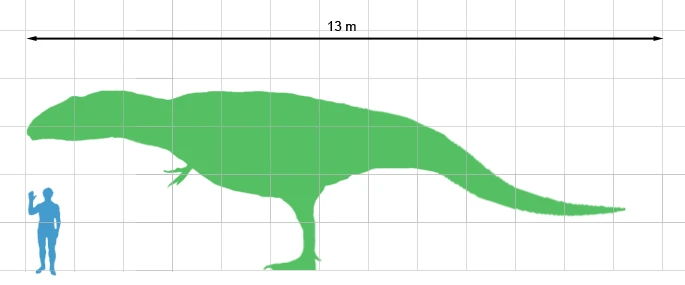
| length | approximately 12 m (First description: 12.5 m; Holotype: 12.2 m) |
| Weight | Depending on the estimate, roughly 4 to 9 tons. |
| skull length | approximately 1.5 to 1.7 m |
| Location | Argentina, Neuquén Province (15 km south of Villa El Chocón) |
| formation | Candeleros formation |
| age | Upper Cretaceous (Albian–Cenomanian) |
| Nutrition | Carnivores |
| relationship | Carcharodontosauridae (a family of large predatory dinosaurs) |
| Fossils | Partial skeleton with skull (around 70% of the skeleton), a second specimen with lower jaw, individual teeth |
Who found him, and what does his name mean?
Rubén D. Carolini discovered the skeleton. Researchers Rodolfo Coria and Philip Currie dated the find to 1993. The site is located 15 kilometers south of Villa El Chocón in Patagonia. The body had fallen apart slightly, and the skull was scattered over an area of about ten square meters. The braincase remained well preserved.Coria & Currie 2002).
Coria and Salgado dropped the name gigan (Latin: huge), motorcycles (Greek: southern) and saurus (Lizard) together, plus the name of the finder (Coria & Salgado 1995).
How big and how heavy was Giganotosaurus?
At just over 12 meters long, it was about the length of a city bus. It walked on two legs. Its tail made up a large part of its weight. Therefore, its center of gravity was close to its hips (Blanco & Mazzetta 2001).
Approximately 70 percent of the skeleton is preserved (Candeiro & Martinelli 2005That sounds like a lot. Nevertheless, researchers have to estimate length and weight, and the results vary widely:
| source | length | Weight |
|---|---|---|
| Coria & Salgado 1995 | 12.5 m | 6 to 8 tons |
| Coria & Currie 2002 | at least 12 m | 4.16 t |
| Blanco & Mazzetta 2001 | more than 12 m | 9 t |
| Mazzetta et al. 2004 | – | good 8 tons |
| Reolid et al. 2021 | 12.5 to 13 m | 6.4 to 7.2 t |
| Pintore et al. 2024 | – | 5.96 t (±25%) |
| Candeiro & Martinelli 2005 | approximately 14 m (caption for the reconstruction) | – |
Why is the range so large? Every study calculates differently. Pintore and colleagues derive the mass from the circumference of the thigh. Coria and Currie also used circumference, but arrived at only 4.16 tons using a different method. The 9-ton figure comes from an unpublished master's thesis. Which number is correct remains unclear to this day.
The measurements for the bones themselves also differ. The initial description measures the femur at 1.43 meters. Pintore and colleagues give a measurement of 1,374 millimeters for the left femur. The studies do not explain why.
A second animal may have been even larger. Its lower jaw is eight percent longer than that of the first specimen. Extrapolating from this, we arrive at... Mazzetta and colleagues between 8.2 and 10.1 tons.
Even the title of "largest predatory dinosaur" is not certain. One study calls it the largest theropod in the worldAnother simply says he is "probably" the largest known one, and compares him to the one of roughly equal size. Mapusaurus to the side (Coria & Currie 2006).
Giganotosaurus or T. rex: Which was bigger?
The initial description places the find next to “Sue”, the largest known Tyrannosaurus rexThe thigh bone of Giganotosaurus is about 5 centimeters longer at 1.43 meters. The tibia, on the other hand, is 8 centimeters shorter at 1.12 meters.Mazzetta et al. 2004The researchers believe the find is about the size of an average T. rex and only slightly smaller than "Sue".
A 3D model comes to the opposite conclusion. Reolid and colleagues They estimate their T. rex weighed approximately 10 to 11.6 tons, significantly heavier than their Giganotosaurus. They attribute the high weight to the tail in the model. Both animals had a very large head relative to their body size and lost little body heat.
A skull as long as a human
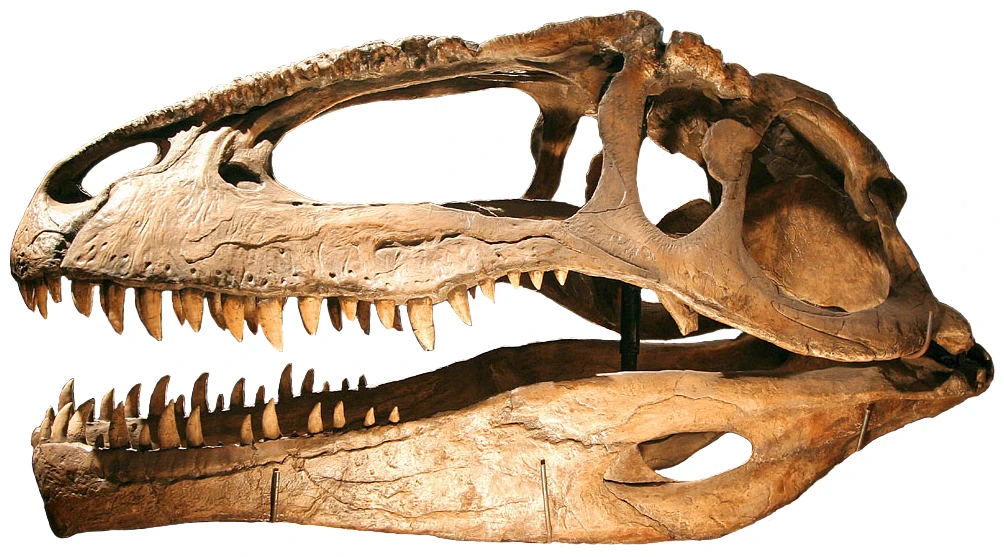
Depending on the study, the skull was between 1.53 and approximately 1.7 meters long. Even at 1.53 meters, it was about twice as long as at Abelisaurus (85 centimeters) Allosaurus (75 centimeters) (Coria & Salgado 1995). Compared to Mapusaurus, several features stand out (Coria & Currie 2006):
- The upper jaw is more elongated, the skull less tall and narrower.
- There are rough ridges on the bridge of the nose.
- Above the eye, a bone on the brow ridge bears a long ridge with deep grooves. It looks like a flat "horn".
- The lower jaw increases in height by 33 percent towards the front. In other large predatory dinosaurs, the increase in height rarely exceeds 10 percent.
The teeth were narrow and sharp as knives. The largest, including the root, measured up to 213 millimeters. That is longer than a pencilThere are 7.5 to 10 small teeth on every five millimeters of edge length (Coria & Currie 2006The enamel is wavy, but only noticeably so on the largest upper teeth (Brusatte et al. 2007).
The frontal bone is only 31.5 millimeters thick. In a slightly smaller T. rex, it measures 65 millimeters (Coria & Currie 2002).
How much brain was in the skull?
The cerebral cavity held approximately 275 milliliters, slightly more than a large cup. This was determined by CT scans and a measurement using water displacement (Paulina Carabajal & Canale 2010For comparison: Carcharodontosaurus had 224 milliliters, Tyrannosaurus 343.
The brain itself was smaller than the cavity, as in reptiles it only fills 50 to 95 percent of it. Coria and Currie estimate it weighed around 248 grams, about the same as a stick of butter. The brain resembles that of modern reptiles and is more primitively structured than that of their avian relatives. The olfactory bulb and olfactory nerve were well-developed. Together they measure about 100 millimeters, roughly 45 percent of the length of the braincase.
How fast could he run?
A fall would have been dangerous for a multi-ton animal. Blanco and Mazzetta therefore asked: How fast can such an animal run before it loses its balance? Their model yields a speed of about 14 meters per second for Giganotosaurus. That's around 50 kilometers per hour, as fast as a car in the city.Blanco & Mazzetta 2001).
Two limitations apply. According to the authors, the model is better suited for comparing species than for absolute values. For ostriches and humans, it calculates speeds of 18 and 9 meters per second, respectively, while the measured speeds are 16 and 8 meters per second. Furthermore, the study only shows what was possible. It doesn't say how often Giganotosaurus actually ran.
A find fits the robust construction. Pintore et al. (2024)The thighbone of Giganotosaurus and Tyrant Titan It is among the most powerful of the giant predatory dinosaurs. The one from Carnotaurus is the slimmest.
War der Biss von Giganotosaurus schwächer als der von T. rex?
This is suggested by a computer simulation. Johnson-Ransom and colleagues compared the skulls of many predatory dinosaurs. They scaled them all up to the same length and muscle strength. The Giganotosaurus skull was found to be under greater tension than that of a fully grown Tyrannosaurus rex (Johnson-Ransom et al. 2025However, the models are flat and greatly simplified.
The authors refer to previous studies. According to these studies, carcharodontosaurs lacked the protection against rotational forces in the skull that tyrannosaurs possessed. Their jaw muscles were relatively weak, and their knife-like teeth were less resistant to bending.
What was on the menu?
There is no evidence for Giganotosaurus itself. Johnson-Ransom and colleagues suggest that large carcharodontosaurs in general hunted large titanosaurs. These are giant long-necked dinosaurs that shared the same habitats (Johnson-Ransom et al. 2025).
Others saw it differently. Reolid and colleagues Two positions are suggested. Paul proposes large sauropods. Therrien and colleagues saw it as a generalist that also hunted smaller prey, including ornithopods (a group of herbivorous dinosaurs) and young sauropods. Both remain speculations.
Medium-sized sauropods, about 13 meters long, lived in its vicinity. The giant Argentinosaurus comes from younger social classes (Coria & Salgado 1995).
Warm-blooded or cold-blooded animals?
The temperature at which they grew can be determined from their bones. Barrick and Showers They examined 82 samples from 13 bones of a Giganotosaurus. The vertebrae were the warmest. The ribs were 2.5 to 3 degrees cooler, the tibia 4 to 5 degrees cooler. The torso thus remained warm and stable, while the legs cooled down towards the outside.
The researchers interpret this as follows: The metabolism was intermediate between that of modern reptiles and mammals. In their view, the climate in Patagonia was temperate. For an animal weighing 8 tons, they calculate a requirement of approximately... 20 kilograms of meat a dayThis is a model calculation. Furthermore, the interpretation is controversial; only one animal was studied, and the study dates from 1999.
Who were his closest relatives?
Giganotosaurus belongs to the Carcharodontosauridae family. The family is named after Carcharodontosaurus from North Africa. The structure of the braincase connects both genera (Coria & Currie 2002Coria and Currie also group Giganotosaurus and Mapusaurus into their own subfamily (Coria & Currie 2006).
Mapusaurus It lived in Argentina in the Huincul Formation, which lies above the Candeleros Formation. The two known Giganotosaurus fossil sites are each about 50 kilometers from the Mapusaurus site. At least seven Mapusaurus specimens were found at one location. There is no evidence of group behavior for Giganotosaurus.
For a long time, the family was considered to be an inhabitant of the southern continent of Gondwana. With Shaochilong from China, researchers found the first definitive Asian representative in 2009.Brusatte et al. 2009). Acrocanthosaurus Some also include North Americans. This is controversial.
Four species of this family lived in North Africa. There, they shared their habitat with other giant predators (Candeiro et al. 2018).
Why did he grow so tall?
The initial description makes a brief observation: The enormous size of Tyrannosaurus and Giganotosaurus arose independently of each other. This could be due to similar environmental conditions, the authors suggest (Coria & Salgado 1995They provide no evidence for this.
A review article, not yet peer-reviewed, suggests that high CO₂ levels, abundant vegetation, and large prey animals promoted the growth of predators. The author himself admits that much of it is based on assumptions (Hu 2024That's not certain.
More information on this topic can be found at urzeittiere.net
Anyone who wants to learn about the most famous giant predator can find him in the article about Tyrannosaurus rexThe South American relatives are mentioned in the articles about Mapusaurus and Tyrant Titan. Carnotaurus It also lived in South America and had the slimmest thigh among the giant predators. The North American one also... Acrocanthosaurus It's worth a look.
Image sources:
Size comparison to humans: Matt Martyniuk, CC BY-SA 3.0, via Wikimedia Commons