Acheroraptor
A jawbone, a few teeth, a single finger joint, and a claw – that's all that remains of Acheroraptor so far. And yet, this meager find tells one of the most exciting stories of the Late Cretaceous period: that of a swift, sickle-clawed hunter who lived in the same swampy riverine landscape as Tyrannosaurus Rex and Triceratops – until the asteroid arrived.
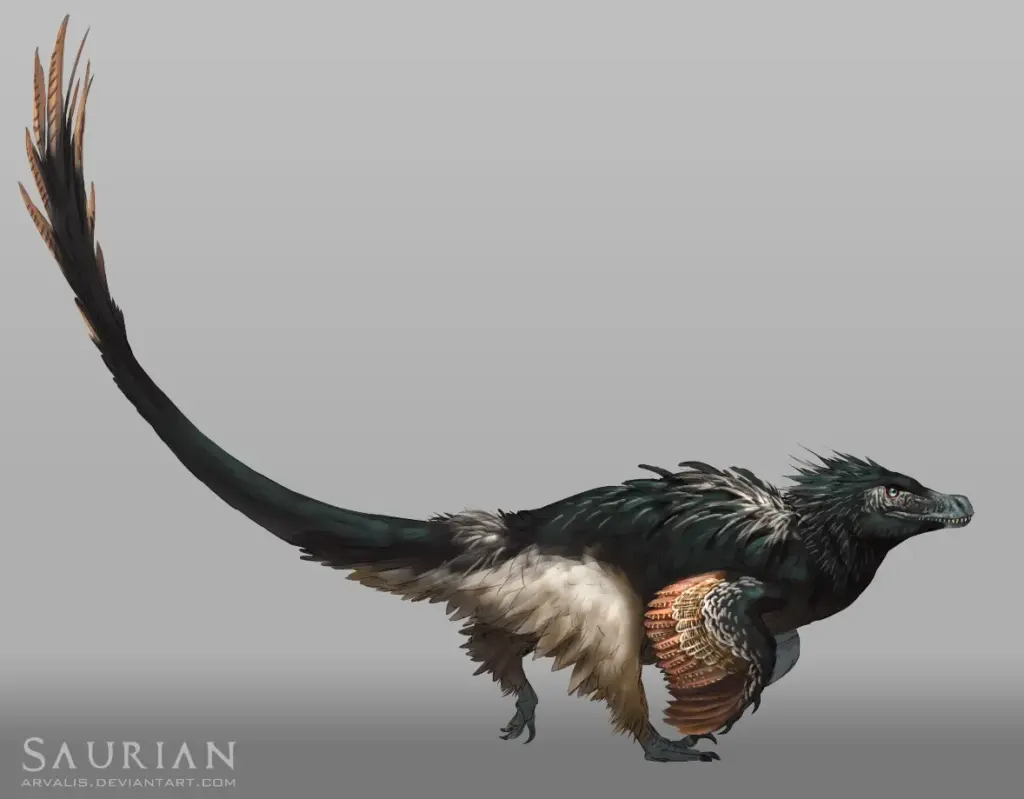
Creative Commons Attribution-3.0 License
Profile
| feature | Value |
|---|---|
| length | approximately 3.3–3.4 meters (estimated, no complete skeleton known) |
| Weight | approx. 40 kg (information provided by the initial description team) |
| Location | Hell Creek Formation, Montana (USA) |
| age | Latest Maastrichtian, approximately 67.2–66 million years ago |
| Food | Carnivores |
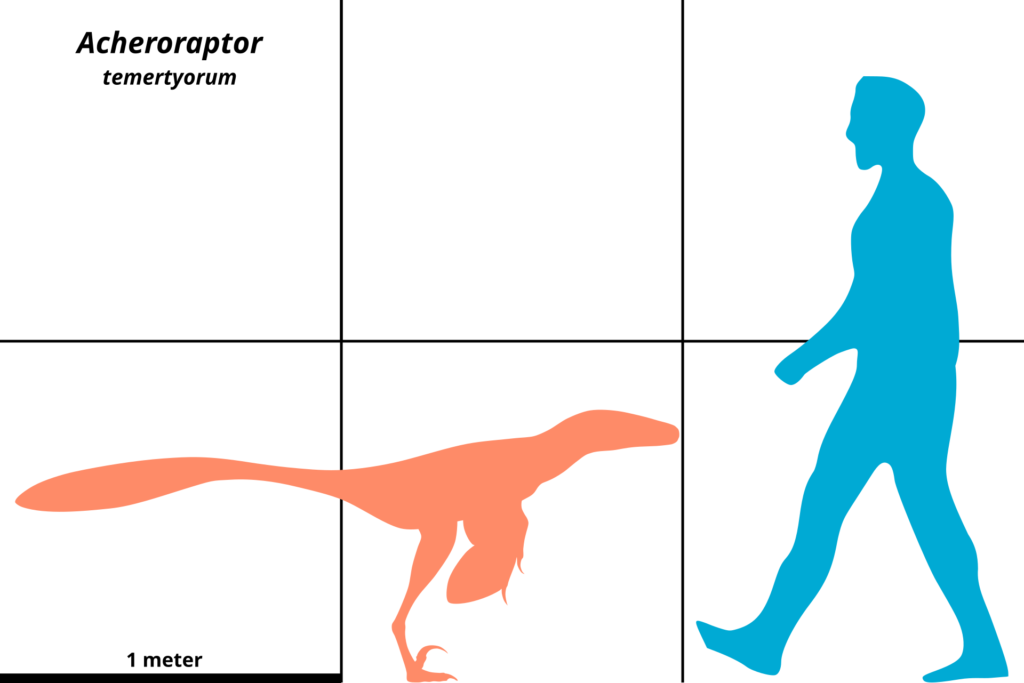
At 3.3 to 3.4 meters in length, Acheroraptor was about the same length as a small car – though roughly half of that was accounted for by its long, stiff tail. Weighing around 40 kilograms, it was – according to its initial description team – comparatively heavy for a raptor, but only about as heavy as a fully grown gray wolf.
Acheroraptor belongs to the family Dromaeosauridae, colloquially called "raptors" – the same group from which the more well-known Velociraptor also comes.
A thief from the underworld
The name says it all: “Acheroraptor” is a combination of the Greek Acheron, the river of the underworld in ancient mythology, and the Latin raptor (“thief”) – an allusion to its origin in the Hell Creek Formation, literally translated as “Hell Creek”. The Canadian paleontologists David Evans, Derek Larson, and Philip J. Currie [described the genus in 2013].
The species bears the suffix temertyorum, named after James and Louise Temerty, long-time supporters of the Royal Ontario Museum in Toronto, where the fossils are now located.
A find by commercial collectors
Commercial fossil collectors discovered the bones on August 28, 2009 – not scientists, but private prospectors – at a site approximately 45 kilometers southwest of Jordan, Montana. The central find is a nearly complete right upper jaw with several teeth; a corresponding lower jaw fragment was found about four meters away in the same rock layer. The Royal Ontario Museum later purchased both pieces from the collectors.
Only years later were a few finger bones and a claw added. To this day, Acheroraptor remains one of the least known raptor genera – its estimated size is based primarily on comparisons with better-preserved relatives such as Deinonychus.
Related to Velociraptor – or not?
The exact position of Acheroraptor in the family tree of the Dromaeosauridae is a matter of debate among researchers. The initial description from 2013 assigned it to the Velociraptorinae, thus placing it close to the famous Velociraptor. A [Study from 2022], however, comes to a different conclusion and places it in the Saurornitholestinae, as the closest relative of Atrociraptor.
Studies on bite force are more in line with the second classification: Acheroraptor bit relatively weakly, but quickly and sharply – a tactic for small, agile prey rather than for crushing bones.
The last Raptor before the catastrophe
Acheroraptor lived in the Hell Creek Formation, a warm, humid swamp in present-day Montana – at the exact same time and in the exact same place as Tyrannosaurus Rex and Triceratops. It is among the geologically youngest known dromaeosaurids and was still there when the asteroid that marked the K-Pg boundary struck.
For a long time, it was even considered the only dromaeosaurid in the entire formation. In 2015, a second, significantly larger raptor, Dakotaraptor, was described from the same rock. However, its status is disputed: some of the attributed material probably does not originate from a dromaeosaurid at all, but was mistakenly attributed to, among other things, turtle and oviraptorosaur bones.
See also
- Tyrannosaurus Rex – lived at the same time and in the same Hell Creek formation.
- Triceratops – also a contemporary from the Hell Creek Formation, but a herbivore.
- Camptosaurus – a herbivorous ornithopod from the much older Jurassic period, around 80 million years before Acheroraptor.
Image sources:
Size comparison: Definitely NOT Dilophosaurus, CC BY-SA 4.0, via Wikimedia Commons
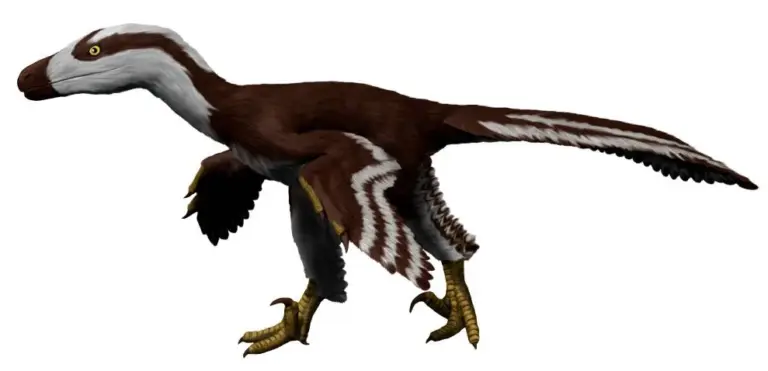
Small picture of Acheroraptor: Nobu Tamura email:nobu.tamura@yahoo.com http://spinops.blogspot.com/ http://paleoexhibit.blogspot.com/, CC BY-SA 4.0, via Wikimedia Commons