Allosaurus
How long was Allosaurus? Depending on the skeleton and study, between 6.4 and 10.4 meters. That's the difference between one and a half mid-size cars and a city bus. Allosaurus was the most common predatory dinosaur of the Morrison Formation in the western United States.Foth et al. 2015And to this day, experts debate how many species there were.
At a glance
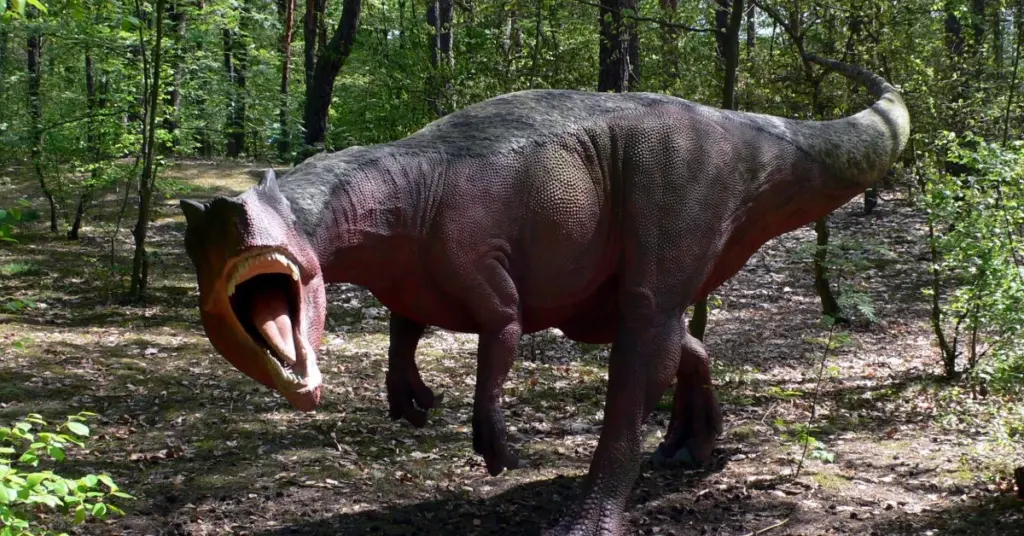
| feature | Value |
|---|---|
| name | Allosaurus (Genus), best-known species Allosaurus fragilis |
| First description | Marsh, 1877 |
| species | three recognized: A. fragilis, A. jimmadseni, A. europaeusA fourth, A. anax, was proposed in 2024 |
| length | 6.4 to 10.4 m depending on the specimen, mostly 7.4 to 7.9 m |
| Weight | 0.7 to 2.9 t depending on the study, often 1.4 to 1.7 t |
| Location | USA (Morrison Formation), Portugal, Germany |
| age | Upper Jurassic, late Kimmeridgian to late Tithonian |
| Nutrition | Carnivores |
| Fossils | At least 46 animals in the Cleveland-Lloyd quarry (Utah) alone |
How big was Allosaurus really?
Each number belongs to a different skeleton or calculation method. Compilation of specialist literature shows the bandwidth.
The smallest specimen (YPM 1930) measures 6.36 meters in length. Most skeletons measure between 7.4 and 7.9 meters. One animal (AMNH 680) reaches 9.7 meters. Molina-Pérez and Larramendi cite the maximum value of 10.4 meters.It's an estimate. The smallest number corresponds to one and a half mid-range cars, the largest to almost a city bus.
There are three camps when it comes to weight:
- 700 to 952 kilograms: about as much as a domestic cow.
- 1,400 to 1,700 kilograms: The weight of a mid-range car. This is where most studies fall.
- 2,090 to 2,900 kilograms: as much as a large SUV.
One often reads about 12 meters and 4 to 5 tons. None of the evaluated studies mention such values. Allosaurus fragilisThey lie across the entire range.
A third method involves examining the femur. Its circumference can be used to estimate weight. A bone 700 millimeters long weighed 899 kilograms, while one 571 millimeters long weighed 452 kilograms.The femur of a Giganotosaurus In contrast, it measures 1,374 millimeters. That's almost double.
A slender body with a long tail
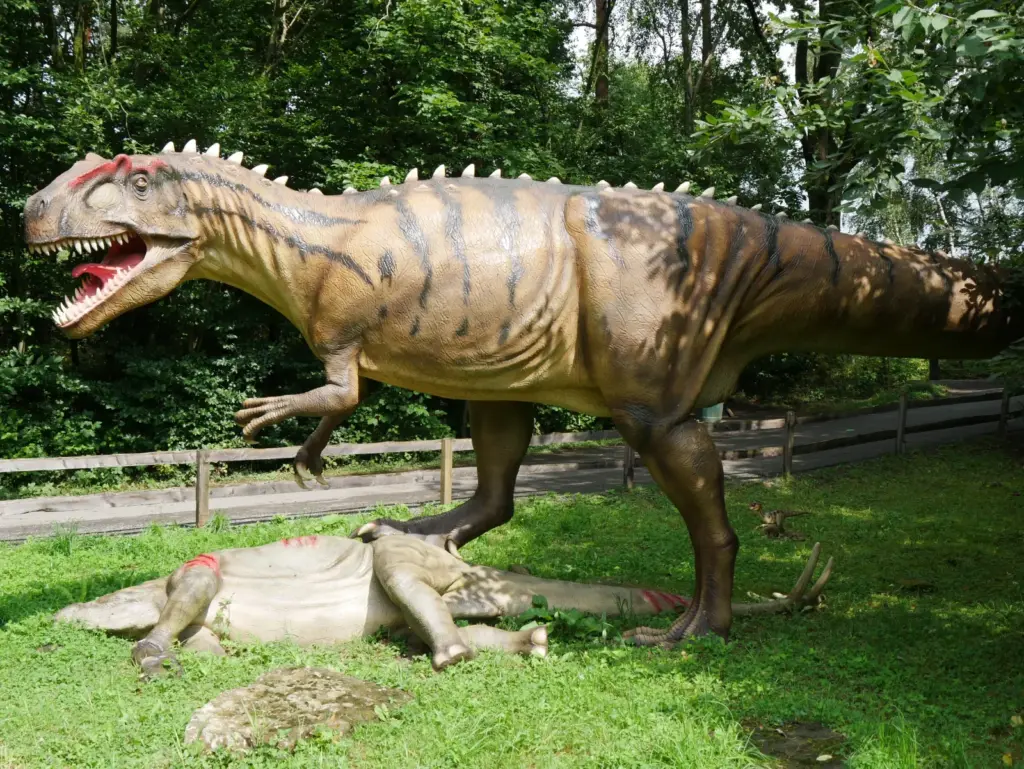
Allosaurus walked on two legs. Its neck formed an S-curve. The long tail helped balance the body. The hind legs were relatively large and, with three toes, supported the weight (Reolid et al. 2021).
The arms were long for a large predatory dinosaur and bore three fingers. A study of 61 predatory dinosaur species. relates skull length to arm lengthA value of 1.0 or higher indicates a shortened arm. Allosaurus's arm length ranges between 0.813 and 0.892, so its arms are not considered shortened. The hand comprised 44 percent of the arm length. In Giganotosaurus and its closest relatives, it was only 34 percent.
The head was short and light, but powerfully built. The skull of a 7.9-meter-long animal was a good 80 centimeters long, about the length of a skateboard. The teeth were sharp and serrated. The cheekbone reached as far as the large eye socket. This was shown by skulls from several collections..
The tooth crowns of large animals have fine folds in the enamel. These are almost entirely absent in smaller animals. Such folds are also known from Giganotosaurus and its relatives. However, they are not a distinguishing feature of this group.A single folded tooth, therefore, does not prove a relative of Giganotosaurus.
Even the tail reveals something. Researchers found something on vertebrae from the Cleveland-Lloyd quarry. a groove where presumably the most important leg muscle was attachedIt extends over the front tail vertebrae and disappears between the 24th and 32nd vertebrae. This allows one to determine how far the muscle extended into the tail.
How did Allosaurus bite?
A computational model showed how the tension is distributed in the skull when biting down. Tyrannosaurus rex The pressure is on the nasal bones. In Allosaurus, the tips are attached to the frontal and parietal bones. Both are thick and firmly toothed. The delicate nasal bones are hardly stressed (Rayfield 2005).
Exactly how he bit is disputed. Previously, his head was compared to an axe blade that he plunged into his prey during a running start. A Spanish research group sees it differently.According to their model, Allosaurus used the force of its muscles to bite into slightly curved surfaces, such as the bodies of very large prey. The neck muscles pressed the head downwards in the process. This is a model, not an observational finding.
A more recent calculation supports the robust structure. For this calculation, all skulls were adjusted to a length of one meter and the same muscle strength. The short, deep skull of Allosaurus jimmadseni remained low impactThis is a comparative method, not a measurement of the actual bite force.
How fast did an Allosaurus grow?
Researchers cut open bones from the Cleveland-Lloyd quarry and counted the growth rings. The largest animals in the sample were 13 to 19 years old.They grew fastest at around 15 years of age, gaining approximately 148 kilograms per year. That's about the same as a fattened pig.
Based on even larger bones, the authors conclude that the maximum lifespan is between 22 and 28 years. The study does not differentiate between the species recognized today.

How many species are there – and which one is called fragile?
Marsh described the genus in 1877 based on a fragment from the Morrison Formation. The holotype is not diagnostic; therefore, it does not allow for unambiguous species identification. For this reason, there is a proposal for a neotype, a replacement type (Chure & Loewen 2020). A more recent study identifies the skeleton USNM 4734 as a neotype (Burigo & Mateus 2025).
Nineteen species have been named since 1877. Two independent studies recognize only three:
- A. fragilis: the classic style of the Morrison formation.
- A. jimmadseni: Described in 2020. The lower border of the zygomatic bone runs almost straight, and the nasal bones bear thin ridges. It includes "Big Al" and "Big Al II" (see below).
- A. europaeus: the species from Portugal. It is the sister species of A. jimmadseni.
The names A. atrox, A. amplus and A. lucasi They possess no distinctive characteristics. They are considered unusable (nomina dubia). A find from Japan, once thought to be Allosaurus, belongs to this group. Segnosaurus (Burigo & Mateus 2025).
In addition, there is a dispute. In 2024, Danison and colleagues described Allosaurus anax from Oklahoma. The bones had previously been known under the name Saurophageal anastomosisThe authors estimate the weight of three femurs to be between 3,776 and 4,634 kilograms. That's roughly the weight of a bull elephant. They maintain Saurophageal anastomosis for a useless name. Burigo and Mateus They see things differently and lead Saurophageal anastomosis further as a valid genre. Her work appeared just over a week later and goes on A. anax Not one. Both viewpoints currently exist side by side.
Who were "Big Al" and "Big Al II"?
Several famous skeletons belong to this group. A. jimmadseniThe discovery stories are in the First description of the species.
Der Holotyp (dinosaur 11541) wurde am 15. Juli 1990 im Dinosaur National Monument in Utah gefunden. An der Oberfläche lagen nur ein paar Zehenglieder und Schwanzwirbel, etwa sechs Meter über dem Boden in einer steilen Felswand. Die Ausgrabung dauerte bis 1994. Der Körper wurde in einem einzigen Block von 2.700 Kilogramm per Hubschrauber geborgen. Der Schädel fehlte. 1996 spürte ihn eine Strahlungsmessung knapp unter der Oberfläche der Wand auf.
“Big Al” (MOR 693) was discovered in Wyoming in 1991 and was long considered a A. fragilisThe same Swiss excavators also discovered another, larger animal, "Big Al II" (SMA 0005). It was 7.6 meters long and is on display at the Aathal Dinosaur Museum.
Researchers found that "Big Al II" Traces of injuries to the lower jaw, neck, ribs, shoulder, upper arm, ischium and toesAll injuries healed except for the ischial tuberosity fracture. The ischial tuberosity fracture could have been fatal. The fact that the animal survived so many injuries could suggest group behavior. However, it could also be due to a metabolism that can survive long periods without food, or to scavenging. This is an interpretation based on the bones, not proof of pack hunting.
What was on the menu?
Bite marks provide clues. Researchers found 68 sauropod bones from 40 animals from the Morrison Formation with tooth marks from predatory dinosaursPossible culprits include Allosaurus, Ceratosaurus, Marshosaurus, and Torvosaurus. It's difficult to identify a specific species. Narrow grooves are consistent with Allosaurus or Ceratosaurus, while the largest grooves suggest Torvosaurus or a very large Allosaurus.
None of the traces show signs of healing. The authors interpret this as follows: The predators probably fed on the carcasses of large sauropods and preferred young animals. Longnecks from the same formation include Apatosaurus, Camarasaurus and DiplodocusThis is an interpretation based on traces, not proof of individual hunting scenes.

Where and with whom did Allosaurus live?
In the Late Jurassic period of North America, Allosaurus lived alongside Torvosaurus, giant sauropods, as well as large armored dinosaurs and ornithopods. There is ample evidence for a predator-prey relationship.. According to the phylogenetic data, the genus originated in North America and arrived in Europe no later than the late Kimmeridgian (Burigo & Mateus 2025).
There, in 2003, collector Aart Walen found skull fragments at Praia de Vale Frades near Lourinhã. They were identified as fossils in 2006. Allosaurus europaeus They were described. Torvosaurus and Ceratosaurus also lived in Portugal at that time. The predatory dinosaur fauna there is strikingly similar to that of the Morrison Formation. Researchers concluded from this that there was a land bridge between North America and the Iberian Peninsula.
Allosaurus or T. rex: What distinguishes the two?
There is a gap of about 80 million years between the two. Allosaurus lived in the Late Jurassic period, while Tyrannosaurus rex lived about 68 to 66 million years ago at the end of the Cretaceous period. According to current estimates, a T. rex weighed between 6 and 8.8 tons, while an Allosaurus usually weighed less than 3 tons. The T. rex had tiny arms, while the Allosaurus had long ones.
The skull structure was also different. In T. rex, the fused nasal bones bore the load, while in Allosaurus, the frontal and parietal bones did. More on the comparison can be found in the article on... Tyrannosaurus rex.
More information on this topic can be found at urzeittiere.net
The most famous antagonist can be found in the article about Tyrannosaurus rex. A larger relative is described in the article about Giganotosaurus. Its prey likely included the sauropods Apatosaurus, Camarasaurus, and Diplodocus.
Image sources:
skeleton of a Allosaurus fragilis: No machine-readable author provided. Sheep81~commonswiki assumed (based on copyright claims)., Public domain, via Wikimedia Commons
Featured image: This photo was taken by Przemysław JahrAutorem zdjęcia jest Przemysław JahrWykorzystując zdjęcie proszę podać jako autora:Przemysław Jahr / Wikimedia Commons, Public domain, via Wikimedia Commons