5 dinosaurs with horns
The Triceratops has long been one of the most recognizable dinosaurs thanks to its distinctive headgear - but why did it have horns and neck shields?
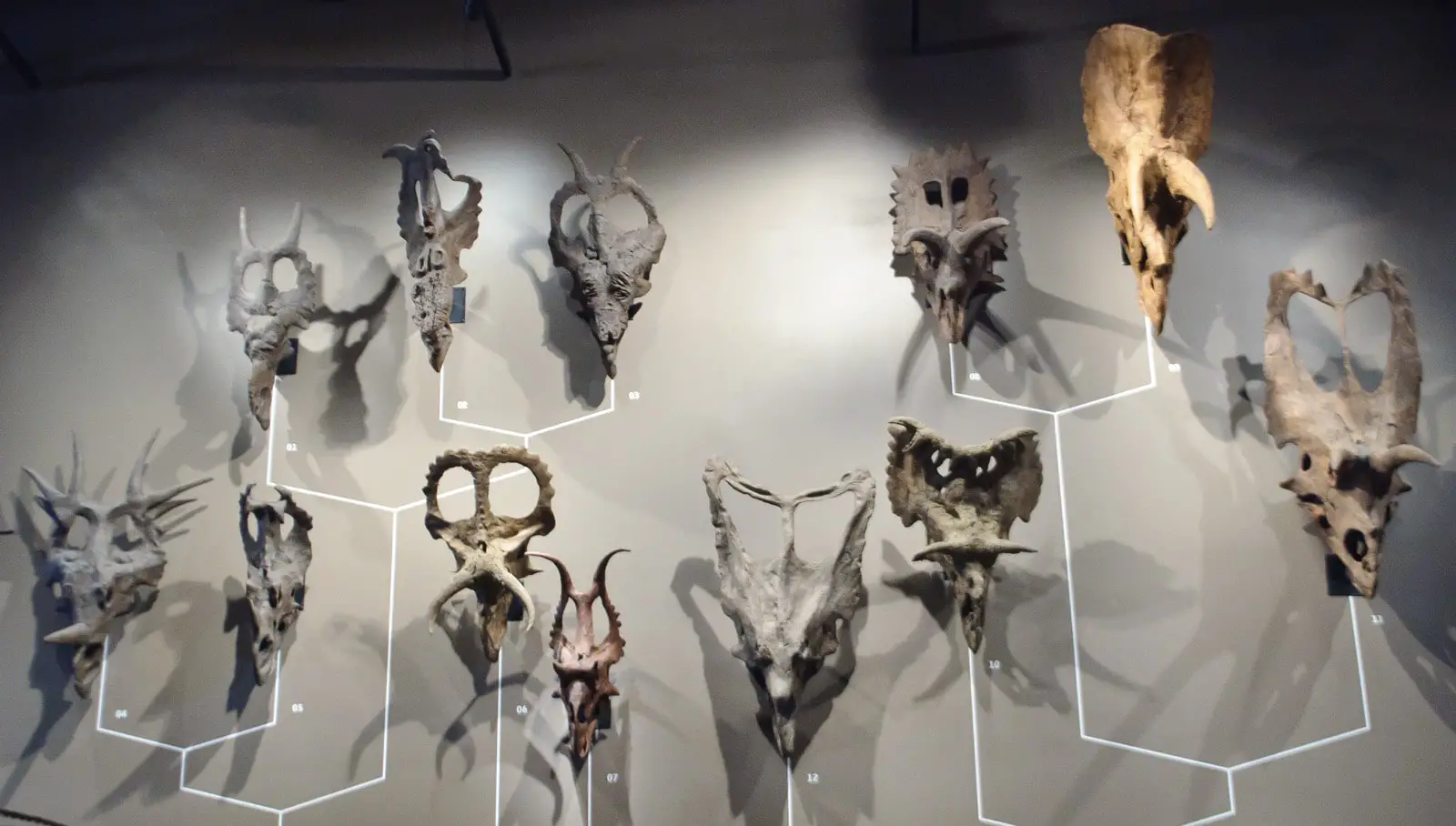
Source: [1] https://www.newscientist.com/article/2236427-some-dinosaurs-might-have-had-fluorescent-horns-or-feathers/
What function did the horns and neck shields have?
The most common and well-known hypothesis is that they served as protection and defense against predators.
The horns were certainly suitable for use as shock weapons. And the shields were certainly big enough to protect against bites from predators, especially in the neck area.
However, opponents of this protective hypothesis counter that the neck shield was very thin and hardly suitable as protection against neck bites. In addition, in most species (unlike Triceratops) the neck shield was not massive.
They often have depressions and thinner bone structures, such as: B. the neck shield of the Torosaurus has holes.
These weak parts of the shield certainly could not provide adequate protection against the powerful jaws of a T-rex.
The majority-held hypothesis today about the function of the horns and shields assumes that these physical features served more for communication with mating partners or played a role in territorial fights.
A very recent theory even suggests that some dinosaurs may also have had ultraviolet, fluorescent horns or ruffs - and a few species may even have used this glow to attract mates [1].
However, the theory of horns and shields as a means of self-defense has not yet been scientifically refuted.
Diabloceratops eatoni
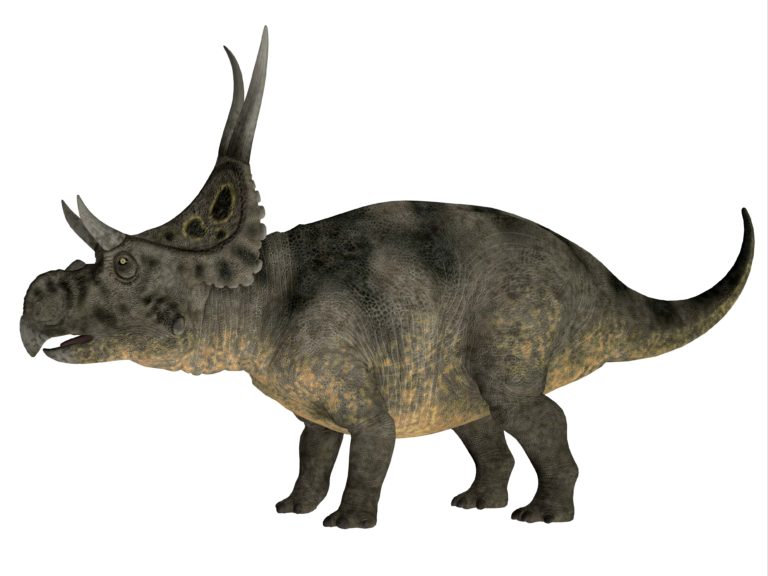
Source: skinnylawyer from Los Angeles, California, USA, CC BY-SA 2.0, via Wikimedia Commons
He lived during the Late Cretaceous Period, about 79.9 million years ago
Diabloceratops, a newly named dinosaur found in 2002 in the Wahweap Formation in the US state of Utah. It was a ceratopsine dinosaur that lived in what is now Utah, USA, during the Late Cretaceous Period, about 79.9 million years ago.
It is the oldest known ceratopsid, and is clearly a basal centrosaur.
Diabloceratops was a 150 kilogram dinosaur that grew to a length of around 3.5 meters and a height of 1.2 meters.
One of the most notable features of this dinosaur is its skull, which is decorated with a ruff and curved horns, which gives it its name.
Cosmoceratops richardsoni
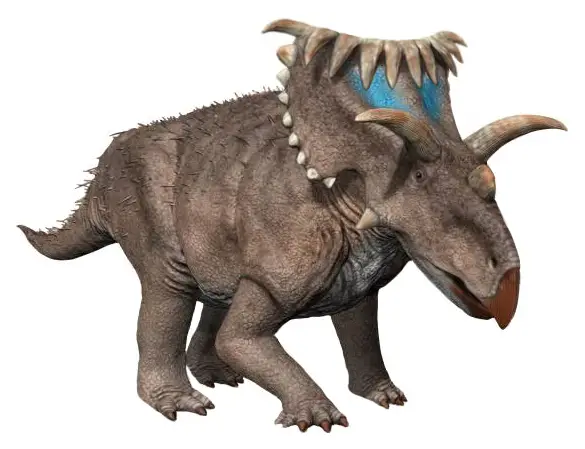
With a total of 15 well-developed horns and horn-like structures, it rightly has the title of:
Most decorated skull of all known dinosaur species.
Kosmoceratops was a horned dinosaur that lived during the Late Cretaceous Period. He lived in what is now Utah, USA. Its genus name “Kosmoceratops” means “horned face from a distant place” or “wandering horned face” and refers to the decorations on the skull.
Kosmoceratops' horns are its defining feature. They point pointedly upwards and to the sides, then downwards, ending in pointed points.
Two horns were on each cheek and above the eyes. A single one on his nose. The other 10 horns were distributed along the upper edge of his pronotum.
This ruff was the shortest of all ceratopsids in terms of width compared to total area.
Anchiceratops ornatus
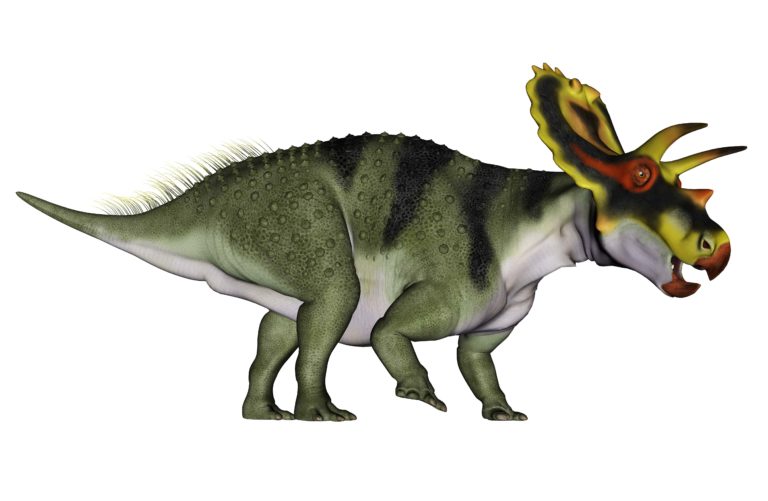
The horns of the Anchiceratops were not offensive weapons, but defensive weapons.
Anchiceratops had the typical Ceratopsidae body model and measured about 6 meters in length, making it a medium-sized member of this family.
He had a powerfully built body with stocky legs. The front legs were significantly shorter than the hind legs.
Anchiceratops had a short horn on its nasal bone and two significantly longer and forward-curving horns above its eyes. His neck shield was relatively long. It was provided with two small paired openings and was therefore a clear distinguishing feature from related species. At the upper edge of the shield there were so-called epoccipitals, or simply put, jagged ossifications.
Eotriceratops xerinsularis
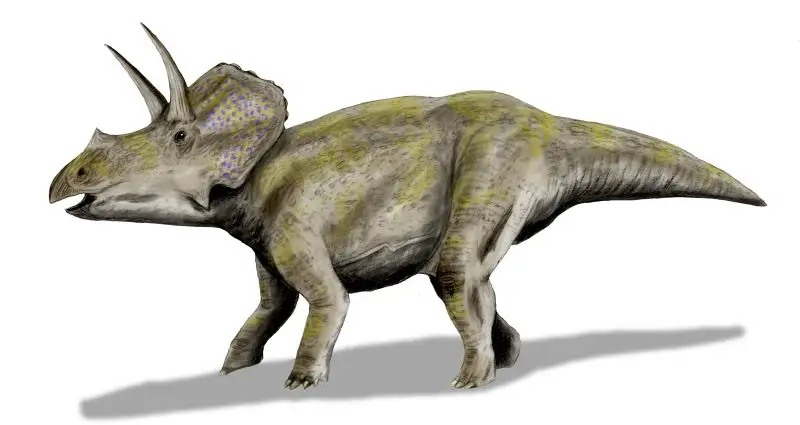
Eotriceratops length is estimated at 9 meters.
This makes it one of the largest ceratopsians ever found. It even exceeds Triceratops in size by about 1 meter. Only Ceratopsipes is thought to have been up to 12 m and 18 tons in size. However, only footprints are known from Ceratopsipes goldenensis.
He had a low, slightly backwards curved nose horn which lay above the nostrils.
The two horns above the eyes were curved forward and were up to 80 cm long.
Image source: Nobu Tamura (http://spinops.blogspot.com), CC BY 3.0, via Wikimedia Commons
Titanoceratops ouranos
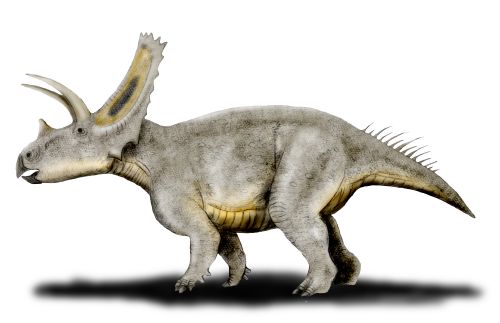
It was arguably the most massive and powerful horned dinosaur ever discovered.
At least as far as the size of his skull is concerned.
The skull plus ruff is 2.65 meters long, which gives it the title of: longest skull of a land animal gives.
Titanoceratops was a massive giant that used its impressive horns to defend itself against predators.
The most massive and powerful horned dinosaur ever discovered, Titanoceratops was a towering giant that used its impressive horns to defend itself against predators. He was an intimidating sight, 6.80 meters long and 2.50 meters high, with those two gigantic horns on his head and the huge ruff.
Its sheer size and the two massive horns on its head probably made this dinosaur less attractive prey for predators.
Image source: NobuTamura email:nobu.tamura@yahoo.com, CC BY-SA 3.0, via Wikimedia Commons
Triceratops horridus
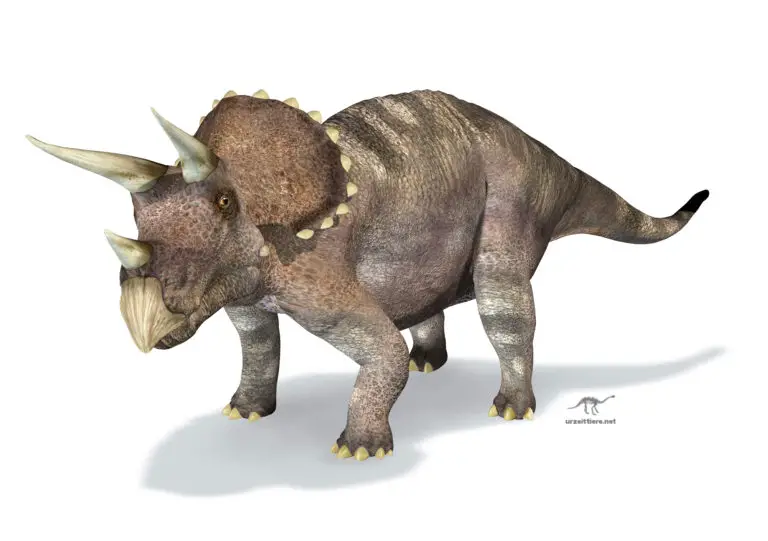
Every child knows the name and picture of the TriceratopsThe curly-faced, three-horned dinosaur is the symbol for everything prehistoric.
He had a relatively small nasal horn on his nasal bone, which may have been covered with keratin.
What stood out, however, were its “brow” or supraorbital horns, which were about 1 meter long.
These horns were relatively long, but the shape varies considerably between individual finds.
Males had larger, more upright horns and larger skulls, while females had smaller skulls with shorter, forward-facing horns.