
Carnotaurus: The dinosaur with the bull's horns
A carnivore with two horns above its eyes. This existed only once in Earth's history. Carnotaurus sastrei lived in Patagonia around 69 to 64 million years ago. Only a single skeleton has been found – but it is a very complete one, with fossilized skin.
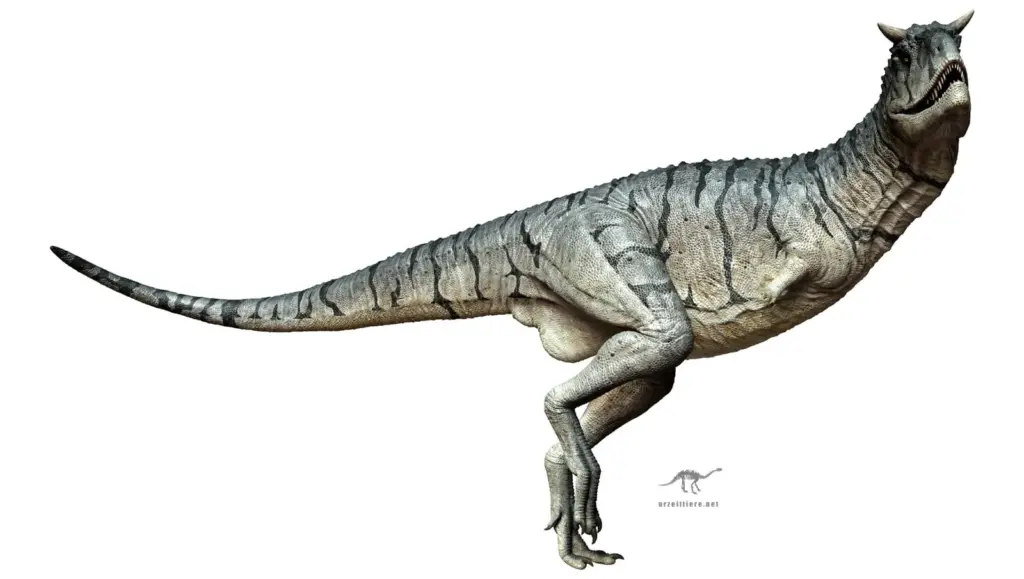
At a glance
| feature | Value |
|---|---|
| length | approx. 7.5–8 m |
| Weight | approx. 1.3–2.1 t |
| Location | La Colonia Formation, Chubut, Patagonia (Argentina) |
| age | Late Cretaceous, approx. 69–64 million years ago |
| Food | Carnivores |
| Special feature | only known carnivore with a pair of forehead horns |
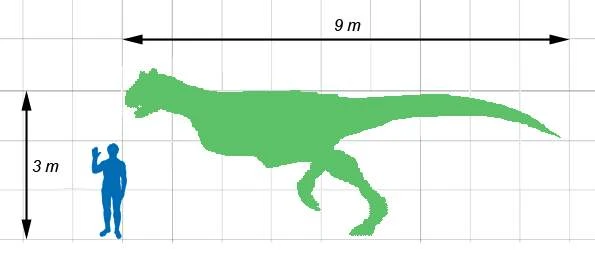
At 7.5 to 8 meters long, Carnotaurus was almost as long as a city bus. Older estimates suggested it could have been up to 9 meters long. A new study (Grillo & Delcourt, 2017) corrected the value downwards. The weight remains at 1.3 to 2.1 tons (Mazzetta, Christiansen & Fariña, 2004) – as much as a fully grown hippopotamus. He still wasn't a heavyweight, though: Tyrannosaurus Rex weighed three to five times as much.
A find for eternity
In 1984, paleontologist José Bonaparte discovered the skeleton on a farm in the Chubut province of Argentina. It was embedded in an extremely hard block of rock. Preparation took years. In 1985, Bonaparte described the genus and species for the first time, followed by a detailed study in 1990.
The name is almost self-explanatory: Carnotaurus It is called the "carnivorous bull" – an allusion to its two horns. To this day, it is the only known skeleton of its kind.
What was the purpose of the forehead horns?
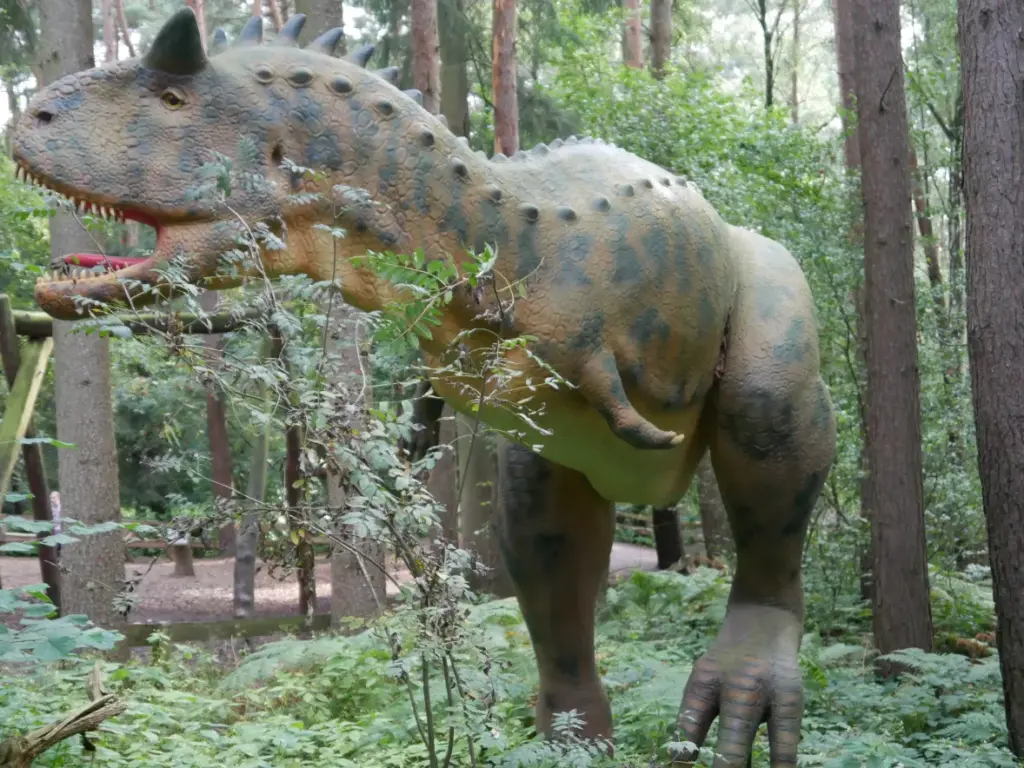
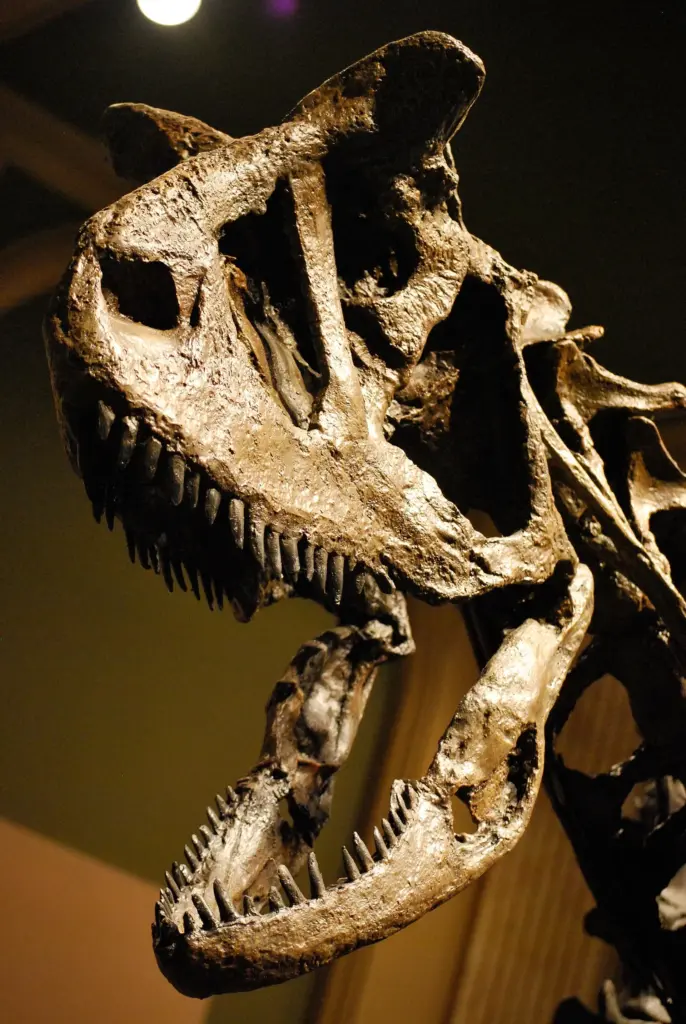
No other carnivorous dinosaur had horns like Carnotaurus. The two horn-like structures grew diagonally from the skull above the eyes and were about 15 centimeters long. Their exact purpose remains a subject of debate.
A study by Mariana Cerroni and colleagues (2020It is suspected that the horns served more as a visual signal than as a weapon. Other researchers calculate that the neck and skull could indeed cushion a headbutt – similar to the white rhinoceros. However, the horns are considered unlikely to have served as a weapon against prey. There is no precedent for this in the animal kingdom.
Shorter arms than the T-Rex
Carnotaurus' arms were tiny – even shorter than those of T-Rex. Relative to its body size, they were even more atrophied than in any other known tyrannosaurid.Ruiz, Torices, Serrano & López, 2011The forearm measured only a quarter of the length of the upper arm.
The hand had four fingers. The most striking was a long, cone-shaped metacarpal bone. In one of the two specimens, it was even directly fused to the ulna – a unique structure among carnivores. The hand was not entirely without claws, however: a cone-shaped terminal segment was found on one finger. Researchers cautiously interpret it as a claw.
A study by Phil Senter (2009) found that the nerves in the arms were almost as atrophied as in the vestigial wings of emus and kiwis. This strongly suggests that the arms were hardly usable for grasping.
The skin that corrected an old image
The first large skin impressions of a carnivore ever come from Carnotaurus. The skin consisted of small scales. Larger, cone-shaped bumps were located between them. Feathers? Not a trace.
For a long time, drawings showed these bumps in neat rows. A new study by Christophe Hendrickx and Phil Bell (2021This is refuted: The humps were completely randomly distributed, without any pattern. The researchers suspect a simple reason: They helped to get rid of excess heat. An active hunter weighing over a ton heats up quickly when running.
How fast was he really running?
The tail of Carnotaurus bore a huge muscle – the main power source for running. A study by Scott Persons and Philip Currie (2011Its weight is estimated at 111 to 137 kilograms per hind leg. Relative to its body size, this is a record value. No other theropod studied to date has had a relatively larger tail muscle.
The study never specifies an exact speed in km/h. It only mentions the potential for short sprints. In their conclusion, the authors go even further: Carnotaurus may even have been the fastest of the large theropods – but without specifying a number. The well-known figure of 48 to 56 km/h comes from elsewhere: from an interview the lead author gave to the CBC. That was a spontaneous assessment, not a measured result. Carnotaurus was hardly agile: the same stiff tail that provided propulsion made tight turns difficult.
A quick bite or a deadly blow?
How Carnotaurus hunted is also a matter of debate. A group led by Gerardo Mazzetta calculated a fast but comparatively weak bite force: around 3,300 to 3,400 Newtons at the front jaw. That's only a tenth of what was determined for T-Rex. This is more consistent with small, agile prey.
François Therrien and colleagues arrive 2005 to a different conclusion. The jaw was more like that of a Komodo dragon. It was built for inflicting deep cuts on large prey.
A new 3D analysis by Rowe, Cerroni and Rayfield (Scientific Reports, 2026This adds another twist to the debate. The skull is not as stable under bite pressure as previously thought. Nevertheless, the researchers draw a clear conclusion: Large abelisaurids in the south played the same role as the tyrannosaurids in the north. They simply hunted differently – snapping and tearing instead of bone-crushing. A definitive answer remains elusive.
Rex: Who was bigger, who was more dangerous?
For all its ferocity, Carnotaurus was no rival to the most famous of all carnivores. Tyrannosaurus Rex, at around 12 meters long, was significantly larger. Weighing in at 8 to 9 tons, it was roughly three to five times as heavy. So, who was bigger was never seriously in doubt.
The T-Rex was also far superior in bite force: estimates place it between 30,000 and 60,000 Newtons. Carnotaurus only managed around 3,300 to 3,400 Newtons at its front jaw – not even a tenth of that. However, Carnotaurus may have excelled in one discipline: sprinting. Its exceptionally powerful tail muscles for its size suggest considerable speed. This has not been documented for the T-Rex.
Neighbors in Patagonia
Carnotaurus lived on a coast with river mouths and mudflats. Its neighbors included turtles, plesiosaurs, crocodiles, and the titanosaur Titanomachya gimenezi – probably its prey.
In 2024, Diego Pol and colleagues described a second, smaller relative from the same formation: Koleken inakayaliBoth predators apparently lived side by side, but in different roles. Carnotaurus was the larger hunter, Koleken the smaller one – a bit like lions and leopards in today's savanna. Relatives such as Aucasaurus, Majungasaurus Niebla and Carnotaurus together form a closer group of related species.
From movie star to streaming star
In Disney's "Dinosaur" (2000), two oversized Carnotauruses chase the heroes' herd. In the series "Prehistoric Planet" (2022), a male, on the other hand, dances around a female. His colorful arms are purely imaginary – as confirmed by consultant Darren Naish. compared to IFLScienceIn "Jurassic World: Camp Cretaceous" (from 2020 onwards), one Carnotaurus even has its own name: "Toro," Spanish for "bull." It is one of the main antagonists of the first season.
Carnotaurus has long since arrived as a collectible figure. Schleich includes him in their product range. LEGO released two official sets: "Carnotaurus Gyrosphere Escape" (2018) and "Carnotaurus Dinosaur Chase" (2021). ARK: Survival Evolved He can even be tamed and ridden. In Jurassic World Evolution It is a popular playable carnivore – but there it is larger, at around 10 meters in length, than the find suggests.
More information on this topic can be found at urzeittiere.net
- Tyrannosaurus Rex – the most well-known benchmark: significantly heavier and more powerful, but probably the slower runner.
- Gnathovorax – a carnivore from South America that is around 165 million years older, from a completely different, much more primitive group of dinosaurs.
Image sources:
Size comparison to humans: Gabriel Solo, CC BY-SA 3.0, via Wikimedia Commons
Carnotaurus skull: StrangerintheAlps, CC BY-SA 3.0, via Wikimedia Commons