Camarasaurus
One-third of all identifiable sauropod bones from the Morrison Formation belong to a single genus. Its name: Camarasaurus. No other long-necked dinosaur from the region has been found so frequently in the Late Jurassic. Yet, it is hardly known. Brontosaurus and Brachiosaurus are far more famous. Its history, however, involves a fierce naming dispute from the early days of paleontology.
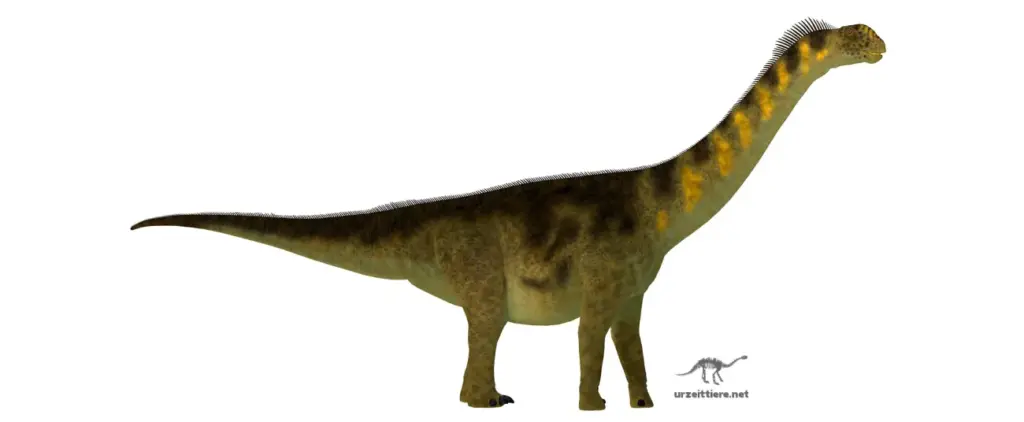
At a glance
| feature | Value |
|---|---|
| genus | Camarasaurus |
| species | 3 recognized species: Camarasaurus grandis, C. lentus, C. supremus |
| length | 14.9–20 m, depending on the species |
| Weight | 11.5–30 t, depending on the type |
| Location | USA: Wyoming, Colorado, Utah, New Mexico, Oklahoma; occasionally Montana |
| formation | Morrison Formation |
| age | Upper Jurassic (Kimmeridgian to Tithonian) |
| Nutrition | herbivores |
| Family | Camarasauridae |
Three types, one robust design
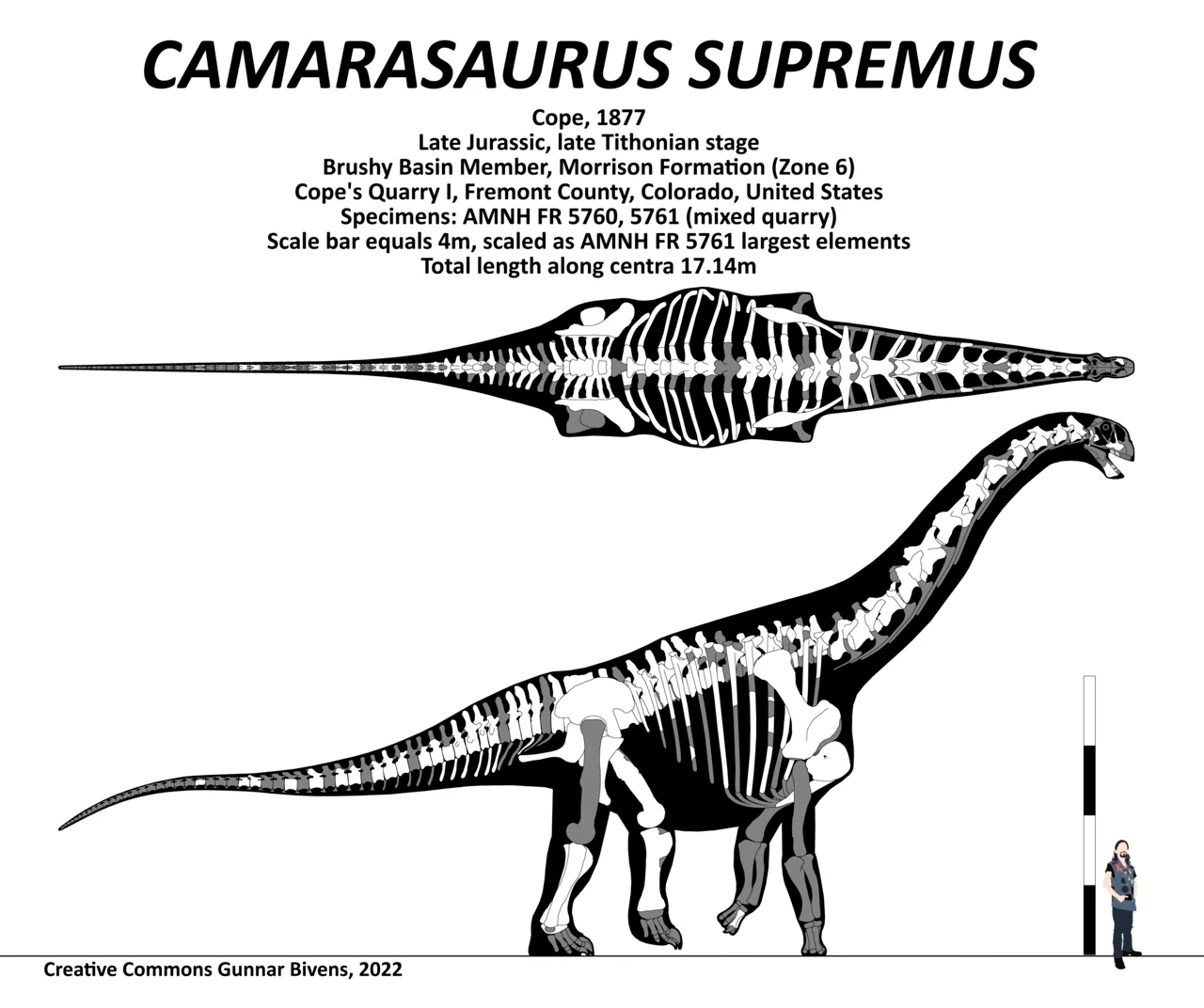
Camarasaurus grandis, lentus, and supremus shared the same basic body plan. Four sturdy legs supported the body. The hind legs were more powerful than the forelegs. The tail remained short, consisting of only about 53 vertebrae. Camarasaurus supremus was the largest species, reaching lengths of up to 20 meters and weighing up to 30 tons—as much as five elephants combined. Camarasaurus grandis was smaller, measuring only 14.9 meters in length and weighing just 11.5 tons.
The forehand was striking. The metacarpal bones formed a narrow tube. This was the case with all large sauropods. A study from 2026 asked: How flexible were the fingers within this tube? The answer: hardly any. The fingers could almost only bend backward. Curling inward was nearly impossible. This very feature protected the closely spaced fingers. They didn't block each other when walking (Senter 2026).
How do you distinguish between the three Camarasaurus species?
At first glance, all three species look similar. A closer look at the spine provides further clues. In Camarasaurus grandis, a vertebral process sits atop a high pedicle. In the other two species, this pedicle is short and solid. The opposite is true at the base of the tail. There, a process widens evenly in Camarasaurus lentus. In the other species, it is more T-shaped, with a narrow center.
Time also separates the three species. Camarasaurus grandis is the oldest species, appearing first in the Morrison Formation. Camarasaurus lentus follows, and Camarasaurus supremus appears last. It is also the largest of the three species. Their locations also differ. Camarasaurus grandis is primarily found in Wyoming, Colorado, and New Mexico. Camarasaurus lentus lived in Wyoming and Utah. Camarasaurus supremus comes from southern Colorado, and likely also Oklahoma.
From cub to 16-meter giant
Two skeletons from Utah reveal just how small Camarasaurus was as a juvenile. The discovery site: the Carnegie Quarry in Dinosaur National Monument. The smaller animal measured only 5.08 meters (11 feet). That's barely longer than a large SUV with a trailer. The second, older animal reached about 8 meters (30 feet). Even the holotype of Camarasaurus lentus was small: only 6.11 meters (20 feet). Adults of this species grew up to 16 meters (50 feet) long.
Was it really a new animal?
In 1918, Earl Douglass discovered the skull of the smaller juvenile. Douglass led the excavation. At first, he thought the find was a Brontosaurus. Shortly afterward, he corrected himself, giving the animal a new name: "Uintasaurus." The reason: its unusually long neck ribs. Douglass considered them unique. Later research revealed otherwise. Long neck ribs are quite normal in Camarasaurus. The supposedly new Uintasaurus was simply a young specimen of Camarasaurus lentus.
One name, eleven fossils, six researchers
Few other species were renamed so frequently in their early days. Edward Drinker Cope described Camarasaurus supremus in 1877, using individual vertebrae from Colorado. That same year, much more happened. Cope and his rival, Othniel Charles Marsh, assigned at least eleven other names. All were supposedly for new giant dinosaurs from the surrounding area, including Atlantosaurus and Apatosaurus. It wasn't until much later that the confusion surrounding the names was resolved. Many of these "new" animals were simply Camarasaurus. Others were brontosaurus or Apatosaurus under double names.
Camarasaurus or Brachiosaurus – how do you tell them apart?
Both giants lived in the same place around 150 million years ago. Both belong to the Macronaria, a common group of sauropods. The biggest difference lies in their body structure. Brachiosaurus The forelegs were longer than the hind legs. This gave it the typical, sloping shoulder. In Camarasaurus, it was the other way around. The hind legs remained longer than the forelegs. The animal therefore stood more horizontally.
A giant as prey
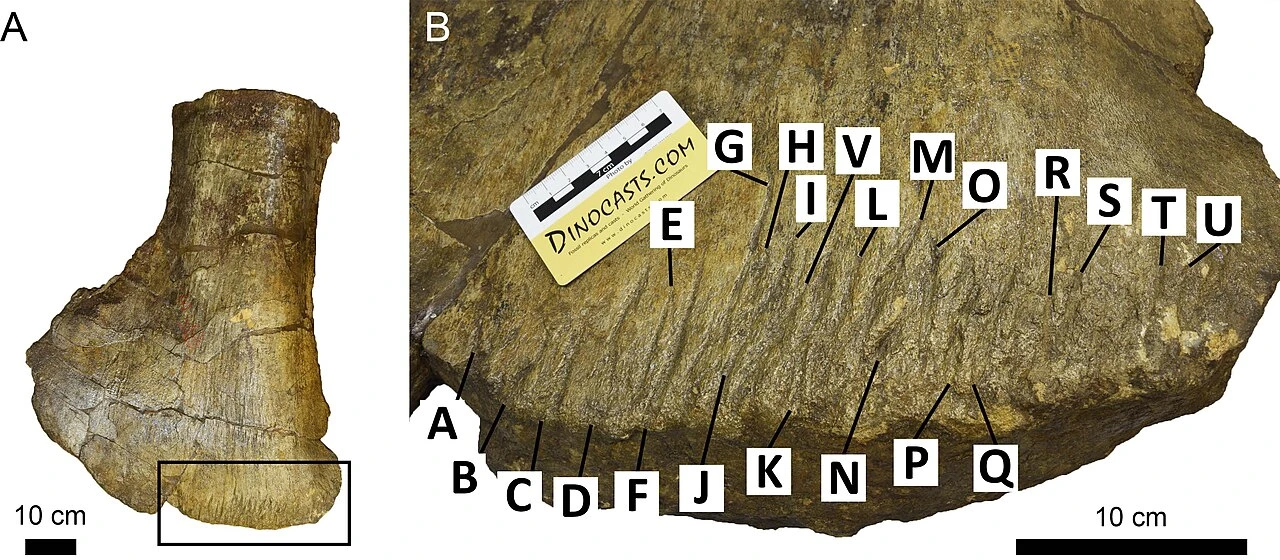
A discovery from 1898 shows that even large Camarasaurus animals were not safe. Deep grooves were found on several tail vertebrae of a large animal. Their pattern matches the teeth of a large carnivore. This is direct evidence of an attack. The find comes from a time when a different theory prevailed. Researchers at the time believed that sauropods, like alligators, lived mostly in water. This theory is now considered disproven.
The northernmost find of the Morrison Formation
In 2017, researchers described a partial skeleton from Montana. The site is located in the Little Snowy Mountains. It is the northernmost known sauropod find in the entire Morrison Formation. An examination of the bone revealed a surprise: despite its small size, the animal was an adult. This shows that size alone does not indicate age in sauropods.Woodruff & Foster 2017).
More information on this topic can be found at urzeittiere.net
Interested in the sauropods of the Morrison Formation? Then the article on [topic missing] is also worth reading. BrachiosaurusHe was the long-legged relative with the distinctive front leg overhang. There is also an article about brontosaurusIts naming history is closely linked to that of Camarasaurus. Also Plateosaurus It's worth a look. It was an older, smaller relative from the Triassic period. And then there's Cathetosaurus. The find is controversial. Perhaps it's just an old specimen of Camarasaurus grandis.
Image sources:
Size comparison: Gunnar Bivens, CC BY-SA 4.0, via Wikimedia Commons
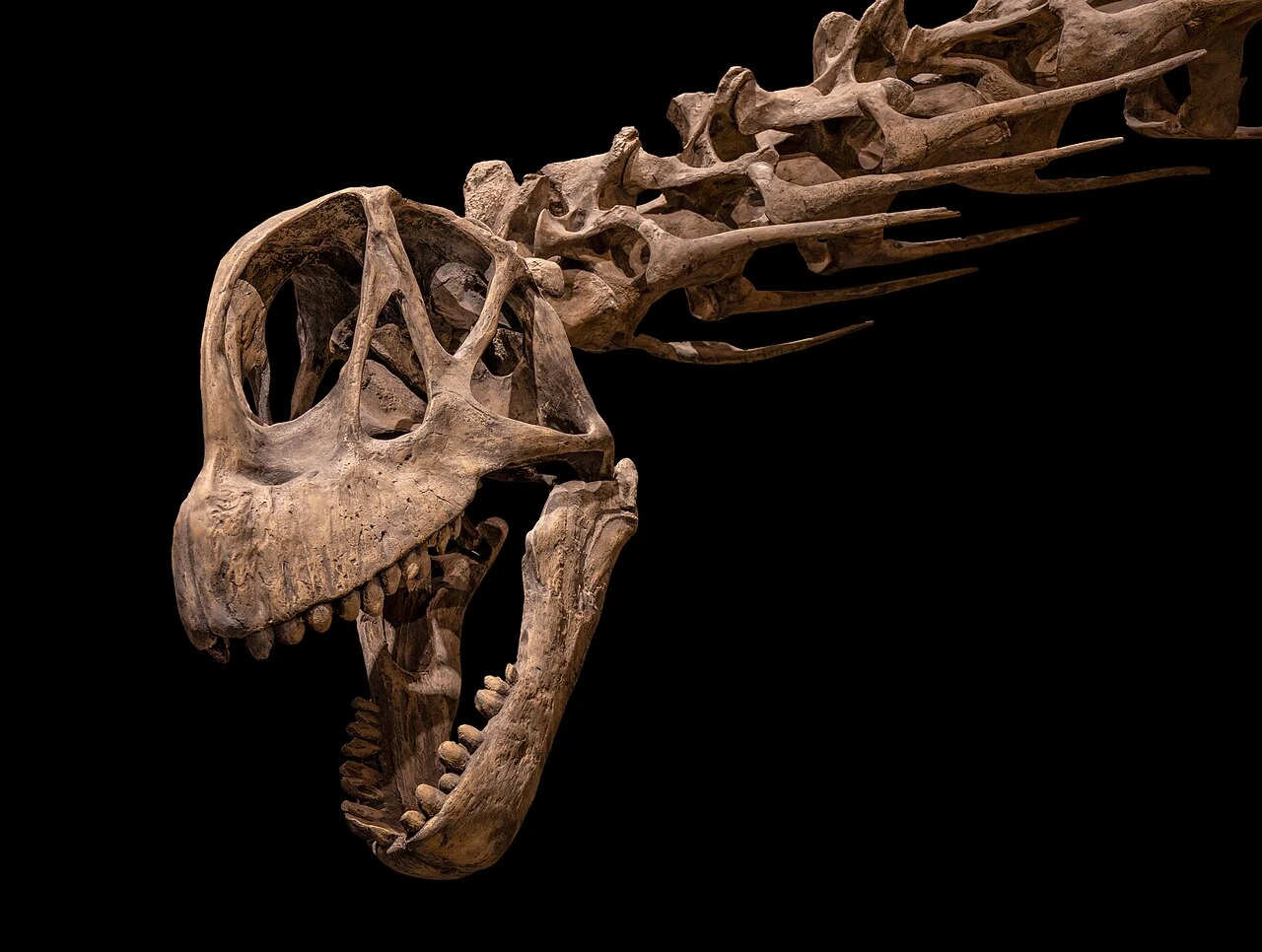
Skull of Camarasaurus supremus, Royal Tyrrell Museum: Chris Woodrich, CC BY-SA 4.0, via Wikimedia Commons
Bite marks on the shoulder blade of a Camarasaurus supremus. Specimen AMNH FARB 5760 sc-3: Roberto Lei, Emanuel Tschopp, Christophe Hendrickx, Mathew J. Wedel, Mark Norell, David WE Hone, CC BY 4.0, via Wikimedia Commons