Brachiosaurus: The most famous dinosaur, which is actually something else
Few long-necked dinosaurs are as famous. And yet, they are so often misrepresented. The first dinosaur image in "Jurassic Park" (1993). The Berlin museum skeleton. Most toy figures. They almost never show it at all. Brachiosaurus altithoraxThey show its relative from Africa: Giraffatitan. The real Brachiosaurus came solely from North America. It was one of the rarest giant dinosaurs of its time.
At a glance
| feature | Value |
|---|---|
| Length | approximately 18–22 m, in a conservative estimate up to 25 m |
| Weight | Approximately 23–47 tons for the known holotype, depending on the calculation method. |
| Location | Morrison Formation, especially near Fruita, Colorado; additional material from Utah, Oklahoma, and Wyoming |
| Era | Upper Jurassic, approximately 154–150 million years ago |
| Food | Herbivores, probably highbrowsers |
| Special feature | Significantly longer front legs than hind legs, giraffe-like body plan |
What did Brachiosaurus look like?
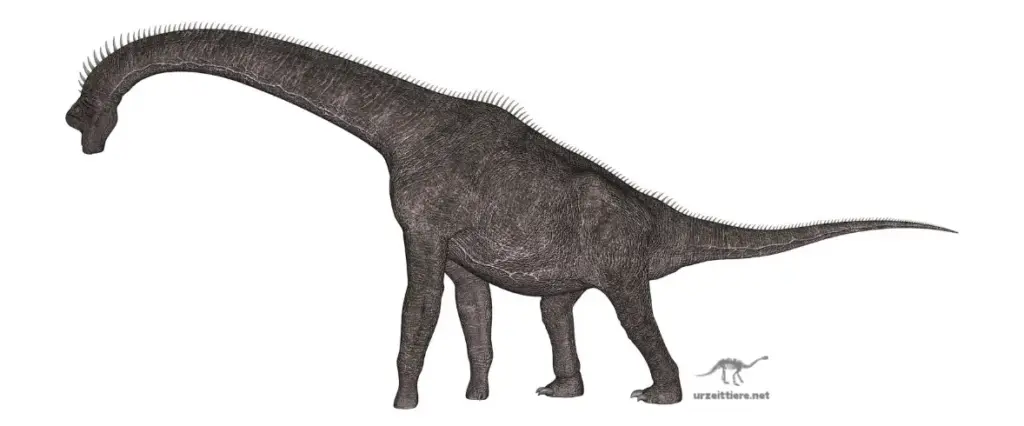
The name reveals its most striking feature. "Brachiosaurus" literally means "arm lizard" – from the Greek word for "arm lizard". brachion (Arm) and saûros ("Lizard"). The forelegs were significantly longer than the hind legs. The difference lies primarily in the long forearm. This resulted in a torso that sloped from the high shoulders to the low hips. The neck grew steeply from the body. The body plan is reminiscent of a giraffe – only many times larger.
The species name altithorax The term "high ribcage" describes a very deep, wide chest cavity. Large air sacs penetrated the vertebrae and ribs, similar to the respiratory system of modern birds. This noticeably reduced body density. As a result, the colossus became lighter than its volume would suggest.
At the shoulder joint, a bone called the coracoid points laterally instead of downwards. This likely means the arms were positioned slightly diagonally, not vertically beneath the body. In addition, there is a robust arm bone. Both of these factors suggest that the forelegs bore a larger portion of the body weight.
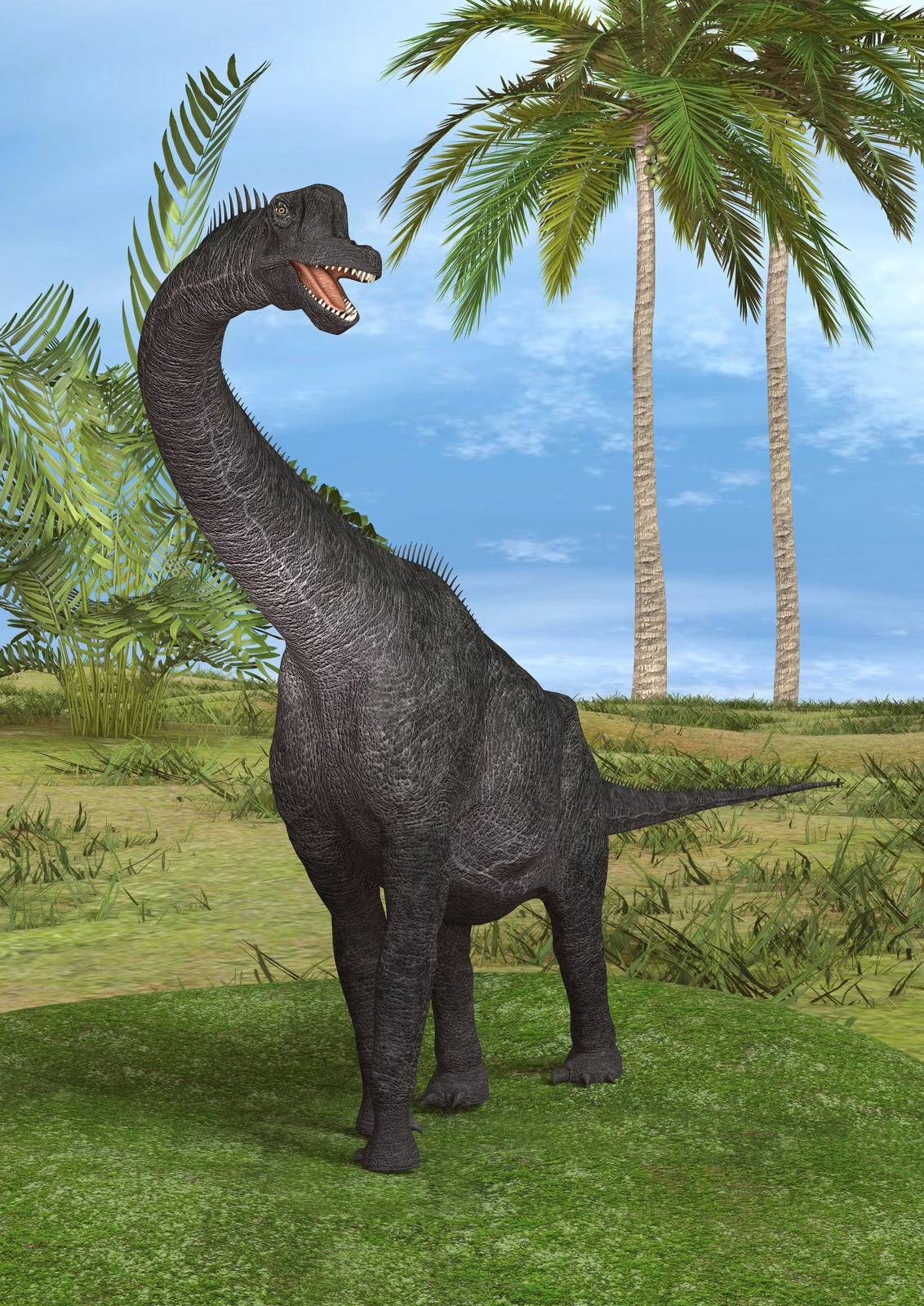
The skull is where things get uncertain. Many books and museums depict a highly domed skull with a prominent nasal arch. They attribute it to a Brachiosaurus. In fact, this skull comes from Giraffatitan in Tanzania. Whether the true Brachiosaurus from North America had the same skull structure is unclear. There is only one possible Brachiosaurus skull, USNM 5730 – and it differs in details. Its dentition consisted of spoon- to chisel-shaped teeth. These were used for plucking plants, not for chewing.
The Giraffatitan Trap: a name for two dinosaurs
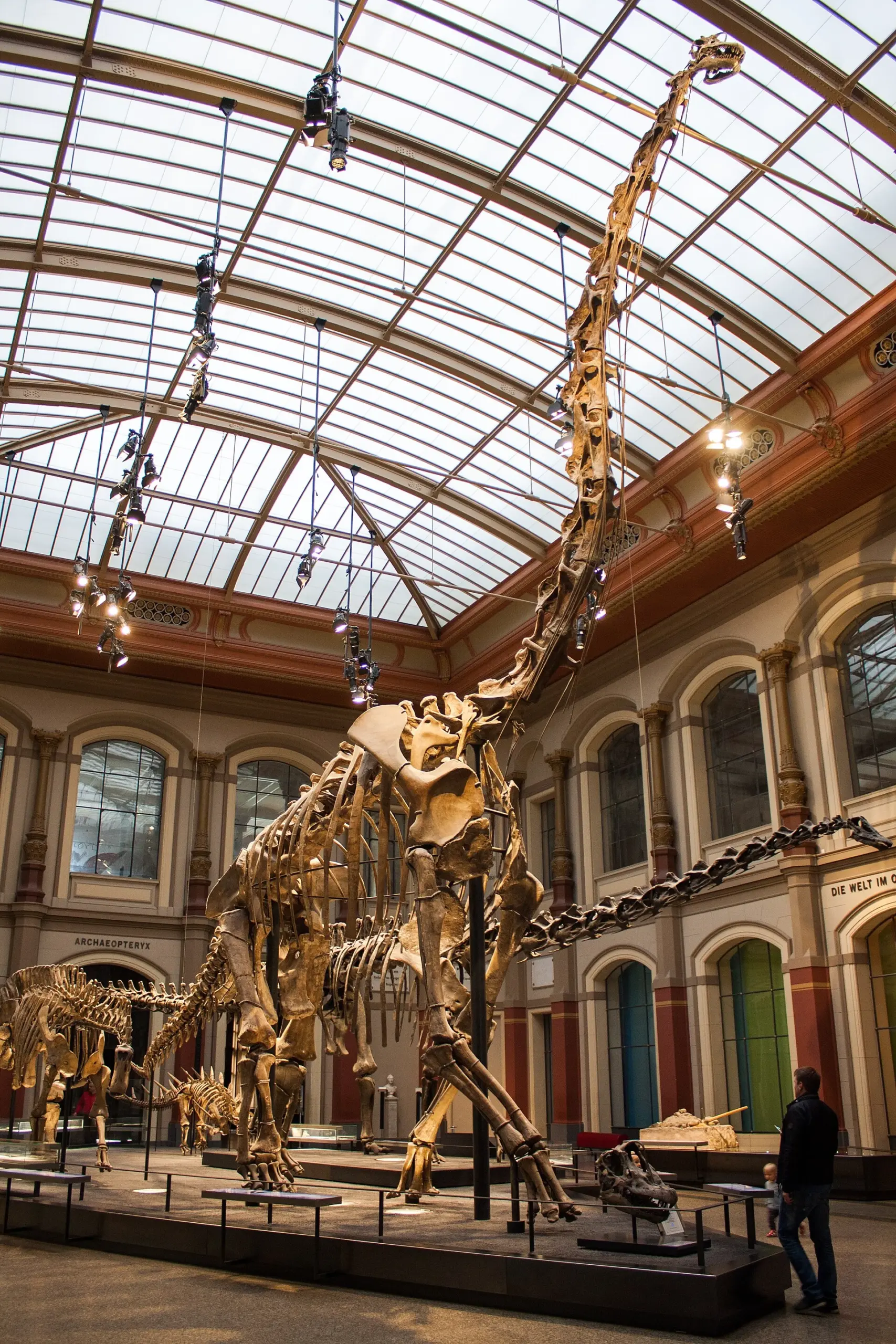
For over 90 years, there was only one "Brachiosaurus." However, it had two very different origins. Besides the B. altithorax A second animal from North America also went by this name: Brachiosaurus brancai from Tanzania, described in 1914 by the paleontologist Werner Janensch. This skeleton from Africa was much more complete. It was precisely this skeleton, housed in the Berlin Museum, that has shaped the image of "Brachiosaurus" to this day.
In 2009, researcher Michael P. Taylor debunked this conflation. In a study in Journal of Vertebrate Paleontology He found at least 26 anatomical differences between the two forms. That's a significant difference. Even between genera long recognized as distinct. brontosaurus and Barosaurus are less different. Taylor's conclusion: The animal from Africa needs its own name. Giraffatitan.
This fact has barely registered in the public consciousness. The famous skeleton in Berlin's Natural History Museum depicts Giraffatitan, not Brachiosaurus. Most standard size specifications also refer to the African animal. Even the digitally constructed dinosaur from "Jurassic Park" has a body structure similar to Giraffatitan.
How big was Brachiosaurus really?
Estimates for the weight of B. altithorax range from approximately 23 to 58 tons – deliberately not a single "correct" figure, but rather a range. Taylor's own calculation arrives at around 23 tons, a composite estimate from several studies ranges from 28 to 47 tons, and an extrapolation based on the circumference of the arm bones yields an uncertain upper limit of 56 to 58 tons. The reason for this wide range: To date, no complete skeleton of B. altithorax itself has been found. Only the dorsal vertebrae, sacrum, and two caudal vertebrae, along with one arm bone, one pelvic bone, and one femur, have been preserved from the holotype. The head, neck, and most of the leg bones are completely missing – any figure is therefore only an extrapolation from this fragmentary skeleton.
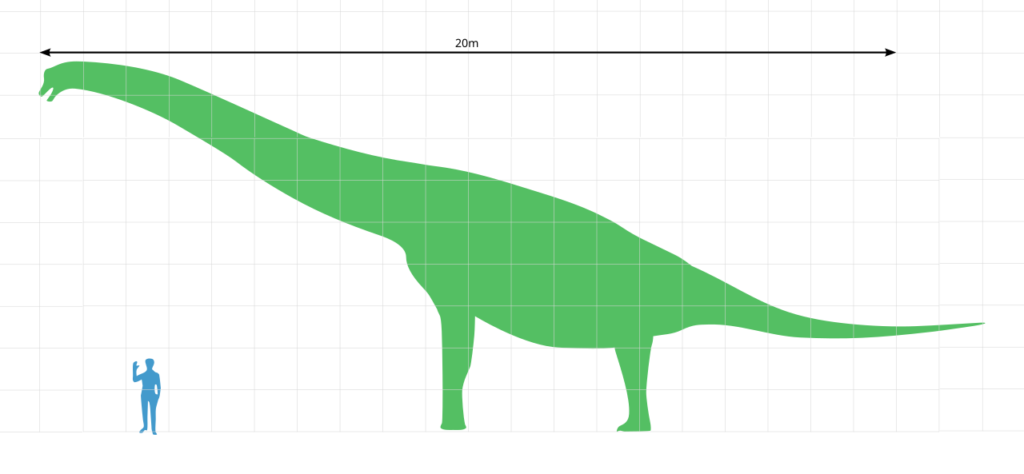
Brachiosaurus versus Brontosaurus: The closely related brontosaurus It comes from the same Morrison Formation. At up to 32 tons, it was similarly heavy. However, it had legs of roughly the same length at the front and rear, lacking the typical Brachiosaurus slant. Cretaceous titanosaurs, such as the still-unnamed find from Patagonia, were significantly larger. Evolution didn't reach the absolute record size among sauropods until about 80 million years later.
Even a supposed super-giant from Colorado actually belongs to this group: "Ultrasaurus macintoshi," presented as a separate species in 1985. As early as 1988, paleontologist Gregory S. Paul demonstrated, based on vertebral material, that the find fits in structure and size. B. altithorax and is not an independent giant.
A high-level browser with a leisurely pace
The shoulder was high, the neck rose steeply. This likely allowed Brachiosaurus to reach food above five meters. That was significantly higher than most other Morrison sauropods. Researchers interpret this as a kind of division of labor: each species preferred to feed at a different height.
He wasn't exactly traveling fast. Fan wikis often cite speeds around 16 km/h, but there's no evidence to support this. The only genuine academic study on the subject was published in 2025. The Physics Teacher. Their model shows a preferred walking speed of around 5.4 km/h – roughly the pace of a briskly walking person.
The design was also woefully unsuitable for standing upright on its hind legs. A computer model from 2011 showed that the center of gravity was too far forward. A bipedal stance would have provided hardly any additional height.
Habitat: a rare giant in the Morrison Formation
Brachiosaurus lived in an arid climate with distinct wet and dry seasons. The landscape consisted of floodplains and forests along the rivers. Vegetation included conifers, tree ferns, ginkgos, and cycads – readily available food for a high-brow scorpion.
Seltsam für ein so bekanntes Tier: Er war einer der seltensten Sauropoden seiner Zeit. Forschende werteten über 200 Fundstellen der Morrison-Formation aus. Das Ergebnis: gerade einmal zwölf Brachiosaurus-Exemplare. Camarasaurus dagegen lieferte 179 Funde, Apatosaurus Even 112. One possible reason: It preferred to feed on very tall conifers. Such trees were rather rare in the landscape.
Popular culture: the most famous dinosaur, who is actually someone else
The famous reveal scene in "Jurassic Park" (1993) shows the first fully computer-generated dinosaur in film history. Anatomically, the model is based on the African dinosaur, not on the real one. B. altithorax It looks different.
The confusion persists even with collectible figures. All of Schleich's "Brachiosaurus" models are more similar in build to Giraffatitan. This also applies to the latest model from 2024. In the survival game ARK: Survival Evolved Incidentally, it's not a base game pet, as many fan wikis claim. In fact, it only comes from the expansion "ARK Additions". In the video game Jurassic World Evolution It is officially playable. Its design is close to its appearance in the 1993 film.
In toy boxes and pictures, he is often depicted next to Tyrannosaurus rex. The two never met: Brachiosaurus lived around 150 million years ago, while T-Rex didn't appear until 80 million years later.
More information on this topic can be found at urzeittiere.net
- brontosaurus – also a giant sauropod from the Morrison Formation, but with a horizontal silhouette instead of the typical Brachiosaurus slant.
Image sources:
Size comparison: Matt Martyniuk and User:Dhatfield, converted to SVG and altered (to incorporate the proportions of Scott Hartman's skeletal) by Slate Weasel, CC BY-SA 3.0, via Wikimedia Commons
The Giraffatitan brancai exhibited in the Museum of Natural History in Berlin: Shadowgate from Novara, ITALY, CC BY 2.0, via Wikimedia Commons