Alamosaurus
Description of physical characteristics of Alamosaurus
Alamosaurus was a giant quadrupedal herbivore from the sauropod group known for its immense size and long neck. This dinosaur had a long tail and limbs with thick, powerful legs to support its weight. Despite its massive body, Alamosaurus only had a small head.
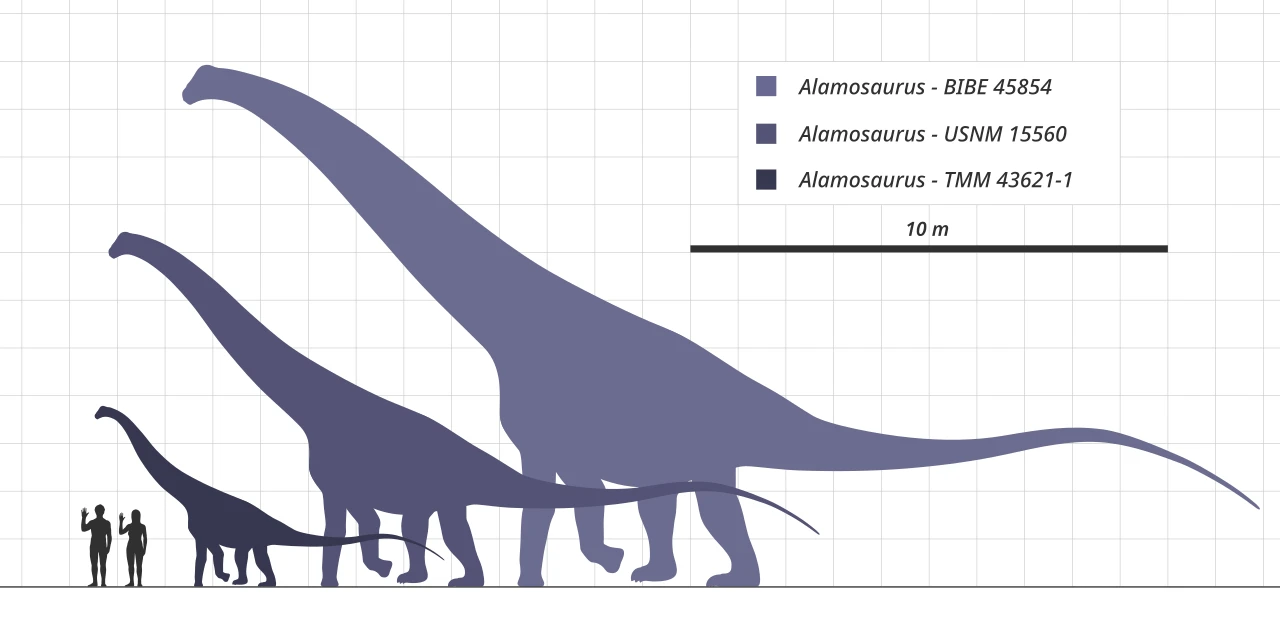
Adult Alamosaurus reached lengths of about 26 meters (85 feet), although there is evidence that some grew up to 30 meters (98 feet). It was about 5 meters (16 feet) high at the shoulder. The weight of known adult specimens is estimated at 30 to 35 tons, but some scientists estimate a much higher weight of 72.5 to 80 tons. These different estimates suggest that many Alamosaurus fossils may represent younger or smaller adults, and fully grown specimens may have been even more massive.
Recent research confirms that Alamosaurus had bony armor in the form of Osteoderms possessed that were embedded in his skin. This peculiarity contributes to our knowledge of its body structure and possible defense mechanisms.
Special features of Alamosaurus
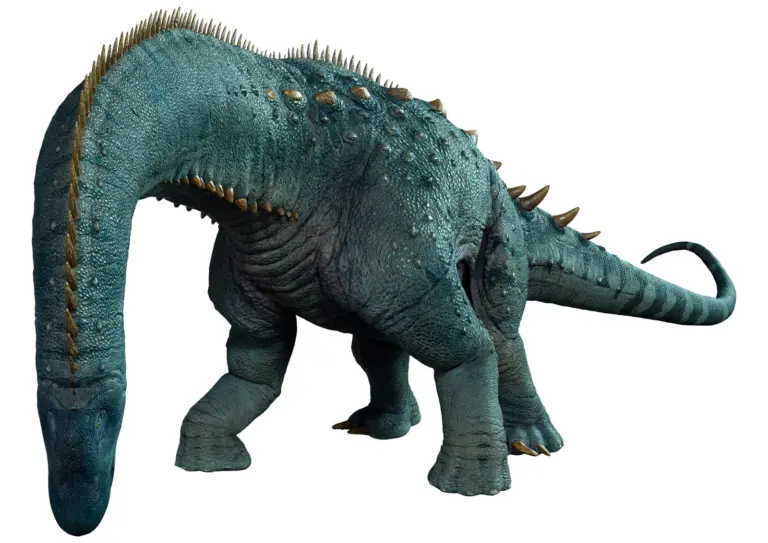
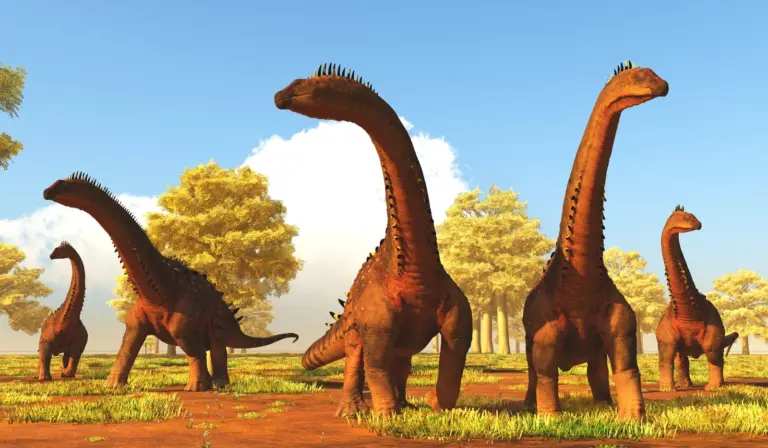
In addition to its size, Alamosaurus had several other notable features. The osteoderms, discovered in 2015, were bulbous and root-shaped and consisted of large spines along the shoulders, back and tail, as well as plate-like elements in the upper neck. These structures likely served multiple purposes, including defense against predators (particularly in younger individuals), storage of minerals for harsh environments, or as visual indicators of health.
A complete Alamosaurus skull has never been found, which is a common challenge in sauropod research. However, the rod-shaped teeth found along with Alamosaurus skeletons suggest a diet that focused on stripping vegetation. The mid-tail vertebrae had elongated centers, and like other titanosaurs, Alamosaurus had shallow depressions on the sides of its vertebrae called lateral fossae.
An important discovery in Big Bend National Park revealed articulated cervical vertebrae (cervical vertebrae), which provided previously unknown insights into the anatomy of the Alamosaurus neck. These bones had one somphospondylic Internal structure which is characterized by numerous air chambers. Similar to other titanosaurs, Alamosaurus had no claws on its front feet.
Detailed analysis of the cervical vertebrae has led to new theories about the evolutionary relationships of Alamosaurus, possibly linking it to South American titanosaurs known for their robust necks.
somphospondylic internal structure
A somphospondylic internal structure refers to a specific bone structure in the vertebrae of certain dinosaurs, especially sauropods from the group of Somphospondyli (e.g. titanosaurs). This structure is characterized by the following features:
Chamber-like structure: The vertebral bones contain numerous cavities (pneumatization) that are separated from each other by thin bone lamellae.
Lightness and stability: This sponge-like pattern means that the bone remains stable, but becomes significantly lighter - an adaptation to the enormous body size of these animals.
Histological peculiarity: The bone substance shows a combination of fibrous and lamellar structure, which indicates rapid growth and high biomechanical resilience.
This structure is a key feature of the Somphospondyli clade and distinguishes it from other dinosaur groups.
Gigantic built
The anatomy of Alamosaurus was a marvel of biological engineering. Adapted to support its immense weight and herbivorous lifestyle. Discover its key physical characteristics, from its protective armor to the specialized tools it used to feed.
The Colossal Form
As a four-legged sauropod, Alamosaurus had a gigantic build. It had the classic titanosaur build: a very long neck and a long, whip-like tail, which balanced each other out. Its four limbs were exceptionally thick and pillar-like, essential for supporting a body weighing many tons. Despite its overall size, its head was proportionally small, a common trait in sauropods. The entire skeleton was a framework of strength, designed to support one of the largest land animals of all time.
Armor and bones
One of its most notable features was the presence of osteoderms - bony plates embedded in the skin. These probably served as armor and provided protection from predators such as Tyrannosaurus, especially for younger individuals. Theories also suggest that they could have been used for mineral storage or for display.
Its skeleton had unique features, including shallow depressions (fossae) on its vertebrae and internal air cavities in its neck bones, which helped reduce weight without compromising strength. This pneumatic system was a key adaptation to managing such a long neck.
A specialized feeder
A complete skull has never been found, but associated fossil teeth give us important clues about its diet. The teeth were slender and rod-shaped, not designed for chewing. Instead, Alamosaurus would have used it like a rake to strip leaves and needles from tall branches of conifers, ferns, and cycads. To process this tough plant material, it probably swallowed stones (gastroliths), which crushed the food in a muscular stomach.
Discovery and naming
The first Alamosaurus fossils were discovered in 1922 by paleontologist Charles W. Gilmore in the Ojo Alamo Formation in San Juan County, New Mexico. This discovery was significant because it provided the first evidence that sauropod dinosaurs had survived in North America until the Late Cretaceous.
The name “Alamosaurus” comes from the Ojo Alamo Trading Post (or Cottonwood Spring), near the first fossil finds, and means “Ojo Alamo lizard.” This name directly connects the dinosaur with where it was found.
Since then, additional Alamosaurus fossils have been found in the southwestern United States and Mexico. Notable finds include parts of the pelvis and an impressive set of interconnected cervical vertebrae of a huge individual, estimated to be about 30 meters long, in Big Bend National Park in Texas. Fossils have also been found in the North Horn Formation in Utah and Wyoming. An incomplete tibia found in Mexico suggests an exceptionally large individual.
The geographical distribution of these fossils shows that Alamosaurus was an important part of the Late Cretaceous fauna in this region. Its status as the only known sauropod in North America during this period, after a long period of absence of sauropods from the continent's fossil record, indicates an important chapter in dinosaur evolution and biogeography.
Nutrition
Alamosaurus was a dinosaur that ate only plants.
During the Late Cretaceous, the landscape was populated by ferns, conifers and cycads, which probably formed the main part of its diet. Some evidence suggests that it may have also eaten soft, leafy plants.
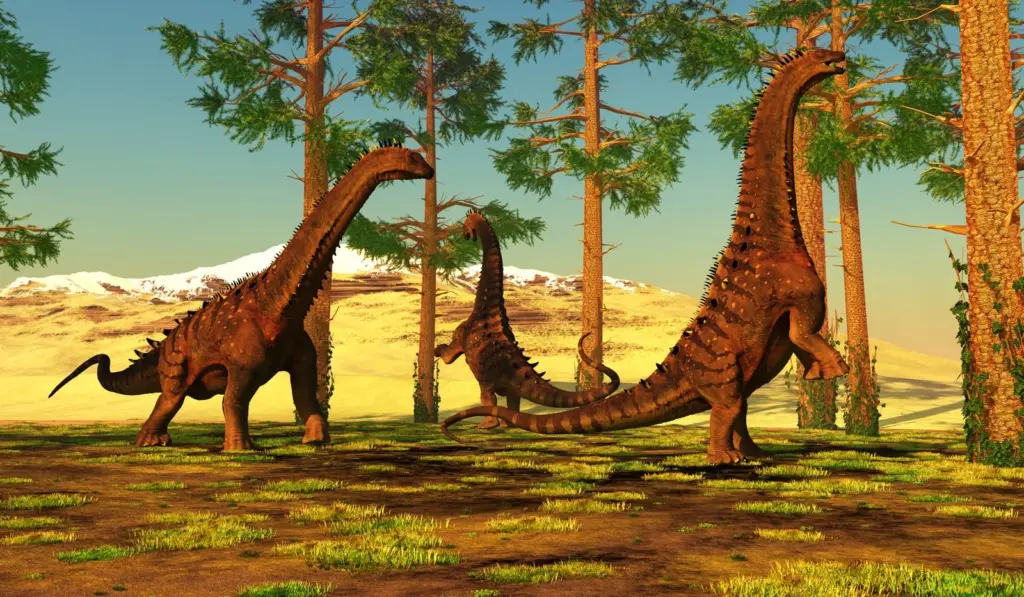
Its exceptionally long neck, which could reach up to 30 feet (9 meters) long, allowed Alamosaurus to forage for vegetation high in the trees, reaching food sources inaccessible to many other herbivores. The cone-shaped or rod-shaped teeth were more suitable for biting and stripping leaves and twigs than for chewing.
The discovery of Gastroliths, i.e. polished stones, in the abdominal cavities of some skeletons supports the assumption that Alamosaurus consumed tough plant substances. These stones were intentionally swallowed to break down the tough plant fibers in the muscular gizzard. This adjustment was for the efficient digestion of large quantities of plant food essential, especially given its relatively small and unspecialized teeth.
Classification of Alamosaurus
Alamosaurus belongs to the order Sauropoda, which is characterized by its immense size, long necks and quadrupedal stance. More specifically, it is classified in the suborder Titanosauria, the most diverse and numerous group of sauropods during the Cretaceous period. Within the Titanosauria, Alamosaurus is often assigned to the family Saltasauridae or Titanosauridae.
One of the most notable aspects of Alamosaurus' classification is its status as only known sauropod, which occurred during the Maastrichtian period late Cretaceous, about 70 to 66 million years ago, lived in North America.
This is significant because sauropods were largely absent from the North American fossil record for nearly 30 million years before the appearance of Alamosaurus.
Based on this, it can be assumed that a significant event occurred, possibly a migration from South America, where titanosaurs were far more abundant during the Late Cretaceous.
A fall in global sea levels near the end of the Cretaceous period may have created land bridges or altered migration routes, allowing the ancestors of Alamosaurus to reach North America.
The exact evolutionary relationships of Alamosaurus to other titanosaurs are still being investigated. Due to its size, it is often compared to giants such as Argentinosaurus and Puertasaurus. Various analyzes have suggested different classifications for Alamosaurus within the Titanosauria group. Some studies suggest a close relationship with Opisthocoelicaudia, while others classify it as a sister taxon to Pellegrinisaurus. Recent research based on cervical vertebrae morphology has even suggested a connection to the South American Lognkosauria clade, which includes massive titanosaurs such as Futalognkosaurus and Mendozasaurus.
Paleobiology
Although direct evidence of Alamosaurus' behavior only exists in the form of fossils, scientists can deduce certain aspects of its life based on its anatomy and comparisons with other dinosaurs. It likely lived in herds, a common social strategy among large herbivorous dinosaurs. Living in groups provided protection from predators, especially for vulnerable young animals.
Studies of the bone histology of Alamosaurus suggest a long lifespan of at least 70 years. It may also have undergone a longer growth period, gaining up to 1,000 kg per year and taking several decades to reach its full size. A 2009 study of a large femur found that the individual was still growing at the time of death.
This would mean that the maximum size of Alamosaurus may have been underestimated.
This combination of long lifespan and prolonged growth is typical of very large animals.
During the Late Cretaceous, Alamosaurus shared its habitat with fearsome predators, including Tyrannosaurus rex. While the size of adult Alamosaurus would likely have repelled most attacks, Young animals were more vulnerable to predators. The presence of osteoderms may have provided an additional line of defense, particularly for younger individuals.
Studies of bone histology and microanatomy have provided details about its growth patterns, the presence of extensive pneumatic ribs (filled with air sacs), and an early onset of the secondary bone reconstruction, in which older bone tissue is replaced by new tissue.
Paleoenvironment
Alamosaurus lived during the Maastrichtian period in the late Cretaceous period, about 70 to 66 million years ago. Its habitat included what is now southwestern North America, with fossils found in New Mexico, Texas, Utah and possibly Wyoming.
The climate during the Late Cretaceous was generally warm, although cooling occurred towards the end of the period. Geographically, the continents were moving closer to their present positions, but sea levels were higher, creating inland seas like the Western Interior Seaway originated in North America. The Big Bend region of Texas, where many Alamosaurus fossils have been found, was characterized by a fluvial and floodplain region with rivers, floodplains and isolated lakes.
The flora of this time included older plants such as ferns and conifers as well as flowering plants and grasses. Alamosaurus shared its habitat with various other dinosaurs, including tyrannosaurs, hadrosaurs, ceratopsians, ankylosaurs, and dromaeosaurs. Marine reptiles such as mosasaurs and plesiosaurs populated the seas, while pterosaurs and early birds flew through the skies.
The appearance of Alamosaurus in North America after a long absence of sauropods suggests a possible migration from South America. Titanosaurs were abundant in South America during the Late Cretaceous, and a fall in sea levels toward the end of this period may have allowed the ancestors of Alamosaurus to migrate north. Alamosaurus was one of the last non-avian dinosaurs in North America and lived until Mass extinction of the Cretaceous-Paleogene boundary, which marked the end of the Mesozoic.
Alamosaurus is a testament to the incredible diversity and immense scale of the dinosaurs that once populated our planet. As one of the largest land animals to have ever lived and the last known sauropod in North America, its existence offers a unique insight into the final chapter of the age of dinosaurs in this part of the world. Ongoing research and future discoveries will continue to reveal more about this giant and expand our understanding of prehistoric life.
Want to learn more about other dinosaurs that populated the world of Alamosaurus? Discover in our others Dinosaur profiles the diverse ecosystem of the Late Cretaceous.
Image sources:
Size comparison: Steveoc 86 and Scott Hartman, CC BY-SA 3.0, via Wikimedia Commons