Plateosaurus
Swabian lindworm
Plateosaurus: The dinosaur that lost its own name
In 1834, the collector Johann Friedrich Engelhardt unearthed the first bones in a clay pit near Nuremberg. It was the first dinosaur discovery on German soil. Three years later, the animal received its name: Plateosaurus engelhardti, in honor of the finder. Almost 200 years later, in 2019, an international panel of experts made a decision: The old name has since been abolished. It was replaced by a new name, Plateosaurus trossingensis – named after a completely different discovery site.
At a glance
| feature | Value |
|---|---|
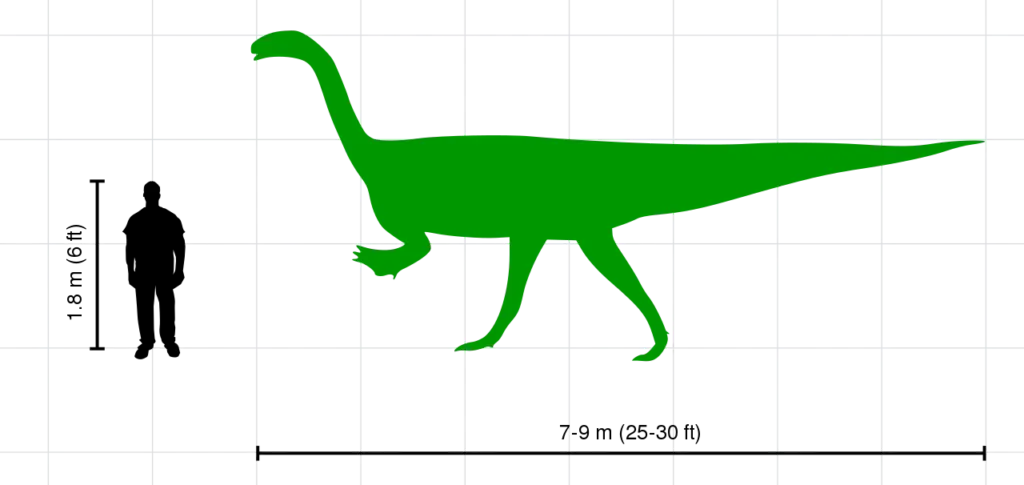
| length | adult animals 4.8–10 meters |
| Weight | approx. 600–1,000 kg |
| Location | Germany (Trossingen, Halberstadt) and Switzerland (Frick) |
| age | Late Triassic, about 210 million years ago |
| Food | herbivores |
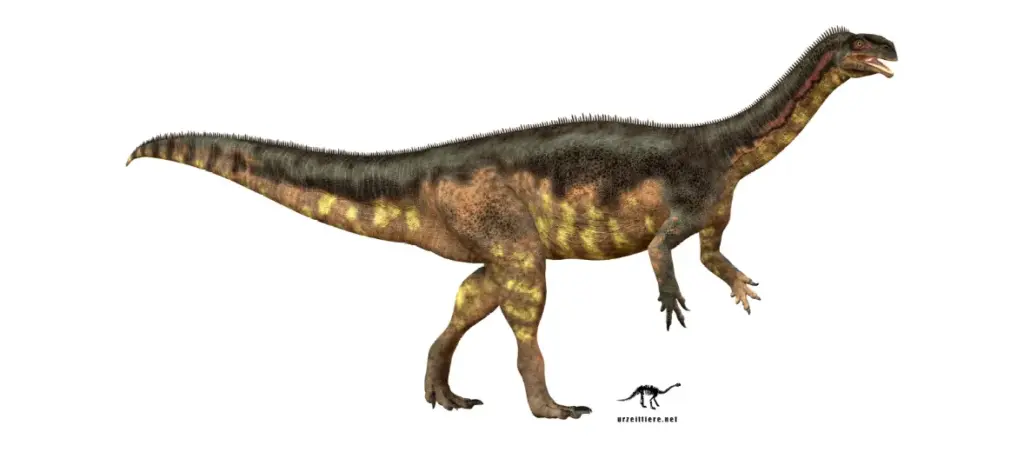
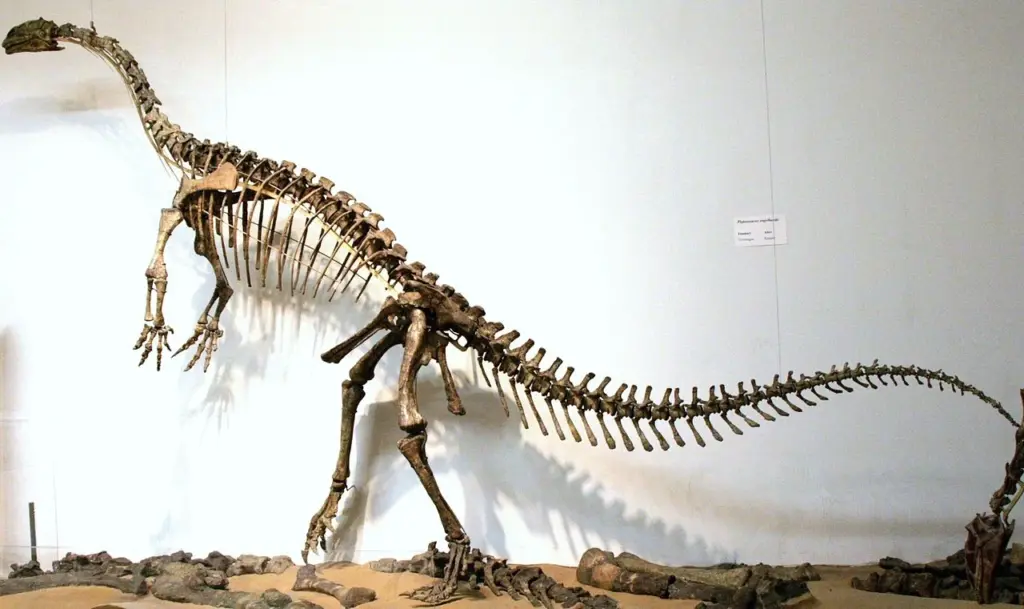
A fully grown Plateosaurus was up to ten meters long. It weighed up to 1,000 kilograms – as heavy as a large domestic cow. It walked on two powerful hind legs. His arms appear strong on museum skeletons, but barely extended beyond his shoulders.They were too short for true four-legged locomotion. It is one of the early representatives of the Sauropodomorpha. The much larger, long-necked sauropods later evolved from this group.
Why is his name suddenly different today?
The name Plateosaurus engelhardti (German name: Swabian lindwormThe genus name persisted for over a century and a half. However, the very first find from 1834 was too incomplete. It could not be definitively assigned to a specific species. Experts call this a "nomen dubium," a doubtful name. In 2012, paleontologist Peter Galton therefore submitted a proposal to the International Commission on Zoological Nomenclature (ICZN). His goal: to change the reference point for the genus. The commission made its decision in 2019. Plateosaurus trossingensis It became the new type species. This name dates back to 1913, named after fossils found in Trossingen. In practical terms, this means that almost all known fossil material bore this name for decades. P. engelhardtiToday it correctly bears the name P. trossingensis.
confirmed in 2021 a large study This finding. She examined 18 skulls from three different sites. One result: There is no evidence for more than one species in this material. Only one exception remains certain: the significantly rarer second species. Plateosaurus gracilisIt can be identified by a unique, clearly distinguishable feature on the skull.
Three mass cemeteries and a mysterious death
Few other dinosaurs are as well documented as this one. The reason: three major fossil sites. Two of them are in Germany, in Trossingen and Halberstadt. The third is in the Swiss canton of Aargau, near Frick. Around 80 nearly complete skeletons come from Trossingen. From Halberstadt, there are between 39 and 50. From Frick, over 40 skeletons have been found. Excavations have continued at the "Gruhalde" clay pit near Frick since 1976.
At all three sites, the skeletons lie in a strikingly similar position: on their bellies, the forebody twisted, the arms spread out to the sides. The hind legs appear bent. Experts informally call this the "frog-kick position." It is considered evidence for the sinking hypothesis. According to this hypothesis, the animals became stuck individually in muddy pools of water in a seasonally dry floodplain. They perished while trying to force their way out with their legs. Whether the numerous finds at the same location indicate a herd-like lifestyle is a matter of debate among experts. Recurring water sources could also have attracted many individual animals over long periods, entirely without herd behavior.
A tail as a defensive weapon?
It possessed neither armor plates nor horns. Against carnivores like the smaller Liliensternus, it was practically defenseless. This is precisely what makes a skeleton from Frick so interesting. It was examined in 2025 and has an almost completely preserved tail. This tail consisted of around 45 vertebrae. It made up about 45 percent of the total body length. It was very flexible laterally, similar to a whip.
A research team calculated the energy of a lateral tail lash based on vertebral mass. A rapid whiplash of the tail tip alone would generate up to 1.6 kilojoules. This is comparable to the defensive strikes of modern monitor lizards and green iguanas. The entire tail, swung horizontally, could even release up to 174 kilojoules. However, this does not prove that the lizard serves as a defensive function. The researchers themselves call their idea a plausible but unproven hypothesis. Direct signs of combat are still lacking.
From egg to giant – without a fixed timetable
For a long time, it was nearly impossible to predict how quickly an individual animal would grow. Some animals reached skeletal maturity as early as eleven years old. Others needed 21 to 25 years. In the end, they still grew to different sizes. Experts call this plasticity in development. This characteristic is otherwise more commonly associated with cold-blooded animals.
What a very young animal looked like remained unknown for a long time. That only changed with a discovery from Frick.A juvenile skeleton nicknamed "Fabian" was discovered. It measured only about 2.3 meters and weighed an estimated 40 kilograms. What was particularly surprising was how closely it already resembled a small adult. Only its neck was relatively longer, and its hand somewhat larger. Apparently, it had already acquired its basic form very early in life – long before it reached its full size.
Injuries and a severe bone infection
With so many preserved skeletons, one thing is surprising: traces of disease and injury have rarely been documented. Two recent finds change that. In two individuals from Trossingen, three tail vertebrae each show clear signs of healing. Overall, 14.8 percent of all animals examined showed such damage.Possible causes include a fall, tail dragging in the mud, or even a botched attack. Both animals survived their injuries.
A skeleton from Frick, recovered in 2018, presents a far more dramatic picture. Now nicknamed "Teoplati," it is housed in the Natural History Museum of the University of Zurich. At approximately 7.7 meters in length, it is one of the largest known animals from Frick. The animal died at the age of about 23 to 25 years. It apparently lived for a long time with a severe, chronic bone infection – in its right shoulder blade and humerus. The research group considers this one of the most severe known cases involving dinosaurs.The restriction in its arm may even have been fatal for the animal. It could have prevented it from freeing itself from a mud trap. Such traps are considered the cause of death in the three mass graveyards found elsewhere.
Robust and slim types – a gender difference?
Researchers measured the arm and forearm bones of numerous individuals in 3D.Two recurring shape types were observed in the radius and ulna: one more robust and one significantly slimmer. In other dinosaurs, such patterns are often interpreted as differences between the sexes. However, this has not yet been confirmed in this case. A targeted examination of the bone tissue found no corresponding differences. Whether these are males and females, two age groups, or simply normal variations between individual animals remains unclear.
Image sources: Dropzink, modified my FunkMonk and Dinoguy2Vector version byGYassineMrabetTalk✉ This W3C-unspecified vector image was created with Inkscape., CC BY 3.0 https://creativecommons.org/licenses/by/3.0, via Wikimedia Commons
Plateosaurus skeleton: FunkMonk, CC BY-SA 3.0 https://creativecommons.org/licenses/by-sa/3.0, via Wikimedia Commons