
Apatosaurus
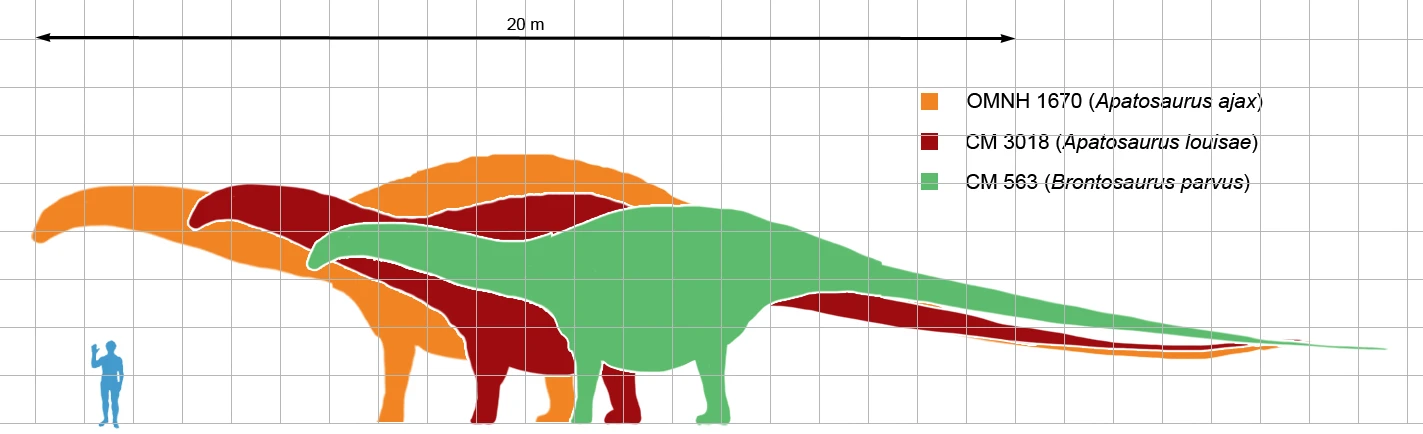
23 meters long, weighing up to 33 tons: Apatosaurus is one of the largest land animals of all time. That's as much as five or six elephants combined. Despite this, its name is still often mistranslated. And it is frequently confused with its most famous relative.
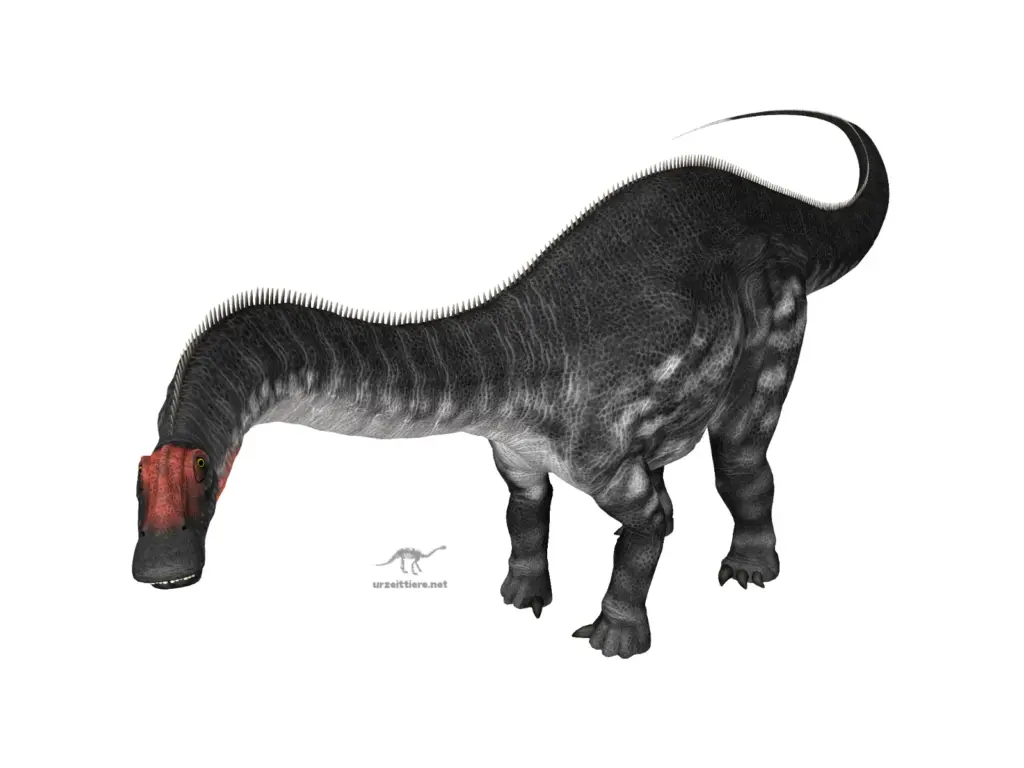
At a glance
| feature | Value |
|---|---|
| genus | Apatosaurus |
| species | 2 confirmed species: Apatosaurus ajax (type species), Apatosaurus louisae |
| length | 21–23 m, large specimens up to 30 m |
| Weight | 16.4–22.4 t, large specimens up to 33 t |
| Location | USA: Colorado, Utah, Wyoming, Oklahoma |
| formation | Morrison Formation |
| age | Upper Jurassic, about 150–155 million years ago |
| Nutrition | herbivores |
| Family | Diplodocidae, subfamily Apatosaurinae |
What is the German name for Apatosaurus?
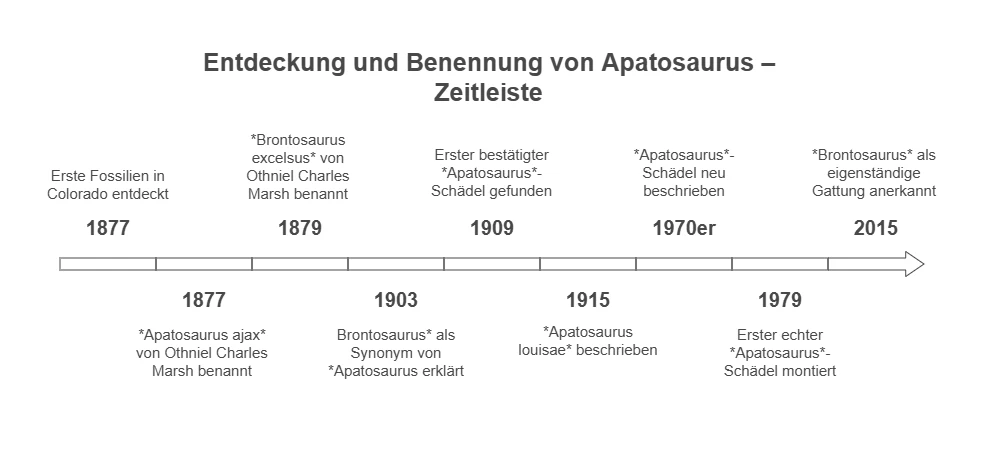
„Deceptive lizard“– not “headless lizard”, as is sometimes written. Othniel Charles Marsh gave the animal this name in 1877. The reason: The tail bones deceived him. They resembled those of mosasaurs, not those of other dinosaurs (en.wikipedia.org/wiki/Apatosaurus).
The name has nothing to do with a missing head. The confusion likely stems from a different, but equally true, story. The world's most famous Apatosaurus skeleton did indeed have the wrong head for decades. More on that below.
A body for records
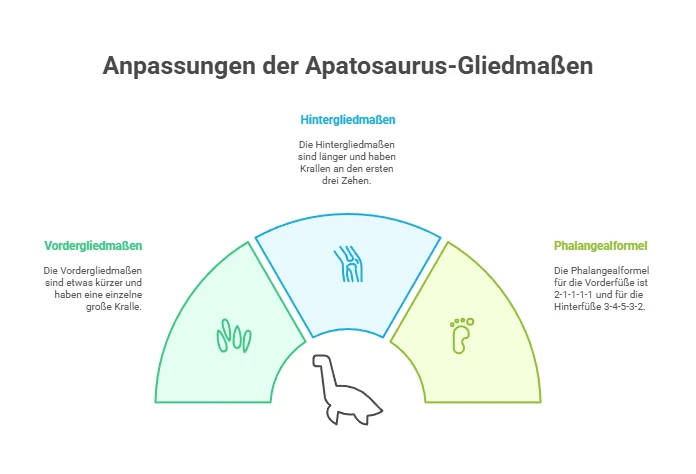
A tiny head gave way to an extremely long neck. The torso rested on four pillar-like legs. Behind it whipped a long tail. The forelegs were slightly shorter than the hind legs. A single large claw sat on the front foot, while the hind foot had three.
Such a colossus needed lightweight construction. The cervical and torso vertebrae consisted of over 60 percent air. Air sacs permeated them, much like those in modern birds.
This trick is almost entirely absent only in the tail. That's precisely where weight savings would have been mechanically advantageous. Researchers found only isolated air chambers there, interspersed with long gaps of completely air-free vortices (Wedel & Taylor, 2013Why this is the case remains a mystery to this day.
Spatula-shaped teeth tore off tough plant material instead of chewing it. They grew continuously. An Apatosaurus likely consumed over a ton of plants daily. It foraged at heights of up to 5 meters above the ground. Elephant-like toe pads and a heart-shaped ribcage confirm that the animal lived on land, not in swamps, as earlier theories suggested.
Why did the museum skeleton have the wrong head for 70 years?
In 1915, the Carnegie Museum in Pittsburgh mounted its Apatosaurus louisae skeleton. Completely headless: a suitable skull had never been found. In 1932, the figure finally received a head. It was a short, blunt-snouted skull in the style of... Camarasaurus – in line with the prevailing expert opinion at the time.
Museum director William Holland had his doubts even during his lifetime. He believed a slimmer skull was correct. After his death, however, the museum disregarded his opinion.
It wasn't until 1978 that paleontologists David Berman and Jack McIntosh revisited the question. They again argued for the slender skull type. A discovery confirmed their view: a skull-neck unit still fused together. In 1979, the skeleton finally received its correct head – more than seven decades after its discovery (Carnegie Museum of Natural History).

Apatosaurus and Brontosaurus: one genus or two?
In 1903, a team of researchers declared the name Brontosaurus invalid. They argued it was merely a synonym for Apatosaurus, whose name had been assigned two years earlier. This remained the official doctrine for over seven decades.
The turning point came in 2015. A large comparative study by Tschopp, Mateus, and Benson found enough anatomical differences. Since then, the following has been true: brontosaurus again as a separate genre (Tschopp et al. 2015, PeerJ). Both genera remain closely related nonetheless: Apatosaurus had a significantly more robust, more massive neck.
Life in the Morrison Formation
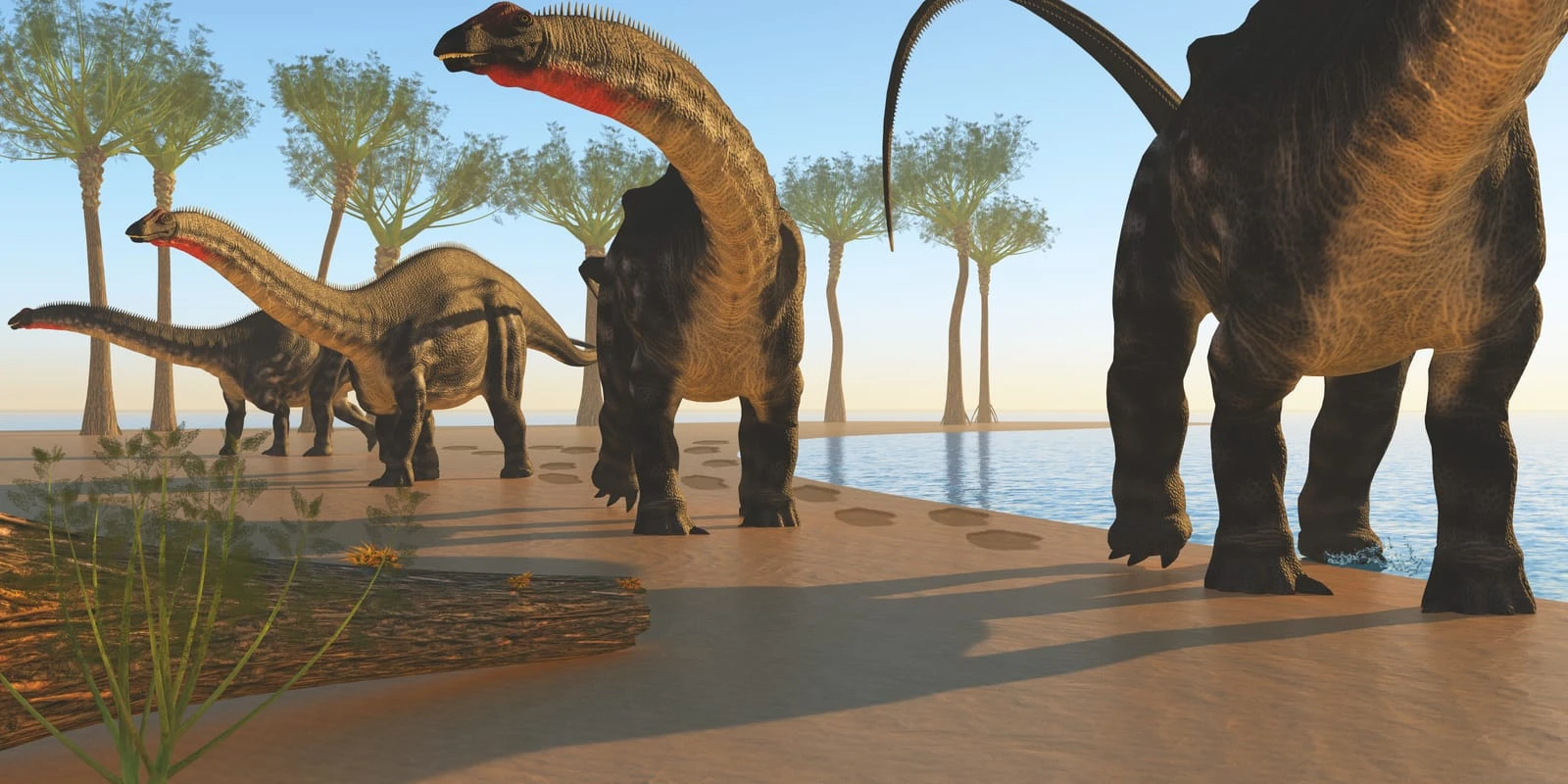
Apatosaurus lived 150 to 155 million years ago in what is now the western United States. The landscape consisted of rivers, seasonal flooding, and conifers, cycads, and ferns. Fossil tracks show several animals running in the same direction, suggesting a herd-like lifestyle – providing protection from predators like Allosaurus. Young animals grew rapidly, reaching their full size in just 10 to 15 years.
More information on this topic can be found at urzeittiere.net
Interested in the giants of the Morrison Formation? Then the article on... is worth reading. brontosaurusFor almost a century, it was considered a mere doppelganger of Apatosaurus. (See also the article on...) Brachiosaurus It fits well. It shared the same habitat, but carried its back inclined like a giraffe instead of horizontally. And for those who want to know which type of skull was mounted on Apatosaurus skeletons for decades: The answer can be found in the article about Camarasaurus.
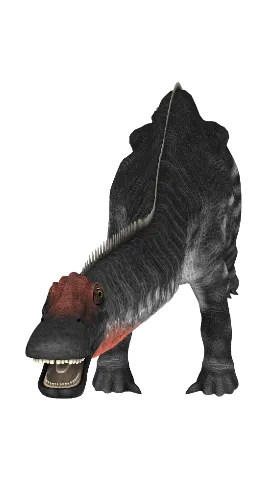
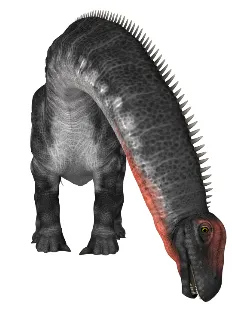
Apatosaurus was an example of the extreme size that land creatures could reach. These sauropods reached a length of 21 to 23 meters and a weight of 16.4 to 22.4 tons. Larger specimens were up to 30 meters long and weighed up to 33 tons. The animal's physique was characterized by a small head on an extremely long neck, a massive torso supported by four column-like legs, and an elongated tail.
TL;DR Quick info about Apatosaurus
Apatosaurus
| scientific name | Apatosaurus ajax |
| Estimated size | Length: 21–23 meters Height: 5 meters Weight: 16.4–22.4 tons |
| geological era | Upper Jurassic |
| Locations | Morrison |
| Order | Saurischia |
| Subordination | Sauropodomorpha |
Physical characteristics
| anatomy | Very large, massive sauropod with a long neck, long tail and four columnar legs |
| Special features | Long whip-like tail, bony plates on back and tail, very robust build |
| locomotion | Four-legged |
| Skin texture | Probably thick, leathery skin like other sauropods (direct evidence is lacking, but likely) |
| Coloring | Unknown; probably earthy, inconspicuous tones for camouflage (speculation) |
discovery
| Explorer | Marsh |
| Discovery date | 1877 |
| Meaning of the name | Deceptive lizard |
| Significant fossil finds | At least one partial skeleton with a fragmentary skull. |
In paleontology, the ratio of brain to body size, the so-called Encephalization quotient (EQ), used as a rough guide to relative intelligence.
| Intelligence (EQ) | Very low, EQ about 0.5 (typical for sauropods) |
| Social behavior | Probably lived in herds to protect themselves from predators |
| Predators | Large predatory dinosaurs such as Allosaurus and other theropods of the Jurassic period |
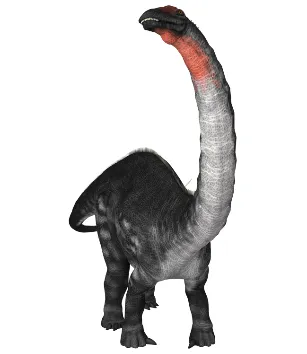
Image sources:
Size comparison: Matt Martyniuk, CC BY-SA 4.0, via Wikimedia Commons
Apatosaurus louisae, Carnegie Museum: Tadek Kurpaski from London, Poland, CC BY 2.0, via Wikimedia Commons