
Europasaurus
Europasaurus the dwarf sauropod
Europasaurus was a dinosaur that shouldn't have been small at all. It belonged to the sauropods – the group of long-necked herbivores that includes the largest land animals in Earth's history. But at only about six meters long, it was barely bigger than an elephant. The reason: It lived 154 million years ago on an island with scarce resources – and there it became a dwarf.
In short: Europasaurus holgeri was a dwarf sauropod about six meters long that lived on an island in what is now Lower Saxony during the Late Jurassic period. Its small size is considered a classic example of island dwarfism.
Europasaurus Fact Sheet: Size, Weight and Age at a Glance
The following values summarize the current state of research. Because individual specimens varied in size, the measurements are considered average and maximum values for adult animals.
| epoch | Upper Jurassic, Middle Kimmeridgian – about 154 million years ago |
|---|---|
| Order | Lizard-pelvis dinosaur (Saurischia) |
| Subordination | Sauropoda |
| Family / Group | Macronaria (taxonomic proximity to Brachiosauridae is discussed) |
| species | Europasaurus holgeri |
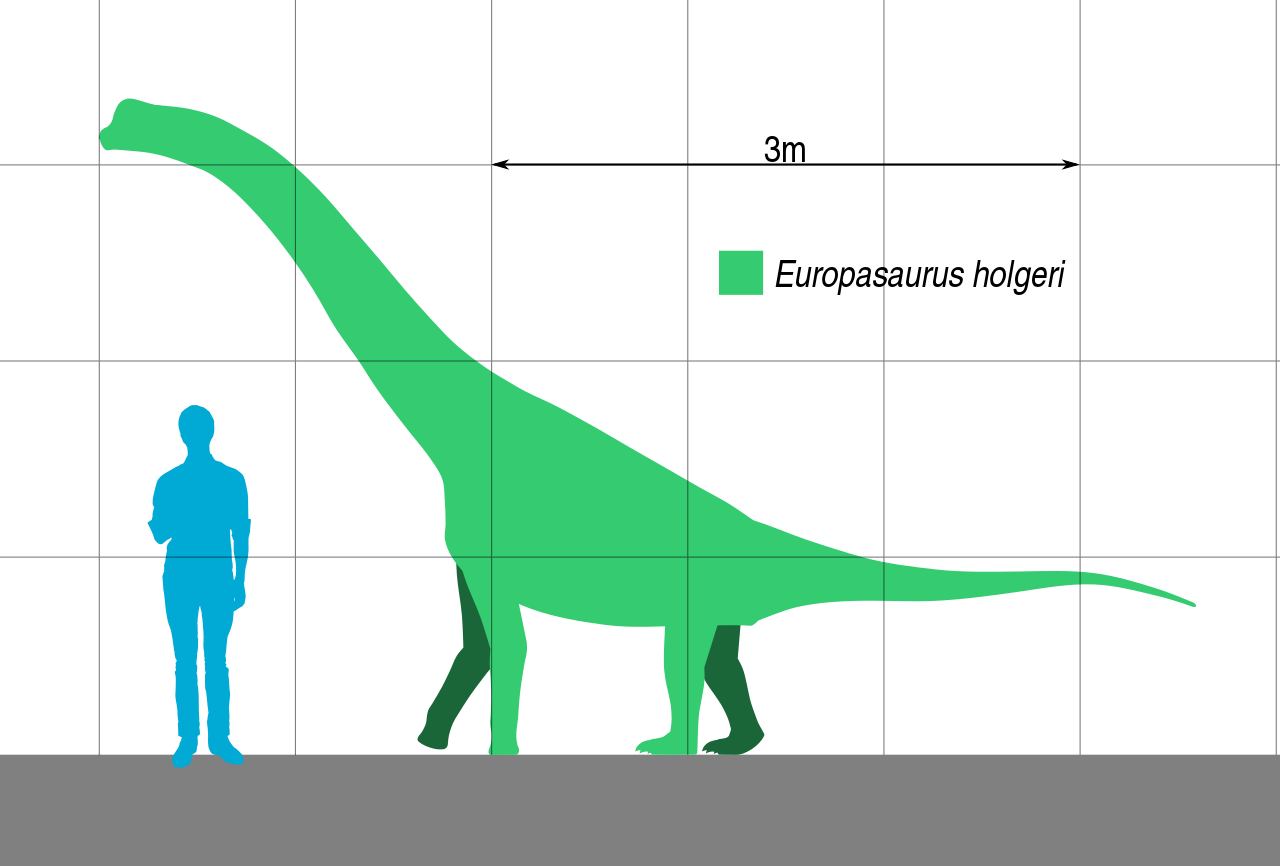
| length | approximately 6 m, up to 8 m in the largest known specimens. |
| Height | approx. 2–3 m |
| Weight | approx. 800 kg |
| Location | Langenberg limestone quarry, between Bad Harzburg and Goslar (Lower Saxony) |
| discovery | First described by Holger Lüdtke in 1998/99, scientifically described in 2006 |
Sources: Wikipedia: Europasaurus, Google Knowledge Base.
For comparison: An average sauropod reached a length of 15 to 20 meters, some species even over 30 meters. Europasaurus looked almost like a juvenile in comparison – even though it was fully grown.
Habitat: An island in the Jurassic Sea
In short: Europasaurus lived on a subtropical island of approximately 100,000 square kilometers in the Tethys Sea at that time – in what is now Lower Saxony.
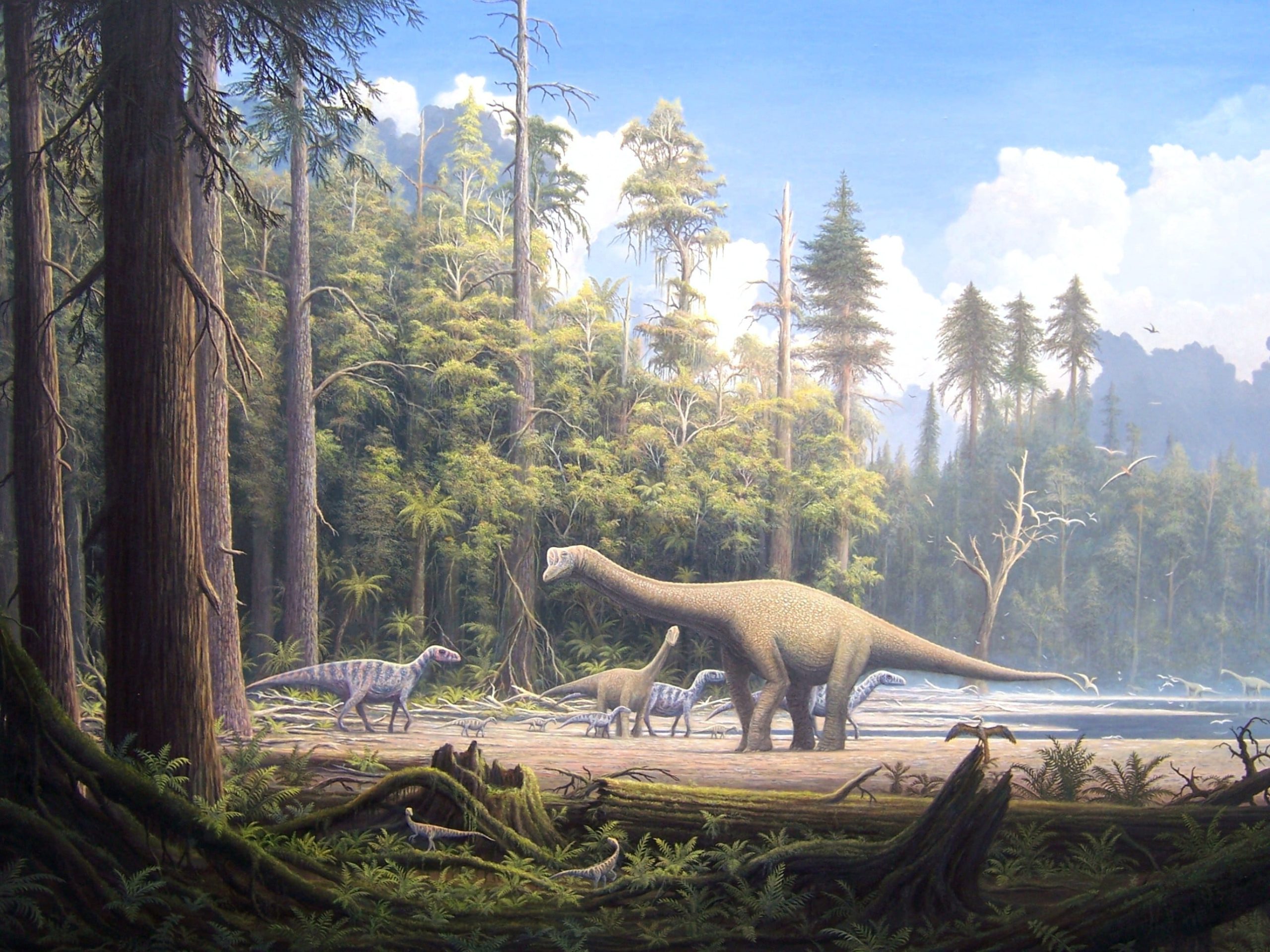
150 million years ago, northern Germany looked completely different than it does today. Large parts of Europe lay beneath a shallow sea, the Tethys Sea. Only isolated landmasses protruded as islands. One of these, in the area of what is now the Lower Saxony Basin, was the home of Europasaurus.
The island's climate was warm and humid, but not a tropical rainforest. Instead, meadows, open woodlands, and river landscapes dominated the area. Horsetails were the most common plant, along with primitive conifers, ferns, and some of the earliest flowering plants. For a land-based herbivore like Europasaurus, the island thus offered food—just significantly less than the mainland.
Why was Europasaurus so small?
In short: Research suggests island dwarfism – limited food on the island favored smaller, slower-growing animals over generations.
Europasaurus descended from significantly larger sauropod ancestors that roamed mainland Europe during the Middle to Late Jurassic. On the island, a process then began that biologists describe as Island dwarfism To describe this phenomenon: Large animals need a lot of food. On a small island with limited resources, smaller individuals have a better chance of survival because they can manage with less food. Over many generations, the smaller animals thus prevailed.
In Europasaurus, this can even be demonstrated in its bone structure: Histological studies – that is, the analysis of bone tissue under a microscope – show that the animals did not simply stop growing early. They grew throughout their lives, but significantly more slowly than their giant relatives. This is also the reason why researchers classify Europasaurus as a distinct dwarf species and not as a juvenile of a previously known, larger species like Camarasaurus.
Other theories: multiple populations and sexual dimorphism
Besides island dwarfism, researchers are discussing other, not necessarily mutually exclusive, explanations for the striking size differences among the specimens: Some experts suspect sexual dimorphism – that is, systematic size differences between males and females. Others consider it possible that the specimens originate from several island populations or even from two different species. A definitive scientific consensus is still pending.
New research: Was Europasaurus a precocial bird?
In short: A study from 2022 suggests that young Europasaurus were able to walk independently shortly after hatching.
For a long time, island dwarfism was considered the only major explanation for the body structure of Europasaurus. In December 2022, another exciting finding emerged: A research team used computed tomography to examine the inner ear and brain of several Europasaurus skulls from different age stages – from newly hatched youngsters to adults.
The result: Even very young animals possessed a well-developed sense of balance. This suggests that Europasaurus was a Precocial This means that young animals were able to move around independently shortly after hatching and probably soon joined the herd instead of receiving intensive care. This finding does not contradict the island dwarf theory, but rather complements it: The enormous size differences between young and adult animals suggest rapid growth immediately after birth and argue against extensive parental care.
Sources: Spectrum of Science, December 2022, VBIO.
Where was Europasaurus found? The Langenberg limestone quarry
In short: All known Europasaurus fossils come from the Langenberg limestone quarry in Lower Saxony, between Bad Harzburg and Goslar.
In 1998, private fossil collector Holger Lüdtke discovered a single sauropod tooth in the Langenberg limestone quarry. The quarry lies between the districts of Harlingerode and Göttingerode in the town of Bad Harzburg and the district of Oker in the town of Goslar, in the Goslar district. What initially appeared to be a single, chance find quickly developed into one of the most important dinosaur fossil sites in Europe.
Systematic excavations began in 1999 in a layer of rock that experts have since dubbed the "dinosaur bank." Further excavation campaigns in 2001 and 2002 unearthed more than 20 skeletons of varying ages – from juveniles just a few weeks old to fully grown adults. Current scientific sources estimate that at least 21 individual animals and approximately 1,300 bones were recovered. Some fossils were still articulated, allowing researchers to draw precise conclusions about the appearance of the living animals.
The first scientific description as an independent genus Europasaurus holgeri – named after its discoverer Holger Lüdtke – was published in 2006 in the renowned journal NatureThis means that Europasaurus is still considered one of the best-documented dwarf sauropods worldwide.
Sources: Wikipedia: Langenberg limestone quarry, Wikipedia: Europasaurus.
Europasaurus in comparison: How small was it really?
To put the size of Europasaurus into perspective, a comparison is helpful: While the average sauropod reached 15 to 20 meters in length, Europasaurus measured only about 6 meters – barely larger than a "Littlefoot" from the animated film. The Land Before Time, which depicts a young Apatosaurus. Those interested in the "real" giants among the long-necked dinosaurs will find more information in the article on Apatosaurus – also known for a long time as Brontosaurus – the appropriate comparison.
Europasaurus is therefore not an isolated case, but part of a larger pattern: island sauropods from different geological eras show similar dwarfing effects. An overview of other German dinosaur finds can be found on the overview page. Dinosaurs from Germany, a complete catalog of all species presented on urzeittiere.net which Dinosaur Database.
Frequently asked questions about Europasaurus
Image sources: Europasaurus ©urzeittiere.net
Size comparison: Slate Weasel, CC0, via Wikimedia Commons
Europasaurus holgeri Scene: Gerhard Boeggemann, CC BY-SA 2.5 https://creativecommons.org/licenses/by-sa/2.5, via Wikimedia Commons