
Camptosaurus: Hidden in its own museum for 60 years
For half a century, a Camptosaurus skeleton sat in the Carnegie Museum—half-embedded in the rock, largely unnoticed. Only during a renovation did preparators chisel it completely free and discover: This wasn't a known species at all, but an entirely new one. Its later species name aptly means "hidden from view."
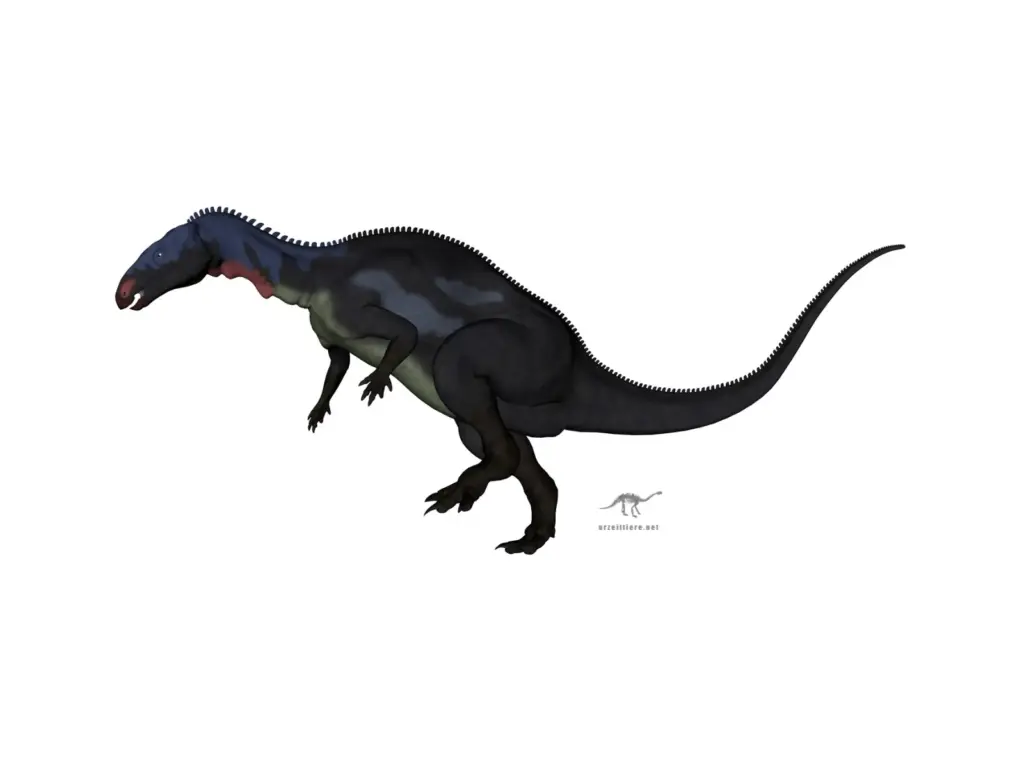
Profile
| feature | Value |
|---|---|
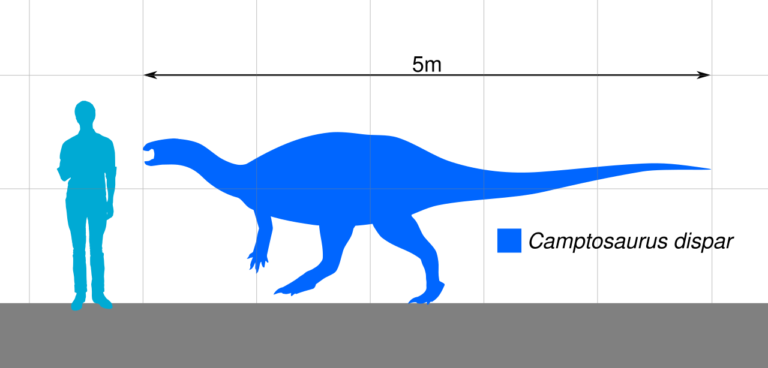
| length | approx. 5–7.5 meters (estimates vary depending on the find and type) |
| Weight | approx. 350–900 kg (estimates vary widely) |
| Location | Morrison Formation, western North America (including Wyoming, Colorado, Utah); isolated, sometimes disputed finds in Europe |
| age | Late Jurassic period, around 155–145 million years ago |
| Food | herbivores |
Camptosaurus belongs to the ornithopods within the bird-hipped dinosaurs (Ornithischia) and there to the group Ankylopollexia – the same clade from which the more famous Iguanodon later emerged. At 5 to 7.5 meters in length, it was, depending on the estimate, about twice as long as a small car; its weight was roughly equivalent to that of a fully grown cow.
Sometimes on two legs, sometimes on four
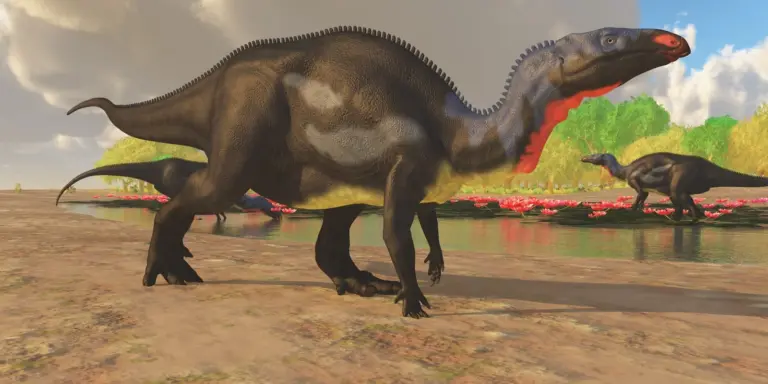
For a long time, Camptosaurus was considered a purely quadrupedal animal. Today, researchers paint a more flexible picture: The animal mostly moved on all fours, but could stand upright to reach higher leaves, and probably ran bipedally when threatened. A full gallop on all fours, however, was likely impossible – its shoulders were simply not flexible enough.
This change was made possible by a peculiarity in his skeleton: the vertebrae of his sacrum were not completely fused together. This is precisely what his name refers to, which comes from Greek and means "bent" or "flexible lizard".
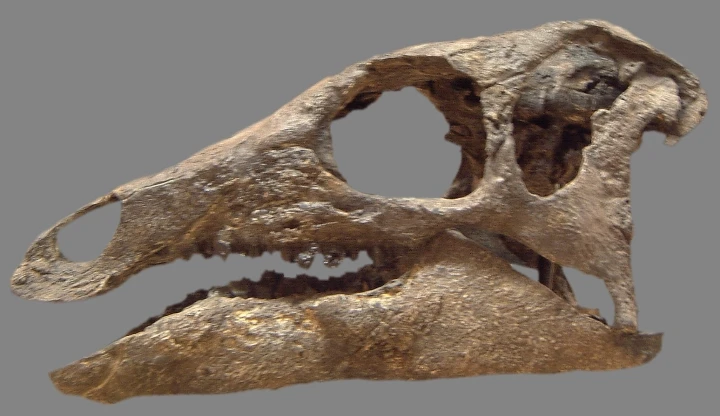
A beak for the best bites
Its head was small and tapered into a toothless beak with an inverted Y-shape at the top. Camptosaurus used this beak to precisely pluck ferns, cycads, and small conifers. Two rows of continuously growing molars further ground the tough vegetation.
The narrow snout suggests a selective diet, focused on the most nutrient-rich parts of plants. However, the wear patterns on the teeth tell a different story: they show that at least some of the food was quite hard and chewy.
Related to Iguanodon – but without a dagger
Camptosaurus und der deutlich größere Iguanodon zählen zur selben Verwandtschaftsgruppe, den Ankylopollexia. Trotzdem trugen beide sehr unterschiedliche Daumen: Iguanodon besaß einen scharfen, kegelförmigen Daumensporn, der wohl auch als Waffe taugte. Der Daumensporn von Camptosaurus war dagegen aus zwei Knochengliedern aufgebaut und deutlich weniger spitz – er diente vermutlich eher der Nahrungsverarbeitung als der Verteidigung.
From insect to dinosaur: a botched naming history
Als der amerikanische Paläontologe Othniel Charles Marsh das Tier 1879 erstmals beschrieb, nannte er es „Camptonotus“. Der Name war allerdings schon vergeben – und zwar an eine Grillenart. 1885 taufte Marsh seinen Fund deshalb um in Camptosaurus, den Namen, der bis heute gilt. Entdeckt hatte das Fossil zuvor der Sammler William Harlow Reed, am 4. September 1879 in der Nähe von Como Bluff, Wyoming.
Hidden from everyone's view
In 1922, excavation teams discovered another skeleton, which for over six decades had remained only partially exposed from the surrounding rock in the Carnegie Museum. It wasn't until renovations in 2005 and 2006 that it was fully revealed. The surprise: it belonged to no known species. In 2008, experts described it as a distinct species, Camptosaurus aphanoecetes – literally "hidden from view."
How many species actually belong to the genus Camptosaurus remains unclear to researchers. Some previously named species later turned out to be growth stages of the same species, while others were removed from the genus altogether and assigned to separate genera – one reason why size and weight data for Camptosaurus vary so widely in the literature.
Neighbors in the Jura marshland
Camptosaurus lived around 80 million years before Tyrannosaurus Rex, Triceratops, and Acheroraptor – in a completely different world of subtropical, seasonally dry plains. Its neighbors were giants like the sauropod Brachiosaurus, the armored Stegosaurus, and the carnivore Allosaurus, which could pose a real threat.
Fossils from bone beds suggest that Camptosaurus did not travel alone, but lived in groups, at least some of the time. This is not definitively proven, but the frequency of finds makes some degree of herding behavior plausible.
See also
- Tyrannosaurus Rex – lived around 80 million years later, also in North America, but in a completely different Cretaceous landscape.
- Triceratops – like Camptosaurus, a herbivore, but from the much younger Hell Creek Formation.
- Acheroraptor – Carnivores from the same late Cretaceous period as T-Rex and Triceratops, also significantly younger than Camptosaurus.
- Iguanodon– Iguanodon und Camptosaurus zählen zur selben Verwandtschaftsgruppe, den Ankylopollexia.
Image sources:
Skull: Anky-man at English Wikipedia(Original text: Anky-man), Public domain, via Wikimedia Commons
Size comparison: User:Slate Weasel, Public domain, via Wikimedia Commons