
Dinosaur Age: Triassic, Jurassic & Cretaceous at a glance
Imagine being able to travel back in time and experience the fascinating world of dinosaurs spanning almost 200 million years. From the first small predatory dinosaurs to the mighty giants of the Cretaceous period - the Geological era of the dinosaurs tell a breathtaking story of evolution. In this comprehensive overview, we take you on a journey through the Triassic, Jurassic and Cretaceous and answer the burning question: When did the first dinosaurs live? and how did they develop into the impressive creatures that still inspire our imagination today?
The three geological eras of dinosaurs: an introduction
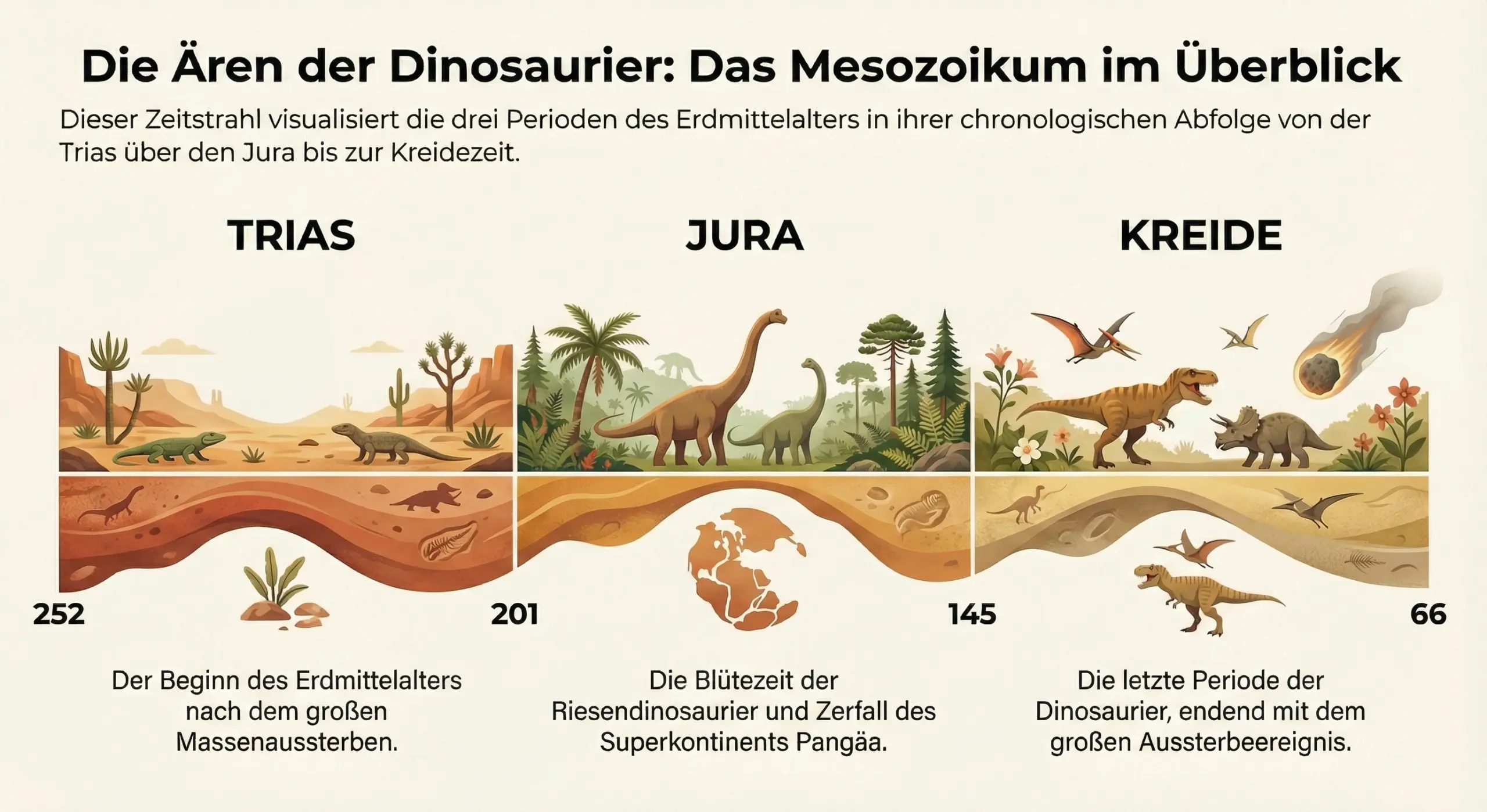
The Mesozoic, often referred to as the “Age of Reptiles,” spanned an unimaginably long period of time, from 252 to 66 million years before our time. This vast era of earth's history is divided into three characteristic periods: the Triassic period (252-201 million years), the Jurassic period (201-145 million years) and the Cretaceous period (145-66 million years).
For a better understanding of the Dinosaur Age Overview It is important to know that each of these periods had its own climatic conditions, geographical features and characteristic life forms. The Triassic Jurassic Cretaceous differences are not only geologically fascinating, but crucial to understanding dinosaur evolution.
During the Triassic period the first dinosaurs entered the world stage, in the Jurassic period they experienced their first major heyday with massive long-necked dinosaurs, and in the Cretaceous period they reached their peak of diversity - before being largely extinct in a catastrophic event at the end of this period.
The distribution of continents changed dramatically during these 186 million years. At the beginning of the Triassic period, the supercontinent existed Pangea, which split over time and laid the foundation for today's continental distribution. These geographical changes significantly influenced the evolution and distribution of dinosaurs.
The Triassic Period: When the first dinosaurs walked the earth
The Triassic period (252-201 million years before present) marks one of the most important turning points in the history of life on Earth. After the devastating Permian-Triassic mass extinction largest extinction event in earth history, which wiped out about 96% of all marine life and 70% of terrestrial vertebrates, nature began to repopulate the vacated ecological niches.
When did the first dinosaurs live? This question takes us directly to the middle to late Triassic period. The earliest known dinosaur fossils date from this period, around 230-240 million years old. Which dinosaurs lived in the Triassic period? is a fascinating question, the answer to which takes us to the humble beginnings of these later giants.
Which dinosaurs existed in the Triassic period?:
The Eoraptor, one of the oldest known dinosaurs, was only about a meter long and weighed just 10 kilograms. This early representative already had the characteristic features that defined all later dinosaurs: upright legs, special hip structure and hollow bones.
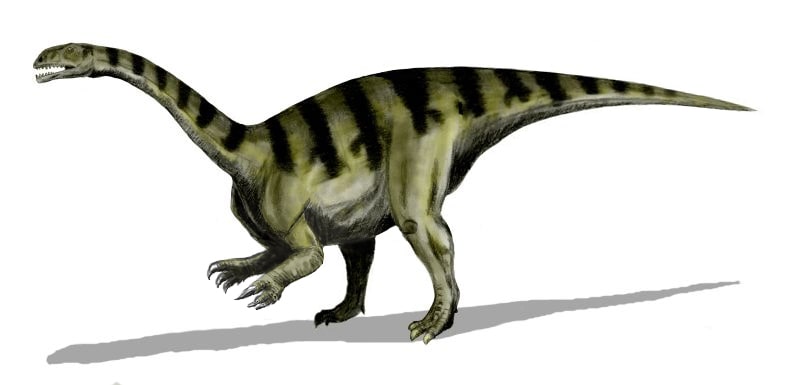
The Herrerasaurus from Argentina was already an impressive hunter with a length of up to 6 meters. Its powerful jaws and sharp teeth already showed the development of specialized predatory dinosaurs. Plateosaurus, one of the first larger herbivores, reached lengths of up to 8 meters and showed the development towards the later sauropods.
Coelophysis was another important early dinosaur that lived in large herds and gives us important insights into the social behavior of early dinosaurs. Fossil discoveries in New Mexico showed hundreds of individuals in one place, suggesting herd migrations or shared cataclysms.
In addition to the dinosaurs, other important groups of reptiles also developed in the Triassic: the first crocodiles, various archosaurs, early turtles and the first mammals. In the sea, ichthyosaurs and early plesiosaurs dominated the waters.
The supercontinent Pangea largely determined the climate of the Triassic period. The interior of the continent was extremely dry and hot, while the coastal regions experienced more temperate conditions. This geographical situation allowed early dinosaurs to spread over large areas because there were no oceans to impede their migrations.
The Jurassic Period: The heyday of the giants
The Jurassic period (201-145 million years before today) is rightly considered to be this golden age of dinosaurs. After the Triassic-Jurassic mass extinction, which wiped out about 80% of all species, the surviving dinosaur lineages experienced an explosive radiation and evolved into the most impressive land animals to ever live on Earth.
Which dinosaurs existed in the Jurassic period? The answer to this question takes us to some of the most famous and spectacular dinosaurs in Earth's history. The Jurassic period was characterized by incredible diversity, ranging from tiny predatory dinosaurs to the largest land animals of all time.
The Sauropods reached their first major flowering in the Jurassic period. Brachiosaurus, with its characteristic long neck and extended forelimbs, could reach a height of up to 13 meters and weighed an estimated 70-80 tons. Its design was perfect for reaching tall vegetation that was inaccessible to other herbivores.
Diplodocus represented a different type of sauropod: longer than a Brachiosaurus (up to 27 meters) but slimmer in build, with a whip-like tail that it may have used for defense. Its teeth were shaped like little pegs, perfect for stripping needles and leaves.
Dominated among the predatory dinosaurs Allosaurus the Jurassic period. With a length of up to 12 meters and a weight of around 4 tons, it was the top predator of its time. Its powerful hind legs, sharp claws, and dagger-like teeth made it a fearsome hunter, able to prey on both smaller dinosaurs and large sauropod juveniles.
Stegosaurus developed one of the most remarkable defense strategies in dinosaur history during the Jurassic period. The characteristic dorsal plates probably served for thermoregulation and possibly intraspecific communication, while the four pointed tail spines (called thagomizers) were effective Weapon against predatory dinosaurs represented.
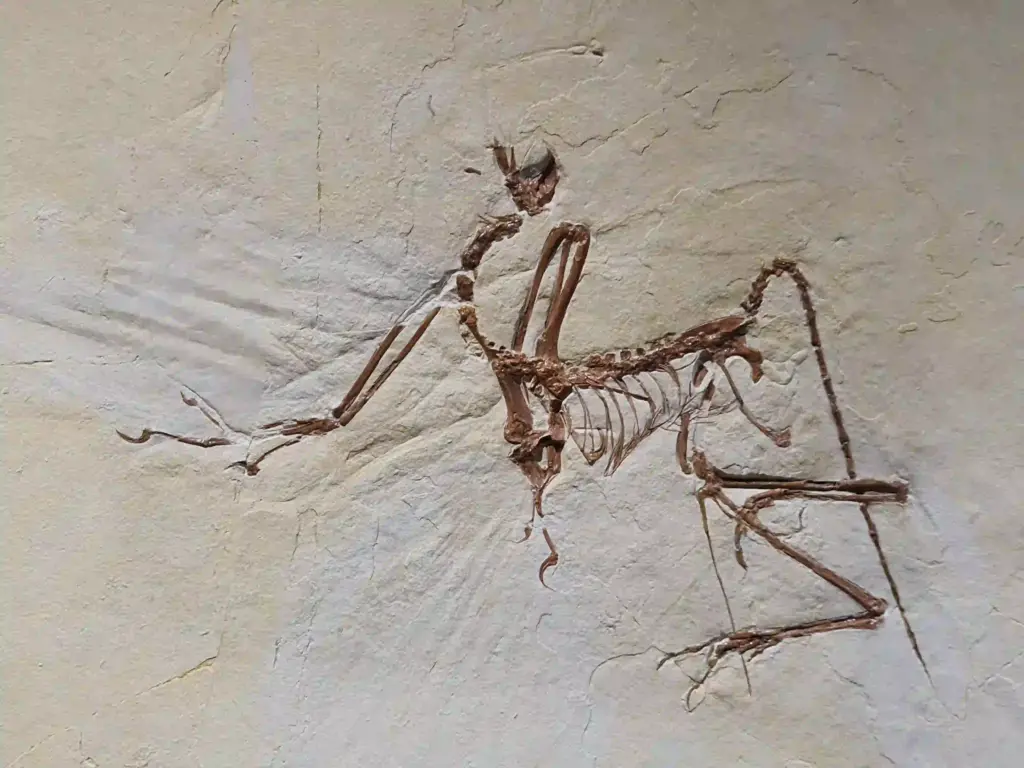
A particularly significant find from the Jurassic period is Archaeopteryx, the missing link between dinosaurs and birds. This feathered creature possessed both reptilian features (teeth, claws, long bony tail) and bird-like features (feathers, wings). It impressively shows the evolutionary connection between dinosaurs and modern birds.
The Jurassic period was characterized by a warm, humid climate without ice caps at the poles. The increased oxygen content in the atmosphere (about 35% compared to 21% today) allowed animals to develop larger body sizes. The breakup of the supercontinent Pangea led to the formation of new sea routes that moderated the climate and promoted lush vegetation.
The emerging continents – Laurasia in the north and Gondwana in the south – gradually developed different dinosaur faunas, laying the foundation for later geographical specialization.
The Cretaceous Period: Diversity and the Grand Finale
The Cretaceous Period (145-66 million years before present) was not only the longest of the three dinosaur ages, but also the most diverse and dramatic. Which dinosaurs lived in the Cretaceous period? This question leads us to an astonishing parade of species that represent the pinnacle of dinosaur evolution.
The Cretaceous period gave us the most famous and well-known dinosaurs. Tyrannosaurus Rex, the “king of the tyrant lizards,” dominated the late Cretaceous of North America as an apex predator. At up to 13 meters long, 4 meters high and weighing 6-9 tons, T. Rex was a fearsome hunter with a bite that could generate forces of up to 12,800 pounds per square inch.
Triceratops developed as a response to the large predatory dinosaurs of the time. With its characteristic neck shield and three horns, it was perfectly equipped to defend itself against T. Rex. These massive herbivores weighed up to 12 tons and lived in herds, providing additional protection.
The Cretaceous period also saw the emergence of highly specialized predatory dinosaurs such as Velociraptor, who, although smaller than portrayed in Hollywood films (about the size of a turkey), was still an efficient hunter with a distinctive sickle-shaped claw. Spinosaurus from Africa exceeded even T. rex in size and was perfectly adapted to a semi-aquatic life, with a characteristic dorsal sail and crocodile-like jaws.
Were there dinosaurs in the Jurassic and Cretaceous periods? Absolutely! But the Cretaceous dinosaurs showed even greater specialization. Ankylosaurus evolved into a living fortress with heavy armor and a bony tail club that acted as a warhammer.
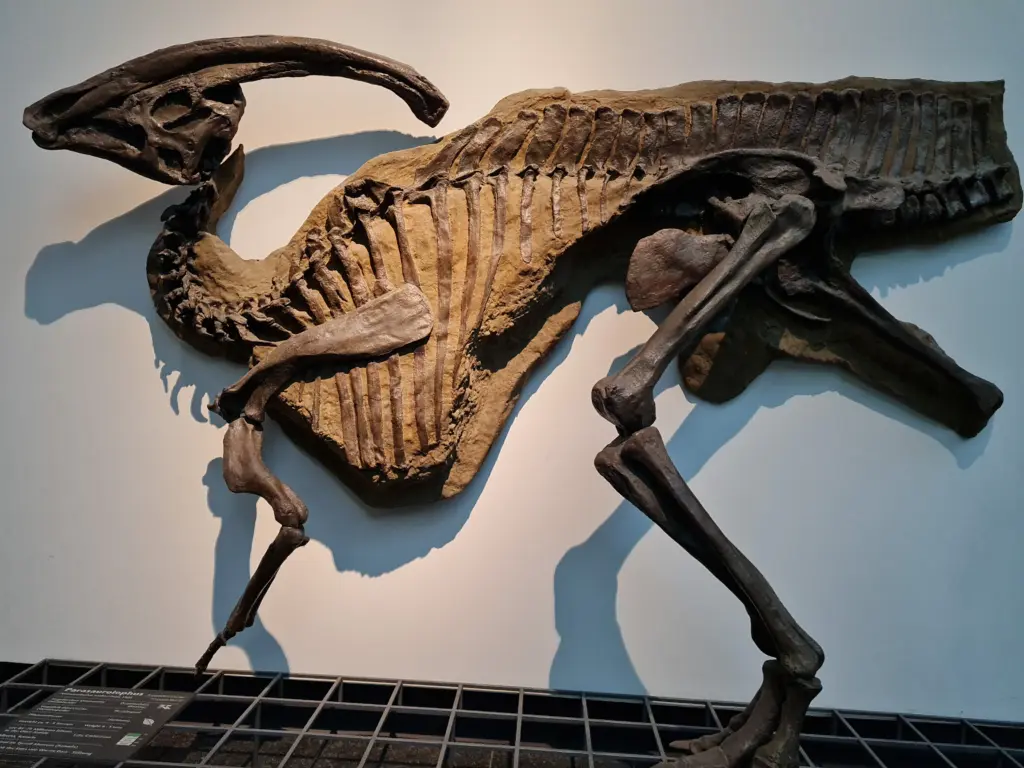
The Hadrosaurs or “duck-billed dinosaurs” represented one of the most successful herbivore groups of the Cretaceous period. Types like Parasaurolophus developed complex cranial crests that served as resonance chambers for communication - they could produce different sounds to communicate with other species.
A notable aspect of the Cretaceous period was geographical specialization. The continents had become further apart, leading to the development of different regional faunas. North America had its tyrannosaurs and ceratopsians, South America developed unique abelisaurs like Carnotaurus, and Africa was home to spinosaurs and various sauropods.
The Cretaceous dinosaurs also showed remarkable adaptations to different environments. Some developed swimming skills, others perfected digging, and still others specialized in certain food sources.
This was the Cretaceous climate warmest of the entire Mesozoic, with global temperatures 6-14°C higher than today. There were no ice caps and the sea level was about 70-120 meters higher than today. These conditions created lush, warm environments that supported incredible biodiversity.
The dramatic end came 66 million years ago with the Chicxulub asteroid impact on the Yucatan Peninsula. This impact, combined with volcanic activity in India, led to drastic climate changes that spelled the end of the non-avian dinosaurs.
Triassic, Jurassic, Cretaceous: The most important differences in comparison
Around the Triassic Jurassic Cretaceous differences To fully understand it, a direct comparison of the three periods is revealing:
Temporal dimensions:
- Triassic: 252-201 million years (51 million years)
- Jurassic: 201-145 million years (56 million years)
- Cretaceous: 145-66 million years (79 million years)
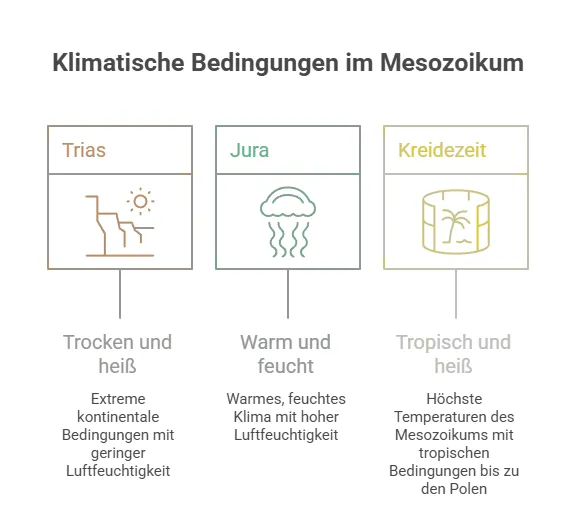
Climatic conditions: The Triassic began dry and hot with extreme continental conditions. The Jura was characterized by a warm, humid climate with high humidity. The Cretaceous reached the highest temperatures of the Mesozoic, with tropical conditions extending to the poles.
Continent distribution: The supercontinent Pangea still existed in the Triassic. During the Jurassic the split into Laurasia and Gondwana began. By the Cretaceous period, the continents were already clearly separated, which led to the geographical isolation of various dinosaur populations.
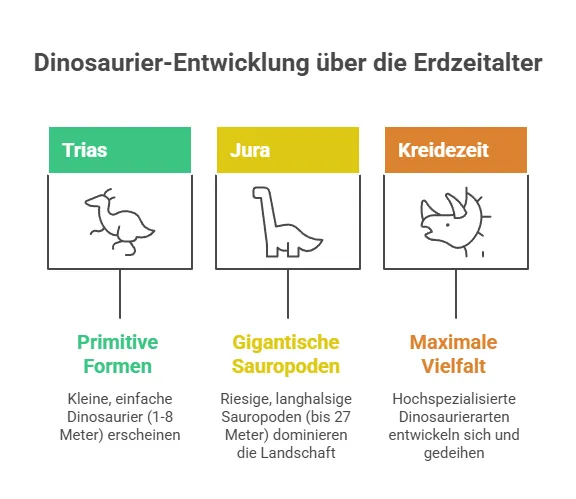
Dinosaur evolution: The evolution of dinosaurs shows a clear progression: from small, primitive forms in the Triassic (1-8 meters) to gigantic sauropods in the Jurassic (up to 27 meters) to maximum diversity in the Cretaceous period with highly specialized species.
Vegetation: The Triassic was dominated by ferns, early conifers and cycads. The Jurassic saw the flowering of gymnosperms (coniferous trees). The Cretaceous period brought with it the revolutionary development of angiosperms (flowering plants), which created new ecological niches.
Atmospheric composition: Oxygen levels increased from about 16% in the Early Triassic to 35% in the Jurassic and fell again to about 28% in the Cretaceous. These fluctuations directly influenced the maximum body size of land animals.
Why didn't the dinosaurs die out between the ages?
An intriguing question is why the dinosaurs survived several mass extinction events before mostly disappearing at the end of the Cretaceous. The Dinosaur Triassic Jurassic Cretaceous overview shows us that these remarkable animals had extraordinary adaptability.
After the Triassic-Jurassic extinction event 201 million years ago, which wiped out about 80% of all species, the dinosaurs not only recovered but diversified explosively. Their secrets to success lay in several evolutionary advantages:
Physiological adaptations: Dinosaurs had efficient respiratory systems similar to modern birds, with air sacs that allowed a continuous flow of air through the lungs. This property gave them advantages in oxygen-depleted environments after catastrophic events.
Variety of sizes: From mouse-sized species to 100-ton behemoths, dinosaurs were able to occupy various ecological niches. Smaller species survived environmental crises better, while large species dominated during periods of stability.
Fast reproduction: Many dinosaur species laid large numbers of eggs and reached sexual maturity quickly, allowing for rapid population recovery after disasters.
Geographical distribution: The wide distribution across different continents meant that local disasters did not affect all populations at the same time.
Social behavior: Fossil evidence shows that many dinosaurs lived in herds, allowing for protection from predators and efficient foraging.
However, the final extinction at the end of the Cretaceous was such an extreme event that even these adaptations were not enough. The asteroid impact caused global darkening, drastic temperature fluctuations and the collapse of food chains - conditions too extreme for even the most adaptable dinosaurs.
Conclusion: The fascinating journey through 186 million years
The Geological Age of Dinosaurs Explained reveal one of the most remarkable success stories of evolution. Over 186 million years These fascinating creatures dominated the Earth and evolved from humble, dog-sized predatory dinosaurs into the largest land animals to ever exist.
Each of the three ages - Triassic, Jurassic and Cretaceous - produced its own distinctive species and demonstrated the incredible adaptability and innovation of evolution. From the first hesitant steps of the Triassic dinosaurs to the gigantic sauropods of the Jurassic to the explosive diversity of the Cretaceous - each period tells its own fascinating story.
Studying these ages teaches us not only about the past, but also about the principles of evolution, adaptation and survival. New fossil discoveries and modern analytical methods continue to reveal new insights into these long-vanished worlds.
While the non-avian dinosaurs died out at the end of the Cretaceous, their direct descendants are alive - the birds – still with us today. Every bird song reminds us that the age of dinosaurs never really ended, but rather evolved in new, fascinating directions.
The Triassic, Jurassic and Cretaceous dinosaur ages remain an endless source of fascination and learning, showing us how life evolved, adapted and thrived over millions of years - a lesson more relevant than ever in our current era of rapid environmental change.
