Stegosaurus
“The Covered Lizard”
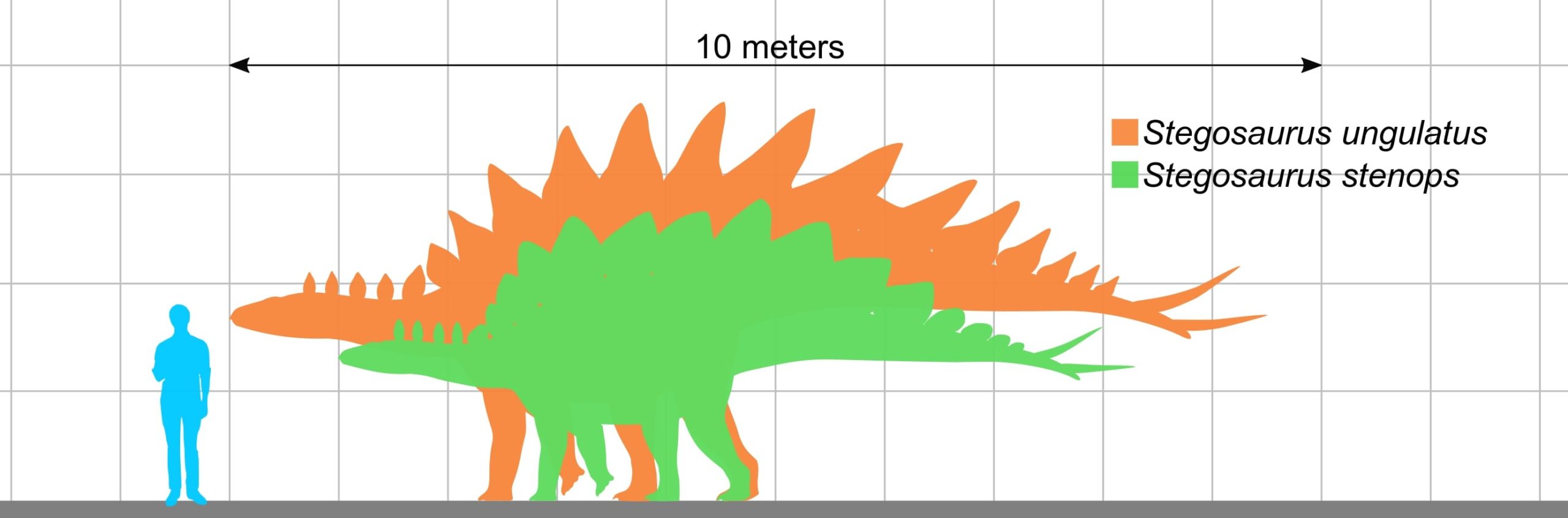
The Stegosaurus (“covered lizard”) was a large, slow-moving herbivore. It lived about 150.8 to 155.7 million years ago, during the Late Jurassic Period. Its fossils were found primarily in western North America. He was about the size of a bus and sported two rows of 17 to 22 large bone plates on his neck, back and tail, making him appear even larger.
It had no front teeth on its beak. Its small teeth were flat, triangular, and slightly serrated; thus they were unsuitable for eating meat. Stegosaurus had cheeks, suggesting that it could hold food in its mouth while chewing.
| Profile | Stegosaurus |
|---|---|
| epoch | Upper Jurassic (Kimmeridgian to early Tithonian) 150 to 155 million years |
| Order | bird-hipped dinosaurs (Ornithischia) |
| Subordination | Thyrophora |
| Family | Stegosauria |
| group | Stegosauridae |
| genus | Stegosaurus |
| species | Stegosaurus sulcatus, Stegosaurus stenops (type), Stegosaurus ungulatus |
| Height | 3 meters |
| length | 9 meters |
| Weight | 3.5 tons |
| Locations | North America, Europe (Portugal), China, India, South Africa |
Thagomizer
The bony plates along the back were embedded in the animal's skin rather than attached to its skeleton, which is why most fossil finds have the plates separated from the body.
After the first Stegosaurus fossil was described by O. C. Marsh, he suggested that the plates lay flat on its back. But when a specimen was discovered that had been covered in mud after its death, it could be seen that the plates were perpendicular to the body and protruded from the body alternately on either side of the spine.
The function of these plates is still being debated by experts. They may have served to protect and warn against predators, or to “communicate” with members of their species.
Since tiny grooves were found on fossils of these plates, it is assumed that they contained blood vessels and were therefore used for heat regulation.
Stegosaurus had 4 to 10 long spines at the end of its flexible tail. These pointed outwards from the sides. Scientists started the spikes informally “Thagomizer” to name; a nod to 1982 pop culture. As a caricature of the “The Far Side“ a group of cavemen showed the sharp spikes after the deceased Thag Simmons named and as Thagomizer designated.
Experts believe these spines were used for defense against predators. His biggest predators were probably Allosaurus and Ceratosaurus.
Scientists have found puncture wounds from Stegosaurus spines in allosaur fossils.
In addition, the tips of around 10 percent of the spines found are damaged.
Stegosaurus was a media star
Because of its distinctive body shape, Stegosaurus has been frequently depicted on television and in movies. He appeared in films such as “King Kong” and in the second and third parts of the “Jurassic Park” films.
Was Stegosaurus the dumbest dinosaur ever?
Stegosaurus has the smallest “body to brain” ratio of any dinosaur.
“The Stegosaurus brain was long thought to be the size of a walnut.”
said armored dinosaur expert Kenneth Carpenter, director of the USU Eastern Prehistoric Museum in Utah.
“But actually his brain was the size and shape of a crooked hot dog.”

He had a short neck and a small head. This anatomy, coupled with its short forelimbs, enabled it to eat primarily ferns, mosses, cycads, fruits, conifers, horsetails, and even fallen fruit.
Perhaps Stegosaurus could even stand on its hind legs to reach lower hanging branches and fruit. However, this behavior is hotly debated by researchers.
According to a 1990 study published in the journal Paleobiology, Stegosaurus may have had a glycogen body (lumbar bulge). This is a structure found in birds and could play a role in energy storage.

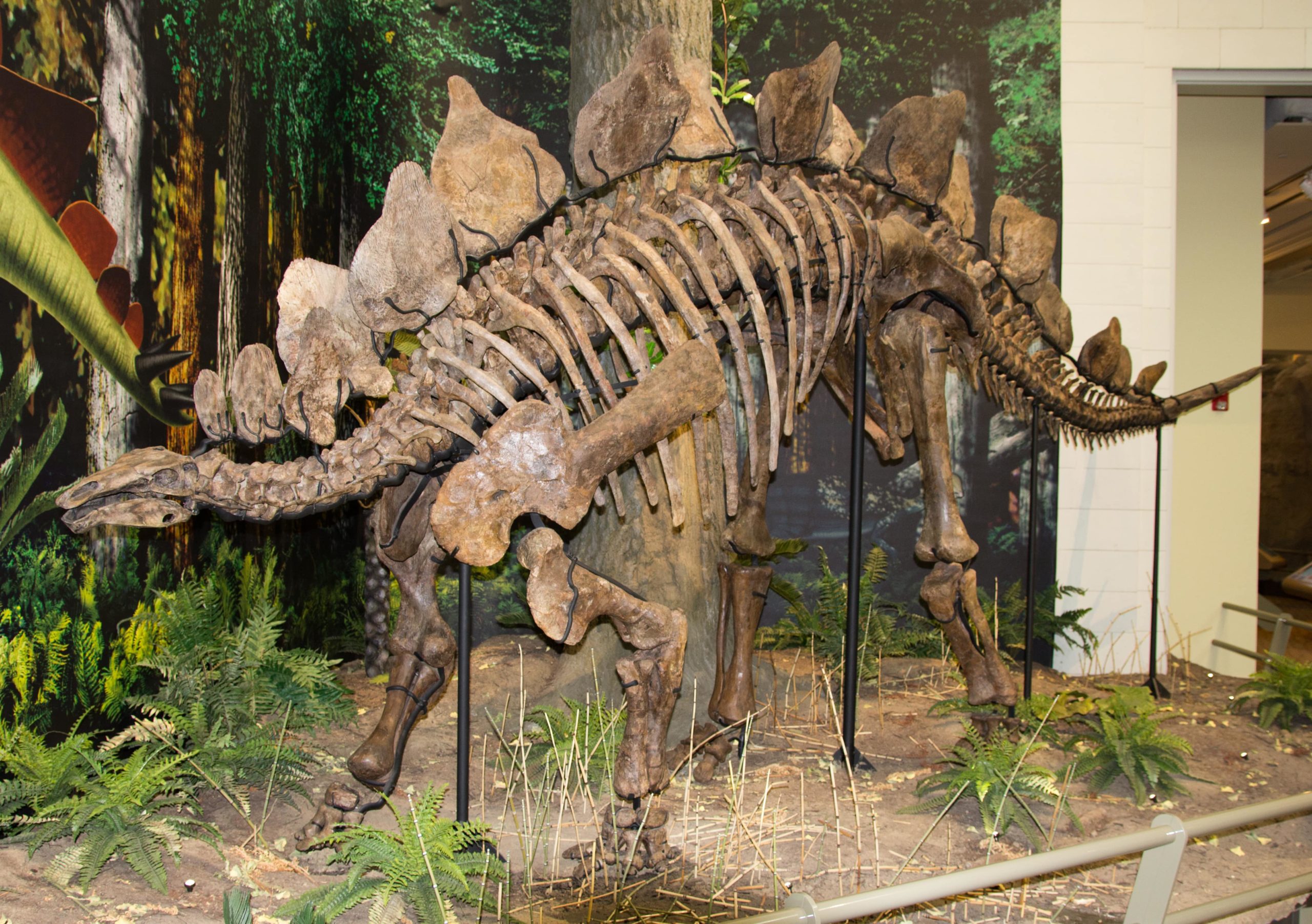
Image sources: Jaime A. Headden (User:Qilong), CC BY 3.0 https://creativecommons.org/licenses/by/3.0, via Wikimedia Commons
Susannah Maidment et al. & Natural History Museum, London, CC BY 4.0 https://creativecommons.org/licenses/by/4.0, via Wikimedia Commons
Size comparison: KoprX, CC BY-SA 4.0 https://creativecommons.org/licenses/by-sa/4.0, via Wikimedia Commons
Stegosaurus_ungulatus: Perry Quan from Oakville, Canada, CC BY-SA 2.0 https://creativecommons.org/licenses/by-sa/2.0, via Wikimedia Commons
Skull: Daderot, CC0, via Wikimedia Commons