
Coelophysis
The Hollow Figure
Coelophysis means something like “hollow shape” or “hollow shape”, which refers to its hollow bones, which are typical of carnivores.
Coelophysis is a very well-known early dinosaur. Scientists have already discovered hundreds of skeletons of this primitive theropod carnivore.
He lived about 216 to 203 million years ago during the Late Triassic Period. Coelophysis is the oldest known dinosaur in North America. He was a fast and agile runner.
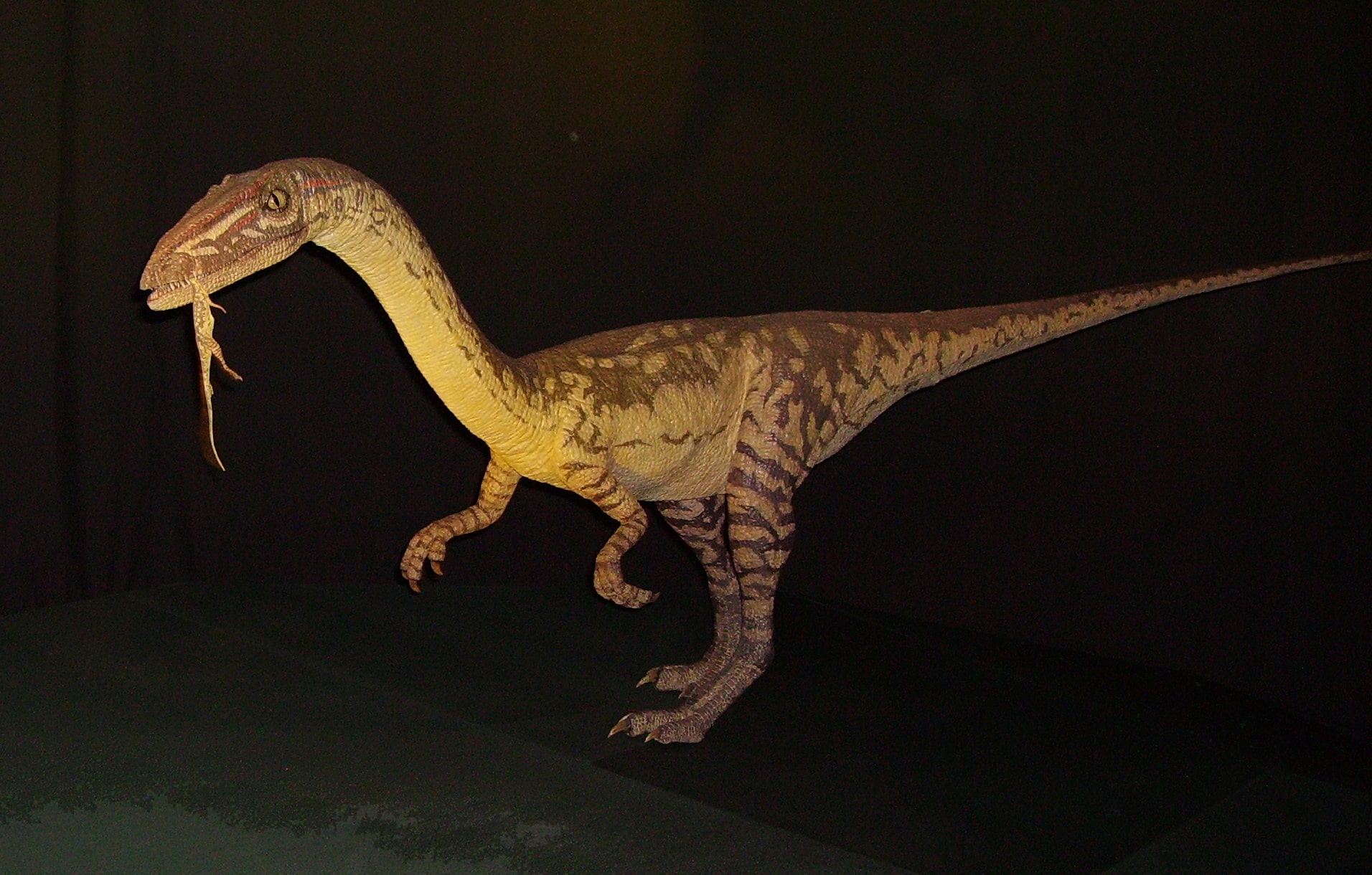
The head was long and narrow and its jaws were equipped with many small, sharp teeth with sawtooth edges. Best suited to tearing flesh from prey.
This dinosaur had a very long tail. This formed the counterweight for the part of the body that was in front of the pelvis. Its limbs were slender and relatively long. The neck was longer than its torso.
Coelophysis became known in 1947. A massive collection of hundreds of skeletons were unearthed at the Ghost Ranch near Abuquiu, New Mexico.
| Profile | Coelophysis |
|---|---|
| epoch | Upper Triassic, 228 to 201.3 million years ago |
| Order | Lizard-pelvis dinosaur (Saurischia) |
| Subordination | Theropoda |
| Family | Coelophysoidea |
| group | Coelophysidae |
| genus | Coelophysis |
| species | Coelophysis bauri |
| Height | 1 meter |
| length | 2.5 to 3 meters |
| Weight | 15 to 30 kilograms |
| Locations | North America |
History of discovery
In 1889, Edward Drinker Cope named the newly discovered dinosaur genus Coelophysis.
Two years previously, the type species was mistakenly considered a species of the genus Coelurus.
Drinker, however, acknowledged key differences Coelurus and Tanystrophaeus, which led him to name a new genus.
Food / What does the Coelophysis eat
Coelophysis had blade-like, backward-curved sharp teeth, typical of predatory dinosaurs. These were decorated with fine fluting on the front and back edges.
It was very agile and fast and hunted a variety of animals such as early small lizards and insects. Other prey included tiny mammal-like reptiles and small herbivorous dinosaurs such as Technosaurus.
Its sharp grasping claws and teeth helped it hold onto food and kill it.
Coelophysis bauri lived primarily in warm, humid coastal areas in what is now southwestern North America. This region was once covered with streams, ponds, ferns, and tropical plants. It was surrounded on all sides by mountains with evergreen trees 30 to 60 meters high!

Did Coelophysis hunt in packs?
Because of the discovery of massive collections of Coelophysis skeletons, scientists now suspect that it may also have hunted in packs to take down larger prey.
Features
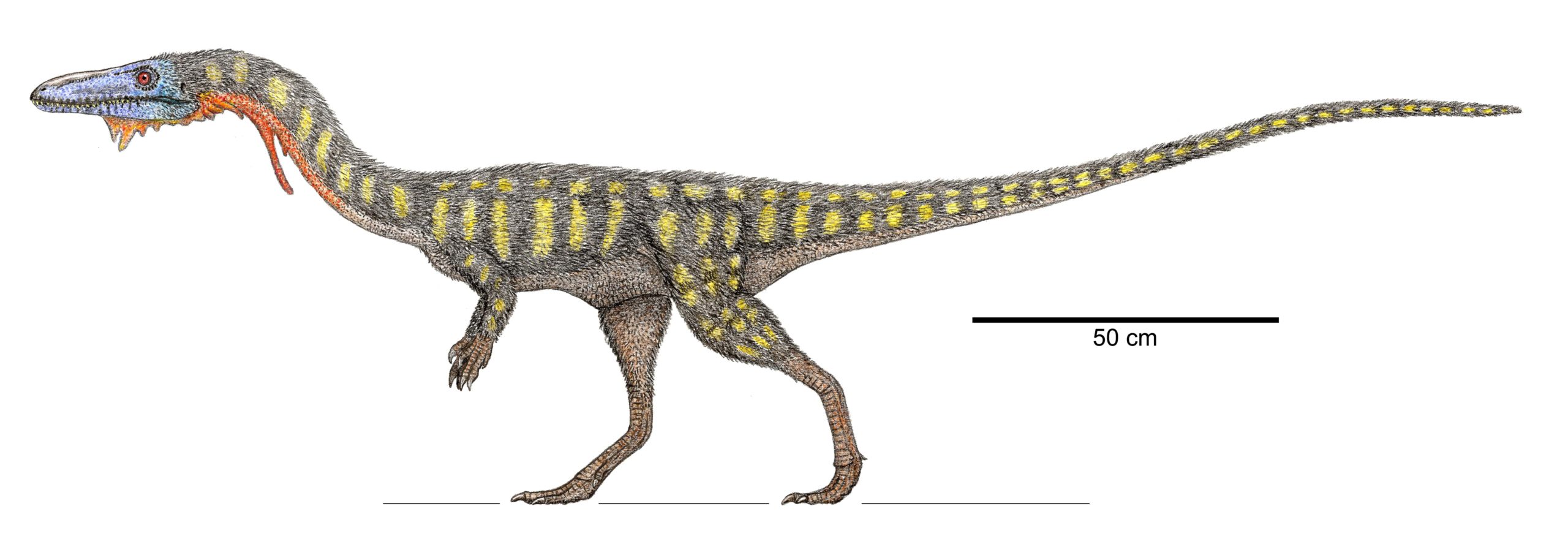
Coelophysis was a lightly built dinosaur. It measured up to 3 m in length and more than a meter high at the hips.
His estimated weight was between 15 kg and 20 kg.
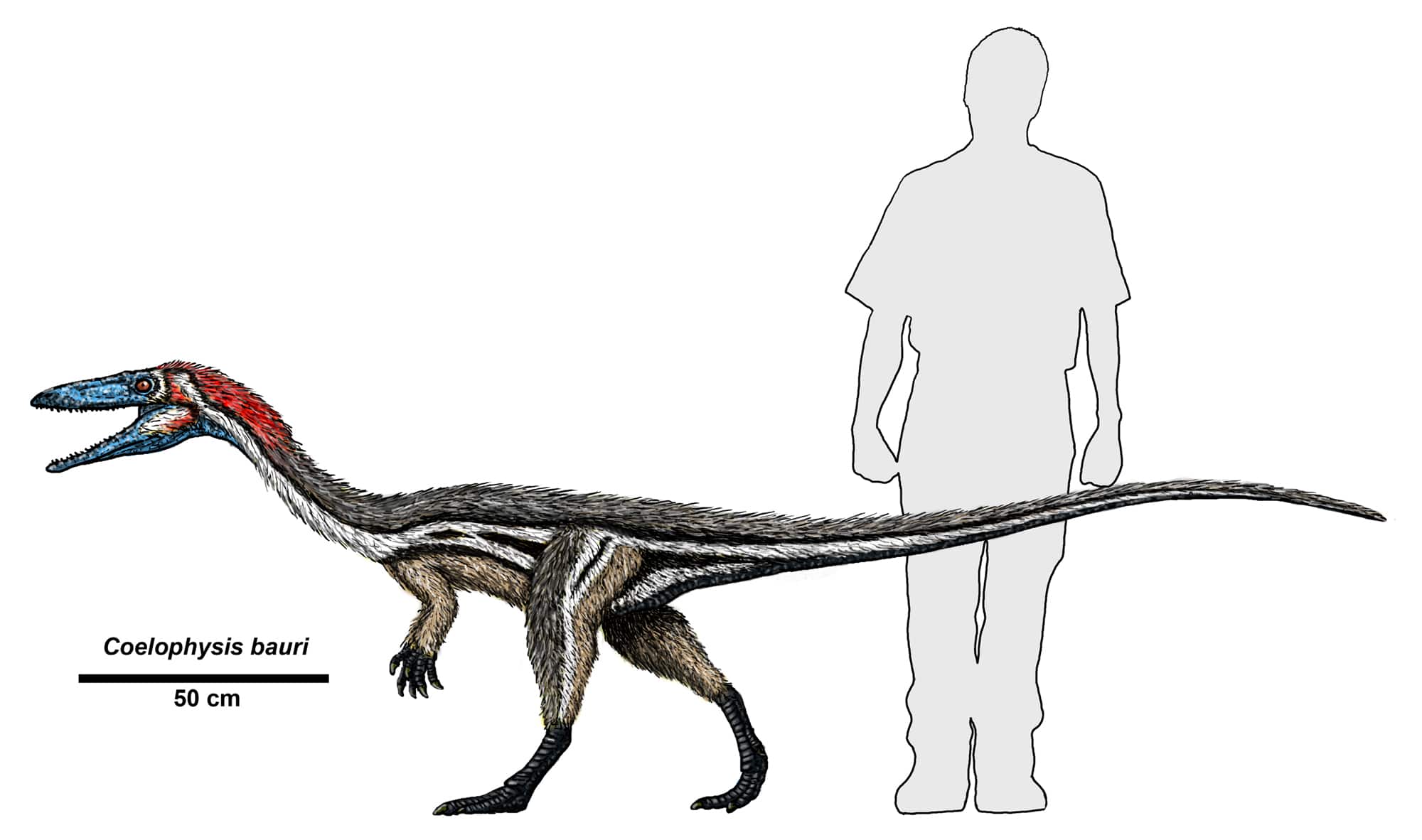
His eyes were directed forward, allowing him stereoscopic vision.
Sclerosis rings could be detected in some specimens. They are similar to the bony rings that support the eyes of modern-day birds, fish or some reptiles. This suggests that Coelophysis was a visually oriented predator compared to sclerosis rings of modern animals.
It probably had excellent depth perception and a range of vision similar to those of today's birds of prey. Furthermore, it can be concluded that he was probably active during the day and therefore had round pupils instead of slit-shaped ones.
Coelophysis probably became sexually mature between its second and third year of life. He was fully grown, just over 3 meters long, in his eighth year.
Did Coelophysis have feathers?
Although many fossils of Coelophysis have already been found, no skin prints have yet been detected. Therefore, it is not known whether he had feathers or not. If that were the case, Coelophysis would be one of the earliest known feathered dinosaurs.
Image sources:
Size comparison: Petrified Forest from Petrified Forest, USA, Public domain, via Wikimedia Commons
Skeletons: Bradley Gordon, CC BY 2.0 https://creativecommons.org/licenses/by/2.0, via Wikimedia Commons
Restoration hypothetical: Park Ranger, artist Jeff Martz[1], Public domain, via Wikimedia Commons
Coelophysis animatronics model,: Firsfron, CC BY-SA 3.0 http://creativecommons.org/licenses/by-sa/3.0/, via Wikimedia Commons