
Iguanodon
Iguanodon: The dinosaur made up of three big mistakes
In 1842, Richard Owen needed only three dinosaurs to coin a new term: "Dinosauria". Iguanodon was one of them, now classified as a species Iguanodon bernissartensis It's well-known. Nevertheless, its history is full of misunderstandings. A horn that wasn't one at all. A herd find that doesn't prove the existence of a herd. And a genus name that once encompassed far too many animals.
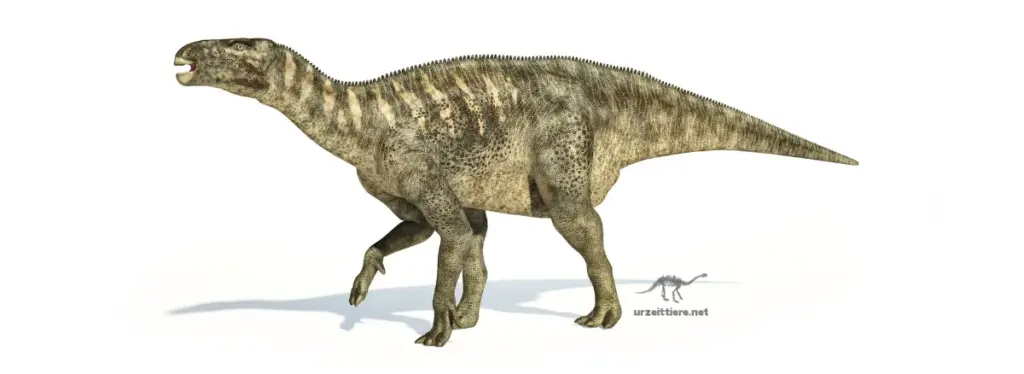
At a glance
| feature | Value |
|---|---|
| Scientific name | Iguanodon bernissartensis |
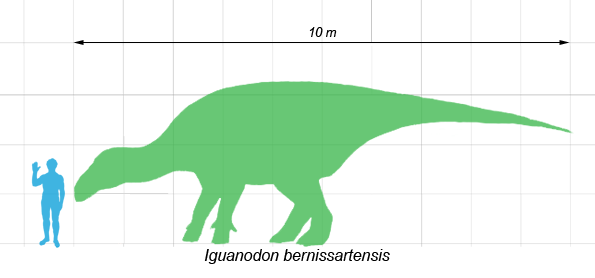
| length | 9–11 m |
| Weight | Disputed: 4 to 8 tons, depending on the source |
| Location | Bernissart (Belgium), Wealden Group (Southern England), Nehden (Germany), Morella Region (Spain) |
| age | Lower Cretaceous, approx. 126–122 million years ago |
| food | herbivores |
| Special feature | sharp thumb spur, originally misinterpreted as a nasal horn |
Did Iguanodon really have a horn on its nose?
In the summer of 1822, the first fossilized teeth were discovered near Cuckfield in southern England. The country doctor, Gideon Mantell, sent casts to several researchers. Most of the responses were unhelpful. Only the renowned anatomist Georges Cuvier replied: he was unaware of any such teeth. However, he suggested their structure indicated a new, herbivorous reptile. Mantell then compared the fossils with the dentition of a living iguana. He found a striking similarity. He chose the name "Iguanodon"—"iguana tooth"—in 1825, following a suggestion from William Conybeare.
Mantell possessed only a few teeth and bone fragments. He could only roughly estimate the animal's size. To do this, he applied the size ratio of an iguana to the much larger fossil tooth. This led him to calculate an animal over 18 meters long, almost twice the length of a bus. From the limited material, he also incorrectly incorporated a pointed bone: as a horn on the nose. Richard Owen adopted this error for the famous sculptures in London's Crystal Palace in 1853. On December 31 of that same year, researchers even dined inside an unfinished Iguanodon model. To this day, this remains one of the strangest anecdotes in paleontology.
It was only the mass discovery by Bernissart in 1878 that cleared up both errors. The nasal horn bone was in fact the thumb spur, just in the wrong place in the skeleton. And the actual length was only 9 to 11 meters instead of the once estimated 18.
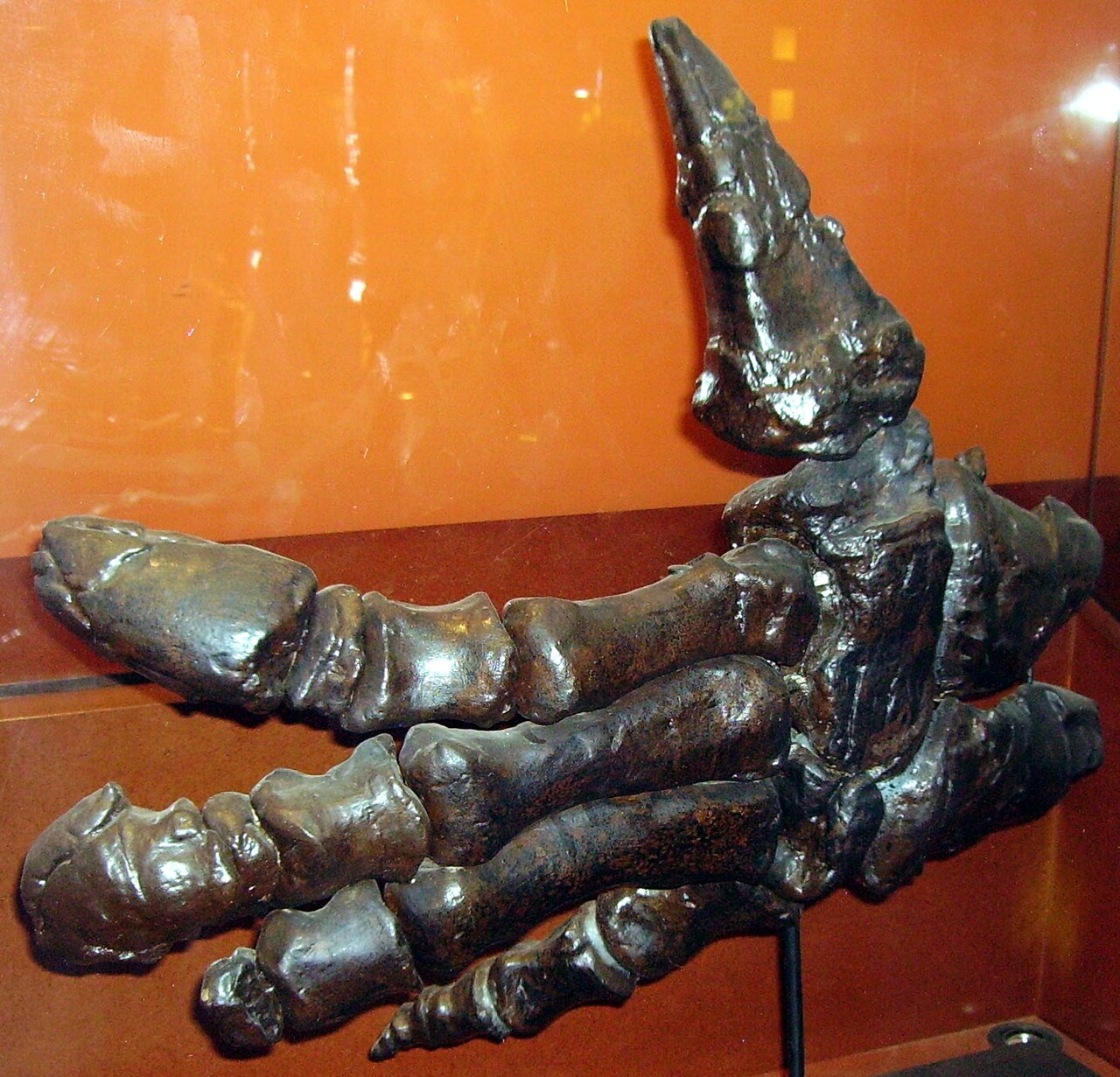
The thumb stud: weapon or tool?
Instead of a thumb, Iguanodon had a long, pointed bony spine. Its purpose is still debated by researchers. In a 2011 study, paleontologist Andrew Farke examined... Journal of Zoology Several ideas. His verdict: A combat function is "quite plausible"—for example, as a weapon against enemies or in conflicts with other members of the species. Use in foraging is also conceivable, such as when cracking open seeds. To date, neither idea has been proven.
Iguanodon is closely related to CamptosaurusBoth belong to the same group, the Ankylopollexia. However, Camptosaurus had a much blunter thumb spur, consisting of two segments instead of a sharp spur.
Four-legged or two-legged – Iguanodon could apparently do both.
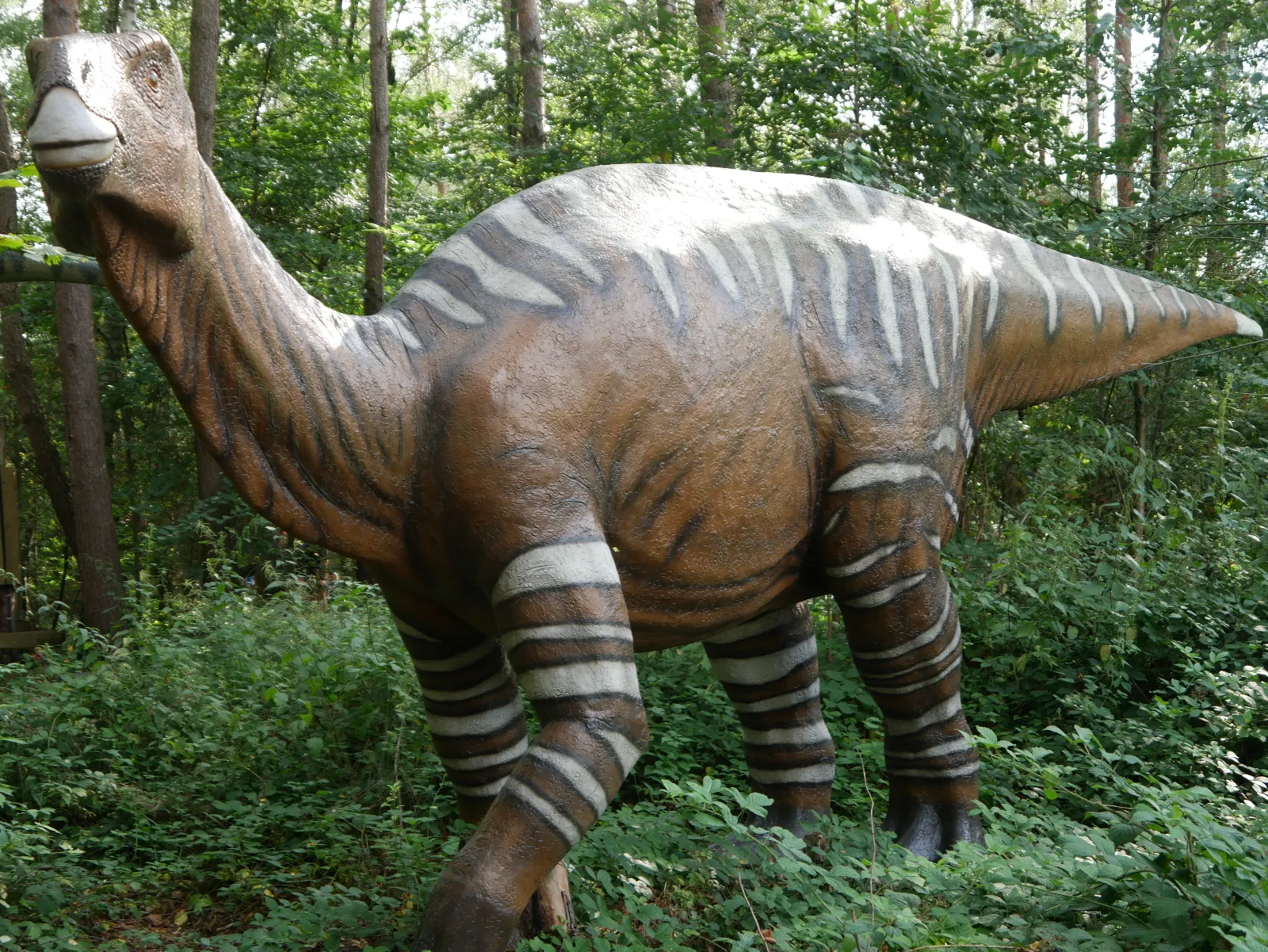
Iguanodon was neither purely quadrupedal nor purely bipedal. Its hind legs were powerful and significantly longer than its arms. Nevertheless, the animal could probably also move on all fours – similar to a gorilla, which also alternates between walking upright and walking on its ankles.
Early 19th-century models, however, depicted Iguanodon standing upright like a kangaroo, with its tail acting as a third leg on the ground. This view is now considered outdated.
The hand was practically a multi-tool. Three middle fingers were fused into a kind of hoof and supported the animal's weight during quadrupedal walking. The fifth finger presumably remained flexible enough for grasping. At the front of the mouth was a toothless, horny beak, followed by broad, leaf-shaped molars. When biting, the upper jaws rotated slightly outwards, grinding the plant matter instead of simply cutting it.
How many species are actually contained in "Iguanodon"?
For over 150 years, "Iguanodon" was a catch-all category. Almost every major find of related herbivores from the Early Cretaceous of Europe ended up in it. That changed fundamentally in 2008. Paleontologist Gregory S. Paul extracted a slimmer species from the genus. It was given a new name: MantellisaurusOther researchers followed with Barilium and HypselospinusA phylogenetic study by Andrew McDonald from 2012 confirms the close relationship of these three genera with Iguanodon bernissartensis.
Essentially, only one method remains that is certainly valid: Iguanodon bernissartensisA second one remains controversial: Iguanodon galvensis from Galve, Spain. More recent studies question whether it even belongs to the genus Iguanodon. I. bernissartensis The presence of these remains is also well documented in another part of Spain. Several partial skeletons have been unearthed near Morella in the east of the country since the 1980s. Most recently, a new find consisting of back and tail vertebrae was discovered in 2022.
The curious thing is that the fossils that gave rise to the name "Iguanodon" in 1825 no longer officially bear that name. In 2000, experts instead designated them as Iguanodon bernissartensis as the type species. However, this species was only discovered in 1878 – over 50 years after Mantell's first description.
Did Iguanodon live in herds?
No – at least not demonstrably. To date, neither eggs nor nests of Iguanodon bernissartensis are known. And even the mass discovery of Bernissart does not prove a mass die-off.
Einen ganz ähnlichen Fall gibt es bei einem kleineren Zeitgenossen aus derselben Wealden-Zeit: Auch bei Hypsilophodon auf der Isle of Wight hielt sich lange die Theorie eines gemeinsamen Herdentods – bis eine Studie von 2024 zeigte, dass die Tiere wahrscheinlich einzeln, über längere Zeit gestorben sind.
A 2012 study by Baele, Godefroit, and their team shows that the more than 30 skeletons lie in several clearly separated layers. The researchers interpret this as evidence of repeated mass die-offs. Presumably, the animals repeatedly drowned in a sinkhole trap that changed depending on the season. Not one single large event, then, but many small ones.
What did Iguanodon eat?
A pure herbivore, despite its strange name "Iguana Tooth". Attila Ősi and his team compared this in 2024 in Nature Communications The teeth of several relatives. Their finding: Later relatives with duck-like bills wore down their teeth two to four times faster. What exactly was on their menu, however, remains a mystery. The stomach contents of Iguanodon itself are unknown.
More information on this topic can be found at urzeittiere.net
- Camptosaurus – a close relative with a significantly blunter thumb spur, from the same Ankylopollexia group.
Image sources:
Hand of Iguanodon; Credit to en:user:Ballista. Taken from the English wikipedia, uploaded here with the same licensing., CC BY-SA 3.0, via Wikimedia Commons
Size comparison: Dinoguy2, CC BY-SA 3.0, via Wikimedia Commons