herbivores

  • Edmontosaurus

    „Echse aus Edmonton“ Edmontosaurus war somit einer der größten Hadrosaurier überhaupt. Seinen Namen erhielt die Gattung aufgrund des Ortes seiner ersten Entdeckung, der Edmonton-Formation Körperliche Merkmale des Edmontosaurus Edmontosaurus, ein Hadrosaurier, lebte während der späten Kreidezeit vor 73 bis 65 Millionen Jahren in Nordamerika. Diese Pflanzenfresser erreichten eine Länge von bis zu 13 Metern und…

  • Parasaurolophus

    “Fellow of the crested lizard” Parasaurolophus was a duck-billed dinosaur with an extremely long, backward-sloping, bony crest. This crest was hollow and as large as the rest of its skull. Researchers believe it served to produce a foghorn-like sound at low frequencies. Parasaurolophus was a herbivore that ate pine needles, leaves, and twigs. It was…

  • Prosaurolophus

    "Before Saurolophus" Prosaurolophus (Greek – vor saurolophus) was a terrestrial dinosaur genus of hadrosaurs (known as duck-billed dinosaurs because of the similarity of its head to that of modern ducks). Prosaurolophus lived during the Late Cretaceous period. It is most clearly distinguished by its long, broad skull and a small crest near the eyes. This…

  • Stegosaurus

    “The Roofed Lizard” The Stegosaurus (“roofed lizard”) was a large, slow-moving herbivore. It lived approximately 150.8 to 155.7 million years ago, during the Late Jurassic period. Its fossils have been found primarily in western North America. It was about the size of a bus and had two rows of 17 to 22 large bony plates on its neck…

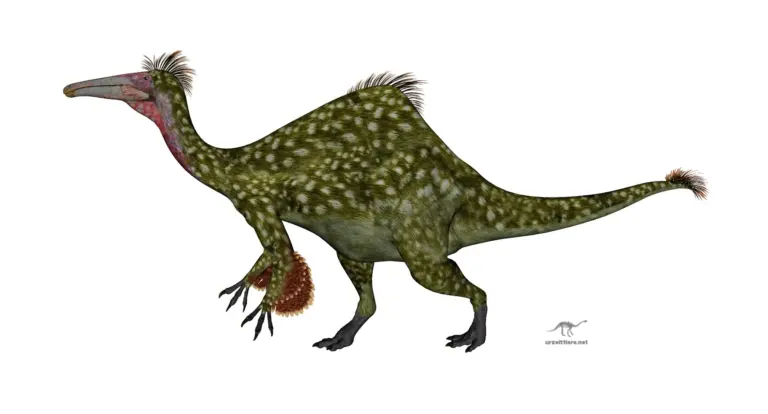
  • Deinocheirus: The dinosaur that consisted of nothing but arms for 50 years

    A dinosaur, eleven meters long. Yet for almost five decades, all that was known of it was a pair of enormous arms. No face, no legs, no body. It wasn't until 2014 that the truth came to light: by far the largest known representative of the "ostrich dinosaurs." At a glance: Characteristic Value Length approx. 11 m Weight approx. 6.4 t (range of other estimates:…

  • Saurolophus

    The name Saurolophus means "lizard with a crest," derived from the ancient Greek words *saurus*, meaning "lizard," and *lophos*, meaning "crested crest." Because a number of nearly complete skeletal systems have been found, archaeologists have a good idea of ​​what Saurolophus looked like. The most distinctive feature of Saurolophus is…