Deinocheirus: The dinosaur that consisted of nothing but arms for 50 years
A dinosaur, eleven meters long. Yet for almost five decades, all that was known of it was a pair of enormous arms. No face, no legs, no body. Only in 2014 did the truth come to light: by far the largest known representative of the "ostrich dinosaurs".
At a glance
| feature | Value |
|---|---|
| length | approx. 11 m |
| Weight | approx. 6.4 t (range of other estimates: 5–7.3 t) |
| Location | Nemegt Formation, Gobi Desert, Mongolia |
| age | Late Cretaceous, early Maastrichtian, approximately 70 million years ago |
| Food | omnivore |
| Special feature | Largest known ornithomimosaurus, 2.4 m long arms |
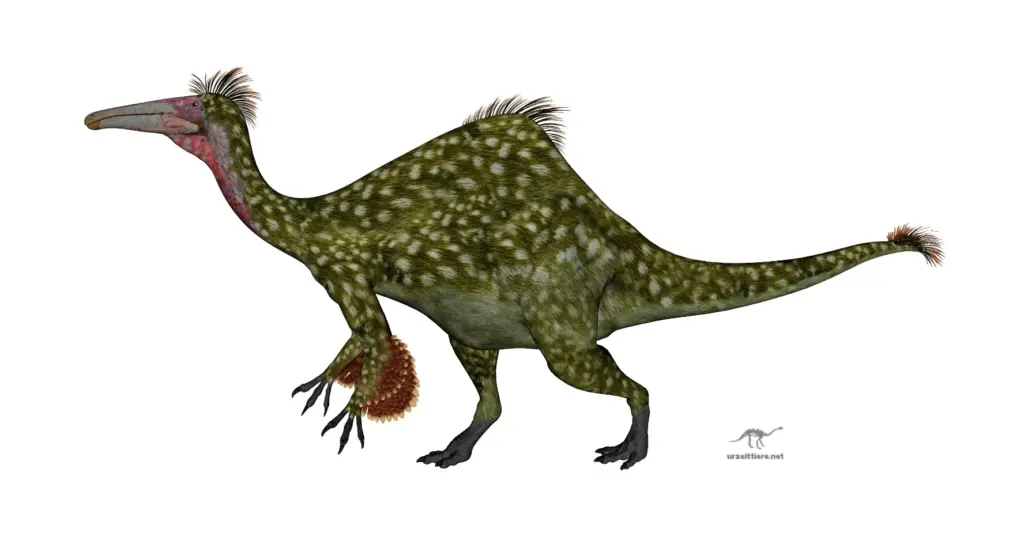
At eleven meters long, it was about the same length as a city bus. Its weight of around 6.4 tons was comparable to that of a large bull elephant. Its arms measured 2.4 meters. That's more than most basketball hoops hang above the ground. The claws on them were about 20 centimeters long: roughly the length of a banana.
Why did Deinocheirus remain a mystery for almost 50 years?
Am 9. Juli 1965 stieß die polnische Paläontologin Zofia Kielan-Jaworowska im Rahmen der polnisch-mongolischen Expeditionen an der Fundstelle Altan Uul III in der Gobi-Wüste auf ein Paar 2,4 Meter lange Arme, dazu Schultergürtel, einzelne Rückenwirbel und Rippen. Schädel, Beine und Rumpf fehlten komplett. 1970 gaben Halszka Osmólska und Ewa Roniewicz dem Fund trotzdem einen Namen: Deinocheirus mirificus, the “unusual terrible hand”.
Without a body, there was plenty of room for wild ideas. Was it a predator, larger than Tyrannosaurus? A relative of the clawed therizinosaurs? Or a climbing, sloth-like creature? As early as 1971, John Ostrom suggested a different solution: a close relationship to the ostrich dinosaurs. He couldn't prove it, however; the necessary material was lacking. Thus, the find remained one of paleontology's great unsolved mysteries for almost five decades.
What does a fossil theft have to do with the solution?
Die Antwort kam erst mit zwei weiteren Skeletten. 2006 fand die Korea-Mongolia International Dinosaur Expedition an der Fundstelle Altan Uul IV ein rund 74 Prozent großes Jungtier (MPC-D 100/128). 2009 folgte in Bugiin Tsav das bislang größte bekannte Exemplar (MPC-D 100/127) – sechs Prozent größer als der ursprüngliche Holotyp.
Beide Skelette waren schon vor der wissenschaftlichen Bergung geplündert worden: Dem größten Exemplar fehlten Schädel, Hände und Füße. Diese Teile tauchten 2011 in einer europäischen Privatsammlung wieder auf. Der französische Fossilienhändler François Escuillié erwarb sie und übergab sie dem Königlich Belgischen Institut für Naturwissenschaften.
Erst mit dem vollständigen Material konnte ein Team um Yuong-Nam Lee 2014 in Nature die Lösung präsentieren – begleitet von einem Kommentar des Paläontologen Thomas R. Holtz unter dem Titel „Mystery of the horrible hands solved“.
A body as if composed of several animals
The only known skull is just over a meter long. Behind the eyes, however, it measures only 23 centimeters. It has a toothless, broad beak like a duck's – curved downwards, similar to a hadrosaur. The jaw muscles were only weakly attached. Deinocheirus probably had a rather weak bite.
A sail-like structure rises above the back. The spinous processes of the posterior vertebrae become progressively longer towards the back. At the highest vertebra, they are 8.5 times as long as the vertebra itself. Only in Therizinosaurus and at the more well-known Spinosaurus gibt es ein ähnlich extremes Verhältnis. Am Schwanzende sitzt ein Pygostyl – ein verwachsener Rest der letzten Schwanzwirbel, wie er sonst nur von Vögeln bekannt ist –, dazu ein U-förmiges Gabelbein, in der Fachsprache Furcula genannt. Beides zeigt: Die Verwandtschaft zu den Vögeln war eng.
Innerhalb der Straußendinosaurier bildet Deinocheirus zusammen mit dem deutlich kleineren Garudimimus und der bislang nur aus der Fachliteratur bekannten Gattung Beishanlong die Familie Deinocheiridae.
The arms remain its trademark feature. 2.4 meters long, with three fingers almost equally long. Only Therizinosaurus had similarly long arms – no other bipedal dinosaur had longer ones. However, the hands were hardly suitable for grasping. They were more likely used for digging and pulling plants along the shore.
What was on the menu?
In the stomach area of the largest skeleton, researchers found over 1,400 gastroliths. These are stones that helped grind up food. Fish vertebrae and scales were also found. This suggests an omnivore: aquatic plants and fish were likely both on the menu. Similar to modern-day ducks or flamingos – only on a gigantic scale.
The Nemegt Formation, where Deinocheirus lived, was significantly wetter than the older desert strata of the Gobi. River channels, mudflats, shallow lakes – often compared to the present-day Okavango Delta in Botswana. Nevertheless, he wasn't safe there. Bite marks on his ribs are attributed to the large predator. Tarbosaurus attributed to it. Even a six-ton giant was not entirely spared.
Why did he weigh ten times as much as his closest relatives?
Deinocheirus belongs to a small family called Deinocheiridae. This family includes only two other, significantly smaller genera: Garudimimus and Beishanlong. The sister group is the slender, fast-running Ornithomimidae. The size difference is enormous. Gallimimus, the largest "classical" representative of this group from the same geological formation, weighed only 285 to 640 kilograms, depending on the calculation. Deinocheirus, at 6.4 tons, weighed at least ten times as much.
Eine 2022 als Preprint veröffentlichte, noch nicht abschließend begutachtete Studie von Chinzorig, Cullen, Phillips, Rolke und Zanno beschreibt Fußknochen eines Ornithomimosauriers aus der Eutaw-Formation in Mississippi (USA). Ihre Größe passt eher zu Deinocheirus als zu anderen bekannten Arten aus Nordamerika. Bestätigt sich das noch, gab es solche Riesen unter den Straußendinosauriern womöglich nicht nur in der Mongolei.
From museum piece to streaming star
In der Apple-TV+-Dokumentation „Prehistoric Planet“ (Staffel 1, Folge 3, „Freshwater“) watet ein gefiederter Deinocheirus durch ein asiatisches Feuchtgebiet. Im Spiel „Jurassic World Evolution“ gehört er zu den spielbaren Dinosauriern. In „ARK: Survival Evolved“ fehlt er dagegen offiziell. Dort gibt es ihn nur über einen beliebten Fan-Mod, „ARK Additions“ – Spitzname in der Community: „Duck King“.
More information on this topic can be found at urzeittiere.net
- Therizinosaurus – the only other dinosaur with similarly long arms and claws, but from a completely different group of carnivores.
- Tyrannosaurus Rex – for comparison, the most famous predator of the late Cretaceous period: much smaller arms, but a stronger bite.
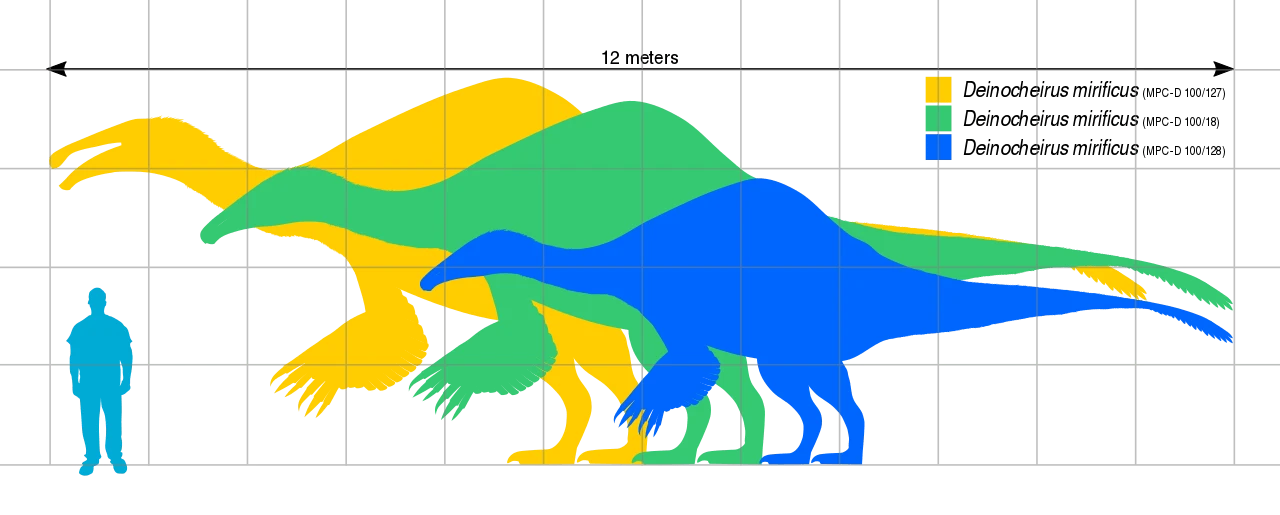
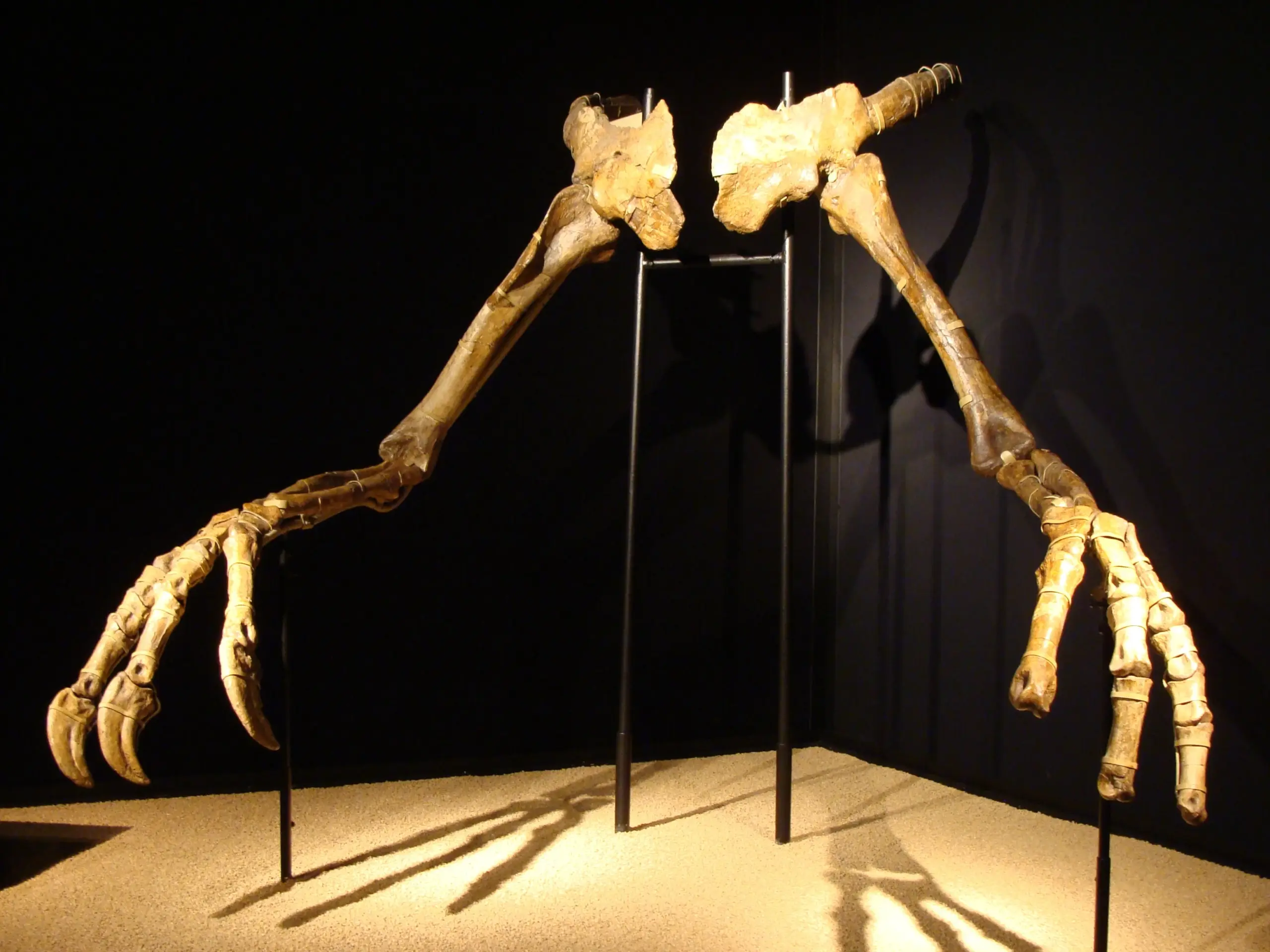
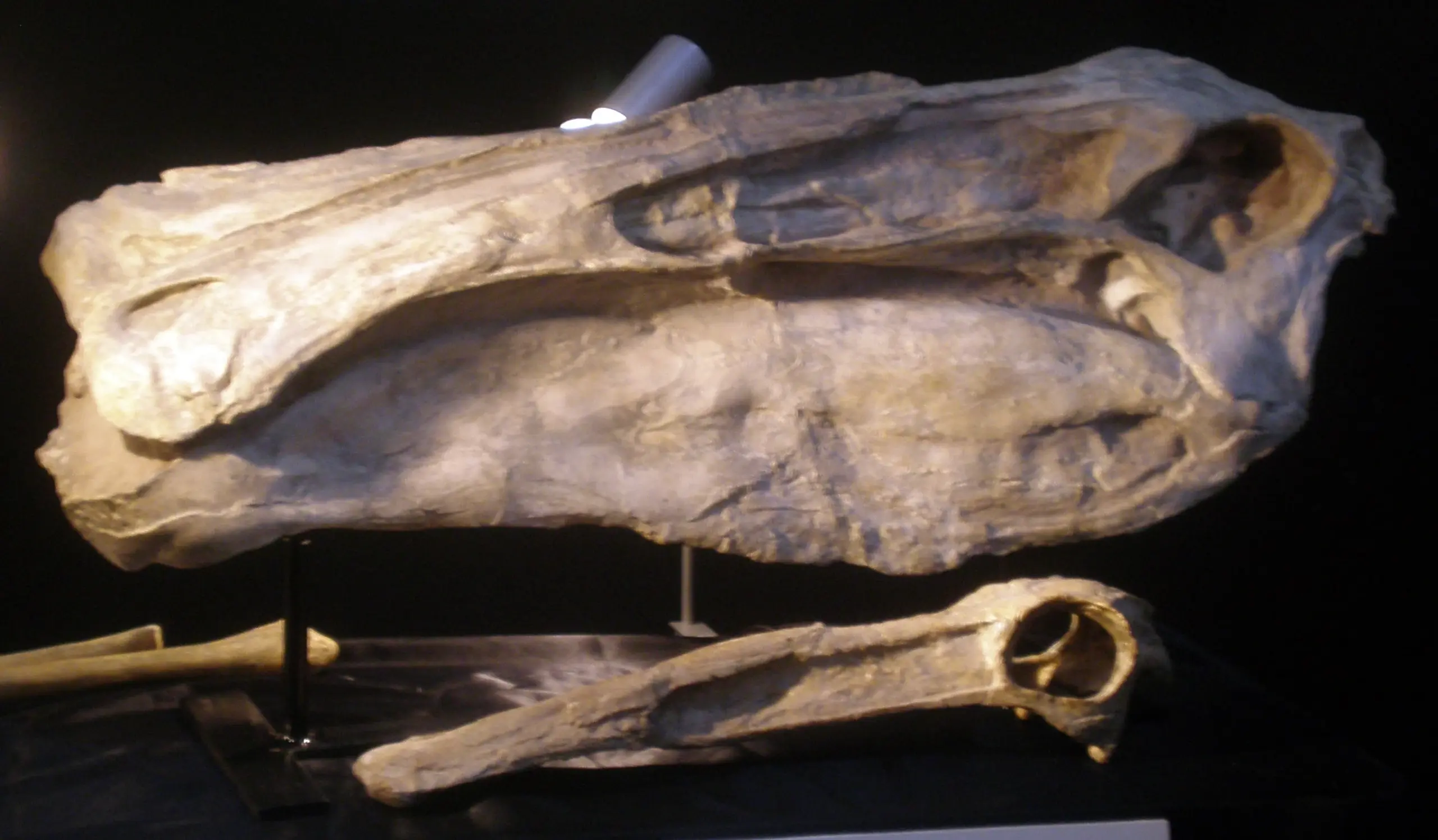
Image sources: FunkMonk (Michael B. H.), CC BY-SA 3.0 https://creativecommons.org/licenses/by-sa/3.0, via Wikimedia Commons
Size comparison: Conty, CC BY 3.0 https://creativecommons.org/licenses/by/3.0, via Wikimedia Commons
Skull: Derdadort, CC BY-SA 4.0 https://creativecommons.org/licenses/by-sa/4.0, via Wikimedia Commons
Deinocheirus arms: Eduard Solà, CC BY-SA 3.0 https://creativecommons.org/licenses/by-sa/3.0, via Wikimedia Commons