Torosaurus
Torosaurus: The horned dinosaur with the window shield
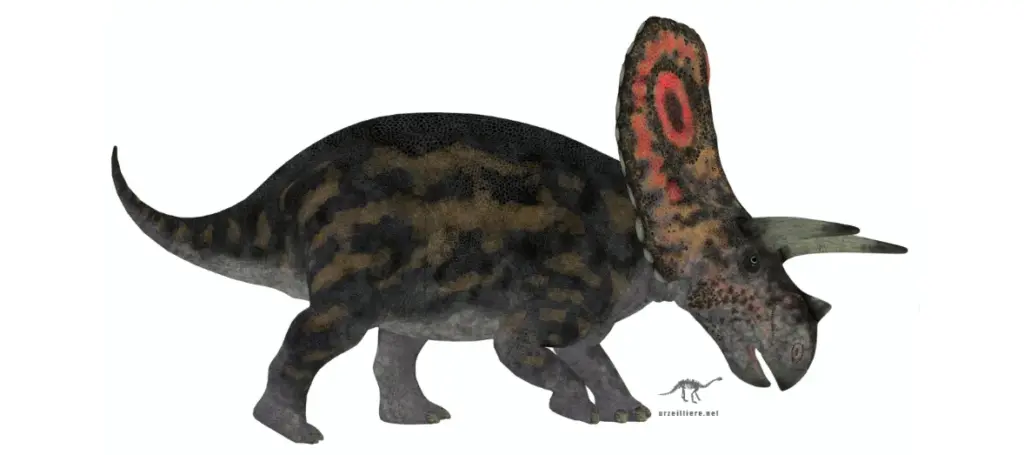
With a skull almost three meters long and a neck frill featuring two large windows, Torosaurus is one of the largest horned dinosaurs in North America. Whether it even constituted its own genus has been a matter of debate among researchers for over ten years. Some consider it a very ancient Triceratops.
At a glance
| feature | Value |
|---|---|
| name | Torosaurus (“Bull Lizard”) |
| species | Torosaurus latus and Torosaurus utahensis |
| skull length | Over 2 meters, the largest skulls almost 3 meters |
| Weight | up to 6.5 tons |
| Location | Wyoming, Montana, South Dakota and Utah (USA), Saskatchewan and Alberta (Canada) |
| age | Late Maastrichtian, end of the Upper Cretaceous |
| food | herbivores |
| Fossils | very rare |
Torosaurus belongs to the chasmosaurines. This is the name given to a group of horned dinosaurs with a particularly long neck frill. It lived at the same time and in the same area as Triceratops and Tyrannosaurus Rex.
A neck shield with two windows
Torosaurus walked on four legs and ate plants. Weighing up to 6.5 tons, he was as heavy as a large bull elephant.However, very little is described about the body behind the head. None of the evaluated studies mention the length of the entire animal.
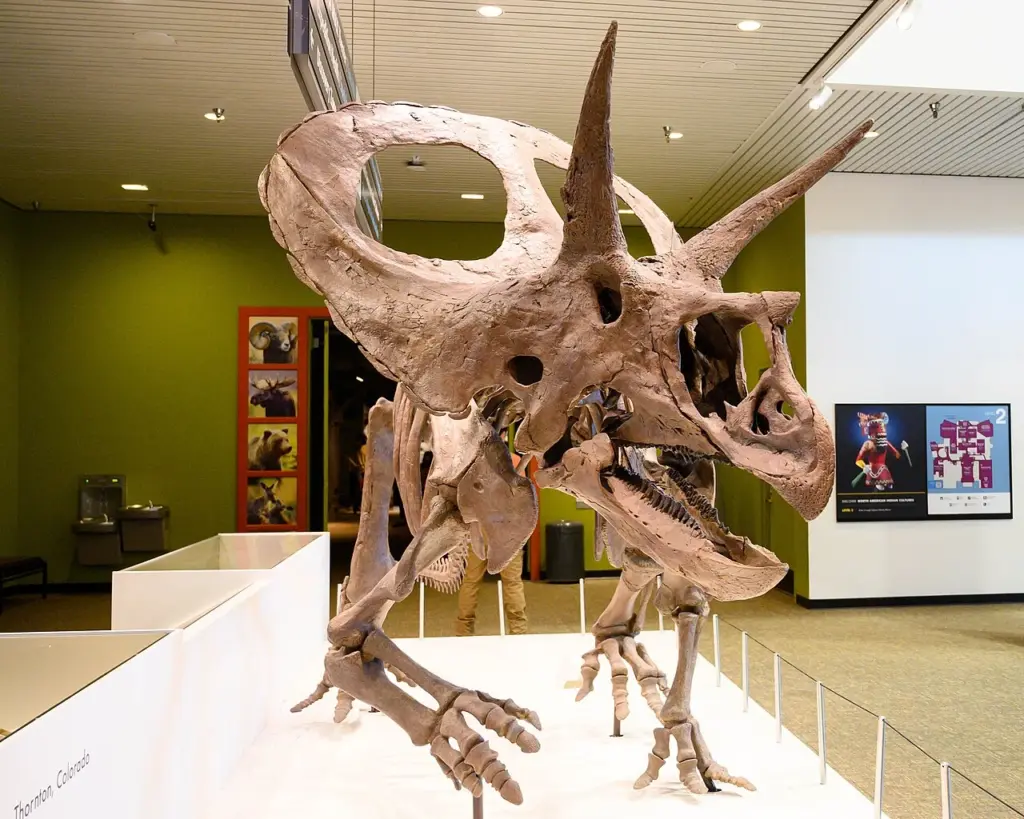
The distinctive feature was located on the head. The face was long, the horns of the eyes largely straight. The largest skulls measure almost three meters.That's longer than a double bed.
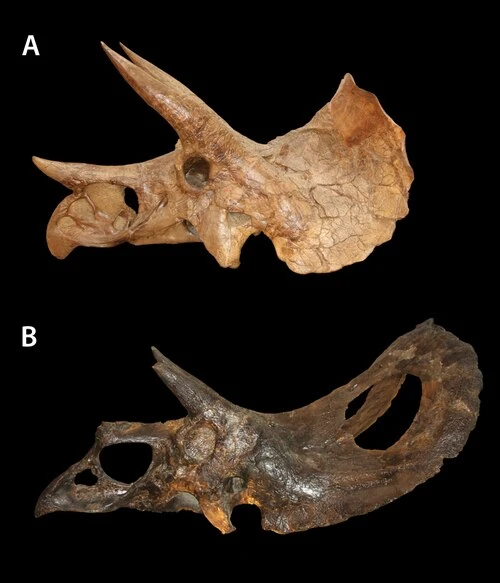
Behind it sat the neck guard, or frill in technical terms. In Torosaurus it is long and has windows, in Triceratops it is short and massiveThe windows are almost circular. The bones in between were In one Utah find, the material was in places thinner than 3 millimeters. – barely more than a euro coin.
Nevertheless, the shield was huge. In a find from Montana, the bone clasp in the shield measures just over two meters..
The two species also look different. T. latus It had a long, pointed squamous bone and eye horns that pointed almost vertically upwards. T. utahensis It had a shorter, rounded posterior squamous bone and an unusually wide horn base. The horn measures approximately 52 centimeters in the preserved piece..
Who discovered the "bull lizard"?
Between 1889 and 1892, fossil hunter John Bell Hatcher collected horned dinosaurs in Wyoming for paleontologist Othniel Charles Marsh. Most of the finds were Triceratops. Two skulls didn't fit the pattern. Marsh named them Torosaurus in 1891., in German “bull lizard”.
Marsh noticed two windows in the neck shield and long, narrow squamosal legs. He named the first skull T. latus, the second T. gladius. Both remained the only specimens for decades.
In 1944, a third, better-preserved skull was recovered in South Dakota. It was smaller than the two from Wyoming. After that, it was considered T. gladius as a synonym of T. latus.
Was there a second Torosaurus in Utah?
Yes, that's how experts have seen it since 1976. To recap: In 1935, geologists in Utah discovered the first horned dinosaur remains in the North Horn Formation. Two expeditions continued collecting. In the end, skeletal remains from eleven animals were available..
Only one specimen was complete enough to warrant a name. Researcher Charles Gilmore initially assigned it to the genus Arrhinoceratops, with a question mark at the end. Douglas Lawson introduced it as Torosaurus in 1976., and all subsequent works followed it.
The redesign in 2005 brought a surprise. The bones of the holotype were found in an area of only 11 square meters, but came from at least three animals..
How far did Torosaurus reach?
For a long time, it was unclear where Torosaurus actually lived. Many finds are only fragments. Researchers later classified a fragment from Texas as an indeterminate chasmosaurine. Finds from New Mexico are also not considered certain.
Two neck guards from Canada were long considered questionable. One was found by two men in Saskatchewan in 1947. Shortly after its recovery, it was repaired with plaster and clay. In 2022, a team re-examined both shields and assigned them to T. latus.According to this, Torosaurus' range extended as far as Canada.
The Canadian fossils come from strata corresponding to the upper part of the Hell Creek Formation. Most of the Montana fossils come from the lower half. It's possible that, as with Triceratops, several Torosaurus species diverged. This hasn't been proven, however.
Was Torosaurus actually a fully grown Triceratops?
This question continues to occupy experts to this day. It is also addressed in the Triceratops articleHere's the view from Torosaurus.
Horned dinosaurs significantly changed their horns and neck frill over the course of their lives. Therefore, in 2010 the idea arose that Torosaurus was the final stage of Triceratops.It is assumed that in its old age the sign would have developed elongated windows.
Three observations so far contradict this.
The age. Researchers classified skulls according to their stage of maturity.Both genera contain young and old animals. A very large Torosaurus skull, measuring over 2.6 meters, was then thought to belong to a subadult. This is controversial, as the skull is heavily augmented with plaster.
The transitional forms. Ancient Triceratops shields have depressions in a different location and shape than the windows of Torosaurus. The decorative bones around the edge also don't match. A clear intermediate stage is missing.
The third candidate. The Nedoceratops skull, which had been proposed as an intermediate stage, is notTriceratops, Torosaurus, and probably also Nedoceratops are distinct forms. According to this study, the scarcity of young Torosaurus specimens is simply due to Torosaurus's rarity.
What's new is the view inside the bones. A thigh from Canada was shaved thin.The bone was heavily remodeled but showed no external growth limit. The animal was therefore not yet fully grown. Its shield was still growing, and decorative bones were missing.
The dispute is not formally over. A very young animal with Torosaurus-like features or a young Triceratops with windows could decide it. Neither has been found so far.
More information on this topic can be found at urzeittiere.net
- Triceratops – the common contemporary with which Torosaurus is often compared and confused.
- Tyrannosaurus Rex – a carnivorous neighbor from the same era and region.
- Pentaceratops – also a horned dinosaur with a fenestrated neck frill.
- Arrhinoceratops – A relative from Canada, to whom Gilmore first attributed the Utah finds.
Image sources:
Torosaurus skeleton: David Wipf, CC BY 2.0, via Wikimedia Commons
Skull comparison A – Triceratops; B – Torosaurus latus : Nicholas R. Longrich*, Daniel J. Field, CC BY 2.5, via Wikimedia Commons