
Daspletosaurus
Daspletosaurus is a lesser-known relative of Tyrannosaurus rex that lived in western North America during the Late Cretaceous.
It was a large theropod dinosaur characterized by a robust build and powerful jaws, similar to its more famous cousin.
Recent studies have revealed more about Daspletosaurus, including its possible social behavior and unique adaptations, which contribute to our understanding of theropod evolution.
Ongoing research on Daspletosaurus could provide new insights into the lifestyle and ecological role of large predatory dinosaurs.
Discovery and naming
The first discovery of Daspletosaurus occurred in 1921, when the first specimen of D. torosus was found in Alberta, Canada. It was originally misidentified as a Gorgosaurus.
This finding is important because it improves our understanding of theropod behavior, particularly with regard to their bipedal locomotion and potential crouching hunting strategies.
In 1970, paleontologist Dale Russell officially described and named the genus Daspletosaurus, which means in Greek “terrible lizard” or “terrible lizard” means.
Further excavations in Alberta and Montana uncovered additional specimens, some of which may belong to previously unknown species, expanding our knowledge of the diversity and geographical distribution of this group of tyrannosaurids.
Features
Daspletosaurus is characterized by its large skull, which could be over a meter long and was robustly built.
Its postcranial skeleton includes a short, S-shaped neck, very small arms with two fingers that are relatively longer than those of other tyrannosaurids, and strong, elongated hind legs.
The dinosaur also had a long, heavy tail that served as a counterweight to its head and torso, helping to maintain balance and stability.
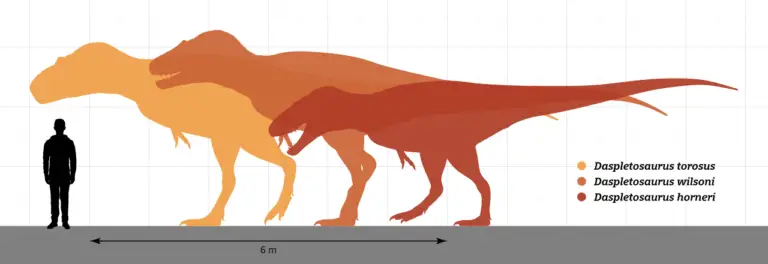
| length | 9.3 meters |
| Weight | 3.1 tons |
| locomotion | Two-legged |
| Food | Carnivores |
skull
The Daspletosaurus had a large skull, often over a meter long, making it a formidable predator.
The structure of the skull included fused nasal bones for added strength and large openings that helped reduce weight.
The teeth of Daspletosaurus were very long, it had around 60 teeth. Most teeth were oval in cross-section rather than blade-shaped.
However, the teeth in the premaxilla, at the front end of the upper jaw, were D-shaped in cross section. This heterodonty, i.e. the presence of different tooth shapes, is found in all tyrannosaurids.
The taller, broader snout of tyrannosaurs such as Daspletosaurus is mechanically stronger than the flatter snout of albertosaurs. However, the thickness of the teeth is similar in both groups.
Bite marks from a young tyrannosaur, possibly Daspletosaurus, were found on a lower jaw of a saurornitholest from the Dinosaur Park Formation.
The design of the skull was well adapted to its role as a predator in the Late Cretaceous of North America.
Postcranial skeleton
The postcranial skeleton of Daspletosaurus exhibited features also found in its tyrannosaurid relatives.
It had a short, S-shaped neck supported by a large body balanced by two strong hind legs. The forelimbs were small but relatively longer than those of other tyrannosaurids and had two fingers.
This anatomical structure is typical of the physique of tyrannosaurs, which adapted to a predatory lifestyle in the Late Cretaceous in North America.
Classification and systematics
Daspletosaurus is classified in the family Tyrannosauridae, more precisely in the subfamily Tyrannosaurinae. This classification suggests a close evolutionary relationship Tyrannosaurus rex and some researchers suggest that Daspletosaurus may have been a direct ancestor of T. rex. However, the exact phylogenetic relationships within the Tyrannosauridae are still debated among paleontologists.
The classification of tyrannosaurid genera is as follows:
| Tyrannosaurid group | Representative genera |
|---|---|
| Tyrannosaurinae | Daspletosaurus, Tyrannosaurus, Tarbosaurus |
| Albertosaurinae | Albertosaurus, Gorgosaurus |
Some studies suggest a closer relationship between Daspletosaurus and North American tyrannosaurids, while others suggest a stronger connection to Asian genera such as Tarbosaurus. This reflects the complexity of tyrannosaurid evolution and the challenges of reconstructing relationships based on available fossil evidence. The placement of Daspletosaurus within the Tyrannosauridae is important for studying the biogeography and evolutionary history of large theropods during the Late Cretaceous. As new fossils are discovered and analytical techniques improve, the position of Daspletosaurus within the Tyrannosauridae taxonomy may become clearer, which could provide insights into the diversification and distribution patterns of these predators in North America and Asia.
Paleobiology
The identification and classification of Daspletosaurus species has provided valuable insights into the paleobiology of these predators. Research suggests that Daspletosaurus had a highly developed sensory system, with evidence pointing to the presence of integumentary sense organs in D. horneri. These structures probably had multiple functions, such as: B. Touch sensation, control of jaw movements, temperature detection and prey identification.
Studies of Daspletosaurus fossils have provided information about their social behavior and growth development. There is evidence that these tyrannosaurs may have lived in groups, as suggested by bite marks on facial bones indicating intraspecific fighting and a bone bed in Montana containing remains of several daspletosaurus and hadrosaurs.
The growth development of Daspletosaurus included an extended juvenile period, followed by rapid growth leading to sexual maturity.
As top predators, Daspletosaurus species played an important role in Late Cretaceous ecosystems. Their prey probably included large herbivorous dinosaurs such as Centrosaurus and Hypacrosaurus. This is supported by the discovery of remains of young hadrosaurs in a D. torosus specimen, providing direct evidence of their predatory behavior and food choices.
Paleoecology
During the Late Cretaceous, Daspletosaurus lived in a diverse ecosystem along the west coast of the Western Inland Sea.
This theropod lived together with another Tyrannosaurus, Gorgosaurus, in an environment that consisted of lush floodplains, woodlands, and riverine landscapes.
The presence of volcanic ash in the rock formations allowed the Daspletosaurus fossils to be accurately dated and provided valuable information about the time period in which this predator lived.
coexistence with Gorgosaurus
Daspletosaurus and Gorgosaurus, two tyrannosaur dinosaurs, lived together in certain regions during the Late Cretaceous Period, about 78 to 74 million years ago.
To reduce competition for resources, these predators are thought to have different ecological roles in their shared environment.
This niche separation likely allowed both species to live successfully in the same areas of western North America.
Daspletosaurus compared to Tyrannosaurus Rex
Daspletosaurus and Tyrannosaurus rex, both members of the tyrannosaur family, have notable differences despite their similarities. A key difference is their size: Daspletosaurus was around 8 to 9 meters long, while Tyrannosaurus rex could grow up to 12 meters long. These size differences likely influenced their role in the ecosystem and their hunting methods.
Anatomically, Daspletosaurus had relatively longer arms compared to Tyrannosaurus rex, which could indicate differences in prey capture method or other behaviors. In addition, there were differences in skull structure; Daspletosaurus had a higher and wider snout, which may have affected its sensory abilities, bite force, or feeding habits.
Here is a summary of their differences:
| feature | Daspletosaurus | Tyrannosaurus rex |
|---|---|---|
| length | 8-9 meters | 12 meters |
| Arm length | Relatively longer | Relatively shorter |
| Shape of the muzzle | Higher and wider | Relatively narrower |
| Period | 78-74 million years ago | 68-66 million years ago |
These differences illuminate the evolutionary paths within the family Tyrannosauridae and show how these predators have adapted to their environment and ecological role.
Frequently asked questions
Frequently asked questions about Daspletosaurus often focus on its discovery and naming. A frequently asked question concerns its relationship to Tyrannosaurus rex. Some scientists believe that Daspletosaurus may be a direct ancestor of Tyrannosaurus, while others consider them to be closely related but not directly in the same lineage. This debate highlights the complexity of Tyrannosaurus evolution and highlights ongoing research in paleontology.
Another common question concerns the size of Daspletosaurus. Adult specimens were typically between 8 and 9 meters long and weighed about 2.5 tons, making them the larger theropods of their time.
The location of the Daspletosaurus fossils is also of interest. These fossils were found in Alberta, Canada, and Montana, USA, suggesting they lived in western North America during the Late Cretaceous.
The name “Daspletosaurus”, which in Greek means “frightful lizard“ or in German “terrible lizard" means, aptly describes this predator. Three species have been officially named: D. torosus, D. horneri and D. wilsoni. Additional species may be described in the future, which would expand our understanding of the diversity and evolution of this genus.
Conclusion
They studied Daspletosaurus, an important tyrannosaur that lived in North America during the Late Cretaceous. They have gathered information about its discovery, its distinctive characteristics and its role as an apex predator. You also learned about its classification, paleobiology, and the similarities and differences from the well-known Tyrannosaurus rex. This information will deepen your understanding of theropod evolution and ecosystems of prehistoric North America and contribute to a more comprehensive knowledge of Earth's prehistoric biodiversity.
Systematics
| Dinosauria |
| Saurischia |
| Eusaurischia |
| Theropoda |
| Neotheropoda |
| Averostra |
| Tetanurae |
| Orionides |
| Avetheropoda |
| Coelurosauria |
| Tyrannoraptora |
| Tyrannosauroidea |
| Pantyrannosauria |
| Eutyrannosauria |
| Tyrannosauridae |
| Tyrannosaurinae |
| Daspletosaurini |
Occurrence in time
| chalk |
| Upper Cretaceous |
| middle Campanian |
Happen
| Area | North America |
| country | Canada |
| region | Alberta |
| formation | Oldman |
Image sources:
Size comparison: SlvrHwk, CC BY-SA 4.0, via Wikimedia Commons