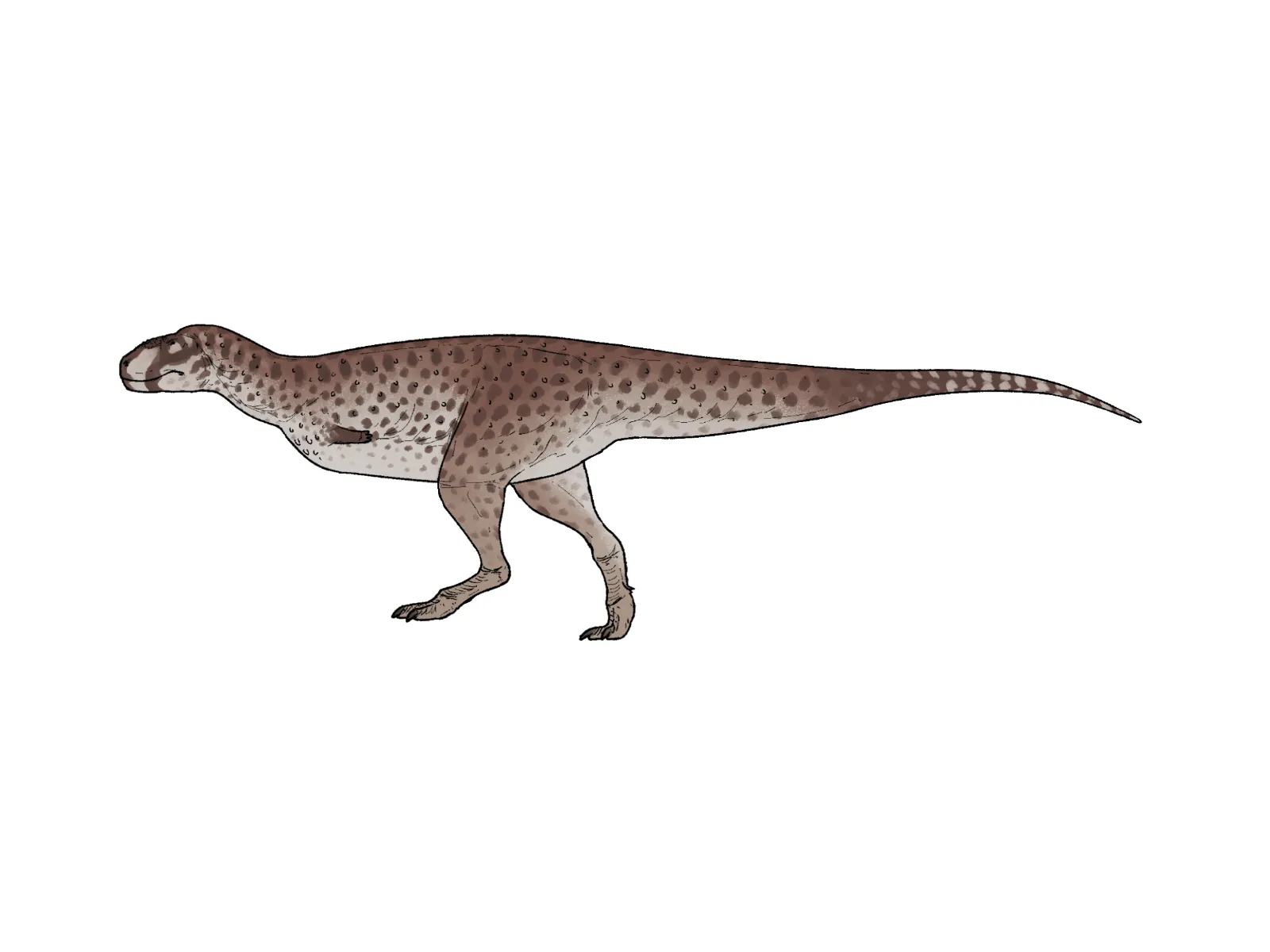
Koleken inakayali: The hornless cousin of the Carnotaurus
A carnivore without horns. Barely bigger than a minibus. It lived in Patagonia around 70 million years ago. Right next door to Carnotaurus. His bones were found back in 2015. He wasn't given a name until 2024.
At a glance
| feature | Value |
|---|---|
| length | approx. 4.97 m (only known animal, not yet fully grown) |
| Weight | No reliable estimate available. |
| Location | La Colonia Formation, Chubut, Patagonia (Argentina) |
| age | Late Cretaceous, approx. 69–72 million years ago |
| food | Carnivores |
| Special feature | close relative of Carnotaurus, but without horns |
The table intentionally omits a weight in kilograms. There is no reliable study on this. Figures like "1,000 kg" do circulate online, but they originate solely from social media. They are often confused with the much larger Carnotaurus.
Nine years between discovery and naming
In 2015, researchers discovered bones in the Cerro Bayo Norte area of Chubut province. The bones were embedded in claystone, where a river once flowed into the sea. It is likely that the river washed the body to this location, and it was buried shortly thereafter. This probably explains why the rear part of the skeleton was so well preserved.
The animal wasn't given a name until 2024. A team led by Diego Pol described the new species. in the journal Cladistics. The find bears the number MPEF-PV 10826. It is located in a museum in Trelew – the same building that also displays the Carnotaurus find.
A name made of clay, water, and resistance
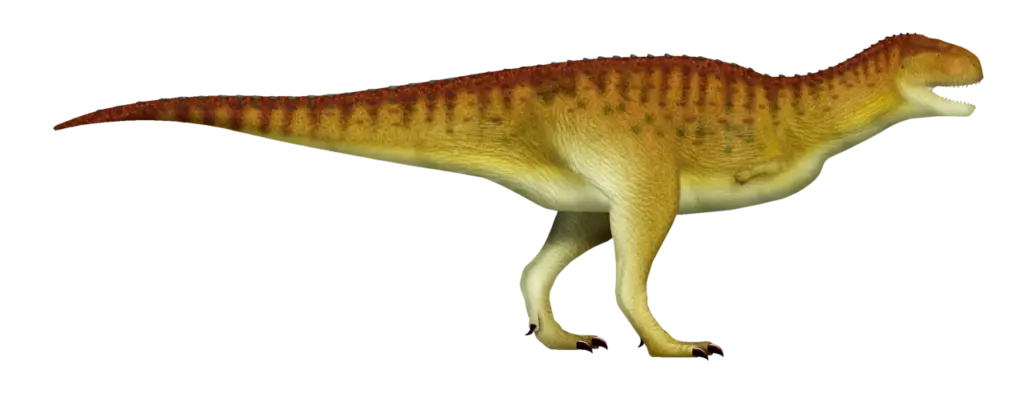
The name Koleken The word comes from the language of the Teushen, an indigenous people of Patagonia. It means "coming from clay and water," referring to the clayey rock in which the fossil was found.
The second part of the name, inakayali, This honors a person. Inakayal was a chief of the Tehuelche people. He fought against the Argentine army in the 19th century. After his death in 1888, his skeleton lay in a museum for decades. It was only in 1994 that it was returned to his people and buried.
Why did Koleken lack horns?
Carnotaurus has two prominent horns on its forehead. Koleken has none. Its frontal bone is simply gently curved. Only a small bump sits on it. The bone at the nasal bone is rough. This could, according to Everything Dinosaur The findings suggest a small bulge or ridge along the snout – but they do not allow for a definitive statement on this.
Other bones also distinguish the two species. The upper jaw is smoother in Kolecus. The nerve canals in the nasal bone run obliquely. The bone behind the eye is particularly flat. These differences are evident at several independent locations in the skeleton. Therefore, researchers consider it unlikely that Kolecus was simply a differently structured subspecies of Carnotaurus.
Was the found animal even an adult?
No. And that's precisely what makes the find so exciting. A thin section of the tibia reveals fine growth lines. They indicate the minimum age: six years. However, a specific bone pattern is missing. This pattern is usually only visible when growth has completely ceased. Individual vertebrae were also not yet fused.
The animal was still growing. The 4.97 meters in the table therefore only apply to this one, young animal. No one knows how large an adult kolecka grew. It was probably somewhat larger, but likely never reached the dimensions of Carnotaurus.
Lion and leopard of the Cretaceous period
For a long time, researchers thought: one habitat, one apex predator. Koleken and Carnotaurus show otherwise. Both lived side by side. But they apparently hunted differently. Carnotaurus, at 7.5 to 9 meters, was the larger predator. It likely preyed on young titanosaurs. Koleken, at around 5 meters, was smaller. Its diet probably consisted of smaller titanosaurs, young hadrosaurs, turtles, snakes, and early mammals.
The researchers themselves Draw a comparison: lions and leopards. Both cats share the same habitat in Africa today. But they hunt prey of different sizes. Koleci and Carnotaurus likely lived in a similar way. Their neighbors also included plesiosaurs, crocodiles, and birds. Shortly before the extinction of the dinosaurs, this ecosystem was therefore remarkably biodiverse.
Relationship in the family tree
Kolecia belongs to a group called Furileusauria. This group includes almost all South American abelisaurids from the Late Cretaceous period. Together with Carnotaurus and Aucasaurus, Kolecia forms a smaller group: the Carnotaurini.
Abelisauridae also include Carnotaurus from the Upper Cretaceous of Argentina, Majungasaurus from the Upper Cretaceous of Madagascar, Abelisaurus from the Upper Cretaceous of Argentina and Rugops from the Upper Cretaceous of Niger.
More information on this topic can be found at urzeittiere.net
- Carnotaurus – the larger, horned neighbor from the same formation, known for its tiny arms and the most famous skin of the dinosaur era.
- Aucasaurus – another relative within the Carnotaurini from the Late Cretaceous fauna of Patagonia.
Image sources:
Featured image: Ddinodan, CC BY 4.0, via Wikimedia Commons
Koleken “Made of clay and water” :TotalDino, CC BY 4.0, via Wikimedia Commons