
Ankylosaurus
Ankylosaurus: Armored giant with a tail club like a wrecking ball
Only three fossils. Not a single complete skull. And yet almost everyone knows its image: heavily armored, with a hammer-like tail. Ankylosaurus magniventris is one of the most famous dinosaurs of all time. And at the same time, one of the least well-documented. Much of what circulates online as "Ankylosaurus" actually depicts a relative: Euoplocephalus.
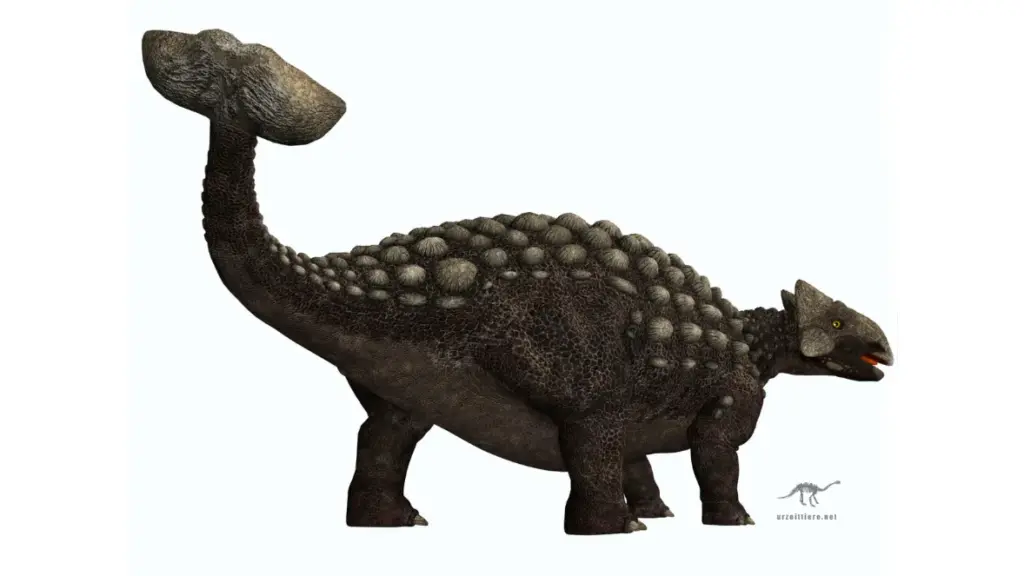
At a glance
| feature | Value |
|---|---|
| length | approx. 6–6.5 m* |
| Weight | Not reliably estimated* |
| Location | Hell Creek and Scollard Formation, North America |
| age | Late Cretaceous, approx. 68–66 million years ago |
| Food | herbivores |
| Special feature | largest known ankylosaurid, with a unique tail club |
*Regarding length and weight: Estimates of 6 to 8 meters and up to 8 tons are circulating online. However, a targeted search in scientific journals found no dedicated study on this animal. These figures likely stem from Kenneth Carpenter's 2004 redescription. We did not have access to the full text of that publication. Therefore, we are deliberately refraining from providing a specific value rather than passing on an unverified figure.
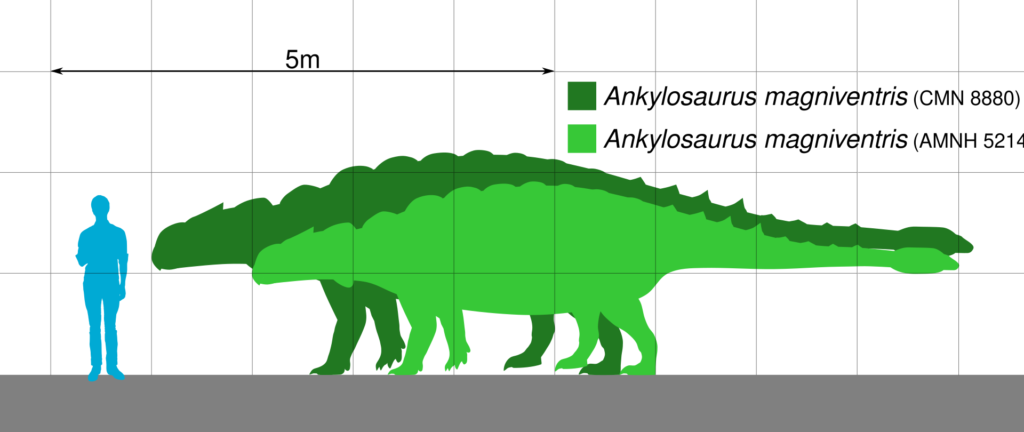
Why is so little of Ankylosaurus left behind?
Barnum Brown described the species in 1908. His description consisted only of a skullcap, a few ribs, and armor plates. To this day, only this one species exists. Therefore, the plural "Ankylosaurus species" is a misconception.
The reason for this is: Michael Vickaryous and Anthony Russell In 2003, researchers described the skull of a close relative, Euoplocephalus. Dozens of good fossils of this species have been found, and they used it as a model for the entire group. The reason: simply too little remains of most other species. Many images of "Ankylosaurus" online therefore actually depict Euoplocephalus.
One detail, however, proves it unequivocally: the shape of its tail vertebrae. In most relatives, they form a narrow V. The angle is between 22 and 26 degrees. In his case, this opens into a broad U of around 60 degrees.
The tail club: weapon, signal, or both?
The tail club is the group's trademark. It has two parts: the Handle from stiffened tail vertebrae and the Knob, the actual striking head. Only a single, relatively recent example of this type is known. Its knob was about 450 millimeters wide. That's roughly the width of a basketball hoop. The largest known club heads of close relatives are even 620 millimeters wide. That's about the diameter of a car tire.
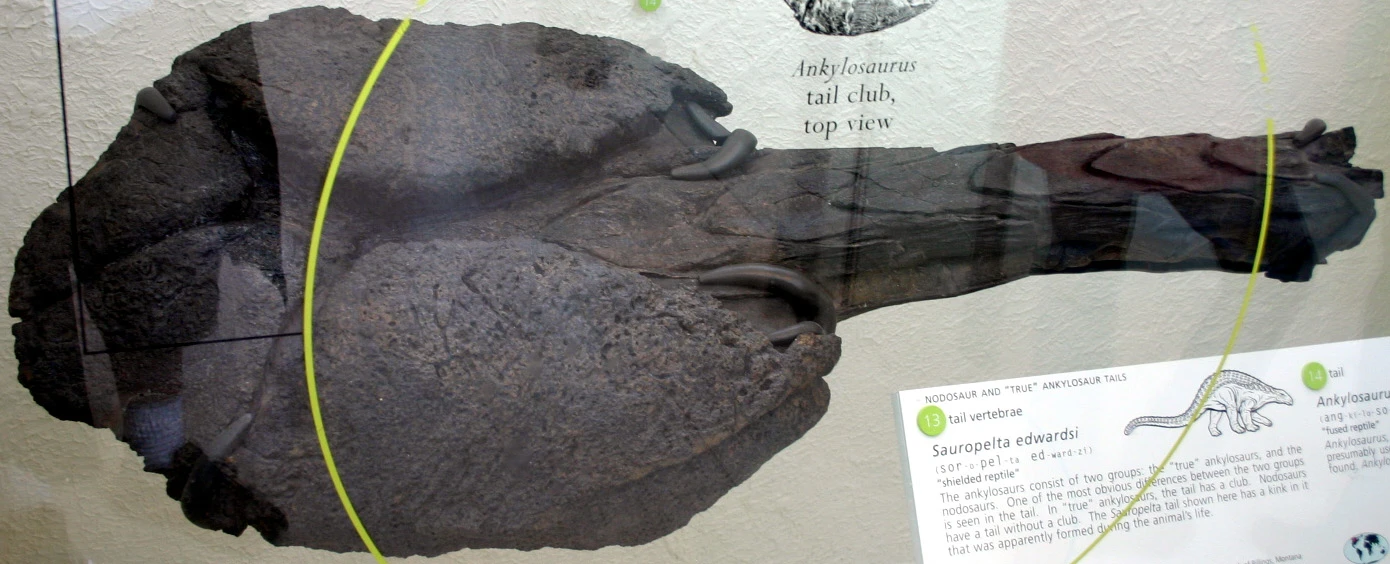
What was its purpose? Despite extensive research, this remains unclear. New model calculations The results showed that medium-sized knobs withstood strong blows. Very large ones were prone to breakage under full force. Andrew Farkes review study She considers a fighting function plausible, but points out two problems. Young animals completely lack a club, and its shape varies considerably from species to species. Both of these factors argue against it being a pure weapon. Fights between rivals and purely signaling functions are also discussed. Victoria Arbor and Lindsay Zanno In 2019, they revealed something astonishing: the club-like tail closely resembles that of ancient glyptodonts. These armored animals, however, were not related to our dinosaur. Both researchers independently arrived at the same solution.
The often-heard phrase "The club served to defend against" Tyrannosaurus Rex“ is therefore a good idea. It is not a proven fact.
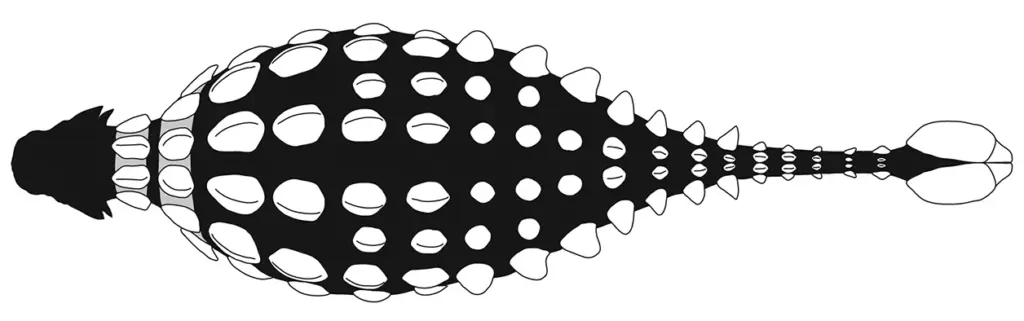
Is that really the "dinosaur with the club"?
Many people don't search online for "Ankylosaurus." They search for the "dinosaur with the club" or the "dinosaur with the club-like tail." Most of the time, they still end up on it. And rightly so: no other characteristic is so closely associated with it.
Despite this, very little of its club remains. Only a single fragment is known, and that comes from a young animal. The knob was around 450 millimeters wide at that time. How large the clubhead of an adult Ankylosaurus would have become remains unknown.
Only one detail is certain about him: the shape of his tail vertebrae. They form a broad U of about 60 degrees. In most of his relatives, it is a narrow V. Everything else about his club, due to a lack of adult specimens, comes from relatives or remains unclear.
Could Ankylosaurus even swim?
Its entire back, head, and tail were covered in bony plates. It was more densely armored than almost any other dinosaur. A study by Asier Larramendi and colleagues He comes to a clear conclusion: These animals were probably the densest dinosaurs ever. Denser even than modern-day hippos.
This armor likely came at a price: swimming was hardly an option for such a heavy body. A popular model explains fossils found lying on their backs: carcasses bloat, float in the water, and turn onto their backs. Larramendi and colleagues, however, consider this model unrealistic. The idea that he was a good swimmer is therefore far from certain.
What was the purpose of the crooked nose?
He himself lacks a CT scan of his skull. Findings of euplocephalus should also be considered with caution. A CT study It shows a highly convoluted nasal passage. The obvious explanation would be: improved sense of smell. However, the olfactory passage is separate from the main respiratory tract. Two other functions are more likely: temperature and water regulation, or a resonating chamber for calls. Cranes also use convoluted nasal passages for their calls today.
What was really on the menu?
It's clear: he was a herbivore. Nevertheless, some people search online for "Ankylosaurus carnivore." He probably wasn't a fan of tough wood. He preferred to eat soft leaves and fruits. Fossils of close relatives show a strong, fleshy tongue. This likely helped him pluck plants. His teeth were small and replaced slowly – a sign of limited chewing power.
Neighbors at the end of the Cretaceous period
Ankylosaurus lived during the last one to two million years before the great mass extinction. Its habitat was the forests and river plains of what is now Montana and Alberta. There it encountered Tyrannosaurus Rex. Triceratops and Edmontosaurus.
Fossils of this group are very rare overall. A study of the nearby Frenchman Formation in Saskatchewan clearly demonstrates this. Researchers found not a single complete skeleton of this group there. In contrast, they did find skeletons of bovids, duckbills, and predatory dinosaurs from the same period. This partly explains why so little remains of this group.
More information on this topic can be found at urzeittiere.net
- Tyrannosaurus Rex – lived in the same Hell Creek fauna, but was a completely different opponent: fast, powerful, and unarmored.
- Triceratops – also a herbivore of the same time and region, relied on horns and a neck frill instead of armor.
Image sources:
Size comparison: User:Slate Weasel, Public domain, via Wikimedia Commons
Arrangement of osteoderms in Ankylosaurus magniventris: Victoria M Arbor, Jordan C Mallon, CC BY 4.0, via Wikimedia Commons
tail club of the Ankylosaurus: Ryan Somma, CC BY-SA 2.0, via Wikimedia Commons