Talarurus
Physical characteristics
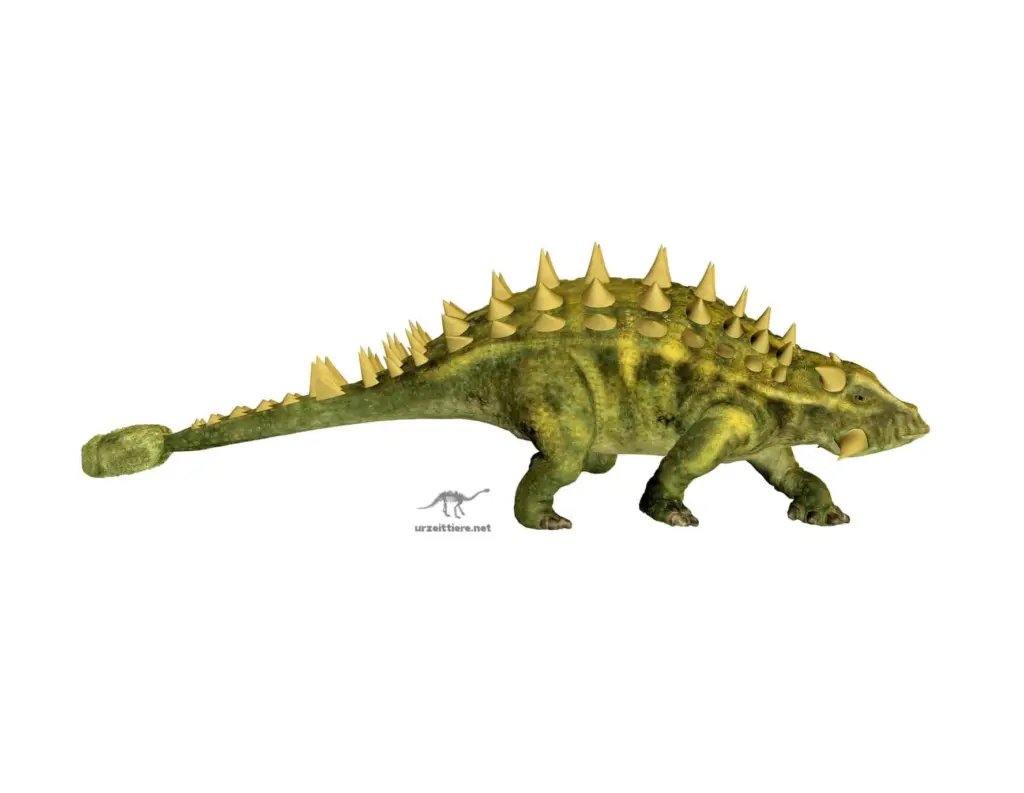
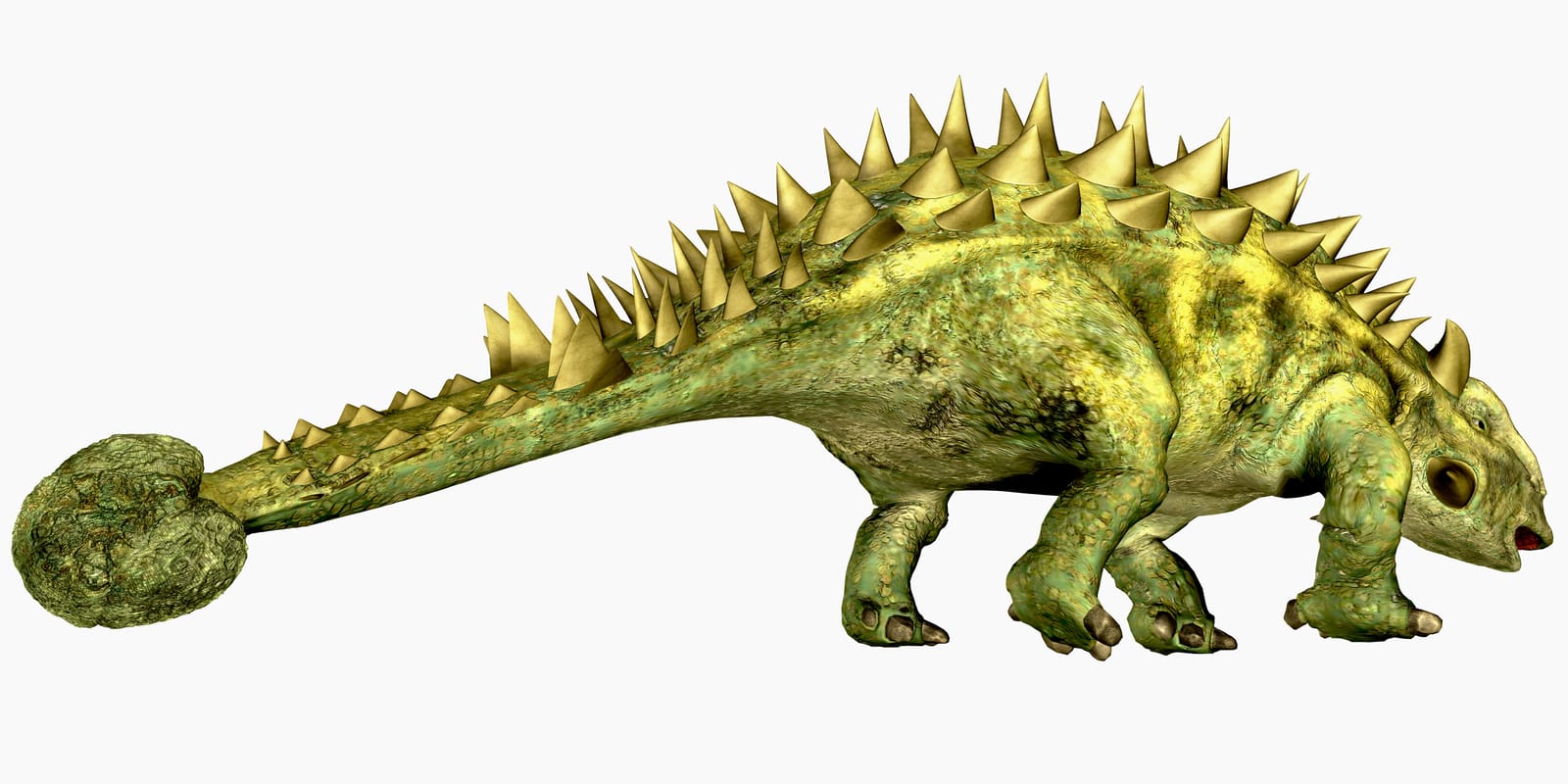
Talarurus reached a body length of 5 to 6 meters. Weight estimates range from 454 to 907 kilograms. Some sources estimate that the animal weighed up to 2.2 tons. The body structure was compact and heavily armored. Short limbs supported the torso. Bone plates covered the back. The tail had reinforced vertebrae that formed a rigid club.
The animal moved on four legs. This four-footed stance lowered the center of gravity. Short legs limited speed but increased stability. The compact body structure concentrated the mass close to the ground. Armored dinosaurs like Talarurus sacrificed mobility for defense. The reinforced tail served as an active weapon against predators. Fused vertebrae formed a rigid base for the tail club. This structure enabled powerful lateral swings in defensive situations.
The skull had protective plates integrated into the bone structure. These osteoderms formed a continuous protective shield over the head and neck. The jaw contained small, leaf-shaped teeth adapted for plant intake. The teeth lacked the cutting edges common to carnivores. Instead, they chewed off and crushed low-growing vegetation. The row of teeth worked through simple up and down movements. This chewing behavior was suitable for fibrous plant material.
Body armor consisted of thick plates of skin embedded into the skin. These osteoderms varied in size depending on the region of the body. Larger plates protected vital areas such as shoulders and hips. Smaller plates filled gaps between the main armor sections. This arrangement created flexible protection without completely restricting movement. During life, keratin sheaths probably covered the bone plates. This organic layer provided additional thickness and impact resistance.
The proportions of the limbs reflect the animal's lifestyle. The front legs were shorter than the hind legs. This difference created a sloping back profile. This posture meant that the head was close to the ground. This position corresponded to the animal's foraging strategy. Talarurus grazed vegetation one meter from the ground. The hip structure allowed for even weight distribution. Robust femur and tibia bones absorbed the loads of the armored body mass.
Compared to other ankylosaurs, Talarurus represents an early, specialized form. Later species such as Ankylosaurus developed larger tail clubs and more extensive armor. Talarurus retained some features of its ancestors but had significant defensive adaptations. The balance between shell weight and mobility places this genus between primitive and advanced ankylosaur forms.
Scientific classification
Evgenij A. Maleev described the genus Talarurus in 1952. The type species is Talarurus plicatospineus. The genus name means “basket tail” or “braided tail”. This name refers to the interlocking caudal vertebrae that stabilized the tail weapon. The species name plicatospineus describes the folded or pleated appearance of the spinous processes.
Talarurus belongs to the family Ankylosauridae. Within this group, the genus is assigned to the Asian ankylosaurines. This subfamily includes armored dinosaurs from the Late Cretaceous of Asia. The classification positions Talarurus as a relatively basal but highly specialized member. Anatomical features support its placement within the Thyreophora, the clade of armored dinosaurs.
The dinosaur belongs to the Ornithischia, the bird-hipped dinosaurs. A more precise classification assigns it to the Ankylosauria, then the Ankylosauridae and finally the Ankylosaurinae. This nested hierarchy reflects evolutionary relationships based on skeletal traits. Common features with relatives include fused skull bones, skin shell and tail clubs.
Discovery and analysis
Soviet-Mongolian expeditions discovered the first Talarurus remains in 1948. The fossils came from the southeastern part of the Gobi Desert in what is now Mongolia. Field teams worked in the Baynshire region during this pioneering period of exploration. The holotype specimen was designated PIN 557-91. The researchers obtained the bones from red calcareous claystone mixed with sand. This sediment belongs to the Bayan Shireh Formation.
The type material includes both cranial and postcranial elements. Skull fragments preserve details of armor placement and jaw structure. The vertebrae show the characteristic fusion pattern in the tail area. Ribs, limb bones and pelvic fragments document the body proportions. Armor plates recovered with the skeleton reveal the diversity of osteoderms. This relatively complete material makes Talarurus one of the better known Asian ankylosaurs.
No eggs or embryos have been documented for this genus. Current research focuses on skeletal anatomy and phylogenetic relationships. The species provides data on the evolution of ankylosaurs in Asia. By comparing Talarurus with North American relatives, patterns of geographic distribution emerge. The ecological niche partitioning among contemporary armored dinosaurs becomes clearer through such comparisons.
The Bayan Shireh Formation dates to the Late Cretaceous. Sediment analyzes indicate a semi-arid (semi-dry) environment with seasonal water availability. Other dinosaurs in this formation include theropods and sauropods. The fossil accumulation documents a diverse ecosystem. Talarurus occupied the low-grazing herbivore niche in this community.
Technical data
The holotype PIN 557-91 is located in the Paleontological Institute in Moscow. The find was made at the Baynshire site of the Bayan Shireh Formation. This geological unit occurs in south-central Mongolia. The stratigraphic position assigns the remains to the Cenomanian to Santonian. The age is estimated to be around 90 to 85 million years.
Nutritional ecology
Talarurus fed exclusively on plant foods. The animal ate vegetation that grew up to a meter above the ground. Small teeth indicate the processing of relatively soft plant tissues. Low-growing ferns, cycads and early flowering plants probably formed the diet. Jaw mechanics relied on vertical crushing rather than grinding. Due to the low nutrient density, large amounts of food were required. The digestive system probably had gut bacteria to break down cellulose.
The posture kept the mouth at almost optimal feeding height. Short legs prevented access to tall vegetation. This dietary specialization reduced competition with long-necked herbivores. Talarurus lived alongside sauropods that grazed in higher canopy levels. The division of resources allowed several species of herbivores to coexist in the same habitat.
Talarurus
| scientific name | Talarurus plicatospineus |
| Estimated size | Length: 5.7 meters Height: 1.8 meters Weight: 2.2 tons |
| geological era | Upper Cretaceous |
| Locations | Bayan Shireh |
| Order | Ornithischia |
| Subordination | Thyrophora |
Physical characteristics
| anatomy | large, heavily armored, quadrupedal ankylosaur with a low build |
| Special features | Bone armor, short spikes/buttons, reinforced tail; probably weaker tail club than in later forms |
| locomotion | Four-legged |
| Skin texture | not directly documented, probably scaly and armored |
| Coloring | unknown |
discovery
| Explorer | Maleev |
| Discovery date | 1952 |
| Meaning of the name | “Basket/Wicker Basket Tail” |
| Significant fossil finds | At least 7 individuals. |
In paleontology, the ratio of brain to body size, the so-called Encephalization quotient (EQ), used as a rough guide to relative intelligence.
| Intelligence (EQ) | cannot be measured with certainty; very probably low, roughly reptilian |
| Social behavior | probably living in groups, but not confirmed with certainty |
| Predators | large Late Cretaceous theropods in Mongolia as likely predators |