Gigantoraptor
Gigantoraptor: Discovery and Naming of the Colossal Oviraptorosaurus
Gigantoraptor erlianensis was discovered in Inner Mongolia, China, in 2005. The genus name Gigantoraptor combines the Latin word “gigas,” meaning “giant,” with “raptor,” which refers to its relationship to other oviraptorosaurs. The species name erlianensis refers to the Erlian Basin in Inner Mongolia where the fossil was found.
This remarkable discovery was made by paleontologists from the Institute of Vertebrate Paleontology and Paleoanthropology in Beijing. The holotype specimen, cataloged as LH V0011, consists of a partial skeleton that includes elements of the jaw, vertebrae, forelimbs, pelvis, and hindlimbs.
Classification
Gigantoraptor belongs to the Oviraptorosauria, a group of theropod dinosaurs. Due to its unusual size and characteristics, its classification was initially difficult. However, phylogenetic analyzes have consistently placed Gigantoraptor as a member of the family Caenagnathidae within the Oviraptorosauria.
The classification of Gigantoraptor in the Oviraptorosauria has been the subject of some debate. While some studies classify it as a basal oviraptorid, others suggest that it is more closely related to caenagnathids. This uncertainty is due to Gigantoraptor's unique combination of features and its significantly larger size compared to other known oviraptosaurs.
Physical characteristics
Size and weight
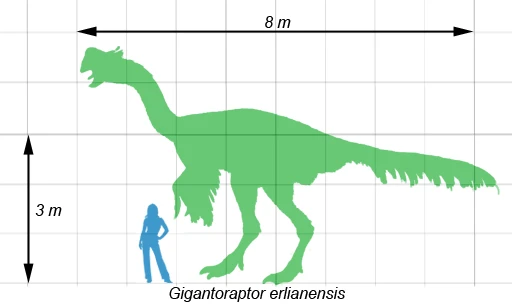
Gigantoraptor stands out as an exceptionally large oviraptosaur. It is estimated to have reached up to 8 meters (26 feet) in length and weighed about 1.4 tons. This makes Gigantoraptor the largest known oviraptosaur, dwarfing its closest relatives.
Gigantoraptor's size challenges previous assumptions about oviraptorosaur body structure. While most oviraptorosaurs were relatively small, with the largest species known to date only growing to about 2 meters long, Gigantoraptor represents a dramatic increase in size within the group.
Skeletal features
Gigantoraptor's skeleton exhibits a combination of typical oviraptosaur features and unique adaptations. Although the skull is not completely preserved, it has features consistent with other oviraptosaurs, including a short, deep lower jaw with a characteristic downward-curved tip.
Gigantoraptor's spine has features that distinguish it from other oviraptosaurs. The spinous processes of the dorsal vertebrae are noticeably high, which suggests strong back muscles. The caudal vertebrae show adaptations that may have allowed for increased flexibility, a trait observed in other oviraptorosaurs but may be more pronounced in Gigantoraptor.
Gigantoraptor's forelimbs are proportionately long and robust, with large muscle insertions that suggest powerful arms. The structure of the manus (hand) is not fully known, but available evidence suggests that it retained the typical theropod three-fingered arrangement.
In the pelvic area, Gigantoraptor has a unique combination of features. The ilium is elongated, a feature shared with other large theropods, while the pubic bone and ischium have features typical of oviraptosaurs, including a backwards-swept pubic bone.
Gigantoraptor's hind legs are particularly notable. They are long and slender, indicating an adaptation to rapid movements despite the animal's size. The metatarsals are elongated, a feature that distinguishes Gigantoraptor from many other large theropods and may have contributed to its locomotor abilities.
Unique customizations
The Gigantoraptor's most noticeable adaptation is its sheer size. This dramatic increase in body mass compared to its closest relatives suggests a significant shift in its ecological role. The combination of size and features typically associated with more agile, smaller oviraptosaurs presents an intriguing evolutionary scenario.
Gigantoraptor's lower jaw exhibits adaptations that may be related to its feeding strategy. The downward-curved tip and overall shape suggest a specialized diet, possibly including plant material, although the exact nature of its diet remains controversial among paleontologists.
Gigantoraptor's elongated hind legs and metatarsals indicate adaptation speed or efficient transportation. This feature is particularly interesting given the animal's size and suggests that Gigantoraptor may was more mobile than other theropods of comparable mass.
Paleobiology
Diet and eating habits
Gigantoraptor's diet remains a subject of scientific study. Its size and its membership in the Oviraptorosauria group, which includes both herbivorous and omnivorous species, have led to various hypotheses about its feeding habits.
The structure of Gigantoraptor's jaw and the presence of a keratin-like beak (like related oviraptorosaurs) suggest that it may have adapted to a diverse diet. Some paleontologists suspect that he is a Omnivore was that could utilize both plant material and small prey. Its lack of teeth, a feature it shares with other oviraptorosaurs, further complicates diet interpretation.
Comparisons with other oviraptors and analysis of potential food sources in its paleoenvironment may provide additional insight into Gigantoraptor's diet. However, without direct evidence such as fossilized stomach contents or coprolites, definitive conclusions about its feeding habits are difficult to draw.
Locomotion and behavior
The fact that Gigantoraptor was able to move relatively quickly despite its size is shown by its long, slender hind legs.
In particular, the lengthening of the metatarsal bones is an indication of an adaptation to speed or efficient locomotion.
This feature distinguishes Gigantoraptor from many other large theropods and raises questions about its behavior and ecological role.
For the balance and maneuverability of the Gigantoraptor played its Tail structure a role that too greater flexibility was adapted.
Some studies of oviraptosaur tail function suggest that these adaptations may have been important for showmanship or mating rituals, although direct evidence for such behaviors in Gigantoraptor is lacking.
Gigantoraptor's sturdy forelimbs have led to speculation about its use. While their exact function remains uncertain, possibilities such as foraging, defense or social interactions have been considered.
The large muscle attachments on their front legs show that they were capable of powerful movements.
Growth and development
Histological studies of Gigantoraptor's bones provide insight into its growth patterns.
Analysis of the bone microstructure shows that, despite its size, the known specimen had not yet reached full adult size when it died.
This means that Gigantoraptor was like many other dinosaurs in its early years showed rapid growth.
Gigantoraptor's growth curve is particularly interesting because it was very large compared to other oviraptorosaurs. The question of how it reached this size and how this rapid growth compares to that of its smaller relatives remains the subject of active research in paleobiology.
Paleoecology
Habitat and environment
Gigantoraptor lived in the late Cretaceous period, about 70 million years ago. The Erlian Basin in Inner Mongolia, where its fossils were discovered, provides a context for understanding its paleoenvironment.
During this time, the region probably had a semi-arid climate with seasonal rainfall. The landscape probably consisted of a mix of open areas and wooded or wooded areas. Rivers and lakes provided water sources and supported diverse plant and animal communities.
The presence of such a large oviraptorosaur in this environment raises questions about resource availability and ecological dynamics. Gigantoraptor's size suggests that it occupied a different niche than smaller oviraptorosaurs, possibly avoiding direct competition with its relatives.
wildlife
Gigantoraptor shared its habitat with a variety of other dinosaurs and prehistoric creatures. Fossils of various theropods have been found in the Erlian Basin, including Tyrannosaurs and Dromaeosaurids, as well as herbivorous dinosaurs like Hadrosaurs and Ceratopsia.
The occurrence of these different groups of dinosaurs shows a complex ecosystem with different levels of nutrition.
Gigantoraptor, one of the largest theropods in this environment, played an important role in the food web, although its exact position remains to be determined.
Other animals in this region included prehistoric mammals, crocodiles and various plant species.
Understanding the interactions between Gigantoraptor and these organisms is important for reconstructing the Late Cretaceous paleoecology of this part of Asia.
Evolutionary significance
The discovery of Gigantoraptor had a significant impact on our understanding of oviraptorosaur evolution and theropod diversity in general. Its size shows that oviraptorosaurs were able to evolve into much larger forms than previously thought, challenging assumptions about body size limitations within this group.
The unique combination of features observed in Gigantoraptor - its size combined with features typically associated with smaller, more agile oviraptorosaurs - provides valuable insights into the evolutionary plasticity of these dinosaurs. It suggests that oviraptorosaurs were able to adapt to a wider range of ecological niches than previously thought.
The position of Gigantoraptor within the Oviraptorosauria, whether as a basal oviraptorid or as a member of the Caenagnathidae, has implications for understanding the evolutionary relationships within this group. The study contributes to ongoing discussions about oviraptorosaur diversification and their biogeographic distribution during the Late Cretaceous.
The existence of such a large Oviraptor dinosaur in Asia also raises questions about possible convergent evolution with large North American forms such as Anzu wyliei on, although Gigantoraptor remains significantly larger than its North American counterparts.
conclusion
Gigantoraptor erlianensis is a testament to the diversity and evolutionary potential of the Oviraptor dinosaur dinosaurs. His discovery has expanded our understanding of size variation within the theropoda and challenged previous ideas about the ecology and evolution of oviraptorosaurs.
While research continues, Gigantoraptor remains a fascinating subject for paleontologists and dinosaur enthusiasts alike. Future discoveries and analyzes could provide further insight into its biology, behavior and evolutionary significance, contributing to our ever-growing knowledge of the rich and diverse world of prehistoric life.
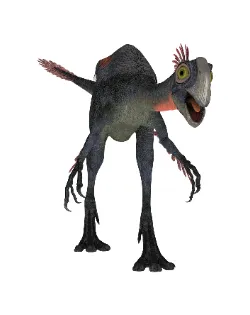
Gigantoraptor
Gigantoraptor was probably one opportunistic omnivore, which fed on plants, eggs and small animals. His combination of size and agility potentially made him one middle robber, which both hunted prey and ate carrion.
| scientific name | Gigantoraptor erlianensis |
| Estimated size | Length: 8 meters Height: 3.5 meters Weight: 2 tons |
| geological era | Upper Cretaceous |
| Locations | Irish Dabasu |
| Order | Saurischia |
| Subordination | Theropoda |
Physical characteristics
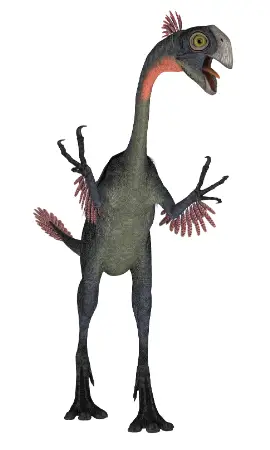
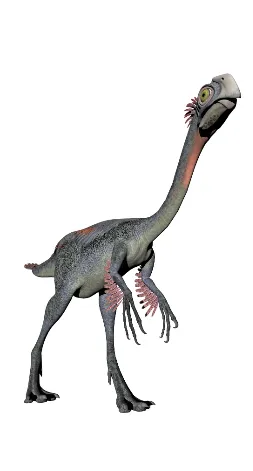
| anatomy | Gigantoraptor had a bird-like build with long, powerful legs, indicating fast locomotion, and long arms with large claws. |
| Special features | It had a large, toothless, parrot-like beak. |
| locomotion | Two-legged |
| Skin texture | It probably had conspicuous, long feathers on its arms and tail, typical of Oviraptorosauria. |
| Coloring | There is no fossil evidence of Gigantoraptor's actual coloring. |
discovery
The only copy so far was in the Inner Mongolia discovered.
| Explorer | Xu, Tan, Wang, Zhao, Tan |
| Discovery date | 2007 |
| Meaning of the name | The species epithet “erlianensis” refers to the Erlian Basin in Inner Mongolia, where the fossil was discovered |
| Significant fossil finds | Incomplete skeleton, lower jaw. |
In paleontology, the ratio of brain to body size, the so-called Encephalization quotient (EQ), used as a rough guide to relative intelligence.
| Intelligence (EQ) | There is no specific scientific data on EQ for Gigantoraptor. |
| Social behavior | There is no direct fossil evidence for the social behavior of Gigantoraptor erlianensis. |
| Predators | Gigantoraptor probably had few natural enemies. Possibly Tarbosaurus |
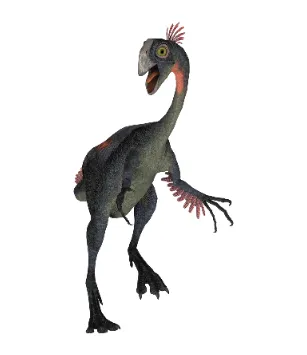
Image sources:
Size comparison: I, Dinoguy2, CC BY-SA 3.0, via Wikimedia Commons