Brachylophosaurus
When we get into the fascinating world of dinosaurs diving in, we come across a variety of species that inspire us through their unique features and adaptations are fascinating. One of the particularly interesting ones herbivorous hadrosaurs is the Brachylophosaurus, a dinosaur that lived millions of years ago in the regions of Alberta, Canada, and Montana, USA. The name Brachylophosaurus, which means something like “Short-crested lizard“ means, already points to one of its most striking features: the short, flat comb on his skull.
In this article we will look at the anatomy, the special features, the discovery, the Diet habits, the classification and the lifestyle of the Brachylophosaurus deal with each other and focus on one Travel through time to find out more about this fascinating dinosaur.
Anatomy Insight: Physical Features of Brachylophosaurus
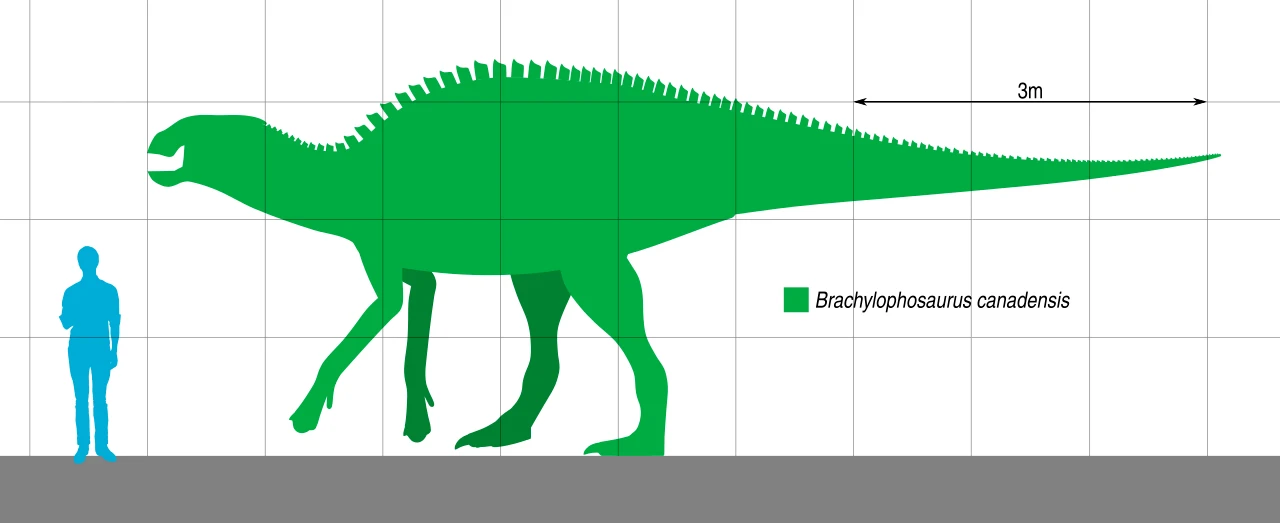
The Brachylophosaurus was an impressive one Hadrosaurs, whose physical characteristics made it an extremely efficient and at the same time agile herbivore. It reached a length of around 8-9 meters, with some studies even reaching one maximum length of up to 11 meters.
With a body height of about 3 meters and a robust stature he brought Brachylophosaurus Depending on the age and the find, it weighs between 2 and 7.7 tons. This physical presence underlines his ability to adapt to his living environment.
One of the most striking features of the Brachylophosaurus His strong limbs as well as the were striking long forearms. These anatomical features suggest a specialized function, possibly related to its locomotion or the Handling of food was connected.
The head of Brachylophosaurus was relatively small in relation to its body, while its neck was moderately long. One strong spine supported the stable, muscular structures of his body. The tail, which served as a tool for balance and efficient locomotion, completed this hadrosaur's supple anatomy.
A particularly remarkable find that improves our knowledge of the anatomy of the... Brachylophosaurus has expanded significantly, comes from the famous “Leonardo” mummy. This subadult individual offers an extraordinary rarity: over 90% of the skin surface of this fossil have been preserved. Examinations of the mummy show that the skin of Brachylophosaurus was covered with small, polygonal scales.
This unique preservation provides us with direct Insights in the external appearance of this dinosaur. The combination of his sturdy build and long forearms suggests that Brachylophosaurus was perfectly tailored not only to his eating habits, but also to his environment. His anatomy made him one of the most fascinating hadrosaurs of his time.
Determining Characteristics: Distinctive features of Brachylophosaurus
Brachylophosaurus is characterized by several eye-catching and unique features that set it apart from other dinosaurs of its time.
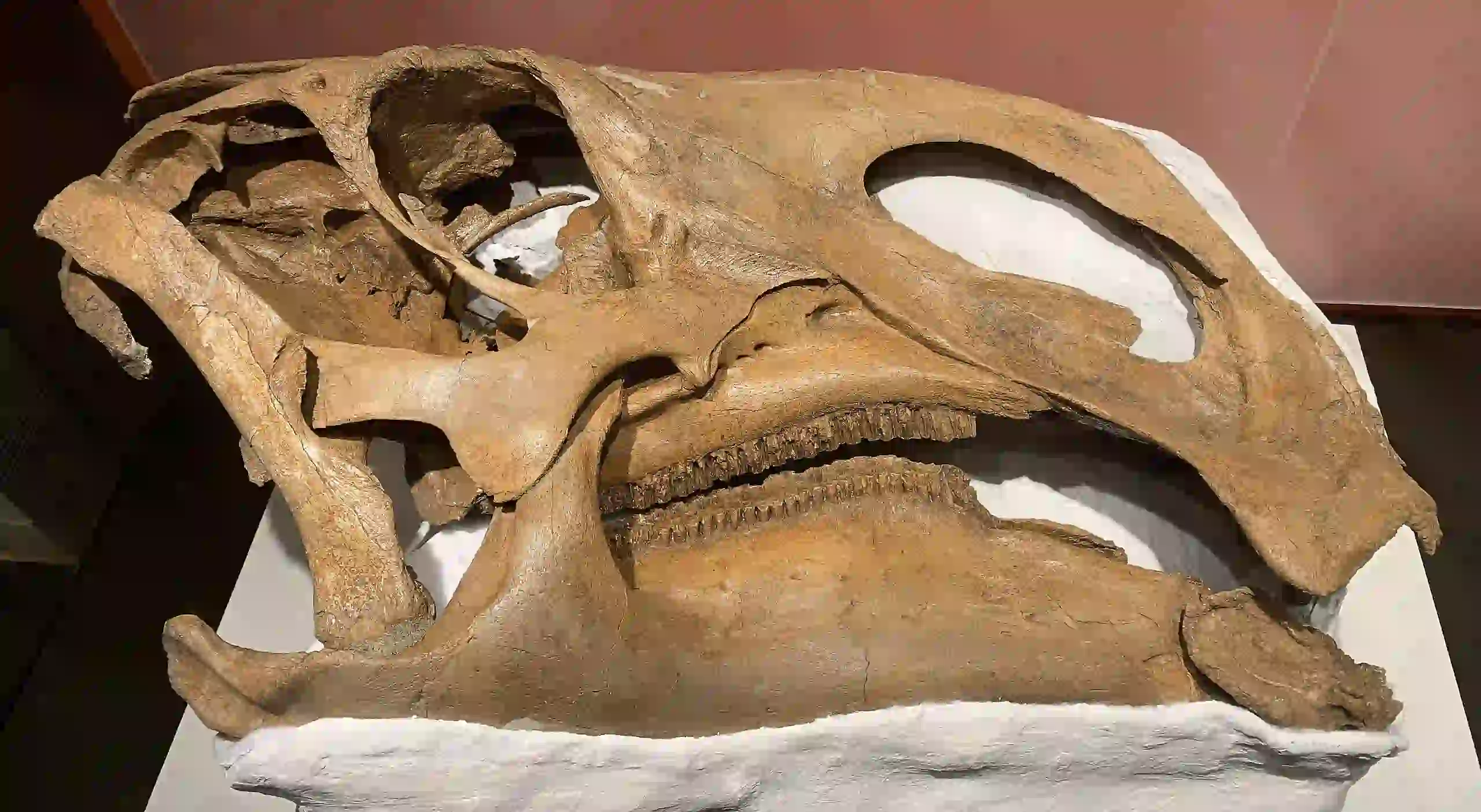
One of the most striking features from Brachylophosaurus is the small, paddle-like bone ridge on his skull. This ridge, which extends over the nasal bone, was solid, but relative fragile in its structure. This comb is believed to be for display, communication and species recognition was used.
Although it may also have been used for headbutting, his Fragility an indication that this function rather secondary was.
Other notable features of Brachylophosaurus are its longer forelimbs compared to its hindlimbs, which suggests quadrupedal locomotion. The broad upper jaw and the characteristic “glove”-like structure of the hands are further special characteristics. The second, third and fourth fingers were combined in a common soft tissue sheath.
The wide, keratinous beak, best documented by the “Leonardo” fossil, was ideal for this Nibbling on soft leaves and stems. The jaws of Brachylophosaurus were equipped with dental batteries. These consisted of hundreds of teeth that were constantly growing. This enabled the animal to shred tough plant material.
This highly developed jaw structures were crucial to its herbivorous lifestyle.
This combination of anatomical peculiarities does that Brachylophosaurus a fascinating example of that adaptability and diversity the hadrosaur in the Late Cretaceous.
Tracing the Past: Discovery and Naming of Brachylophosaurus
The discovery of Brachylophosaurus is a fascinating story that takes us back to the 1930s. In 1936, American paleontologist Charles Mortram Sternberg led a Geological Survey of Canada expedition to the Dinosaur Provincial Park region in Alberta, Canada.
During this expedition, Sternberg collected several fossils for the Canadian Museum of Nature, including a skull and partial skeleton of a hadrosaur, designated holotype NMC 8893 (now CMN 8893).
Sternberg originally believed that the fossil represented a new species of hadrosaur Gryposaurus represented. However, further studies led to the realization that the fossil clearly different and required a new genre. In 1953, Sternberg officially named the fossil as Brachylophosaurus canadensis, which comes from the Greek words βραχύς (brachys), λόφος (lophos) and σαῦρος (sauros) is derived and means “short-crested lizard”.
In addition to the original find in Alberta, many other fossils have been discovered by Brachylophosaurus discovered in the Judith River Formation in Montana, USA. These finds include not only bones, but also valuable skin impressions, which give us insights into the appearance and anatomy of these dinosaurs.
A particularly remarkable find is the bone deposit MOR 1071, which contains the remains of approx 800 animals contains.
One of the most outstanding finds is the so-called “Leonardo” mummy, a subadult individual who not only Skin and muscles, but also preserved the stomach contents. This mummy, which is one of the best-preserved dinosaur finds, provides valuable information about the biology and behavior of the dinosaur Brachylophosaurus. Other well-known finds include “Elvis,” “Roberta,” “Peanut,” and “Marco,” all of which make important contributions to research on this dinosaur.
An interesting aspect of the discovery story is the rediscovery of the original site in Alberta in 2001. The original excavation site, described by Sternberg as Quarry No. 58, which had been marked and recorded on a map, had been lost for over 20 years as the back wall of the excavation site collapsed and spilled the marker. The rediscovery and official renaming as Q103 helped further research into the Brachylophosaurus to move forward further.
Plant-Based Diet: Dietary Habits of Brachylophosaurus
Brachylophosaurus was a herbivorous dinosaur whose feeding habits provide valuable insight into its lifestyle. A central source for this information is the famous “Leonardo” mummy, a subadult specimen of the Brachylophosaurus, which is preserved in exceptionally good condition.
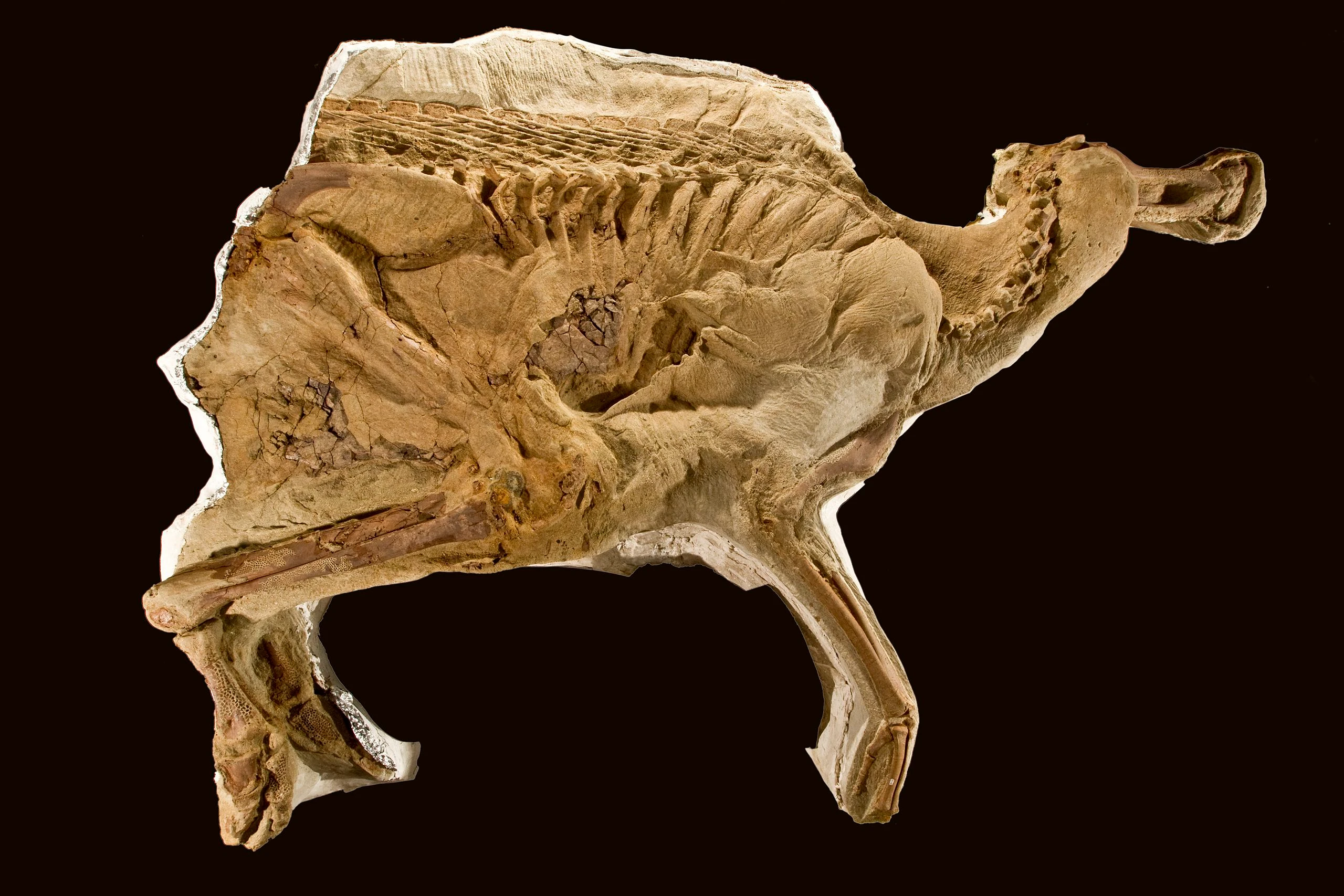
The examination of the stomach contents “Leonardo” mummy has shown that the Brachylophosaurus one diverse plant-based diet had. The identified plant remains included ferns, conifers, leaves, pollen of about 40 different types, algae, liverworts and even flowering plants like magnolias.
Analysis of the stomach contents also shows that the leaves and plant parts were very finely chopped, with an average size of less than 5 millimeters. This indicates that the Brachylophosaurus about one efficient chewing mechanics which enabled him to specifically break down and digest tough plant fibers.
As a herbivore it showed itself Brachylophosaurus a generalist nutritional behavior. It was both a folivore, eating leaves and fruit from trees and shrubs, and a green-eater, eating low-growing plants.
Nevertheless, the composition of the stomach contents leaves the “Leonardo” mummy suggest that it was primarily a leaf eater. Be broad, keratinous beak was particularly well suited to efficiently nibbling leaves and soft plant parts, while its highly developed tooth batteries, consisting of Hundreds of teeth, ideally adapted for shredding tough plant fibers.
These specialized anatomical adaptations allowed it Brachylophosaurus, a wide selection to use plant resources and to assert themselves successfully in their environment.
Tracing Ancestry: Classification of Brachylophosaurus
This dinosaur belongs to the kingdom of Eukaryota, the kingdom Animalia, the phylum Chordata and the clade Dinosauria.
Inside the dinosaurs will be Brachylophosaurus It belongs to the group Ornithischia, also known as bird-hipped dinosaurs. More specifically, it belongs to the family of Hadrosauridae, often referred to as the “duck-billed dinosaur.”
The subfamily Saurolophinae, to which Brachylophosaurus heard, stands out solid or missing crests on the skull. Within the Saurolophinae it is part of the Tribe Brachylophosaurini, a group defined by their specific cranial features.
The type Brachylophosaurus was first described by Charles Mortram Sternberg in 1953, with the type species Brachylophosaurus canadensis is. Interestingly, a second type, Brachylophosaurus goodwini, nowadays as synonym or considered indeterminate and with a high probability of the species B.canadensis attributed.
The relationship of the Brachylophosaurus with other hadrosaurs like Acristavus, Maiasaura, Probrachylophosaurus, Ornatops and Wulagasaurus underlines its importance within the group. What is particularly noteworthy is the relationship with Probrachylophosaurus, the as Transitional form between earlier hadrosaurs and the Brachylophosaurus is viewed. The Probrachylophosaurus had a smaller crest, which evolved into the characteristic crest of the Brachylophosaurus further developed.
Phylogenetic analyzes and the study of proteins such as Collagen I have shown that Brachylophosaurus is part of a complex network of relationships within the Hadrosauridae. Such studies support the hypothesis that proteins and peptides exist in fossils over millions of years receive can stay and provide valuable information on the evolutionary Provide history of dinosaurs.
Life and Behavior: Paleobiology of Brachylophosaurus
While she is mostly As they moved quadruped in search of food, they could also stand up on their hind legs if necessary to reach higher plants or better perceive potential dangers in their surroundings.
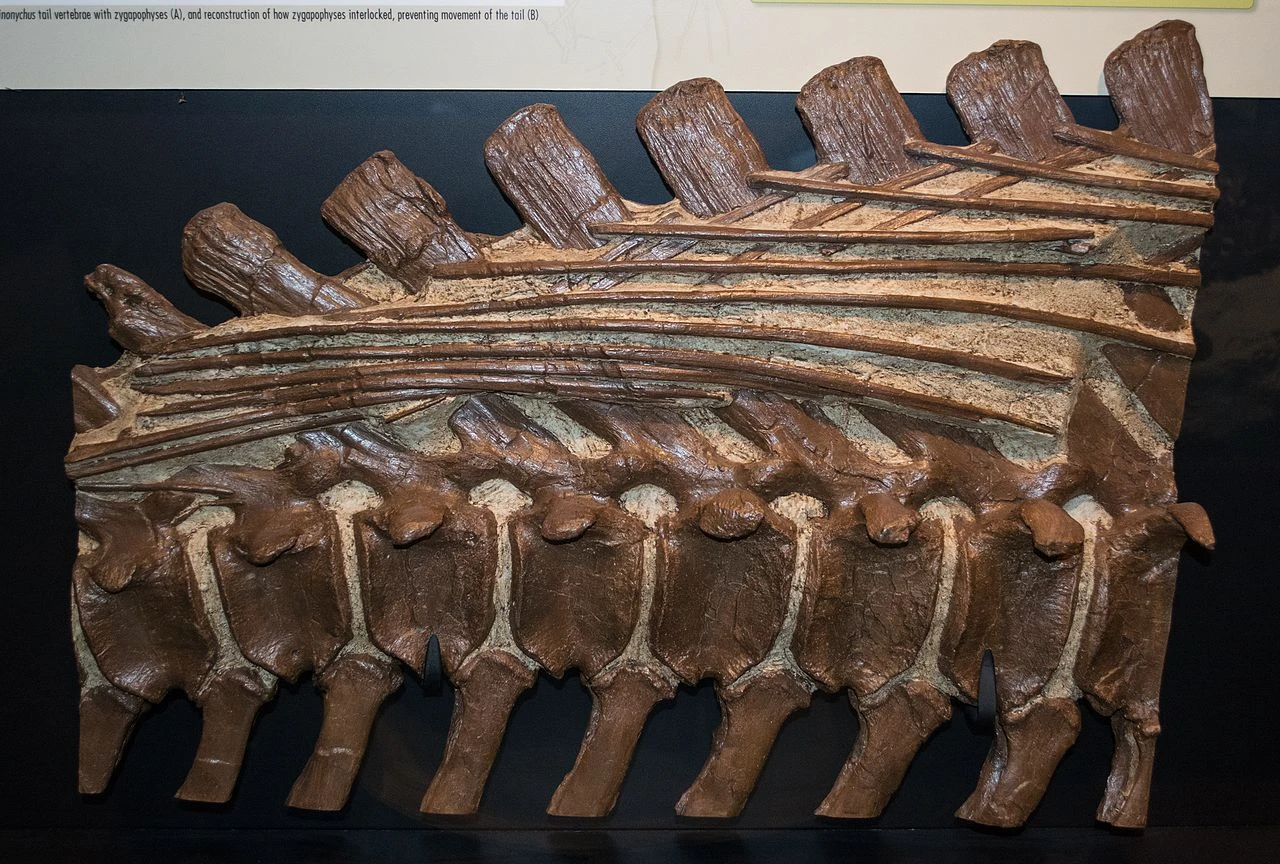
The ossified caudal tendons of Brachylophosaurus were essential for the stability and locomotion. The tail not only served as a counterbalance, but also provided additional support, especially when the animal was on all four legs or moving faster.
There is clear evidence that Brachylophosaurus a social was a creature and lived in herds. This behavior provided important protection from predators and facilitated foraging within the group. The structure of such herds could also be communication and the social Interactions played a significant role, with the crest on the skull playing a key role.
The crest most likely served as a visual signal for communication between individual animals and for species recognition within the group.
The growth phases of a Brachylophosaurus are very well documented thanks to fossils such as the famous “Leonardo” mummy. This specimen, measuring approximately 7 meters in length and estimated to be 3-4 years old, shows the characteristic cranial crest and teeth changing as it grows developed.
Bone histological studies have also highlighted that Brachylophosaurus underwent relatively rapid growth, a trait that links it to other hadrosaurs.
The findings are particularly noteworthy health conditions and injuries in the hadrosaurs. Some fossils show evidence of tumors and surviving attacks from predators like that Daspletosaurus there. These findings paint a picture of the life of the Brachylophosaurus: a dynamic and often dangerous environment that adaptability and required survival skills.
A world long gone: paleoenvironment of Brachylophosaurus
Brachylophosaurus lived in one fascinating and long-gone world that covered much of western North America during the Campanian, a period of the Late Cretaceous period (about 83.5 to 72.1 million years before present). This region, which today includes parts of Montana, Alberta and possibly Utah, was then dominated by a warm and moist climate that created ideal conditions for dense forests and extensive river systems.
The geological formations in which fossils of Brachylophosaurus were found provide valuable insights into the paleoenvironment of this era. In particular, the Judith River Formation in Montana, one of the main sites, reveals one swampy Coastal plain with floodplains and dense vegetation. In contrast, the deposits of the Oldman Formation in Alberta show a different dynamic: here they dominate River deposits, which indicate a dynamic and changing environment.
The vegetation of this period was diverse and included ferns, conifers, cycads and early flowering plants such as magnolias. These plant species, which were also found in the stomach contents of the mummy known as "Leonardo", formed the vital basis of the food chain in which Brachylophosaurus lived. These findings provide crucial information about the dinosaur's diet and living conditions.
Brachylophosaurus shared its habitat with a variety of other dinosaurs. The ceratopsians were among the prominent contemporaries Chasmosaurus and the hadrosaur Parasaurolophus. As a herbivore it was Brachylophosaurus but also potential prey for predators such as tyrannosaurids Daspletosaurus and Gorgosaurus. These predators were dominant carnivores of their time and probably a constant threat to the peaceful herbivores.
The Judith River Formation is particularly noteworthy as it is a... extraordinary Has a diversity of dinosaur species. In addition to fossils of the Brachylophosaurus Remains of many other species have been discovered in this formation. This diversity makes it one of the richest and most important paleontological sites of the Late Cretaceous.
In short
Brachylophosaurus is a truly fascinating hadrosaur, thanks to its unique features and Adjustments provides an impressive insight into the late Cretaceous period. With its characteristic, paddle-like comb, his long forearms and his robust body, he was excellently adapted to his environment at the time.
He roamed the warm and humid landscapes Western North America, lived in herds and fed on a variety of plants.
The discovery and detailed analysis of fossils, such as the famous "Leonardo“-Mummy, have valuable knowledge about his Diet habits, its social behavior and its evolutionary development brought to light. The Brachylophosaurus illustrates in an impressive way how diverse and adaptable Dinosaurs were, and shows how important the study of their fossils is for understanding our earth's history.
The knowledge gained motivates us to continue investing in paleontology and unraveling the hidden mysteries of the past. With the study of dinosaurs like that Brachylophosaurus we can not only our knowledge about the evolution and expand past ecosystems, but also our appreciation for today's natural world and strengthen the urgency of protecting our modern ecosystems.
Brachylophosaurus
| scientific name | Brachylophosaurus canadensis |
| Estimated size | Length: 9.7 meters Height: 3 meters Weight: 4.2 tons |
| geological era | Late Cretaceous |
| Locations | Oldman, Judith River |
| Order | Ornithischia |
| Subordination | Neornithischia |
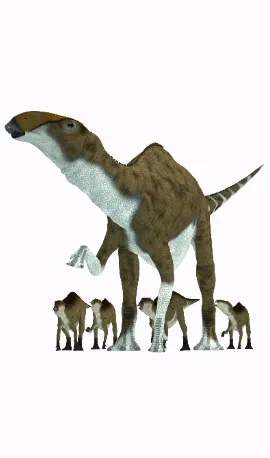
Physical characteristics
| anatomy | Large, massive herbivore with a long tail, small head, long forelimbs and flattened snout |
| Special features | Flat, paddle-shaped, bony crest on the skull, broad duck-billed snout, very long forelegs |
| locomotion | Four-legged |
| Skin texture | Small, polygonal scales, many folds of skin, a row of individual, triangular scales in the middle of the back |
| Coloring | Unknown because no pigment remains have been preserved; Coloring therefore speculative |
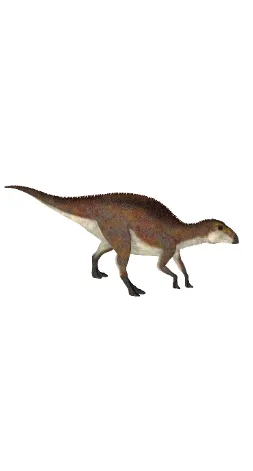
discovery
| Explorer | Sternberg |
| Discovery date | 1953 |
| Meaning of the name | Brachylophosaurus means "short-crested lizard" or "short-crested lizard" |
| Significant fossil finds | Many individuals (juvenile adults) – partial skeletons, skulls, also with soft tissues. |
In paleontology, the ratio of brain to body size, the so-called Encephalization quotient (EQ), used as a rough guide to relative intelligence.
| Intelligence (EQ) | Estimated low to medium EQ for dinosaurs, typical of hadrosaurs |
| Social behavior | They probably lived in large groups with pronounced social behavior, similar to today's ungulates |
| Predators | Probably large predatory dinosaurs like Tyrannosaurus |
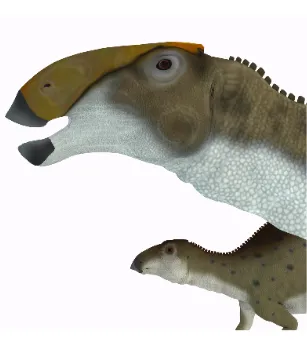
Image sources
Leonardo, mummified Brachylophosaurus canadensis: The Children's Museum of Indianapolis, CC BY-SA 3.0, via Wikimedia Commons
Skull: Bloopityboop, CC BY-SA 4.0, via Wikimedia Commons
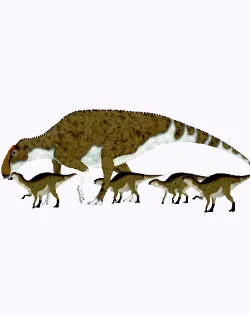
Size comparison: User:Slate Weasel, Public domain, via Wikimedia Commons
Tail of Brachylophasaurus with tendons: Tim Evanson, CC BY-SA 2.0, via Wikimedia Commons