
Velafrons
Velafrons: A duck-billed dinosaur with a sail-like forehead
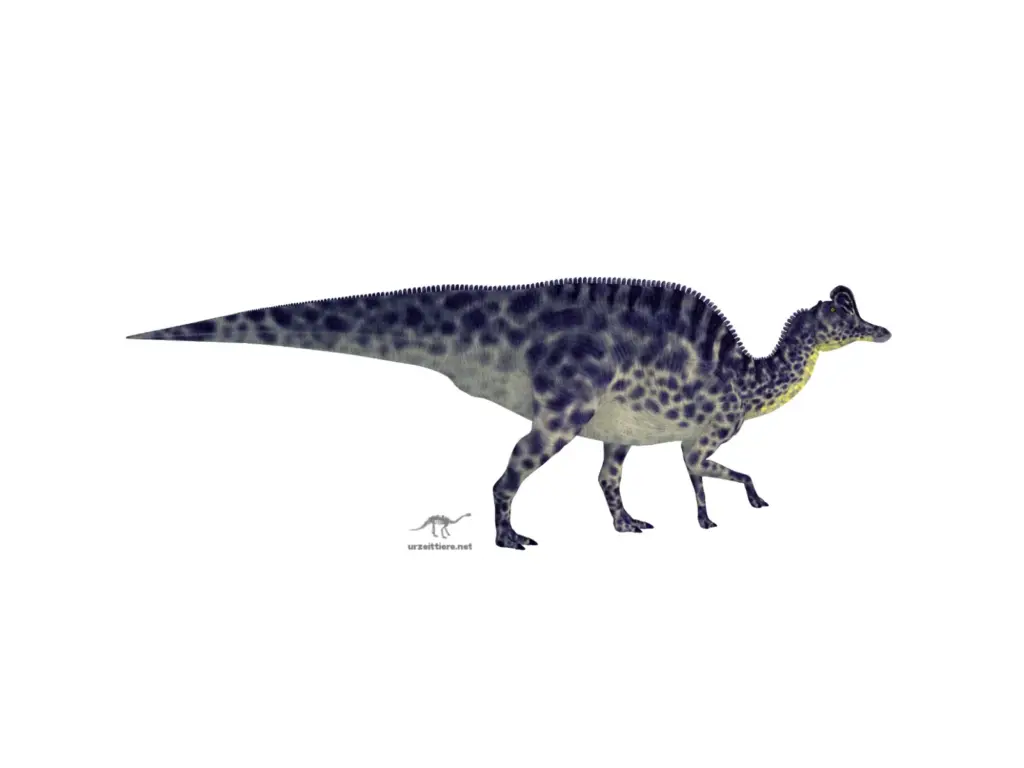
His name means "sail's forehead". On his head he wore Velafrons A fan-shaped comb. It was found in Mexico, and it wasn't yet fully grown. No one knows what the comb looked like when it was fully grown.
At a glance
| feature | Value |
|---|---|
| name | Velafrons coahuilensis (“Coahuila sail front”) |
| group | Duck-billed crest dinosaurs (Lambeosaurinae) |
| length | approx. 6.5 m (estimated value, not from specialist literature) |
| Weight | approx. 1.8 t (estimated value, not from specialist literature) |
| Location | Rincón Colorado, Coahuila State, Mexico |
| age | Late Cretaceous, about 73 million years ago |
| food | Plant |
| Fossils | an animal: partial skull and parts of the skeleton |
What does a dinosaur with a fan-shaped crest look like?
Velafrons It belongs to the crested dinosaurs. These are duck-billed dinosaurs with a hollow head crest. Velafrons was the comb a flat fan made of nasal and premaxillary bonesHe is more reminiscent of Corythosaurus as an Lambeosaurus.
The name "duckbill" has a reason. There are six large serrations on the edge of the premaxilla. It was probably held in place by a horny beak..
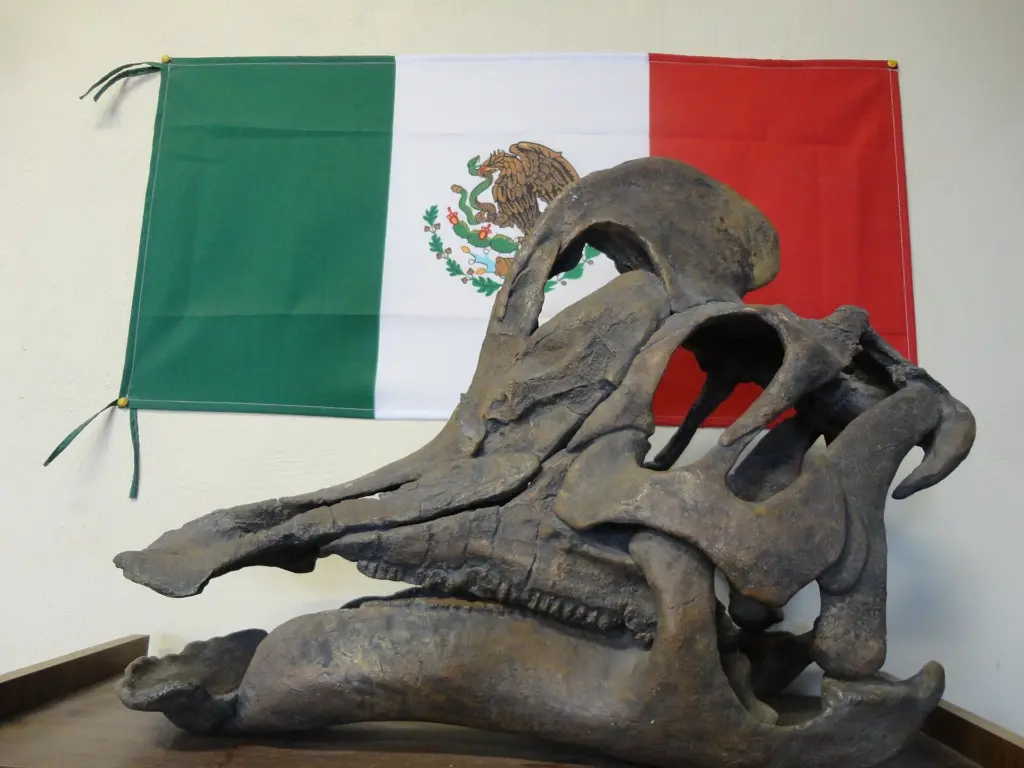
The nostril was approximately 25 centimeters longThis is longer than the short side of an A4 sheet of paper. The lower jaw measured 37 centimeters, and its dental arch comprised 34 tooth positions. No teeth survived in the lower jaw.
Little is known about the rest of the body. Experts only described the skull in 2007. The pelvic bones were not described until 2021. The ilium is 690 millimeters long.The ischium ends in a "foot" without a "heel," just like in... Corythosaurus.
The figures for length and weight come from our species database. They are not mentioned in the specialist literature. At 6.5 meters, it would be Velafrons It would have been longer than a small van. At 1.8 tons, it would have weighed as much as a hippopotamus. Because the animal was still growing, its adult size is unknown.
Why is a juvenile animal still considered a separate species?
Herein lies the trick. Combs change significantly during growth. Therefore, they are poorly suited for identification in a young animal. The researchers therefore relied on bones, which hardly change as they grow.
Three features made the difference:
- The recess in the quadrate bone, a bone of the jaw joint, is noticeably narrow.
- Behind the eye, a bony projection rises steeply upwards.
- The hyoid bone ends in a rounded shape at the front, rather than a square one.
In addition, there is a "clamp" on the nasal bone, which is common in young animals. Velafrons She wore it longer than his relatives.Three explanations are possible. The comb remained small, it grew late in a growth spurt, or Velafrons It grew faster and larger than the others. The exact cause remains unclear.
One clue comes from Presa San Antonio. There, researchers described a basin in 2021 that is larger than that of the holotype. It could be from an adult Velafrons originWithout skull bones, however, it remains "Lambeosaurinae, not further specified".
How was the skeleton found?
The search lasted ten years. From 1992 to 2001, a team excavated in quarry 7A near Rincón, Colorado. It contained a largely complete torso skeleton, but no skull.The skull was only discovered in 2002 by a joint expedition from Utah, Canada, and Mexico. It had disintegrated into pieces and was covered by a thick iron crust.
The rock contained shells and snails from brackish water. The site was therefore located in a coastal area with slightly salty water.
Today the holotype is considered the most complete type specimen among Mexico's named dinosaurs.
Who is related to Velafrons?
The next known relative is Magnapaulia from Baja California. Both form a southern group of crested dinosaurs.They are the sisters of the northern group around Corythosaurus and LambeosaurusThe common ancestor probably lived throughout North America. Later, the group split into northern and southern silos.
Magnapaulia was significantly larger. The largest animal reached a length of approximately 12.5 meters.Furthermore, a branch of the upper jaw is present at Velafrons horizontal, at Magnapaulia he points downwards.

What did his world look like?
Velafrons He lived on a coastal plain at the edge of the tropics. The sea repeatedly advanced and retreated. The ground contains ammonites, mosasaurs, turtles, and crocodiles..
The formation is today the Mexico's richest hadrosaur fossil siteAmong its neighbors was a tyrannosaurid, 2024 as Labocania aguillonae describedThat he Velafrons Whether they hunted each other is not documented. It is only documented that both occurred in the same habitat.
At the same time, there lived Parasaurolophus tubicen in present-day New Mexico, also a crested dinosaur, but with a long, tubular crest.
More information on this topic can be found at urzeittiere.net
- Lambeosaurus – northern crested dinosaur with a different crest.
- Parasaurolophus – Contemporary in present-day New Mexico, with a reed comb.
Image sources:
Velafron's skull: Juan Carlos Fonseca Mata, CC BY-SA 4.0, via Wikimedia Commons
Velafron's skeleton: Rogelio Reyna, CC BY-SA 3.0, via Wikimedia Commons