
Avimimus

The bird impersonator
Avimimus was a bird-like dinosaur.
Its name means something like: “bird impersonator”.
It was a very fast, lightweight dinosaur that belongs to the group Theropoda.
Its legs were extremely long and slender, suggesting that Avimimus was a highly specialized runner. Its shins were long compared to its thighs, a trait common among flight animals.
| Profile | Avimimus |
|---|---|
| epoch | late Cretaceous, about 85 – 70 million years ago |
| Order | Lizard-pelvis dinosaur (Saurischia) |
| Subordination | Theropoda |
| Family | Oviraptorosauria |
| group | Avimimidae |
| genus | Avimimus |
| species | Avimimus portentosus |
| Height | |
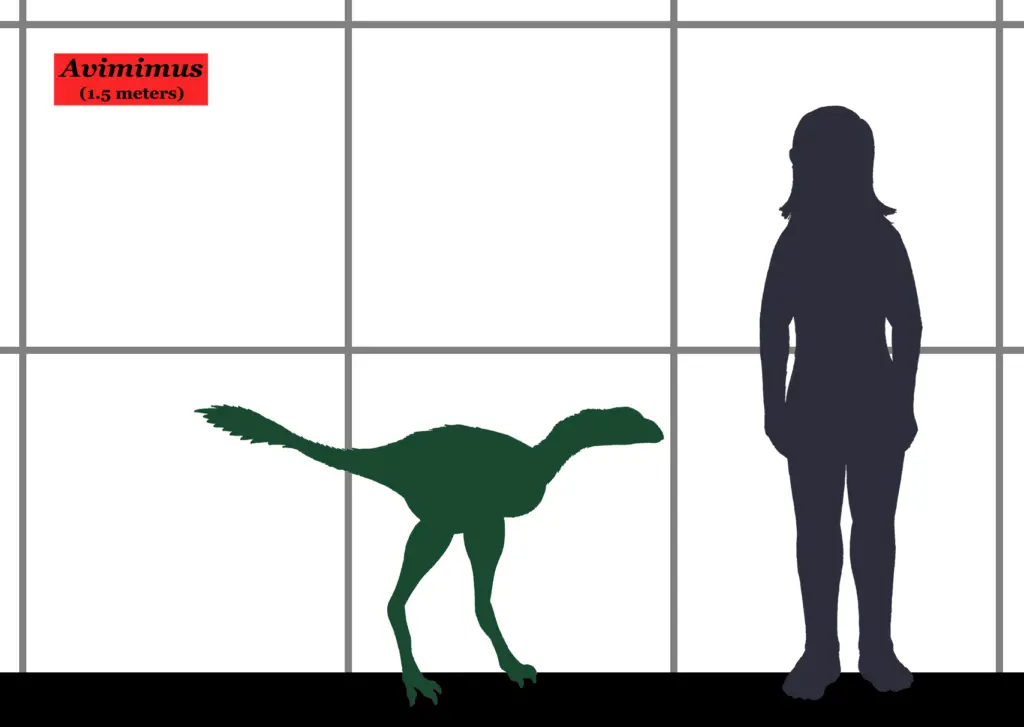
| length | 1.5 meters |
| Weight | 15kg |
| Locations | Mongolia |
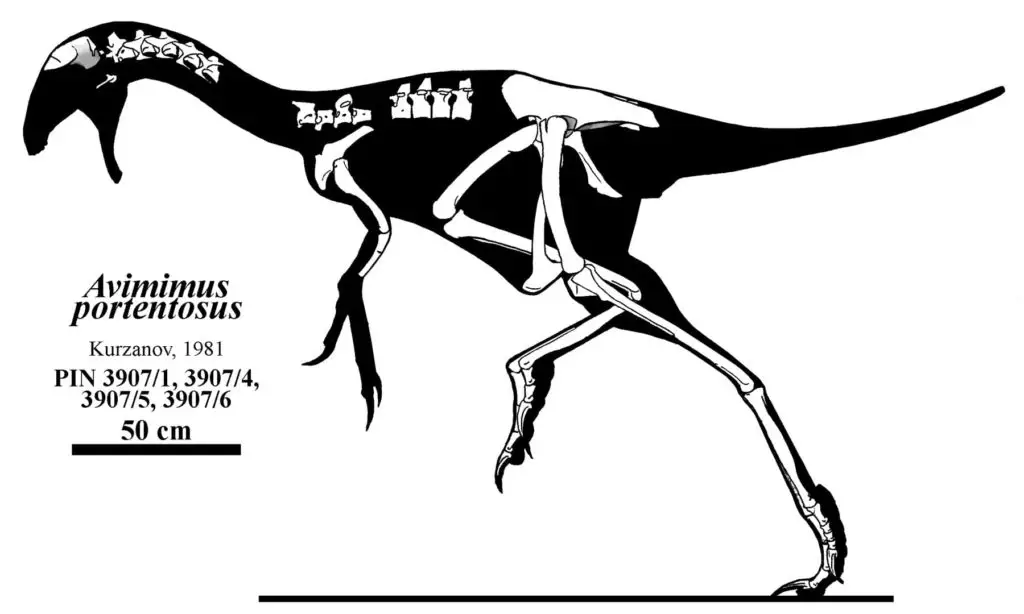
Closer examination revealed that Avimimus had no or only rudimentary teeth in its parrot-like beak, suggesting that it was likely a herbivore or omnivore.
Its diet may have consisted of small animals, insects, eggs and some plant material.
In 1973, the first Avimimus fossils were discovered by a Soviet-Mongolian expedition in the Gobi Desert.
In 2006, researchers found several Avimimus individuals in Mongolia near the town of Nemegt. This location led researchers to put forward various hypotheses about the life of Avimimus.
The researchers were able to see tiny ridges on the arm bones of Avimimus, which led them to believe that these served to anchor feathers. Illustrations by Avimimus therefore depict this dinosaur with feathers.
However, most researchers doubt that Avimimus could fly.
Behave
The site near Nemegt in the form of a bone bed, where fossils of several individuals are found, gives rise to the assumption that these animals lived in colonies. This bone bed is the first discovered by oviraptors from the Late Cretaceous. Avimimus bone beds are unusual in that no juvenile individuals were detectable. This could indicate that the animals have gathered to form a lek.
A Lek is a place where several individuals gather to court a female.
A bone bed can also indicate avimimus swarming behavior or a common sleeping place.
Image sources: Jaime A. Headden (User:Qilong), CC BY 3.0 https://creativecommons.org/licenses/by/3.0, via Wikimedia Commons
Conty, CC BY 3.0 https://creativecommons.org/licenses/by/3.0, via Wikimedia Commons
★Kumiko★, CC BY-SA 2.0 https://creativecommons.org/licenses/by-sa/2.0, via Wikimedia Commons
Matt Martyniuk, CC BY-SA 3.0 https://creativecommons.org/licenses/by-sa/3.0, via Wikimedia Commons