
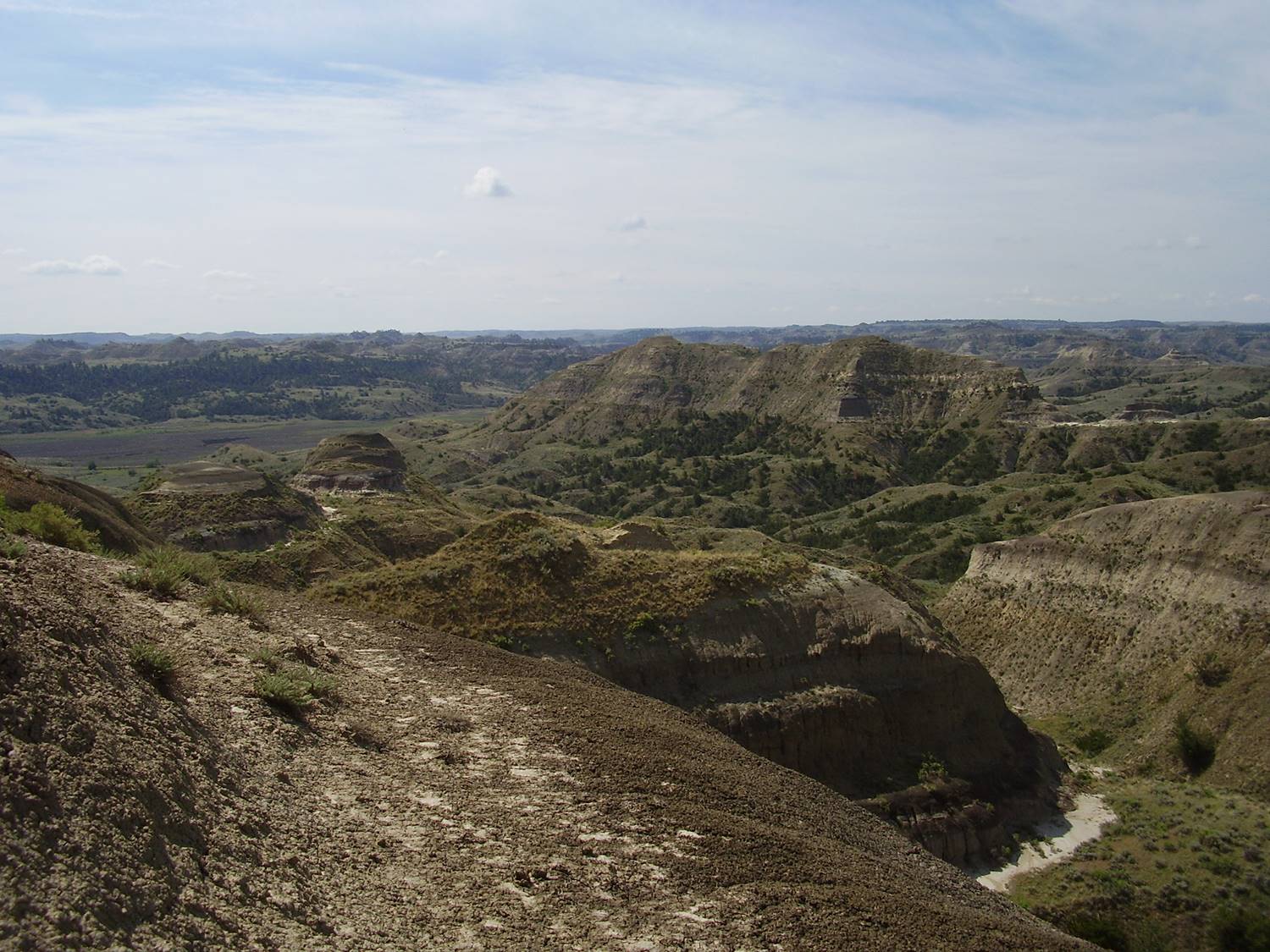
Hell Creek Formation
The Hell Creek Formation is considered one of the most important paleontological treasure troves in the world. Here, in the sedimentary layers of the North American Great Plains, the final chapters of the dinosaur era are preserved - a fascinating journey back in time to the late Cretaceous period, 66 to 68 million years ago. This geological formation not only offers spectacular fossil discoveries, but also crucial clues to the dramatic mass extinction that ended the reign of the dinosaurs.
What is the Hell Creek Formation? Basics and geological significance
The Hell Creek Formation extends across much of Montana, North Dakota, South Dakota, and Wyoming and represents one of the most complete geologic records of the Late Cretaceous. These sedimentary layers were formed 68 to 66 million years ago through complex depositional processes in an extensive river system characterized by regular floods.
Geologically, the formation consists primarily of sandstones, mudstones and siltstones, which were created by changing water levels and seasonal flooding. The characteristic gray-brown color of the rocks reveals their formation in oxygen-poor waters, which are responsible for the extraordinary preservation of organic materials. These unique conditions made the Hell Creek Formation the most important site for Upper Cretaceous dinosaur fossils in North America.
The formation is particularly geologically valuable because it has a continuous sequence of sedimentary layers that documents the transition from the Maastrichtian to the Paleocene. This allows scientists to study the evolution and abrupt disappearance of dinosaurs with exceptional temporal resolution. The layers contain not only dinosaur fossils, but also remains of the entire community of that time, from microscopic pollen to complete skeletons of large vertebrates.
The most famous dinosaurs from the Hell Creek Formation
The Hell Creek Formation is home to some of the most famous dinosaur species in Earth's history. At the top of the food chain was the legendary Tyrannosaurus rex, whose imposing remains find their most complete representation in this formation. At up to 13 meters long and an estimated weight of 9 tons, T. rex was the dominant apex predator of its time. Fossil finds show that these massive predators had exceptionally powerful jaws with teeth up to 23 centimeters long.
Among the most common herbivores was Triceratops, of which over 50 specimens have been discovered in the Hell Creek Formation. These three-horned giants reached lengths of up to 9 meters and weighed around 12 tons. Their characteristic neck shields and three prominent horns made them one of the most recognizable dinosaurs of all. Fossil records show that Triceratops lived in large herds and fed primarily on low-growing plants.
Edmontosaurus represents the group of duck-billed dinosaurs (hadrosaurs) and was one of the largest herbivores in the formation with a length of up to 15 meters. These social herd animals had complex chewing apparatus with hundreds of small teeth that were perfectly adapted to processing hard plant fibers. Fossil skin casts of Edmontosaurus are among the most spectacular finds from the Hell Creek Formation.
Pachycephalosaurus stands out due to its characteristic skull dome, which is up to 25 centimeters thick. These “thick-skulled dinosaurs” may have used their reinforced skulls for intraspecific fights or for defense against predators. Their fossils are relatively rare in the Hell Creek Formation, indicating a specialized ecological niche.
Ankylosaurus completes the spectrum with its characteristic carapace made of bony plates and its huge tail club. These armored herbivores, up to 10 meters long, were perfectly adapted to defend themselves against large predators and represent the final phase of the evolution of armored dinosaurs.
Spectacular Fossil Finds: From Sue to Preserved Soft Tissues
The Hell Creek Formation has given paleontology some of the most spectacular dinosaur finds of all time. Probably the most famous one is "Sue", the most complete Tyrannosaurus rex skeleton ever discovered. With 90 percent of the bones preserved, Sue offers a nearly complete look at the anatomy of this apex predator. The 12.3 meter long skeleton was discovered in 1990 by fossil collector Sue Hendrickson and is now in the Field Museum of Natural History in Chicago.
The finds of are particularly noteworthy preserved soft tissues, making the Hell Creek Formation a hotspot for biomolecular research. In recent years, scientists have been able to identify organic material in Tyrannosaurus rex bones that may contain original protein and even DNA material. These discoveries are revolutionizing our understanding of fossil preservation and opening up completely new research approaches.
Extraordinary Edmontosaurus finds have led to the first documented dinosaur “mummies,” in which not only bones but also skin, muscles and internal organs were fossilized. A specimen discovered in 2008, affectionately dubbed “Dakota,” shows the actual body shape of a hadrosaur for the first time and proves that these dinosaurs were more athletic and muscular than originally thought.
Fossilized footprint seals and tracks in the formation's fluvial deposits provide unique insights into dinosaur behavior. These fossil traces document migration movements, herd behavior and even hunting scenes between predators and prey. Particularly spectacular are the discoveries of trilobite tracks, which show that different dinosaur species used the same habitats at the same time.
Habitat and ecosystem 66 million years ago
66 million years ago, the Hell Creek Formation region presented itself as a subtropical paradise with a warm, humid climate and extensive river systems. Average temperatures were around 10-15 degrees Celsius higher than today, which enabled lush plant growth and formed the basis for the rich dinosaur fauna.
The Landscape was characterized by meandering rivers that meandered through vast flood plains. These wetlands provided ideal living conditions for a variety of organisms. Conifers such as sequoias and cypresses, along with early flowering plants, formed dense forests, while open areas were dominated by ferns and cycads. This plant world formed the food basis for the large variety of herbivores.
The food chain was complexly structured: at the base were large herbivores such as Triceratops and Edmontosaurus, which roamed the landscape in huge herds. These were preyed upon by predators of various sizes, from the massive Tyrannosaurus rex to smaller dromaeosaurids. The coexistence of different dinosaur species in the same habitat shows highly developed ecological niche separation.
Next to the dinosaurs divided other vertebrates the habitat: crocodiles controlled the waters, turtles populated both land and water, and early mammals exploited nocturnal niches. Pterosaurs ruled the skies, while primitive bony pikes and rays swam in the rivers. This diversity shows a highly complex and stable ecosystem that has existed for millions of years.
The K-Pg boundary: evidence of mass extinction
The Hell Creek Formation documents one of the most dramatic events in Earth's history: the mass extinction at the Cretaceous-Paleogene boundary (K-Pg boundary) exactly 66.04 million years ago. This geological boundary layer is clearly visible in the sediments of the formation Iridium layer documented - a chemical fingerprint of the devastating asteroid impact in the Gulf of Mexico.
The Iridium anomaly, first discovered in the 1980s, contains concentrations of this precious metal hundreds of times higher than normal. This iridium has been proven to come from the approximately 10-15 kilometer wide asteroid that created the Chicxulub crater in Yucatán. In the Hell Creek sediments, this layer is only a few centimeters thick, but represents a geological moment of enormous consequence.
Fossil finds immediately below the K-Pg boundary show a thriving dinosaur community in the last millennia before the impact. Tyrannosaurus rex, Triceratops and Edmontosaurus fossils show that dinosaur populations were stable and diverse until the end - a strong argument against the theory of gradual extinction.
Above the boundary layer Dinosaur fossils disappear completely from the geological record. Instead, remains of survivors dominate: crocodiles, turtles, small mammals and birds. This dramatic change in fossil composition within a few centimeters of sediment documents the speed and completeness of the extinction event.
The Hell Creek Formation allows scientists to immediate effects of the impact to study. Shocked quartz grains, microtektites, and charred plant remains in the boundary layer demonstrate global devastation caused by heat radiation, fires, and “nuclear winter” conditions.
Important sites and modern excavations
The Hell Creek Formation spans several significant discovery regions, each making unique scientific contributions. In Montana are some of the most productive sites, including the famous Fort Peck area where Sue was discovered. The Jordan Formation in Montana has yielded particularly complete Triceratops skeletons and is considered a reference region for Late Cretaceous stratigraphy.
North Dakota is home to the legendary Marmarth Research Foundation area, where scientists from the Denver Museum of Nature & Science regularly make new discoveries. An exceptionally well-preserved Triceratops juvenile was found here in 2019, providing new insights into the development of these animals. The region is particularly rich in smaller dinosaur fossils and offers insights into the overall biodiversity of the Late Cretaceous.
Modern excavation techniques have revolutionized fossil research. GPS mapping and 3D scanning enable precise documentation of the circumstances of the discovery and the reconstruction of entire sites in digital space. Computed tomography scans reveal internal structures of fossils without damaging them, while electron microscopy allows the study of soft tissue preservation at the cellular level.
Current scientific expeditions combine traditional excavation methods with the latest technology. Drones map large areas and identify potential discovery sites, while portable X-ray devices enable initial analyzes in the field. These innovations have led to a number of spectacular new discoveries since 2020, including several near-complete dinosaur skeletons.
The most important fossil collections from the Hell Creek Formation are now housed in world-class museums: The Field Museum of Natural History in Chicago houses Sue and one of the most comprehensive Hell Creek collections. The Museum of the Rockies in Montana, led by Jack Horner, specializes in the developmental biology of dinosaurs and presents groundbreaking research on the growth dynamics of T. Rex and other species.
Scientific significance and new findings
The Hell Creek Formation has led to revolutionary scientific breakthroughs in recent years that have fundamentally changed our understanding of dinosaur biology. Insights into growth rates and life expectancy are based on detailed bone histology showing that Tyrannosaurus Rex grew extremely quickly and had a life expectancy of around 28-30 years. These analyzes show that large theropods grew from juveniles to adult giants in just 20 years.
Controversial research on warm-bloodedness have gained new nourishment through isotope studies of Hell Creek fossils. Oxygen isotopes in teeth and bones of Tyrannosaurus Rex indicate a constant body temperature that was well above ambient temperature - a strong indication of endothermy. These findings revolutionize the traditional image of dinosaurs as cold-blooded reptiles.
Computed tomography and biomechanics studies have decoded the locomotion and hunting strategies of Hell Creek dinosaurs. Finite element analyzes of Tyrannosaurus skulls show bite forces of up to 57,000 Newtons - enough to crush car keys. At the same time, biomechanical models show that adult T. Rex could reach speeds of 25 km/h despite their size.
Paleoneurological research use CT scans to reconstruct dinosaur brains. Hell Creek finds show that tyrannosaurs had exceptionally developed organs of smell and balance, which explains their efficiency as hunters. These neuroanatomical studies also demonstrate complex social behavior in theropod dinosaurs.
The Hell Creek Formation remains an inexhaustible source of scientific knowledge about one of the most fascinating periods in Earth's history. Their fossils tell not only the story of the last dinosaurs, but also the dramatic story of their disappearance and the beginning of a new era. For paleontology, it is a living laboratory that promises to continue to make groundbreaking discoveries and continually expand our understanding of life on Earth.
| Dinosaurs of the Hell Creek Formation |
|---|
| Acheroraptor temertyorum |
| Ankylosaurus magniventris |
| Anzu wyliei |
| Dakotaraptor steini |
| Denversaurus schlessmani |
| Leptoceratops gracilis |
| Richardoestesia isosceles |
| Tatankaceratops sacrisonorum |
| Thescelosaurus garbanii |
| Thescelosaurus neglectus |
| Triceratops horridus |
| Triceratops prorsus |
| Trierarchuncus prairiensis |
| Tyrannosaurus rex |
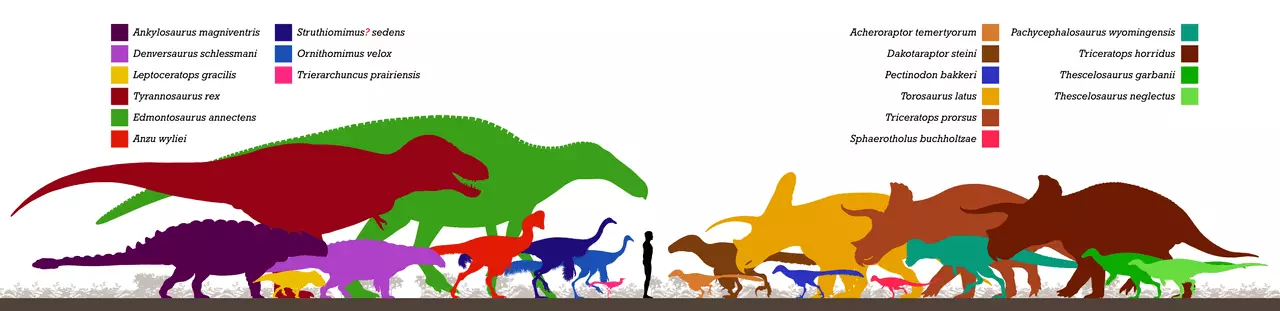
Image source: Meridas (Vladimír Socha), CC BY-SA 4.0 https://creativecommons.org/licenses/by-sa/4.0, via Wikimedia Commons