
Afrovenator
Afrovenator abakensis – the African hunter
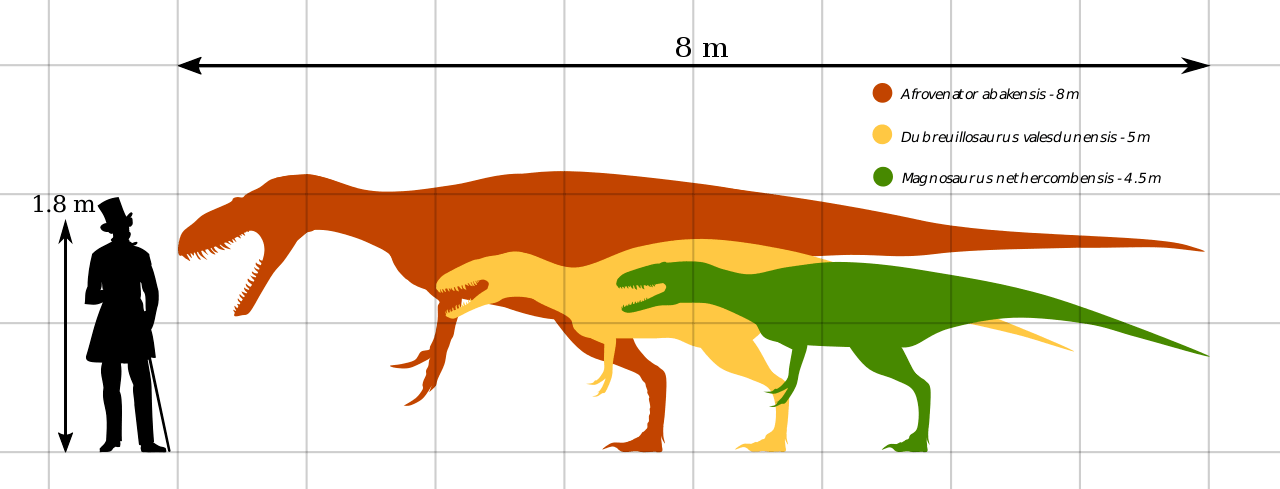
Afrovenator was an efficient, bipedal predator. Measuring 9 meters long and 3.5 meters high, it was a dangerous hunter that pursued and devoured herbivorous dinosaurs such as Jobaria, whose fossils were found in the same rock formations.
He had a graceful physique with long, slender legs and a long, balancing tail.
Its approximately 5 cm long serrated teeth were ideal for cutting deep into the flesh of its victims and tearing it out of their bodies.
It had long sickle claws on three fingers with which it could grab and probably slash its prey.
To date, Afrovenator remains the most complete Cretaceous predatory dinosaur fossil ever found in Africa.
The blueprint of his body suggests that he is a cousin of Allosaurus, a 150 million year old dinosaur from North America.
However, it was probably lighter and more fleet-footed than Allosaurus, as indicated by its longer and slimmer bones.
The fossil remains of Afrovenator were discovered in 1993 by paleontologist Paul Sereno and his team in North Africa in the Republic of Niger.
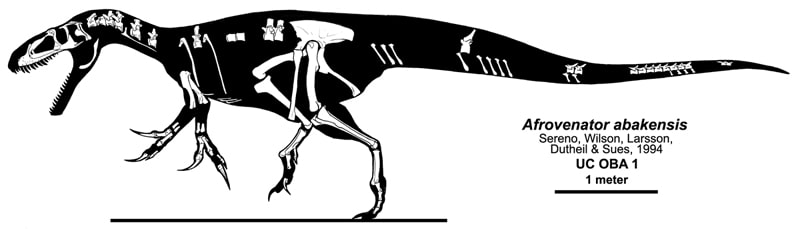
The name Afrovenator abakensis means something like the hunter from Avatar, Africa. The dinosaur received the species name abakensis because its skeleton was found in the Sahara region of Agadez. Because Abaka is the Touareg name for this region in Niger.
The skeleton found by Sereno was more complete than any previously discovered Cretaceous African carnivores.
| Profile | Afrovenator |
|---|---|
| epoch | Middle Jurassic to ? Upper Jurassic 168 to ? 157 million years |
| Order | Lizard-pelvis dinosaur (Saurischia) |
| Subordination | Theropoda |
| Family | Megalosauridae |
| group | |
| genus | Afrovenator |
| species | Afrovenator abakensis |
| Height | 3.5 meters |
| length | 7 to 9 meters |
| Weight | 1 ton |
| Locations | Tiouraren Formation, Agadez, Niger |
What did Afrovenator abakensis eat?
The area where Afrovenator lived was lushly forested with nearby lakes and rivers.
As mentioned above, a large sauropod called Jobaria tiguidensis was found in the same formation where Afrovenator was found.
Scientists suspect that Afrovenator hunted this sauropod. Since Jobaria tiguidensis grew to 18 to 21 m long, it can be assumed that he particularly targeted the smaller juveniles, as the smaller specimens would have been easier to handle for a predator the size of Afrovenator. However, there is currently no scientific evidence for this theory.
Because of its similarity to Allosaurus, Afrovenator is thought to have lived in packs and even hunted adult Jobaria specimens.
Classification problems
Afrovenator is currently assigned to the family Megalosauridae.
Paul Sereno, who first described Afrovenator in 1994, assigned it to the Torvosauroidea. Sereno came to this conclusion because the rock layer from which the fossil was recovered was assigned to the Early Cretaceous period. The rock layers have now been re-dated and assigned to the Middle Jurassic.
Another study by Rauhut from 2003 sees Afrovenator not as a member of the Megalosauroidea but as a close relative of Allosaurus.
The official affiliation is currently to the family Megalosauridae.
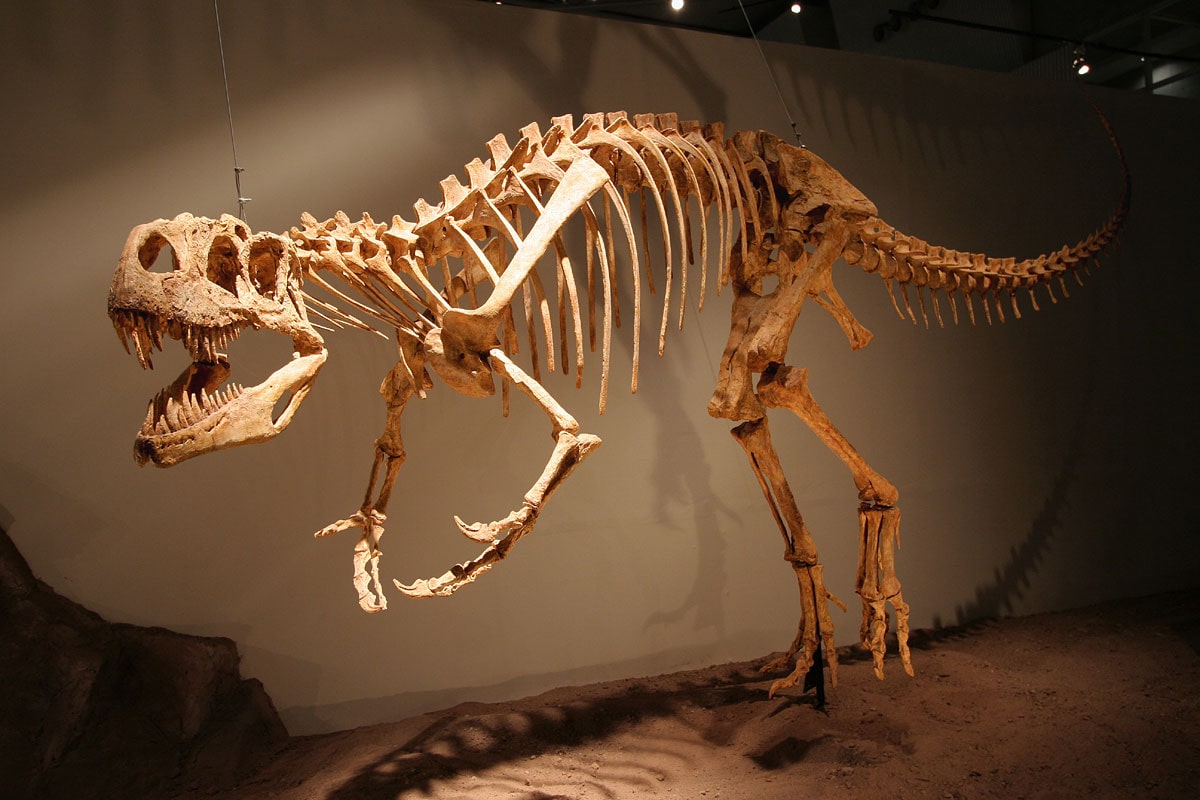
Image sources: PaleoGeekSquared, CC BY-SA 4.0 https://creativecommons.org/licenses/by-sa/4.0, via Wikimedia Commons
Skeleton:Kabacchi, CC BY 2.0 https://creativecommons.org/licenses/by/2.0, via Wikimedia Commons
Skelton: Jaime Headden (User:Qilong), CC BY 3.0 https://creativecommons.org/licenses/by/3.0, via Wikimedia Commons
Size comparison: PaleoGeekSquared, CC BY-SA 4.0 https://creativecommons.org/licenses/by-sa/4.0, via Wikimedia Commons