Shantungosaurus
Only recognized species: Shantungosaurus giganteus
Shantungosaurus is a species of dinosaur that lived in the Late Cretaceous Period, about 72 to 66 million years ago. It is classified as a hadrosaur, a group of herbivorous dinosaurs known for their duck-like beaks. Shantungosaurus is the largest hadrosaur in the world to date and also the largest ornithopod, making it a true giant among its peers.
Shantungosaurus giganteus was first described in 1973 by Chinese scientist Xing Xu and his colleagues. Its name means “Shandong lizard,” named after the Shandong province of China where its fossil remains were found. The description of Shantungosaurus reveals a number of unique features that set it apart from other hadrosaurs.
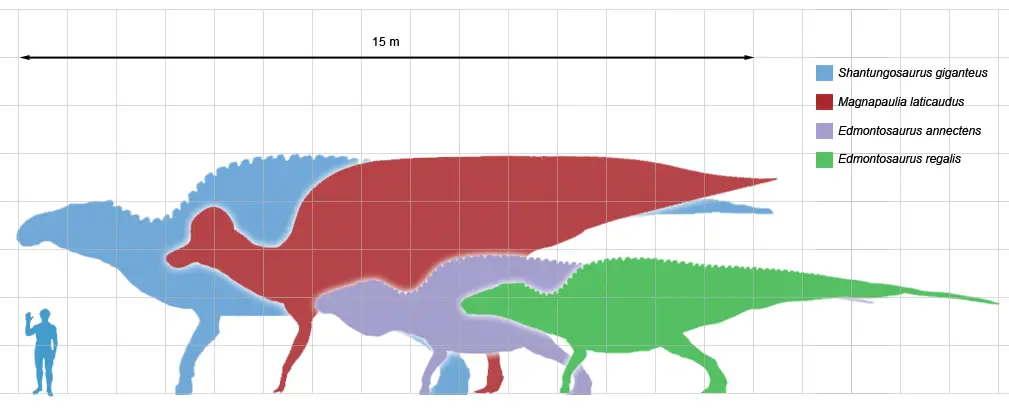
One of the most striking features of Shantungosaurus was its size. It was one of the largest herbivorous dinosaurs ever discovered, estimated to be up to 15.3 meters long and weighing around 16.5 tonnes. This massive body size made it a formidable herbivore, capable of eating large amounts of plant material to maintain its enormous body.
Despite its size, Shantungosaurus was probably a relatively peaceful and gentle dinosaur. Like other hadrosaurs, it presumably fed primarily on foliage and low-growing plants, which it reached easily thanks to its long neck and flexible snout. It is thought that Shantungosaurus lived in large herds to protect itself from predators such as tyrannosaurs, which hunted in the region at the time.
As for its appearance, Shantungosaurus resembled the American one Edmontosaurus. It had a toothless beak, but its jaws were equipped with around 1,500 tiny chewing teeth that were excellent at shredding tough plant material. Additionally, Shantungosaurus had a large hole near its nostrils, which may have been covered by a loose flap of skin. He could inflate this skin to make sounds. This behavior may have been used for communication within a herd.
Overall, Shantungosaurus was a fascinating and important member of the Late Cretaceous ecosystem. Its size and herbivorous habits made it an integral part of the food chain, and its presence helped shape the environment in which it lived.
| Shantungosaurus giganteus | |
|---|---|
| length | 15.3 meters |
| Weight | 16.5 tons |
| locomotion | Four-legged / Two-legged |
| Food | herbivores |
Systematics
Ornithischia
Genasauria
Neornithischia
Cerapoda
Ornithopoda
Iguanodontia
Ankylopollexia
Styracosterna
Hadrosauriformes
Hadrosauroidea
Hadrosauromorpha
Hadrosauridae
Saurolophinae
Edmontosaurini
Occurrence in time
chalk
Upper Cretaceous
Late Campanian
Happen
Asia
Country: China
Region: Shandong
Formation: Xingezhuang