Omeisaurus
| length | 16.5 meters |
| Weight | 6 tons |
| locomotion | Four-legged |
| Food | herbivores |
Omeisaurus was a Middle Jurassic sauropod dinosaur characterized by its long neck, which could reach up to 8.5 meters long. This made it one of the most easily recognizable dinosaurs of its time.
The remains of Omeisaurus were first discovered in China's Sichuan province in 1936. Paleontologists have identified three different species within this genus.
Recent discoveries have provided new insights into its behavior and anatomical adaptations. These findings provide a better understanding of how Omeisaurus may have interacted with its environment and what role it played in the Jurassic ecosystem.
Description of Omeisaurus
Omeisaurus stands out among sauropods for its remarkably long neck. The neck this dinosaur from the Middle Jurassic was among the longest of all known sauropod species. In Omeisaurus junghsiensis, the neck measured around 8.5 meters, contributing significantly to its total length of 10 to 15 meters. The larger species, Omeisaurus tianfuensis, reached a length of 16 to 20 meters and weighed between 9.8 and 11.8 tons.
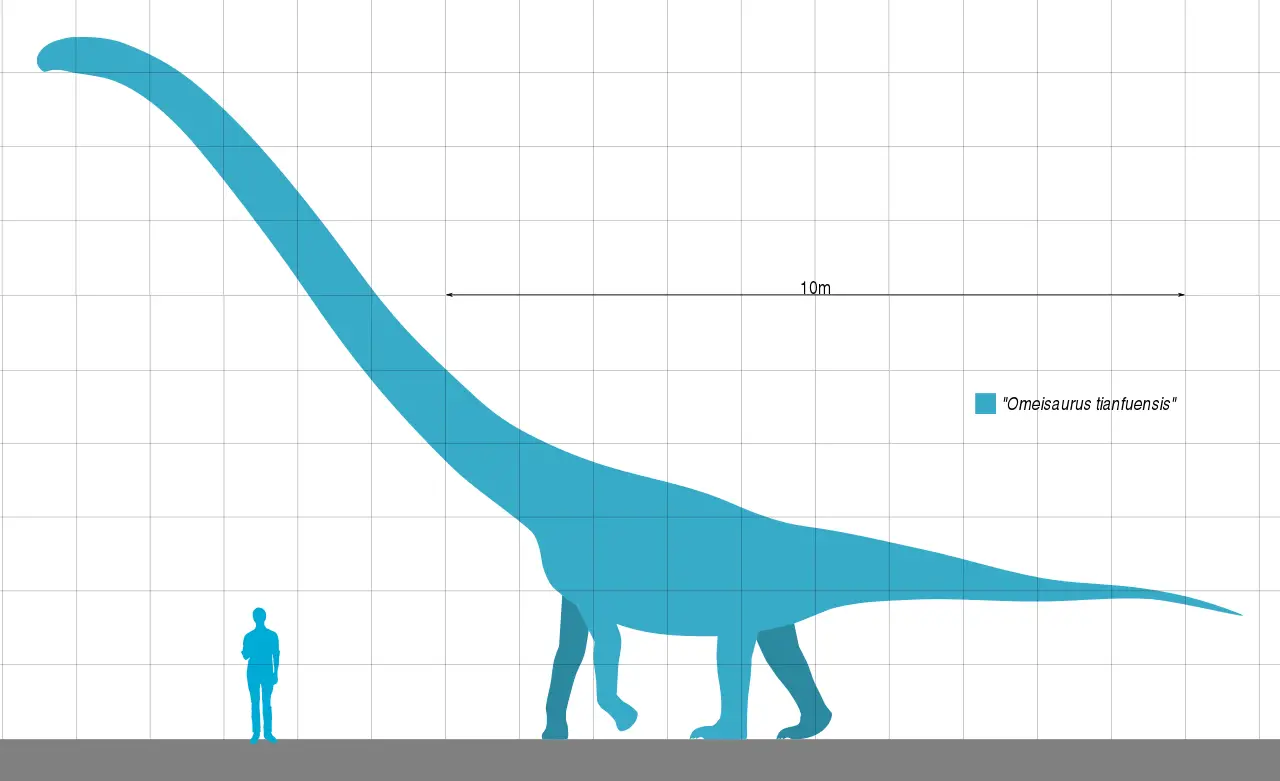
Compared to its elongated neck, Omeisaurus had a relatively short body and legs. His spine consisted of 16 to 17 elongated cervical vertebrae, 12 dorsal vertebrae, and 4 fused sacral vertebrae.
The skull of Omeisaurus was similar to that of Shunosaurus, but was shorter and taller. Its teeth were spatula-shaped and comparatively larger than those of the Shunosaurus. The jaw structure included 4 teeth in the premaxilla, 11 in the maxilla, and 13–15 in the mandible on each side.
These anatomical features, particularly the long neck and unique tooth structure, distinguish Omeisaurus within the sauropod group and expand our understanding of sauropod diversity during the Middle Jurassic.
Discovery and species
The discovery of Omeisaurus dates back to 1936, when the first skeleton was found in Rong County, Sichuan Province, China. The researchers Yang Zhongjian and Charles Camp recovered the specimen and transported it to Beijing for further examination. In 1939, Yang Zhongjian officially described it as a new genus and species and named it Omeisaurus junghsiensis.
Other significant discoveries occurred in the 1970s during construction work on the Wujiaba Dam in Zigong, where many Omeisaurus fossils were found. In the 1980s, other important finds were made at Dashanpu in Zigong, including an almost complete skeleton of Omeisaurus tianfuensis.
Currently, three species of Omeisaurus are recognized as valid: O.junghsiensis (the type species), O. tianfuensis and O. maoianus. Although there are descriptions of six additional species, their validity is still debated among paleontologists.
These discoveries have greatly improved our understanding of sauropod diversity during the Middle Jurassic in China. The genus Omeisaurus, known for its long neck and uncertain phylogenetic relationships, remains the subject of ongoing scientific research and discussion in the paleontological community.
Recent discoveries
Since the 1980s, paleontologists have discovered several new species of Omeisaurus. One of the most important finds was in 2001 O. maoianus, which is considered the most complete discovery of this genus. This specimen was collected from the Shaximiao Formation in Jingyan in the 1990s by Jin Xingshen and Zhang Guojin. It includes a skull, partial spine, and various postcranial elements and is cataloged as ZNM N8510. The holotype skull is currently on display at the Zhejiang Natural History Museum.
However, the classification of O. maoianus has been debated, with some phylogenetic analyzes suggesting that it may be more closely related to Mamenchisaurus and Xinjiangtitan.
In 2011 a new species was introduced Omeisaurus jiaoi, identified from a well-preserved, partially articulated postcranial skeleton found in Zigong, now on display at the Zigong Dinosaur Museum (ZDM 5050).
The newest addition to the genre, O. puxiani, was discovered in Yunyang and is one of the best-preserved Omeisaurus specimens found to date. This specimen, listed at the Chongqing Laboratory of Geoheritage Protection and Research under catalog number CLGRP V00005, contains fossils from most of the spine and pelvic girdle and provides valuable insights into the anatomy and development of Omeisaurus.
Paleoecology of Omeisaurus
During the Middle Jurassic, about 170 to 145 million years ago, Omeisaurus lived in what is now Sichuan Province in China, more specifically in the Shaximiao Formation.
As a herbivorous sauropod, Omeisaurus contributed significantly to the plant communities of its time due to its unique adaptations. Its neck, which consisted of 16 to 17 elongated cervical vertebrae, gave it access to plants that other herbivores could not reach. The hollow structure of its vertebrae reduced the weight of its neck, and its rounded body shape helped with thermoregulation.
Omeisaurus is thought to have consumed up to a ton of plant material daily, which had a significant impact on its environment. Fossil evidence suggests that Omeisaurus may have exhibited herd behavior based on the large number of fossil remains found in similar locations.
The large number of fossils suggests that Omeisaurus was well adapted to its ecological niche during the Middle Jurassic period in China.
Conclusion
Omeisaurus is a sauropod dinosaur that has been of interest to paleontologists since its discovery in 1936. This dinosaur is known for its distinctive long neck and there are three recognized species. Omeisaurus was a herbivore. Recent discoveries have provided insights into its paleoecology and contributed to a better understanding of the habitats it inhabits. The study of these Middle Jurassic sauropods has contributed to the knowledge of sauropod evolution, behavior and ecosystems in the Jurassic of China.
Systematics
| Dinosauria |
| Saurischia |
| Eusaurischia |
| Sauropodomorpha |
| Plateosauria |
| Massopoda |
| Sauropodiformes |
| Anchisauria |
| Sauropoda |
| Gravisauria |
| Eusauropoda |
| Mamenchisauridae? |
Occurrence in time
| Law |
| Middle Jurassic |
| Bathonium-Callovium |
Happen
| Area | Asia |
| country | China |
| region | Sichuan |
| formation | Lower (=Xia) Shaximiao Formation |