Compsognathus
Compy – “The Dainty Jaw”
Compsognathus looks like a typical representative of theropods.
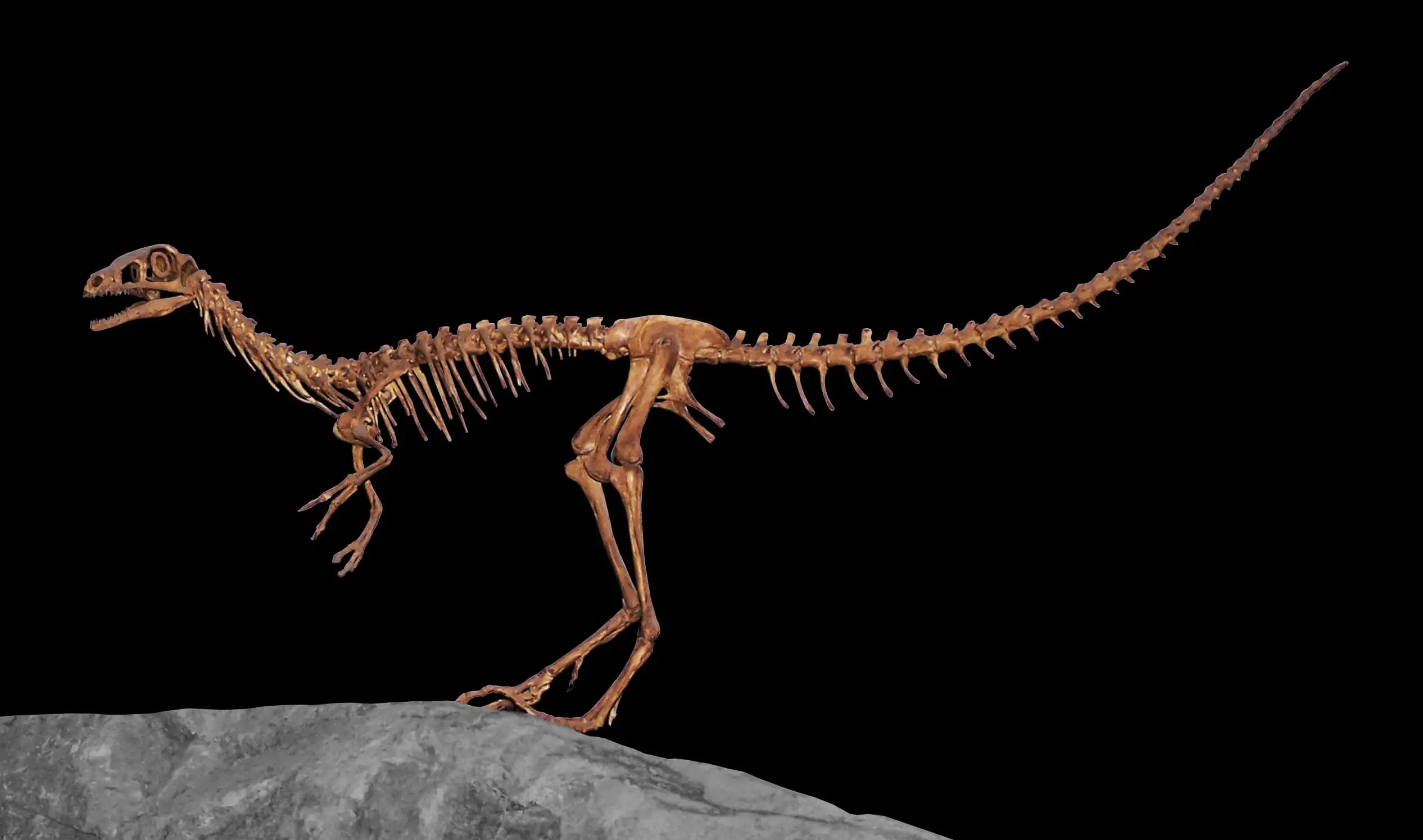
It walked on two legs, had relatively short arms with three strong fingers each and a relatively long but thin skull.
Its teeth were long and sharp and well adapted to its prey. This consisted of insects, small vertebrates and lizards.
He also had an extremely long tail. Although some caudal vertebrae are missing from the excavated specimens, it is believed that Compsognathus had up to 60 caudal vertebrae. This means that it had the proportionally longest tail of any theropod.
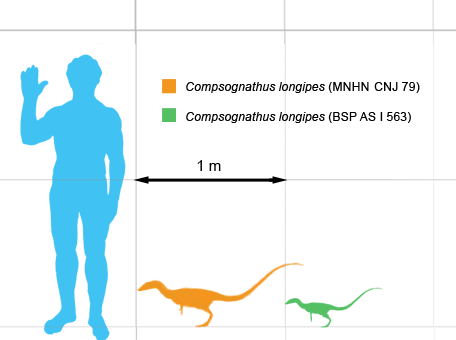
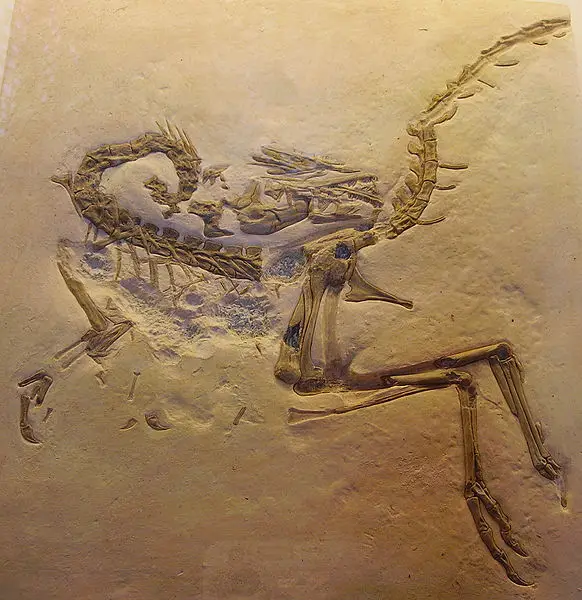
Two almost complete skeletons of him were recovered in Germany and France. The German fossil belonged to a specimen that was only 80 cm long. The French one is slightly larger and is 129 cm long.
| Profile | Compsognathus |
|---|---|
| epoch | Upper Jurassic, 152.1 to 147.7 million years ago |
| Order | Lizard-pelvis dinosaur (Saurischia) |
| Subordination | Theropoda |
| Family | Coelurosauria |
| group | Compsognathidae |
| genus | Compsognathus |
| species | Compsognathus longipes |
| Height | 0.4 meters |
| length | 1.25 meters |
| Weight | 0.26 to 3.5 kilograms |
| Locations | Germany, France |
Was Compsognathus the world's smallest dinosaur?
For decades, Compsognathus was actually considered the world's smallest dinosaur - a title it can no longer fully claim today. At 80 to 129 cm long and weighing just 0.26 to 3.5 kilograms, it was barely larger than a goose, but it has since been pushed out of this place by even smaller relatives such as Microraptor and Parvicursor.
Nevertheless, Compsognathus remains one of the smallest known dinosaurs and is therefore a prime example of the fact that “dinosaur” does not automatically mean “huge”. In its own habitat it was even the largest land animal far and wide - surrounded only by pterosaurs and prehistoric fish.
Nutrition
The diet of Compsognathus is known with certainty. In the fossil finds, remains of small lizards were found in the bellies of both skeletons.
At first the small skeletons were interpreted as embryos. The remains found were later thought to be those of a lizard. In 1994, researcher Ostrom attributed the lizard to the genus Bavarisaurus.
But this assumption has also been refuted today. The last meal of Compsognathus was a lizard called Bharatagama rebbanensis.[source]
Like many of the light theropods from the Triassic and Jurassic, Compsognathus was a fast and agile dinosaur. This agility was very useful to it when hunting its prey and, due to its size, important for survival when escaping larger predators. Its unusually long tail was very helpful in keeping its balance during high-speed chases.
How fast was Compsognathus?
In 2007, the maximum speed of Compsognathus was estimated to be around 64 kilometers per hour. Researchers William Sellers and Phillip Manning calculated this speed using a computer model of the muscles and skeleton of Compsognathus. Despite its small size, it was one of the faster dinosaurs of its time.
For comparison: Usain Bolt reached a top speed of 44.72 km/h.
Compsognathus grabbed its prey with its three-fingered hands
He had hands with three fingers that he could use skillfully to grab his prey. However, he did not yet have an opposable thumb.
The eyes were exceptionally large, as indicated by the large eye sockets. The structure of the eye sockets suggests that Compsognathus has binocular vision. This enabled him to get a spatial depth impression of his surroundings and helped him to recognize and fixate on his prey.
Summary of some of the key facts about Compsognathus:
- Compsognathus was first discovered in Bavaria, Germany in 1859 by Joseph Oberndorfer
- “Compsognathus” means “delicate jaw”.
- Compsognathus is not closely related to lizards, but had similarly shaped pelvic bones.
- He was a theropod.
- Compsognathus was found in the same rock formations as Archeopteryx. Early scientists such as Thomas Henry Huxley believed that birds evolved from dinosaurs because of the similarity of the skeletons.
- It may have had short bristles
- Compsognathus was the largest dinosaur in its habitat, which was more populated by pterosaurs and prehistoric fish!
- Compsognathus was covered in classic reptilian skin. Its fossils show no trace of primitive feathers.
- For decades Compsognathus was considered the smallest dinosaur. It has since been replaced in this ranking by dinosaurs such as Microraptor and Parvicursor.
- Known by his nickname Compy
- Compsognathus is one of the most famous small dinosaurs of all and served as a model for the “Compys” from Jurassic Park - there they appear under the name Procompsognathus, but their appearance and behavior are clearly based on the real Compsognathus.
Image sources: Compsognathus longipes ©urzeittiere.net
Skeleton: Zach Tirrell from Plymouth, USA, CC BY-SA 2.0 https://creativecommons.org/licenses/by-sa/2.0, via Wikimedia Commons
Size comparison: No machine-readable author provided. Dinoguy2 assumed (based on copyright claims)., CC BY 3.0 https://creativecommons.org/licenses/by/3.0, via Wikimedia Commons
Cast Fossil: Photograph by User:Ballista. Image edited in Adobe PhotoShop CS2 by User:Firsfron, CC BY-SA 3.0 http://creativecommons.org/licenses/by-sa/3.0/, via Wikimedia Commons