
Anzu wyliei

The chicken from hell
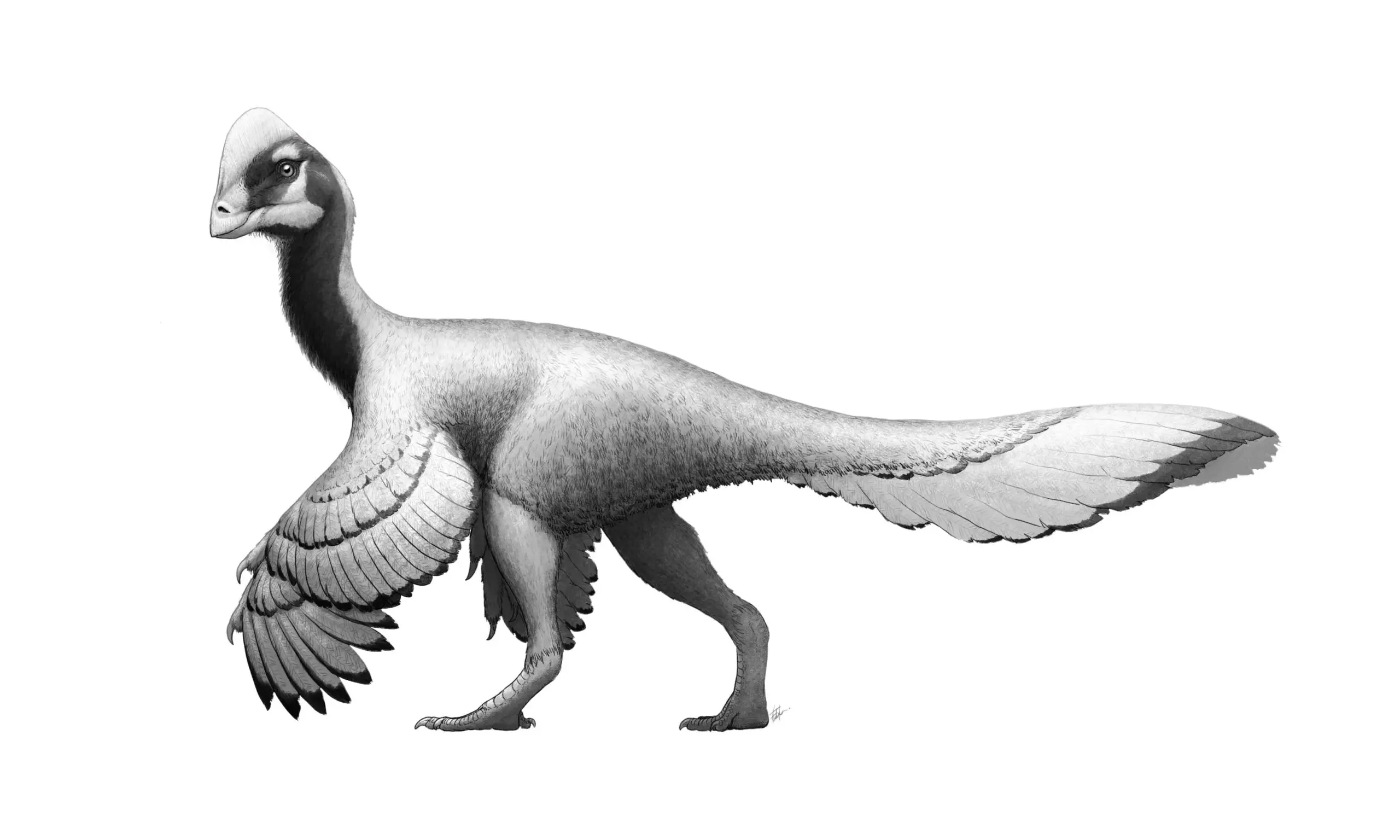
Anzu wyliei is a strange bird-like creature.
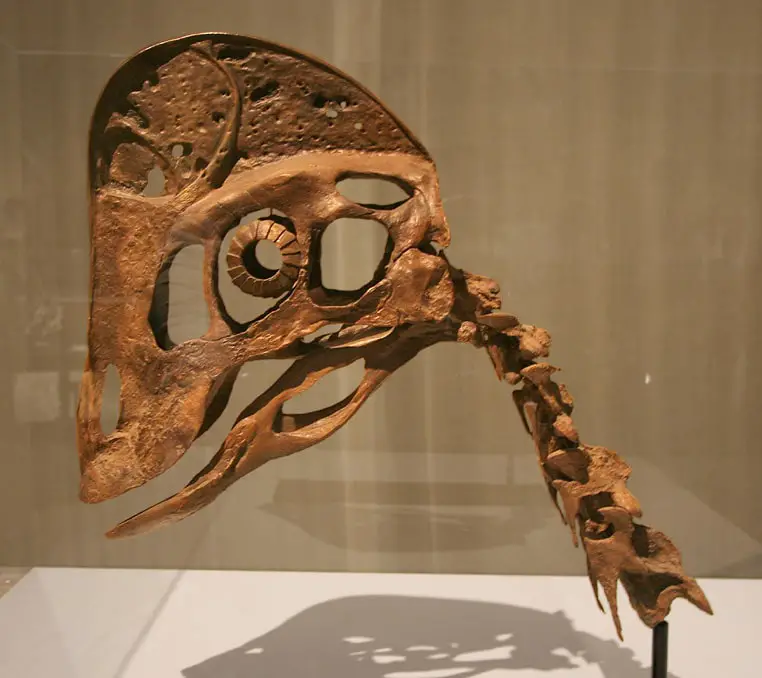
He has an exceptionally high and thin bony ridge on his skull.
This dinosaur has a huge beak with sharp edges and no teeth. The anatomy of the jaw joint is also extraordinary. The lower jaw can be moved forwards and backwards in a sliding movement, probably in order to “cut up” the food.
Anzu also had feathers on his upper arms.
Because of its appearance and the location called the “Hell Creek Formation,” it was nicknamed Chicken from Hell.
| Profile | Anzu |
|---|---|
| epoch | late Cretaceous, about 69 million years ago |
| Order | Lizard-pelvis dinosaur (Saurischia) |
| Subordination | Theropoda |
| Family | Caenagnathidae |
| group | Caenagnathinae |
| genus | Anzu |
| Art | Anzu wyliei |
| Height | 1.5 meters |
| length | 3 to 3.5 meters |
| Weight | 200kg to 300kg |
| Locations | North Dakota and South Dakota |
Size
It was up to 3.5 meters long and its hip height was 1.50 meters. Its weight is estimated at 200 to 300 kg.
It resembled a large flightless bird with feathers on its tail and arms. The neck and hind legs were long and slender and looked not unlike an ostrich. However, the front limbs were equipped with large, sharp claws.
Anzu also had a long tail like a lizard, which negates the resemblance to an ostrich.
Behave
Scientists believe that Anzu was able to run very quickly.
He did not specialize in a particular ecological niche. The anatomy of its jaw suggests that it could eat a variety of different foods. It is believed that it ate both plants and small animals and may even have been able to open and eat eggs.
Anzu is not related to birds, but his bird-like features suggest that he exhibited many bird-like behaviors. The large crest on his head, made of extremely thin bone, was probably only used for display. Similar to the cassowary living in Australia, which uses its comb to attract mates.
The Anzu bones are the first detailed evidence that oviraptorosaurs also lived in North America.
It belongs to a group of dinosaurs known as Oviraptorosauria. Most of the evidence for their existence comes from fossils discovered in Central and East Asia.
The size of a small car, the dinosaur also had claws and feathers on its upper arms.
Scientists realized early on that the bones they found belonged to a meat-eating dinosaur.
Because the bones of carnivorous dinosaurs are hollow, and the bones found were hollow.

Discovery of Anzu wyilei
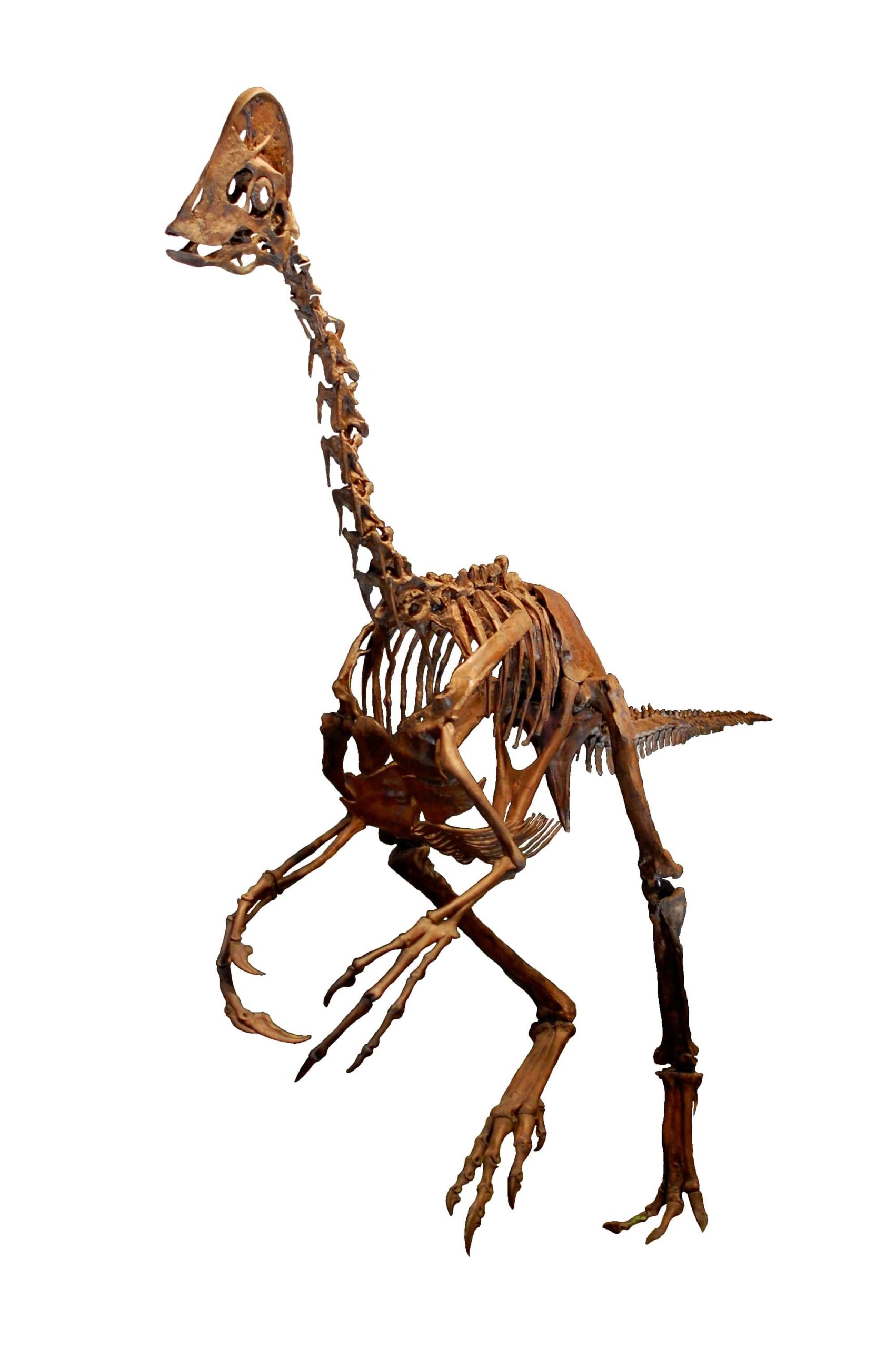
The dino was assembled and identified using pieces from three skeletons collected in North and South Dakota.
Together they form an almost complete skeleton, which allows good conclusions to be drawn about its appearance.
Approximately 80% of the skeleton could be reconstructed in this way.
Two partial skeletons were found by private collectors and later acquired by the Carnegie Museum of Natural History in Pittsburgh;
Mike Triebold
Nut family
The third partial skeleton was uncovered by Tyler Lyson and his team at the Smithsonian's National Museum of Natural History, in North Dakota.
Lyson was also one of four scientists who worked together to identify the genus Anzu.
The quartet also included Hans-Dieter Sues, curator of vertebrate paleontology in the Division of Paleobiology at the National Museum of Natural History, lead author Matthew Lamanna, assistant curator of vertebrate paleontology at the Carnegie Museum of Natural History, and Emma Schachner, a postdoctoral fellow at the University of Utah in Salt Lake City.
Matthew Lamanna, who came up with the species' name, originally wanted to use a Latin or Greek version of "chicken from hell."
However, this term did not translate well, so it changed the name Anzu chose. A bird-like demon from Sumerian mythology. This term can roughly be translated as: “heavenly eagle” be translated.
All three Anzu skeletons are now housed in the Carnegie Museum of Natural History in Pittsburgh.
Image sources: Fred Wierum, CC BY-SA 4.0 https://creativecommons.org/licenses/by-sa/4.0, via Wikimedia Commons
Skull: Kabacchi, CC BY 2.0 https://creativecommons.org/licenses/by/2.0, via Wikimedia Commons
Skeleton: Tadek Kurpaski from Pittsburgh,PA, USA, CC BY 2.0 https://creativecommons.org/licenses/by/2.0, via Wikimedia Commons
Hand: James St. John, CC BY 2.0 https://creativecommons.org/licenses/by/2.0, via Wikimedia Commons