
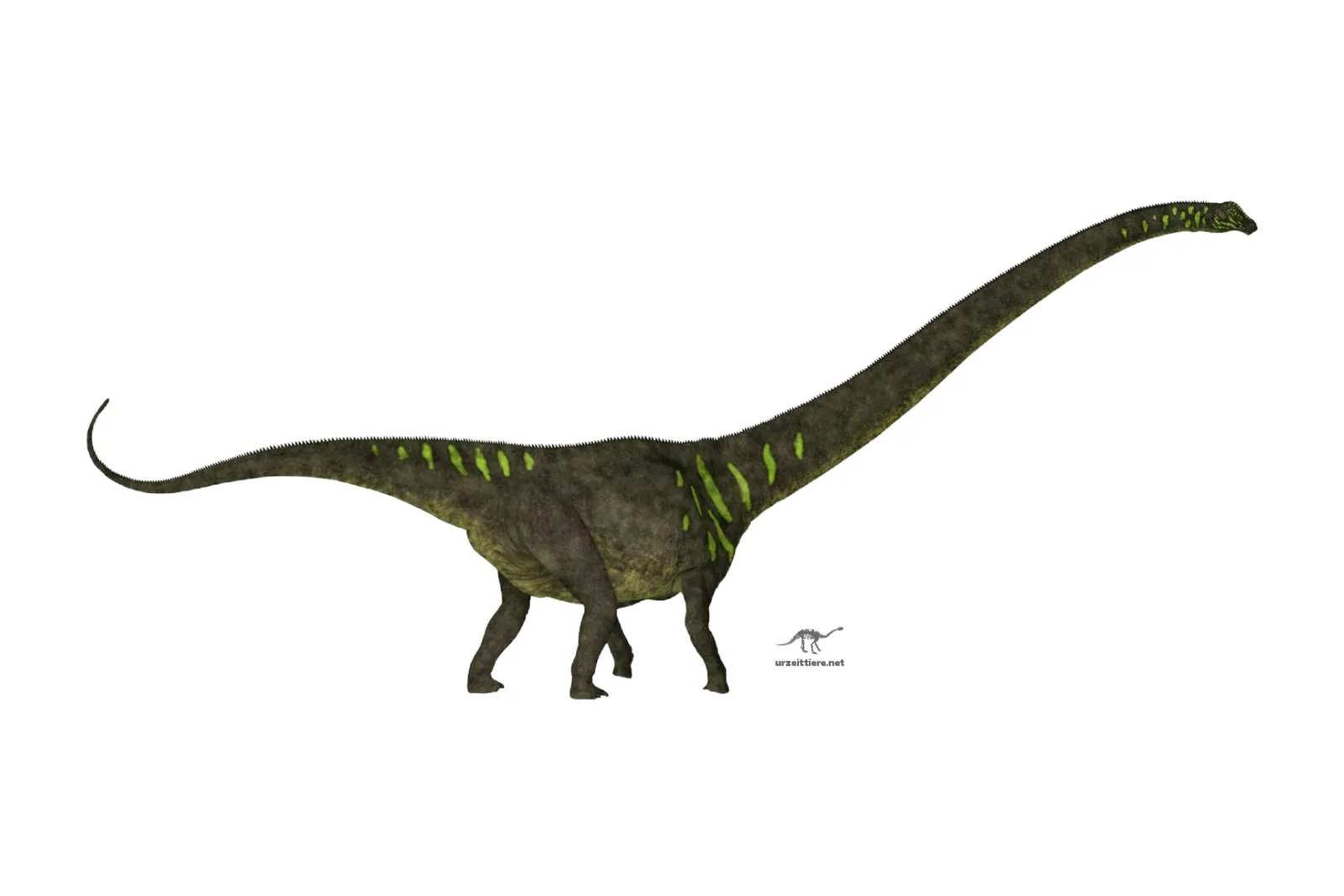
Mamenchisaurus
Mamenchisaurus, a dinosaur from the Late Jurassic period, is characterized by its exceptionally long neck, which could reach up to 14 meters long. This length exceeds that of a standard school bus.
Aside from its neck, Mamenchisaurus had distinctive body structure and feeding strategies that provide insight into sauropod evolution and the ecosystems of its time.
Ongoing research is examining various aspects of this dinosaur, including its classification and behavior, as well as unresolved questions about its life and environment.
| length | 20 meters |
| Weight | 12 tons |
| locomotion | Four-legged |
| food | herbivores |
Description and physical characteristics of Mamenchisaurus
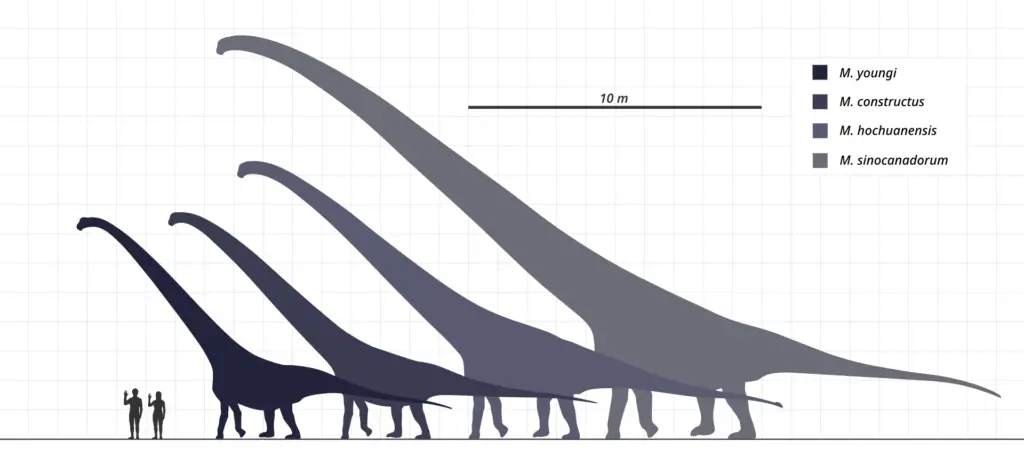
Mamenchisaurus was a large sauropod dinosaur known for its considerable size. Some species grew up to 26 meters long. Its most striking feature was its extremely long neck, which could reach more than 14 meters in length in species such as M. sinocanadorum. This neck was supported by 18 to 19 cervical vertebrae and elongated cervical ribs, allowing Mamenchisaurus to access food sources that were inaccessible to other dinosaurs.
Similar to Omeisaurus, which had 16 to 17 elongated cervical vertebrae, the vertebrae of Mamenchisaurus were specifically adapted to the greater neck length.
The body structure of Mamenchisaurus resembled that of a suspension bridge, with the almost horizontal neck balanced by a long tail. The vertebrae in the neck, back, and tail were hollow and light, while the leg bones were massive and sturdy.
The skull of Mamenchisaurus was relatively small compared to its body size, measuring 51 cm in length in M. youngi and containing a brain cavity of only 60 milliliters. The lower jaw featured a small external mandibular fenestra, a feature shared with few other sauropods such as Shunosaurus.
Mamenchisaurus had between 14 and 18 chisel-like teeth on each side of the upper jaw, including 4 in the premaxilla, and between 18 and 24 teeth on each side of the lower jaw.
Classification and taxonomy of Mamenchisaurus
The classification and taxonomy of Mamenchisaurus is controversial among paleontologists. Mamenchisaurus belongs to the family Mamenchisauridae, known for their exceptionally long necks. Over the years, his systematic position has been debated.
In 1990, paleontologist John McIntosh assigned it to the family Diplodocidae. However, Paul Upchurch later assigned it to the family Euhelopodidae in his studies conducted between 1995 and 1999. Today, Mamenchisaurus is usually considered a basal member of the Eusauropoda group, positioned outside Neosauropoda, and is often assigned to the family Mamenchisauridae.
The family Mamenchisauridae may also include other genera such as Chuanjiesaurus, Eomamenchisaurus, Tienshanosaurus, Tonganosaurus, Omeisaurus and Yuanmousaurus. However, Upchurch noted in 2004 that the internal systematics of Mamenchisaurus requires further clarification, as many specimens attributed to Mamenchisaurus may not belong to this genus.
There are currently six known species of Mamenchisaurus: M. constructus, M. hochuanensis, M. sinocanadorum, M. youngi, M. anyuensis and M. jingyanensis. The status of M. fuxiensis as a potential seventh species is unclear and continues to be debated among experts.
Neck posture and feeding strategy of Mamenchisaurus
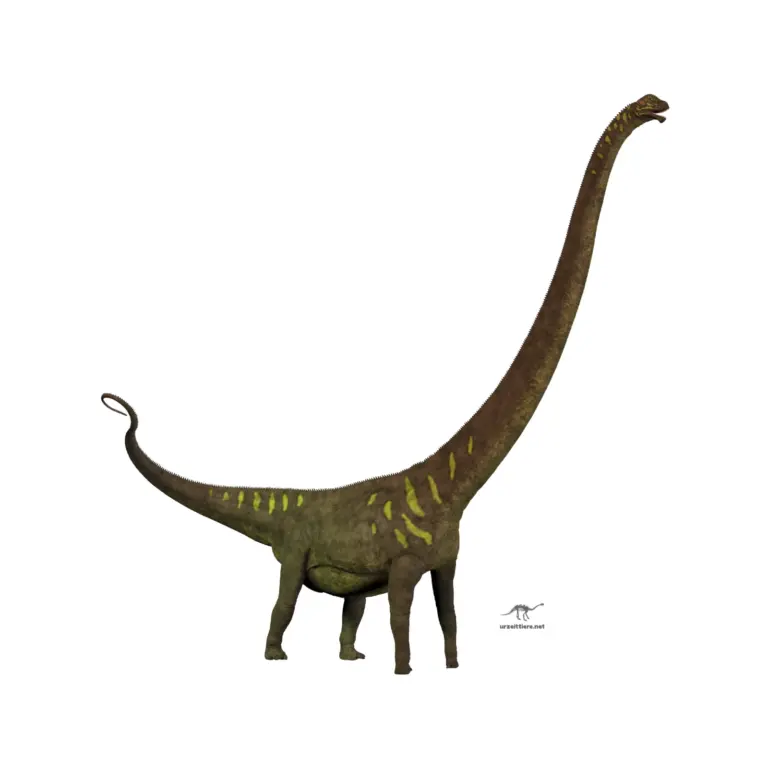
The neck posture and feeding strategies of Mamenchisaurus are the subject of ongoing debate among paleontologists, similar to other sauropod dinosaurs. The main question is whether Mamenchisaurus held its neck horizontally or vertically. A biomechanical study suggests that the immobility of the neck due to its long ribs likely prevented it from maintaining an upright posture. This feature distinguishes Mamenchisaurus from diplodocids, which had more flexible necks.
For example, could Diplodocus raise its neck slightly and thus feed on low vegetation. Based on current evidence, Mamenchisaurus likely employed a low- to medium-altitude grazing strategy. Its elongated neck provided several advantages, allowing the dinosaur to reach a wide area for feeding without having to move its entire body - an advantage in areas with sparse vegetation.
In addition, this anatomical peculiarity could have shortened the time between feeding phases and thus improved the efficiency of foraging. Although the precise mechanics of Mamenchisaurus's neck movements remain unclear, these hypotheses provide insights into its likely feeding behavior and ecological role.
Further research and fossil discoveries will be important to gain a clearer understanding of this sauropod's lifestyle.
Tail club of Mamenchisaurus
In recent years, paleontologists have found evidence of a possible tail club in a specimen of Mamenchisaurus hochuanensis, designated ZDM 0126. This specimen had four fused caudal vertebrae at the end of the tail, which had enlarged neural arches and higher spinous processes. These features suggest the possible presence of a tail club, similar to other Chinese sauropods such as Shunosaurus and Omeisaurus, although with some morphological differences.
The discovery of Fona herzogae in Utah illustrates the diversity of anatomical adaptations in dinosaurs and suggests different evolutionary developments. To evaluate the functionality of this potential tail club, the researchers used the finite element method. The results suggested that it was not very effective as a defensive weapon, challenging previous assumptions about its primary function.
Another hypothesis is that the tail club may have functioned as a sensory organ. This interpretation highlights the complexity of sauropod anatomy and the ongoing debates about the roles of various anatomical features.
Hypothetical forms of communication: The tail club may have been used to produce sounds by hitting the ground or other objects. It could also have sent out visual signals through certain movements or the size and shape of the club.
It is important to note that these points are speculation and there is no direct evidence to support this Mamenchisaurus used his tail club for communication. Further research is needed to examine this hypothesis.
It is important to note that the existence and function of tail clubs in Mamenchisaurus are still under scientific investigation and further research is required to fully understand their significance in the context of sauropod evolution and behavior.
Paleochronology of Mamenchisaurus
Paleochronological research on Mamenchisaurus has improved our understanding of the timeline in which these sauropods existed. Mamenchisaurus is primarily associated with the Late Jurassic period, particularly in the region now known as China. This dating is supported by the discovery of fossils of M. hochuanensis in the upper Shaximiao Formation, which has been reliably dated to the Late Jurassic period. The geographic and stratigraphic context of these fossils provides important information about the environment in which Mamenchisaurus lived.
In addition, paleontological studies in other areas, such as the Nemegt Formation in Mongolia, have contributed to our knowledge of dinosaur diversity in the Late Cretaceous.
However, recent studies suggest that the family Mamenchisauridae may have had a longer time span, possibly extending into the Early Cretaceous. This finding challenges previous assumptions about the timing of their extinction and suggests that these long-necked dinosaurs may have survived beyond the Jurassic-Cretaceous boundary.
This raises questions about the adaptability and resilience of Mamenchisaurus and related species. As paleontologists continue to examine new fossil evidence and improve dating methods, our understanding of how Mamenchisaurus fits into Earth's history may change, potentially revealing more about the evolution and diversification of sauropods.
Additional Notes
Mamenchisaurus is a major genus of sauropod dinosaur that has contributed significantly to our understanding of sauropod evolution. It provides important insights into the evolution and diversification of these long-necked herbivores. The unique anatomical features of Mamenchisaurus were examined in comparison to those of Omeisaurus, another sauropod with a similarly elongated neck structure.
Mamenchisaurus has been featured in various media reports about prehistoric life, highlighting its role in connecting the public to Earth's ancient past. Ongoing research on Mamenchisaurus continues to provide valuable information.
Future discoveries could provide further insight into the biology and ecology of these dinosaurs. As new fossils continue to be found and advanced analytical techniques are used, our understanding of Mamenchisaurus is expected to continue to increase. These future findings could provide information about their growth patterns, locomotion, and environmental adaptations.
Mamenchisaurus continues to be an important object of study in both scientific research and popular culture. It serves as an important representative of sauropod diversity and offers insights into the Mesozoic.
Conclusion
Mamenchisaurus is an Upper Jurassic sauropod known for its exceptionally long neck. It has distinctive physical characteristics, belongs to a specific classification within the dinosaurs, and had particular feeding strategies adapted to its environment. Mamenchisaurus also possessed a tail club, which played a role in its interactions within prehistoric ecosystems. Ongoing research could provide more information about its anatomy and behavior. Mamenchisaurus is an important focus in paleontology and provides insights into the evolution of sauropods and species diversity in prehistoric times.
Image sources:
Steveoc 86, CC BY-SA 3.0, via Wikimedia Commons
Systematics
| Dinosauria |
| Saurischia |
| Eusaurischia |
| Sauropodomorpha |
| Plateosauria |
| Massopoda |
| Sauropodiformes |
| Anchisauria |
| Sauropoda |
| Gravisauria |
| Eusauropoda |
| Mamenchisauridae |
Occurrence in time
| Law |
| Upper Jurassic |
| Oxfordium |
Happen
| Area | Asia |
| country | China |
| region | Sichuan |
| formation | Shangshaximiao Formation |