Albertaceratops
Description (physical characteristics)
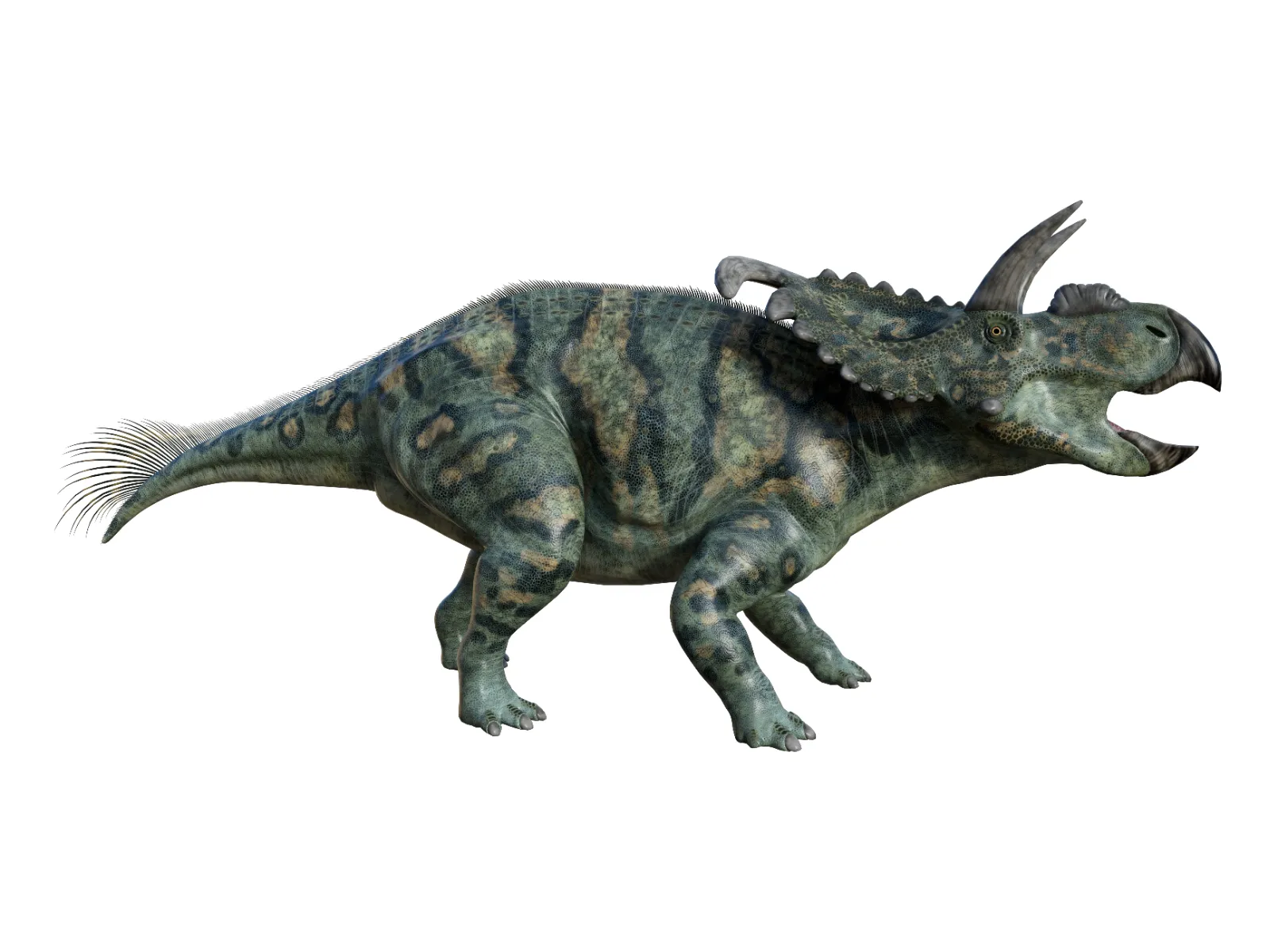
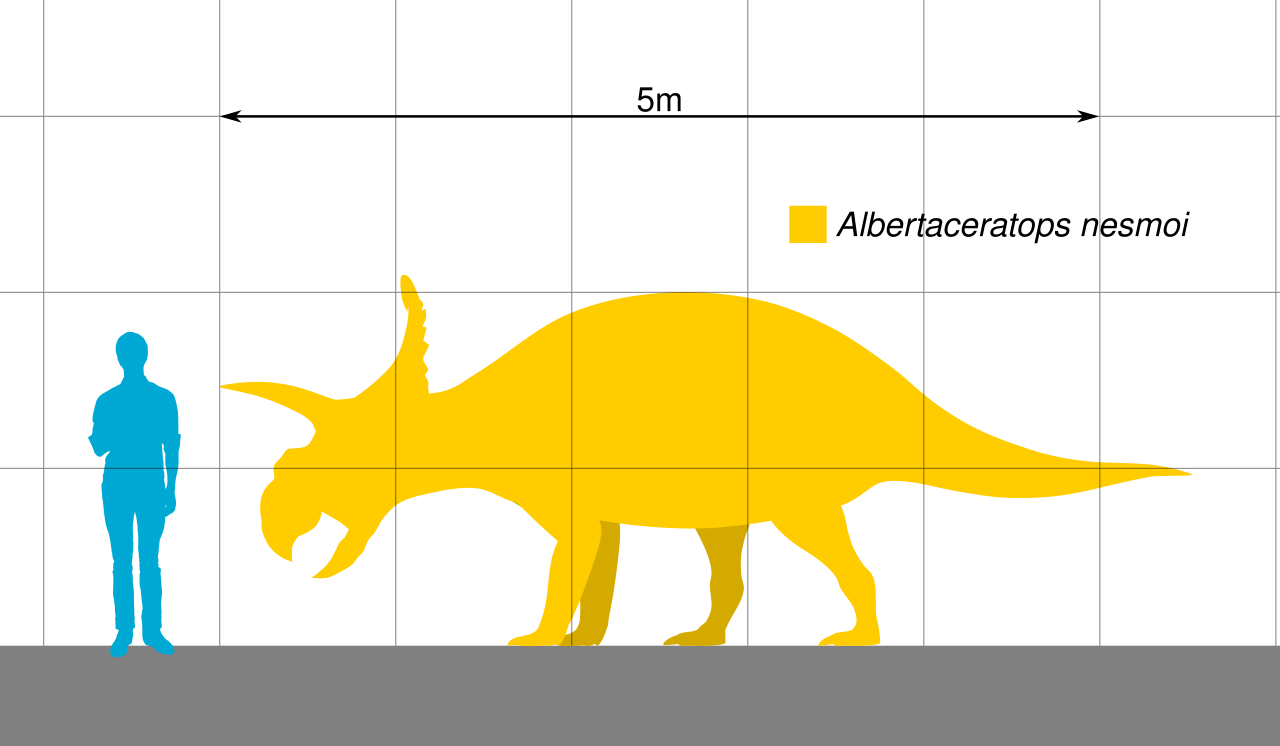
Albertaceratops nesmoi was a medium-sized horned dinosaur from the subfamily Centrosaurinae that lived during the middle Campanian stage of the Late Cretaceous period, about 80 to 76 million years ago, in the region of present-day Alberta, Canada. This herbivorous dinosaur reached respectable dimensions, with an estimated body length of around 6.2 meters and a weight of around 2,800 kilograms - comparable to a modern African elephant.
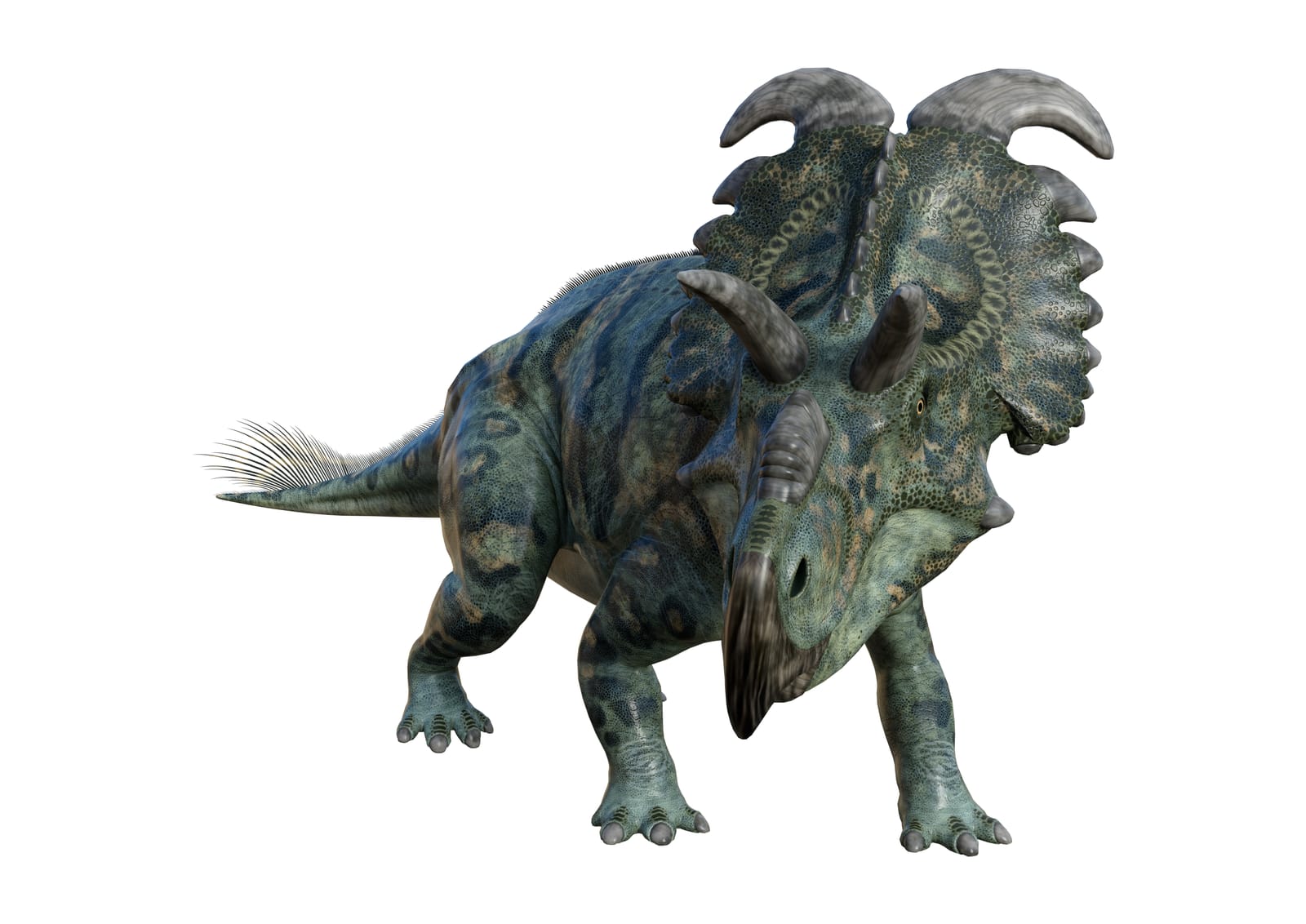
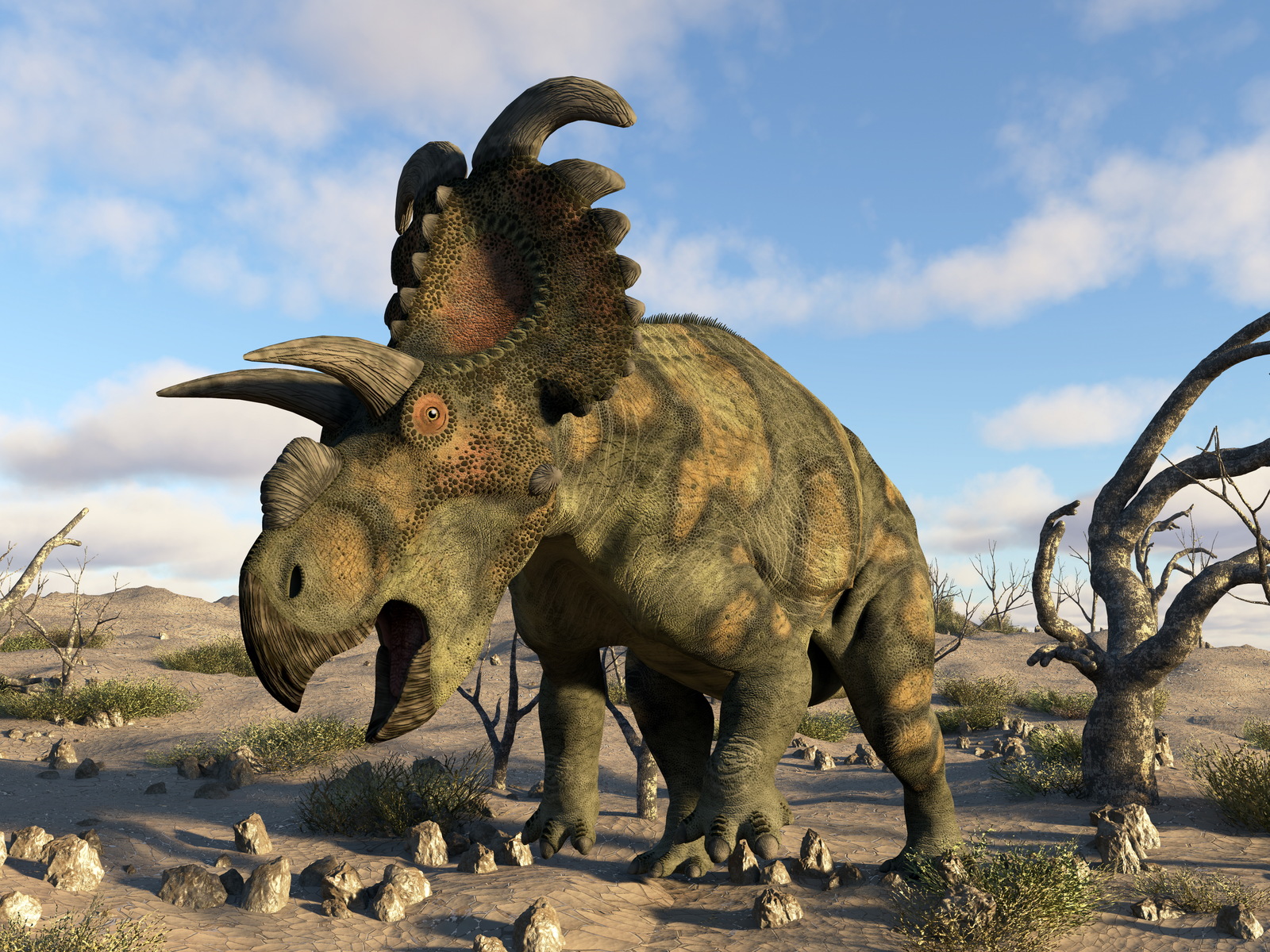
The most striking feature of Albertaceratops was its unusual combination of anatomical features. In contrast to typical centrosaurines, which are characterized by short overeye horns, Albertaceratops had remarkably long overeye horns, approximately one meter long. These horn cores were thin, tapered and projected upwards and slightly outwards - a feature usually found in the related subfamily Ceratopsinae. This unique morphological combination, long overeye horns paired with an otherwise typically centrosaurine skull, makes Albertaceratops a basally positioned genus within the Centrosaurinae.
Instead of a nasal horn like other centrosaurines sported, Albertaceratops had a bony spine or crest on the top of its snout, a structure similar to that of the later Pachyrhinosaurus. This was a distinctive feature of these primary Centrosaurinae and suggests different biological functions - perhaps for sexual display or species identification.
The frill of Albertaceratops was another distinctive identifying feature. The shield was relatively short and broad, typical of centrosaurines, but on its posterior edge there were two particularly characteristic structures: two large, strongly outwardly curved horn cores that looked like hooks and protruded from the upper edge of the neck shield. These horn nuclei were not particularly long, but their orientation was clearly lateral, giving them a unique appearance. The bone extensions that arise at the edge of the frill – were subtly modeled in Albertaceratops, suggesting a specialized visual signaling structure.
The skullcap itself was robustly constructed. The postorbital Horn core - the horn above the eye - was rather small and pointed, as is typical of primitive centrosaurines, and protruded dorsally (upwards) from the skull roof. The orbit (eye socket) was large and rounded, fitting for a herbivorous dinosaur with good vision. The cheekbones (jugals) were strongly developed, and the entire skull showed the characteristic robust structure of a grass-feeding ceratopsid.
TL;DR
in short Albertaceratops
Albertaceratops
| Albertaceratops nesmoi | |
| Length: 6.2 meters Height: 2.5 meters Weight: 2,800 kg | |
| Late Cretaceous (Campanian) | |
| Oldman Formation | |
| Ornithischia | |
| Ceratopsia |
Physical characteristics
| anatomy | Medium-sized, quadrupedal horned dinosaur with characteristic long horns above the eyes and a short neck shield |
| Special features | Two outwardly curved horn cores on the neck plate |
| Special features | Bony crest/spine over the snout instead of a nasal horn |
| locomotion | Four-legged |
| Skin texture | Unknown (fossils show only bone structures) |
| Coloring | Unknown (no color findings) |
Discovery and naming
| Michael J Ryan | |
| 2007 | |
| “Horn Face of Alberta” (Latin: Alberta, place of discovery; Greek: keras = horn; ops = face) | |
| A nearly complete skull (holotype TMP.2001.26.1), skull and skeletal fragments |
The fossil remains of Albertaceratops nesmoi were discovered in August 2001 at Cecil Nesmo's ranch in Manyberries, Alberta, Canada. Student Michael J. Ryan, then at the University of Alberta, made this significant discovery that would revolutionize the classification of centrosaurine ceratopsids. The holotype specimen (TMP.2001.26.1) consisted of a nearly complete skull - a rare and valuable fossil, as complete ceratopsid skulls from this period and region are relatively rare. In addition to the holotype, other skull and skeletal fragments were recovered from the same location.
Six years later, in 2007, Ryan, at the time curator of vertebrate paleontology at the Cleveland Museum of Natural History, formally described the new genus and species. A phylogenetic analysis conducted by Ryan positioned Albertaceratops as the most basal centrosaurine known - a positioning that underscores its primitive position within the subfamily. The genus name honors the Alberta location, while the species name nesmoi was chosen in honor of Cecil Nesmo, a local rancher who assisted in the excavation work and on whose land the fossils were discovered.
Additional specimens were later reported from the Judith River Formation in Montana. The Judith River Formation is a lateral equivalent of the Oldman Formation and differs only in the political boundary between Canada and the United States. However, upon further investigation, it was found that these Montana specimens belonged to a different centrosaurine - Medusaceratops lokii - a finding that underscores the importance of accurate paleontological analysis for correct species identification.
Anatomy and special features
The over-eye horns – An unusual feature
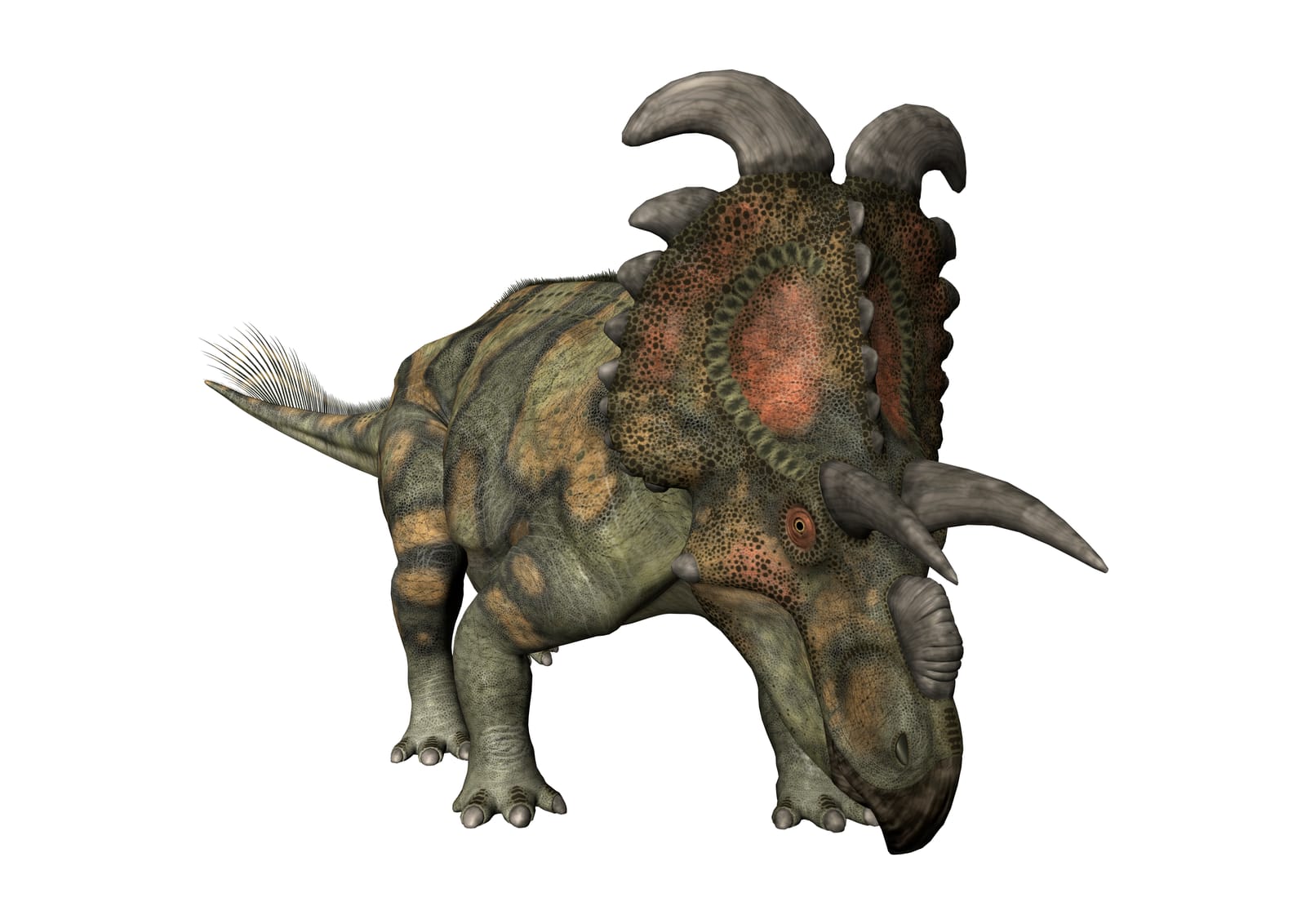
The most distinctive feature of Albertaceratops was its combination of long, powerful overeye horns with an otherwise typically centrosaurine skull. These superocular horns were thin, pointed, and not flattened like the broad horn nuclei of other ceratopsids. They protruded from the postorbital region (behind the eye socket) at a dorsolateral (back and side) angle, giving the skull an imposing profile. In contrast to the massive overeye horns of Triceratops or other Ceratopsinae, the Albertaceratops horns were slender and elegant, yet robustly built.
The base of each horn core was traversed by blood vessel grooves, indicating active vascularization. This could indicate a biological function for thermoregulation - the horn nuclei could have acted as heat ice radiators, similar to modern horned animals. However, the primary functions of these conspicuous structures were probably sexual display (intrasexual selection) and species identification.
The bridge of the nose
Another unique feature was the bony ridge or spine on the top of the snout, which extended from the nasal bone to the premaxilla. This was not a true nasal horn as in other centrosaurines (e.g. Centrosaurus with its large nasal horn or Styracosaurus with its spectacular horn forest), but rather a roughened crista (crest structure), similar to that in the primitive centrosaurine Xenoceratops or the later Pachyrhinosaurus. This structure suggests a transitional type and supports Ryan's interpretation of Albertaceratops as a basal centrosaurine taxon.
The neck shield and the characteristic hooks.
The neck shield (the parietosquamosal ruff) was flat and relatively short, a typical feature of the Centrosaurinae in contrast to the longer frills of the Ceratopsinae. The most striking feature of the frill, however, were the two large, outward-facing horn cores located on the rear edge of the frill. These structures were directed outwards (laterally) and slightly backwards (posteriorly) and resembled hooks or clasps. In contrast to the epiparietal tips of other centrosaurines, which typically projected more upwards or to the sides, these structures were particularly strong and noticeably curved.
The morphology of these epiparietal hooks suggests that they had a specific biological function. They could have served as attack points for powerful neck muscles, suggesting an aggressive fighting strategy - possibly for rank battles between rival males. Alternatively, they may have served as unique visual identifiers between individuals or sexes, similar to the different arrangement of horns and frills in other centrosaurines.
Phylogenetic position and classification
A critical discovery in the analysis of Albertaceratops was its phylogenetic position within the Centrosaurinae. Ryan's cladistic analysis positioned Albertaceratops as the most primitive (basal) centrosaurine known - a result of enormous paleontological importance. This means that Albertaceratops retained morphological features present in older common ancestors of all centrosaurines before evolving specialized features such as massive nasal and postorbital horns or complex frill structures.
The long over-eye horns of Albertaceratops are particularly revealing. They may indicate that the common ancestors of Centrosaurinae actually possessed superocular horns for a long time before subsequent centrosaurines reduced these features in favor of other horny structures. This would be a classic example of morphological regression or reversal during evolution - a phenomenon documented in dinosaurs and other organisms.
Paleoenvironment and lifestyle
Albertaceratops lived in the Oldman Formation of southeastern Alberta during the middle Campaniome stage, about 80 to 76 million years ago. This rock formation is known for its exceptional fossil wealth and provides detailed insights into Late Cretaceous ecosystems in North America. The Oldman Formation was a river-based environment, with floodplains, river channels and lakes that supported a diverse range of flora and fauna.
The fauna of the Oldman Formation that coexisted with Albertaceratops included a remarkable diversity of dinosaur groups. Large ceratopsids such as Centrosaurus and related species were common. Theropods included the large tyrannosaurids such as Daspletosaurus, as well as various smaller theropods and ornithomimes. Sauropods were rare but not absent, while ornithopods like Edmontosaurus were present in significant numbers. Ankylosaurs and Pachycephalosaurs rounded out the dinosaur community.
Albertaceratops, as a herbivore, would have been a consumer of low vegetation. Its parrot-like beak was ideal for cutting down tough vegetation. With a body length of about 5.8 meters, Albertaceratops would have been a medium-sized animal in its ecology - not as imposing as the large centrosaurines such as Centrosaurus or Styracosaurus, but still a significant herbivore that may have lived in herds or aggregations.
The overeye horns and frill pattern may have been important in herd contexts. With its long over-eye horns, Albertaceratops would have looked visually independent, which would have contributed to effective species recognition in a herd of different ceratopsid species. The hooks on the frill may also have played an intrasexual signaling role - perhaps dominant males displayed more conspicuous or distinct hooks than subordinate animals.
Diet and behavior
Like all ceratopsids, Albertaceratops was a specialized herbivore. Its parrot-like beak ended in a sharp rostral tooth, ideal for cutting ferns, conifers and other Cretaceous vegetation. Batteries of teeth in the upper and lower jaws processed the cut vegetation into smaller chunks for digestion.
The social behavior of Albertaceratops is speculative but plausible based on paleoecology and related ceratopsids. Several interpretations suggest that centrosaurines lived in herds. Bonebed finds - gatherings of many individuals in one place - suggest mass extinction events, possibly during floods or droughts when herds were crowded together. The long overeye horns and prominent frills may have functioned as identifying features in such aggregations.
The super-eye horns would also have fulfilled aggressive functions. During intrasexual conflicts - such as between rival males over mating rights or resources - these horns may have been used as weapons, similar to how modern ungulates use their horns for thrusting and fighting. The bony bridge of the nose may have provided additional protection for the nostrils underneath.
Importance for paleontology
The discovery of Albertaceratops was a milestone in our understanding of the Centrosaurinae. As a basal Centrosaurinae taxon, it provided insight into the primitive morphology of the group.
The long superocular horns, usually associated with the sister subfamily Ceratopsinae, on an otherwise centrosaurine skull suggest that the evolution of the Ceratopsidae was more complex than previously thought.
Albertaceratops also illustrates a fundamental principle of paleontology: that the phylogenetic position of a taxon – where it “sits” in the tree of life – is crucial to understanding evolutionary processes. By analyzing traits and their distribution across related taxa, paleontologists can make plausible reconstructions of ancestral (original) states.
Additionally, Albertaceratops has challenged researchers to think rigorously about how traits change during evolution. Are long overeye horns primitive or derived features of the Centrosaurinae? The discovery of Albertaceratops with long-horned overeye horns in a basal position suggested that long overeye horns may represent the primitive condition for Centrosaurinae before they were later reduced into specialized centrosaurines. This is an important finding for our understanding of the morphological evolution of ceratopsians.
In summary, Albertaceratops represents a good example of the diversity of ceratopsid evolution. With its unique combination of long overeye horns, a bony nasal bridge, and distinctive frills hooks, this "hornface of Alberta" represents an important evolutionary transition within the Centrosaurinae and contributes significantly to our understanding of the evolution of this iconic dinosaur group. Ongoing research and the discovery of additional fossils will undoubtedly further deepen our understanding of this fascinating Cretaceous creature.
Bid sources:
Size comparison: User:Slate Weasel, Public domain, via Wikimedia Commons