What enemies did the Parasaurolophus have?
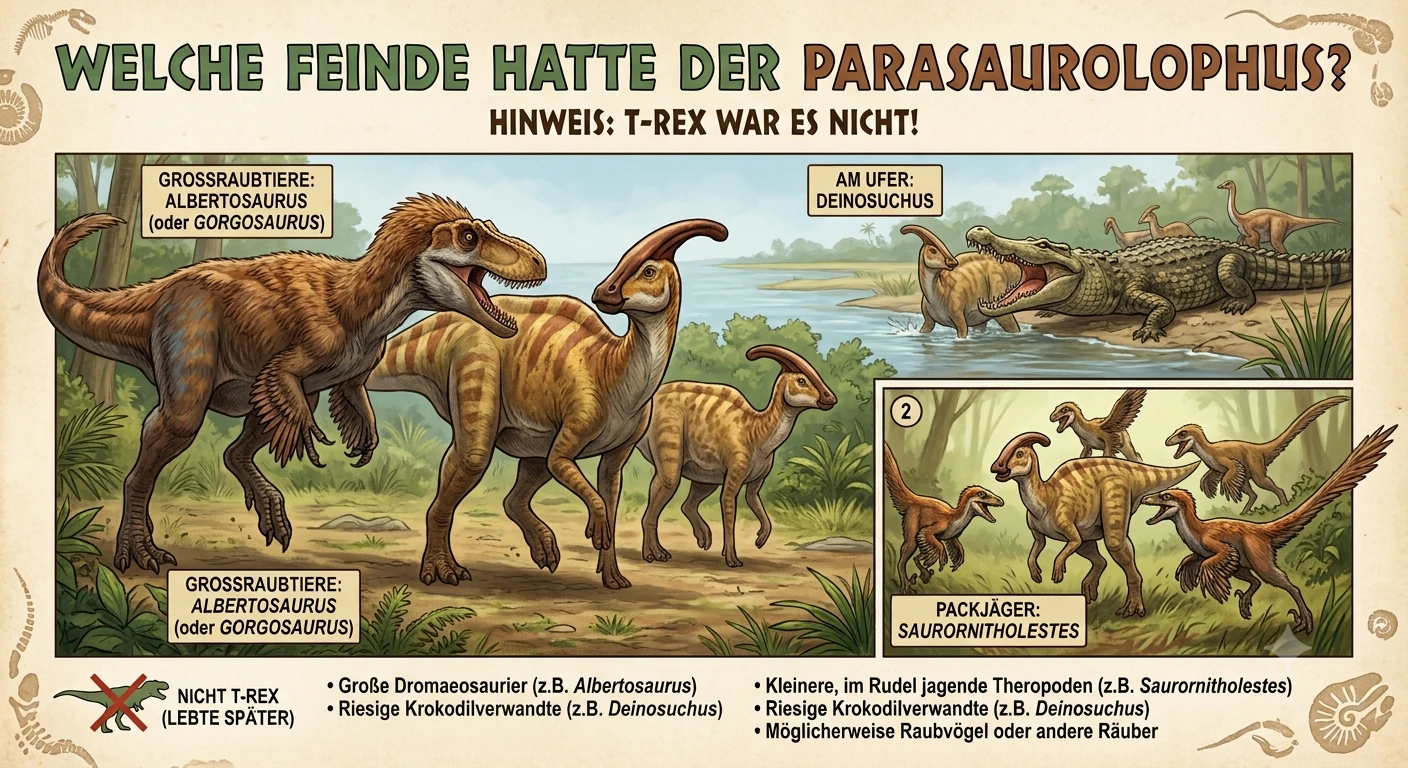
Parasaurolophus had primarily large theropods as natural enemies in the Late Cretaceous. The most important threat was tyrannosaurids, i.e. large, two-legged predatory dinosaurs with powerful teeth and high bite force. The northern parts of North America probably hunted most of all Albertosaurus and Gorgosaurus. These were slightly more lightly built than later forms, but were probably faster and well adapted to hunting large herbivores in herds. It was also dangerous Daspletosaurus, a bulkier tyrannosaurid with particularly robust skull morphology.
In the more southern distribution area, for example in today's Utah, this applies Teratophoneus as a possible main predator. In addition to these large predators, smaller theropods such as dromaeosaurids (Dromaeosaurus, Saurornitholestes) poses a danger, especially for young animals or weakened individuals. These predators may have hunted cooperatively.
T-rex was not the main enemy of Parasaurolophus:
A common misconception concerns this Tyrannosaurus rex:
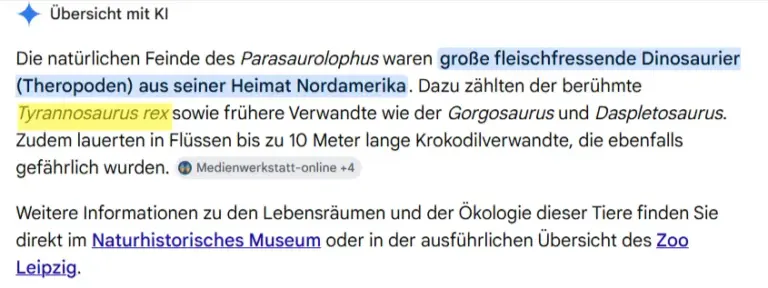
In films and books he is often portrayed as the main enemy. In fact, the best-known species overlapped Parasaurolophus walkeri Hardly any time with him because she already extinct was when T. rex appeared about 72.7 million years ago. Parasaurolophus walkeri lived in the period from 76.4 to 72.2 million years. Later species like Parasaurolophus tubicen However, early large tyrannosaurs could still have been encountered.
To defend itself, Parasaurolophus relied less on active resistance than on strategies such as herd life, good sensory perception, acoustic warning calls via the characteristic head crest and quick escape on two or four legs.
You can find more here frequently asked questions about dinosaurs.
Featured image: generated using AI