Sauropelta
Sauropelta is a nodosaur that lived in the Lower Cretaceous, making it the earliest known genus of its kind.
This heavily built quadrupedal herbivore was about 6 meters long and weighed around 1.5 tons.
Sauropelta was known for its unique armor, which consisted of bone masses embedded in the skin and served as protection against predators.
The habitat of Sauropelta was the wide floodplains around rivers that flowed into shallow inland seas in the north and east.
It fed on a variety of conifers and cycads.
The Cloverly Formation, where the remains of many animals, including Sauropelta, were buried, is now known for its fossils.
In this article we will examine the characteristics of Sauropelta, its defense mechanisms against predators, the predators it faced and its habitat.
| length | 6.75m |
| Weight | 2.2 t |
| locomotion | Four-legged friends |
| food | Plant |
Description of Sauropelta
This section provides a detailed description of the physical characteristics and adaptations of a nodosaur that lived in North America during the Early Cretaceous.
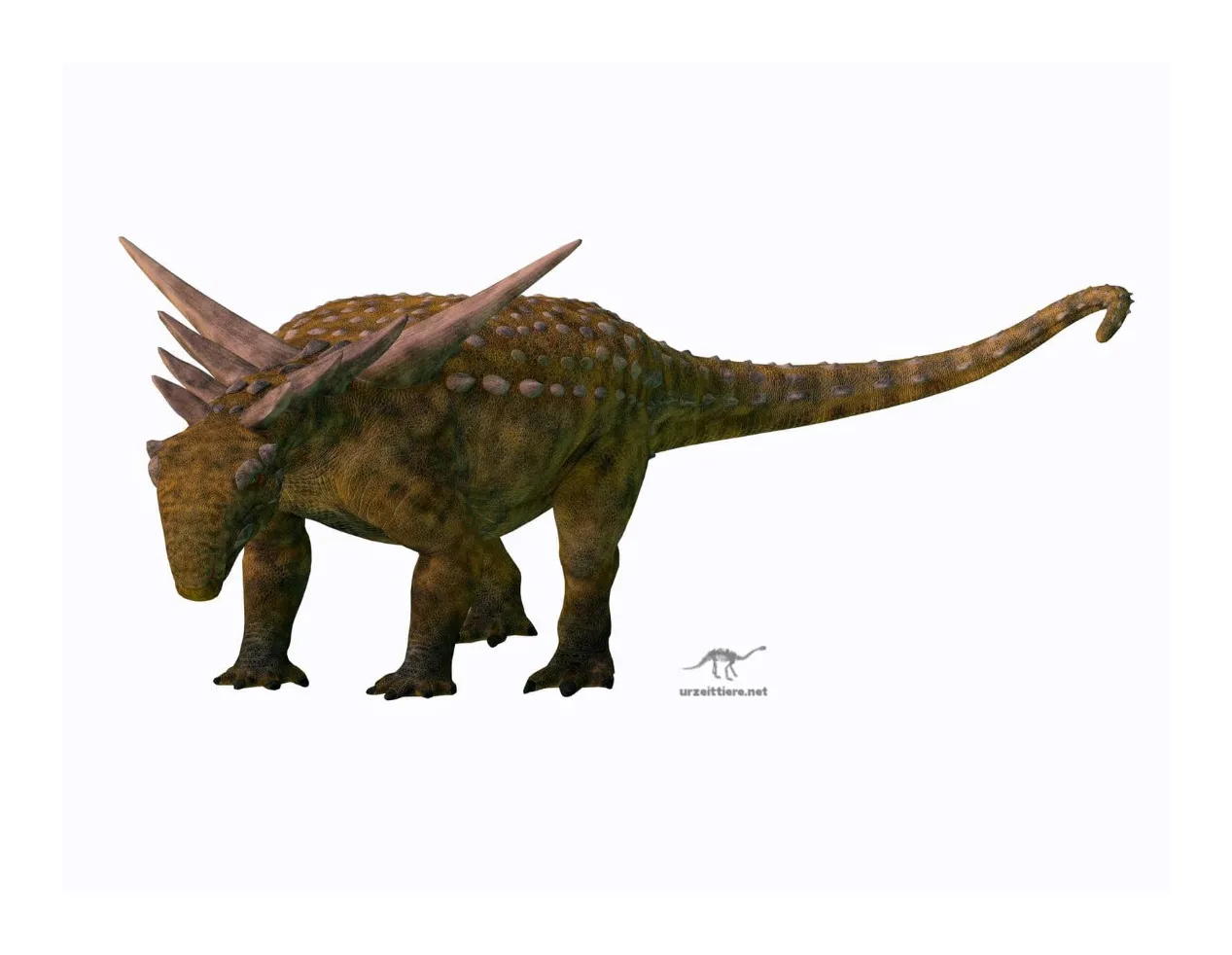
Sauropelta was a powerfully built quadrupedal herbivore that was about 5-6 meters long and weighed 1.5-2 tons. Its triangular skull had a flat roof and leaf-shaped teeth, which were adapted to selective grazing with the narrow snout.
Sauropelta's most distinctive feature was its shell, which consisted of bone masses embedded in the skin called osteoderms. Sauropelta's carapace was studded with two rows of arched scales on the top of the neck. Large, sharp spines on the sides of its neck provided an excellent defense against predators. Its long tail, which was almost half its body length, was also armored.
Sauropelta's reinforcement likely made it appear larger than it actually was, which may have helped it deceive predators. The armor was probably also used in intraspecific fights as males competed for mating opportunities.
Sauropelta lived in wide floodplains around rivers that flowed into a shallow inland sea to the north and east. The Cloverly Formation, where many Sauropelta fossils were found, contained the remains of many animals, some of which were fossilized. Sauropelta was part of the Late Jurassic fauna, which gave way to the Early Cretaceous fauna dominated by dromaeosaurs, ornithopods and nodosaurs. Its adaptations and armor likely helped it survive in a changing environment and defend itself against predators.
How did Sauropelta defend itself against predators?
The heavily built nodosaur defended itself against predators with a protective array of bony armor and spines, including large sharp spines on the neck, which may have been an adaptation to ward off attackers.
Sauropelta had impressive armor, consisting of bony plates on the back, hips, and tail, as well as a series of triangular spike-like projections on the flanks. The armor made Sauropelta a formidable opponent to any predator that dared attack it.
Sauropelta was also known for its long tail, which it could use to deliver powerful blows to attackers. The tail was almost half its body length and was a powerful weapon that could be used to deter predators.
Sauropelta was an unsociable animal that lived in pairs and fought with other armored dinosaurs, including other sauropeltas, when there were too many animals in the environment that it didn't like. Its combative nature and impressive armor made it one of the best-defended dinosaurs of its time.
In summary, Sauropelta was a powerfully built nodosaur that used its bony shell and spines to defend itself against predators. Its large, sharp spines on its neck may have been an adaptation to ward off attackers. Its unsociable nature and combative behavior combined with its impressive armor made it one of the best-defended dinosaurs of its time.

Who were the predators of Sauropelta?
Predators of the heavily built nodosaur included dromaeosaurids such as Deinonychus and large theropods such as Acrocanthosaurus, which lived in North America at the time of this armored dinosaur.
Deinonychus was a dromaeosaurid dinosaur that lived in the same area and at the same time as Sauropelta. However, the large spines protruding from Sauropelta's neck and shoulders would have made it difficult for Deinonychus to jump onto its back and bite its neck, which was a tactic favored by dromaeosaurids.
On the other hand was Acrocanthosaurus a large theropod that could pose a significant threat to Sauropelta. Acrocanthosaurus was a large, carnivorous theropod that also lived during the time of Sauropelta. It was a predator that may have posed a significant threat to Sauropelta due to its size and powerful jaws. However, it is uncertain whether Acrocanthosaurus specifically ate Sauropelta, as there is not enough evidence to support this theory.
Nonetheless, Sauropelta possessed a number of features that helped it defend itself against predators, such as its long tail, which was supported by a network of tendons that kept it off the ground.
What was the habitat of Sauropelta and its predators?
The habitat of the nodosaur and its predatory dinosaurs during the Early Cretaceous was a fertile floodplain formed around rivers draining into a shallow inland sea, probably covered with conifer and cycad forests.
Sauropelta lived in this habitat, feeding on young cycads and conifers that grew along the fertile region. Its predators, such as Deinonychus and Acrocanthosaurus, also lived in this environment and probably hunted for prey along the river banks.
The floodplains in which Sauropelta lived were extensive and provided a variety of vegetation for herbivores to graze. The region was probably covered with forests of conifers and cycads, which provided a rich source of food for these animals.
Sauropelta's narrow snout may indicate that it was more selective about its food choices than other ankylosaurids, such as the Ankylosauridae. The teeth were only partially suitable for chewing, and the further breakdown of food probably took place in the voluminous torso.
The region was teeming with life, and Sauropelta had to compete for food not only with predators, but also with other herbivores.
Systematics
Ornithischia
Genasauria
Thyrophora
Eurypoda
Ankylosauria
Nodosauridae
Occurrence in time
chalk
Lower Cretaceous
Aptium-Albium
Happen
North America
Country: USA
Region: Wyoming, Montana
Formation: Cloverly
Summary
Sauropelta was a remarkable nodosaurid dinosaur that lived during the Lower Cretaceous. It was a powerfully built, medium-sized quadruped covered in a bony shell that gave it a unique and impressive appearance. The Sauropelta's shell was its primary defense mechanism against predators, as it had two rows of arched scales on the top of its neck and large sharp spines on the sides.
It lived in vast floodplains surrounding rivers that drained into shallow inland seas to the north and east, and fed on a variety of conifers and cycads.
The Sauropelta habitat supported a variety of predators, including Acrocanthosaurus and Deinonychus. These ferocious predators would have posed a major threat to Sauropelta and would have been constantly looking for an opportunity to attack. Sauropelta's armor was probably the only thing that protected it from these predators.
Image source:
Size comparison: Dinoguy2, CC BY-SA 3.0 http://creativecommons.org/licenses/by-sa/3.0/, via Wikimedia Commons