

Ornitholestes
Ornitholestes – the “bird predator”
Ornitholestes, which means “bird predator,” was a small bipedal carnivore.
An almost complete skeleton of him is known to have been found in Wyoming, USA.
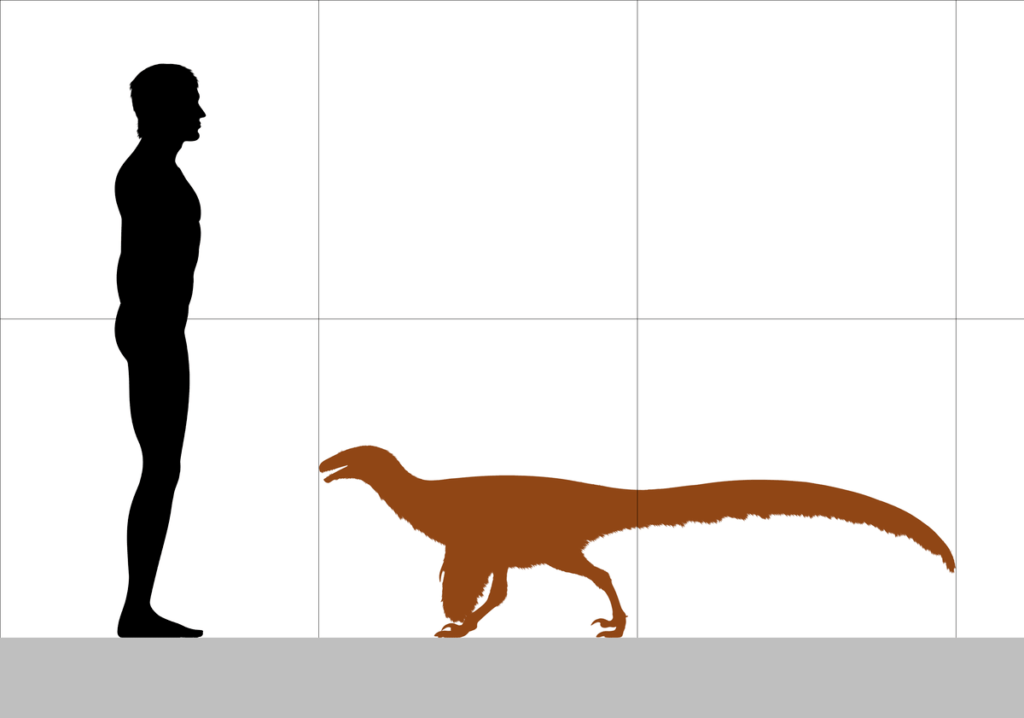
It was about 2 m long, with the tail alone making up half of its body length.
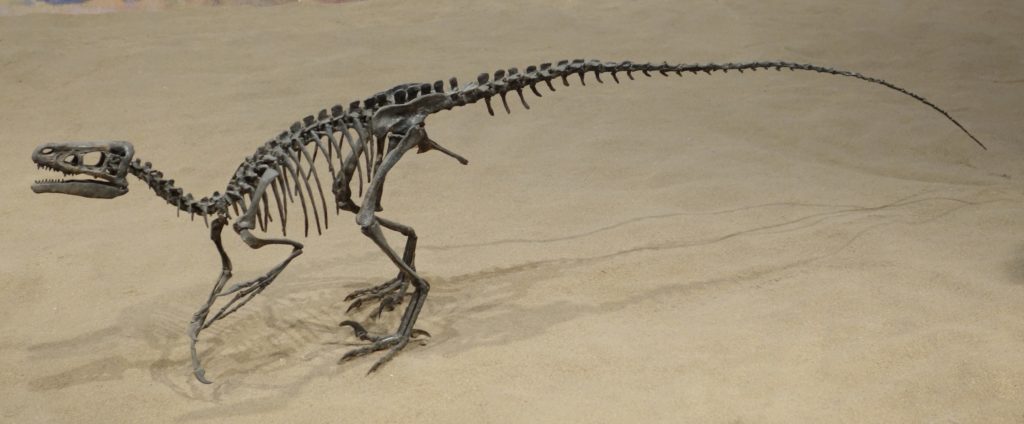
Ornitholestes had a long skull, neck and tail, although the neck was probably very flexible.
He weighed between 15 and 20 kilograms.
| Profile | Ornitholestes |
|---|---|
| epoch | Upper Jurassic (Kimmeridgian to Tithonian) 157.3 to 145 million years |
| Order | Lizard-pelvis dinosaur (Saurischia) |
| Subordination | Theropoda |
| Family | Coelurosauria |
| group | Maniraptora |
| genus | Ornitholestes |
| Art | Ornitholestes hermanni |
| Height | 0.8 meters |
| length | 2 meters |
| Weight | 13 – 20 kilograms |
| Locations | North America, Morrison Formation |
The arms were well developed and ended in three long clawed fingers. These enabled him to catch fast and elusive prey.
The hind limbs were also well developed, with strong running muscles.
The lightly built and long-legged Ornitholestes was a very fast bipedal runner.
It probably ate small, fast lizards and even early mammals.
Its head was proportionally smaller than that of most other predatory dinosaurs. However, the skull was compactly built, with a short snout and a robust lower jaw.
A special feature of Ornitholestes is its teeth. These were significantly smaller and more conical in shape on the front half of the jaw than those on the back half of the jaw ( Heterodontia).
The teeth on the front half were conical and slightly serrated. They were used to tear pieces of flesh out of his prey.
The teeth in the back of the mouth were pointed backwards. They had reinforced teeth to cut meat more effectively.
One feature that Ornitholestes is most commonly depicted with is a small horn on the tip of the snout. Today, however, it is assumed that this horn did not even exist. Because it was subjected to intense pressure during the fossilization process, the skull was deformed and this deformation was incorrectly interpreted as a horn.
A kinematic study of Ornitholestes' forelimbs revealed that it could only extend its wrists moderately.
Flexion, on the other hand, was easily possible, both in the wrist and in the elbow joint. The elbow could be bent significantly beyond a right angle.
This meant he was able to hold objects on his chest. Clamping the forearms to protect them or to reduce heat loss is also discussed.
Image sources: PaleoNeolitic, CC BY-SA 4.0 https://creativecommons.org/licenses/by-sa/4.0, via Wikimedia Commons
PaleoNeolitic, CC0, via Wikimedia Commons
Etemenanki3, CC BY-SA 4.0 https://creativecommons.org/licenses/by-sa/4.0, via Wikimedia Commons