Edmontosaurus
“Edmonton Lizard”
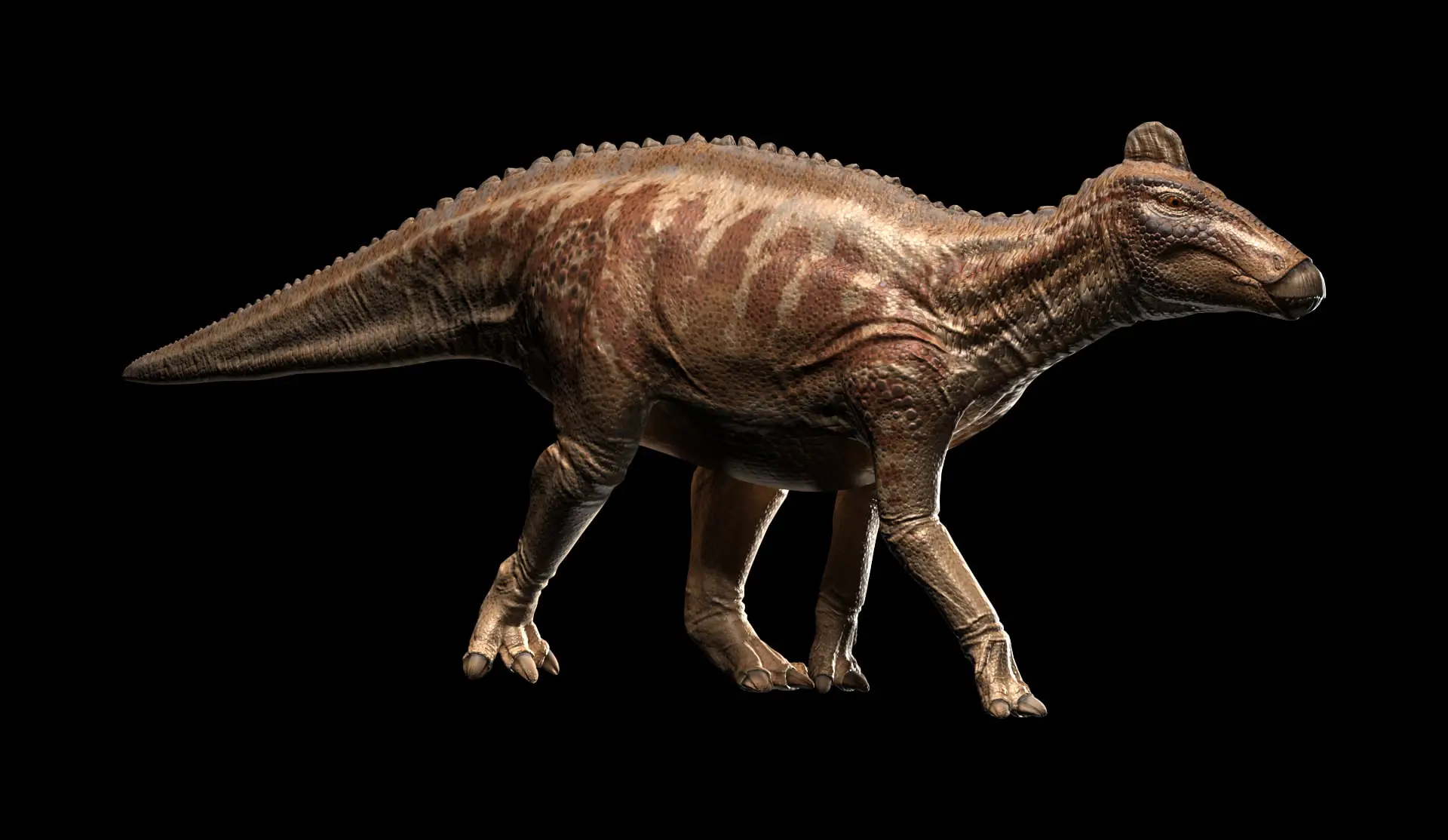
Edmontosaurus was one of the largest hadrosaurs ever. The genus got its name from the location of its first discovery, the Edmonton Formation
Physical characteristics of Edmontosaurus
Edmontosaurus, a hadrosaur, lived in North America during the Late Cretaceous Period, 73 to 65 million years ago. These herbivores reached a length of up to 13 meters and a weight of over 4 tons, making them among the largest known hadrosaurs. Their flat, elongated snouts facilitated efficient grazing on plants.
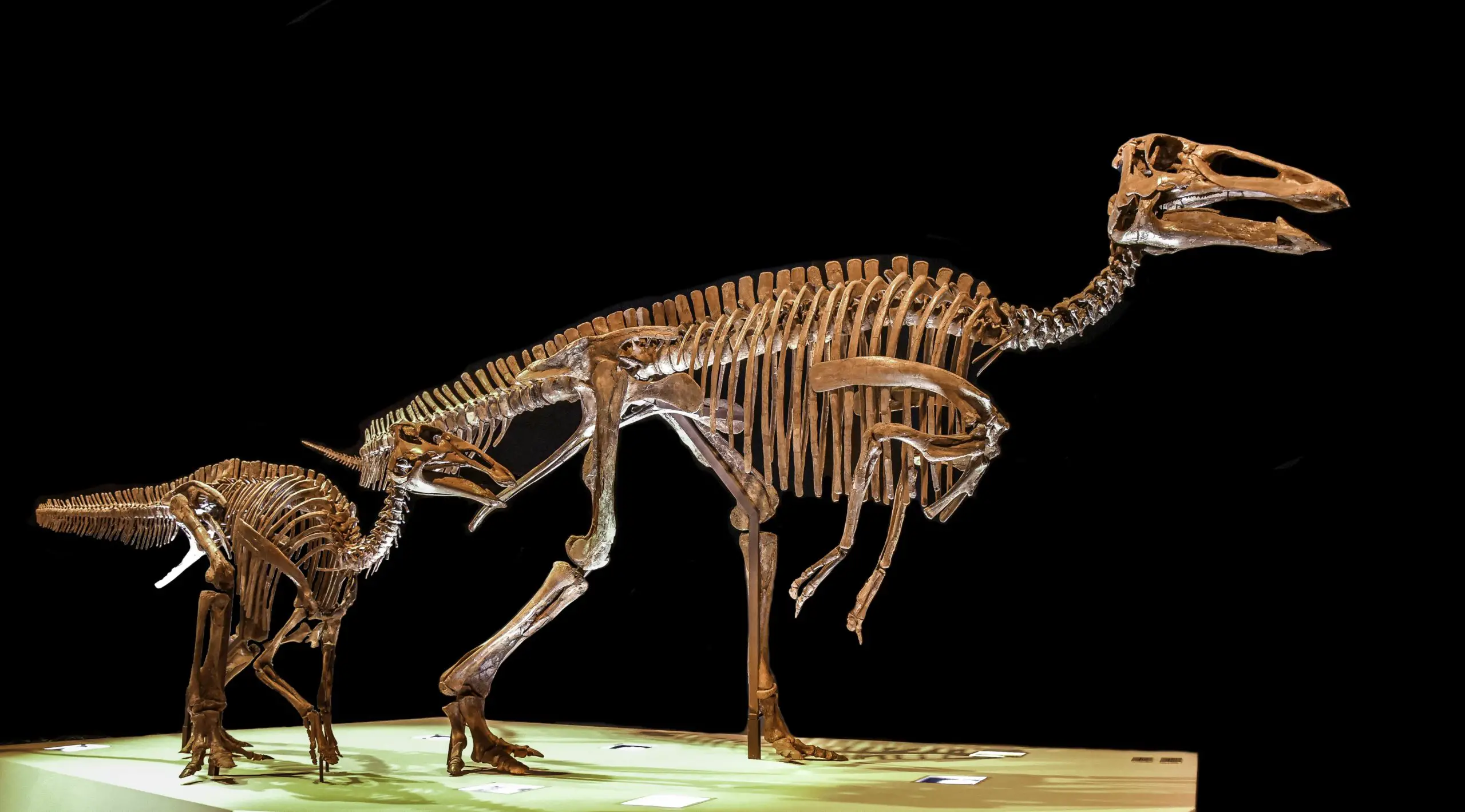
Recent studies have revealed unique skull features in Edmontosaurus specimens and provided new insights into their evolutionary relationships within the hadrosaur family. The skull structure of Edmontosaurus suggests a complex feeding mechanism that allowed them to exploit various plant resources in their environment.
Edmontosaurus species and classification
The genus Edmontosaurus includes two valid species: Edmontosaurus regalis and Edmontosaurus annectens. This classification refines our understanding of hadrosaur taxonomy and challenges previous suggestions for additional species within the genus.
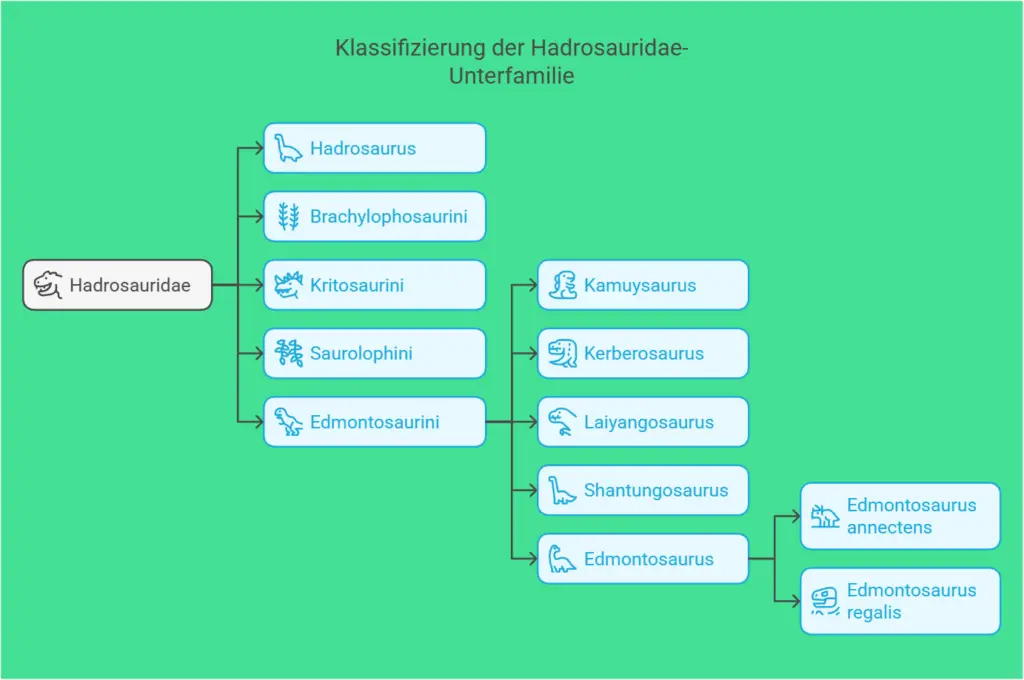
Paleontologists first described Edmontosaurus regalis using fossils from the Horseshoe Canyon Formation in Alberta, Canada. Edmontosaurus annectens, discovered in younger deposits in western North America, was crucial in elucidating the evolutionary history and biogeography of hadrosaurs before the mass extinction at the end of the Cretaceous.
2 species of Edmontosaurus are currently recognized among experts.
- Edmontosaurus regalis
- Edmontosaurus annectens
In 1912, brothers Jorge and Levi Sternberg unearthed two skeletons with skulls in Alberta (USA). The Canadian paleontologist Lawrence Lambe then described the genus Edmontosaurus based on these skeletons in 1917.
Habitat and distribution of Edmontosaurus
Edmontosaurus thrived in the lush, subtropical environments of North America in the Late Cretaceous. Fossil records show that these dinosaurs lived in regions that are now part of Alberta, Canada, and various locations in the United States. Their paleoenvironment was characterized by lush vegetation, including conifers, cycads, and early flowering plants.
The wide distribution of Edmontosaurus fossils in North America suggests their adaptability to different ecosystems. Their remains, found in various geological formations, suggest that they occupied both coastal plains and inland habitats. This large geographic range makes Edmontosaurus an important index fossil for Late Cretaceous stratigraphy.
Appearance of Edmontosaurus
The appearance of Edmontosaurus can be clearly understood using very well-preserved fossils.
- It probably had a segmented dorsal crest, unlike other hadrosaurs.
- On his skull he bore a fleshy crest, similar to that of a rooster.
- Its front legs were shorter than its stronger hind legs.
- Based on the impressions of the inside of its skull, researchers assume that Edmontosaurus had very good sea, hearing and smelling senses.
- Its skull has an elongated snout.
- At the front end the mouth is widened like a duck's beak.
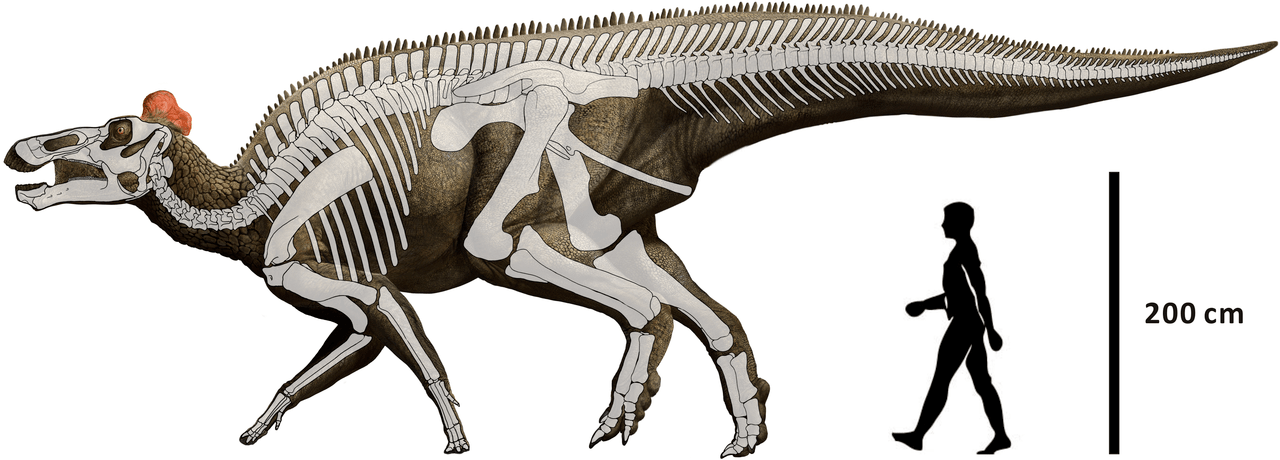
How big was an Edmontosaurus?
An adult Edmontosaurus could reach a height of up to 3 meters to reach.
Social behavior and herd behavior of Edmontosaurus
There is evidence that Edmontosaurus exhibited complex social behavior, including living in herds. This social structure provided advantages such as protection from predators and more efficient foraging. Fossil bone beds containing several Edmontosaurus individuals of different ages support the herd life hypothesis.
Tracks attributed to hadrosaurs such as Edmontosaurus confirm herd behavior. These fossilized footprints often show multiple individuals moving in the same direction, suggesting coordinated group movement. Living in herds likely increased the chances of survival of young Edmontosaurus in an environment populated by large predatory dinosaurs such as Tyrannosaurus rex.
Based on research in recent years, it is assumed that these herds contained a huge number of individuals.
These herds probably undertook large migrations to obtain food.
Edmontosaurus was one of the most common dinosaur genera of the Late Cretaceous in North America.
locomotion
The hind legs of Edmontosaurus were longer and more powerful than the front legs. Researchers assume that this dinosaur could move on both four legs and two legs.
Its maximum speed is estimated at 50 kilometers per hour.
How did Edmontosaurus feed?
Edmontosaurus had up to 300 keeled teeth. however, the front half of his jaw was toothless. Experts believe that Edmontosaurus was one of the few dinosaurs that could chew. He was able to grind plant matter into pulp before swallowing it.
As a megaherbivore, Edmontosaurus specialized in consuming large amounts of plant material. Its duck-like beak contained hundreds of small, tightly packed teeth arranged in dental batteries, allowing for continuous replacement of worn teeth. This unique tooth structure ensured efficient processing of tough plant materials throughout the animal's life.
Analysis of fossilized stomach contents and coprolites associated with Edmontosaurus specimens reveals a diverse diet. These dinosaurs likely ate leaves, twigs, and seeds of conifers, cycads, and angiosperms. Their ability to process various plant materials may have contributed to their success and widespread distribution in North America during the Late Cretaceous.
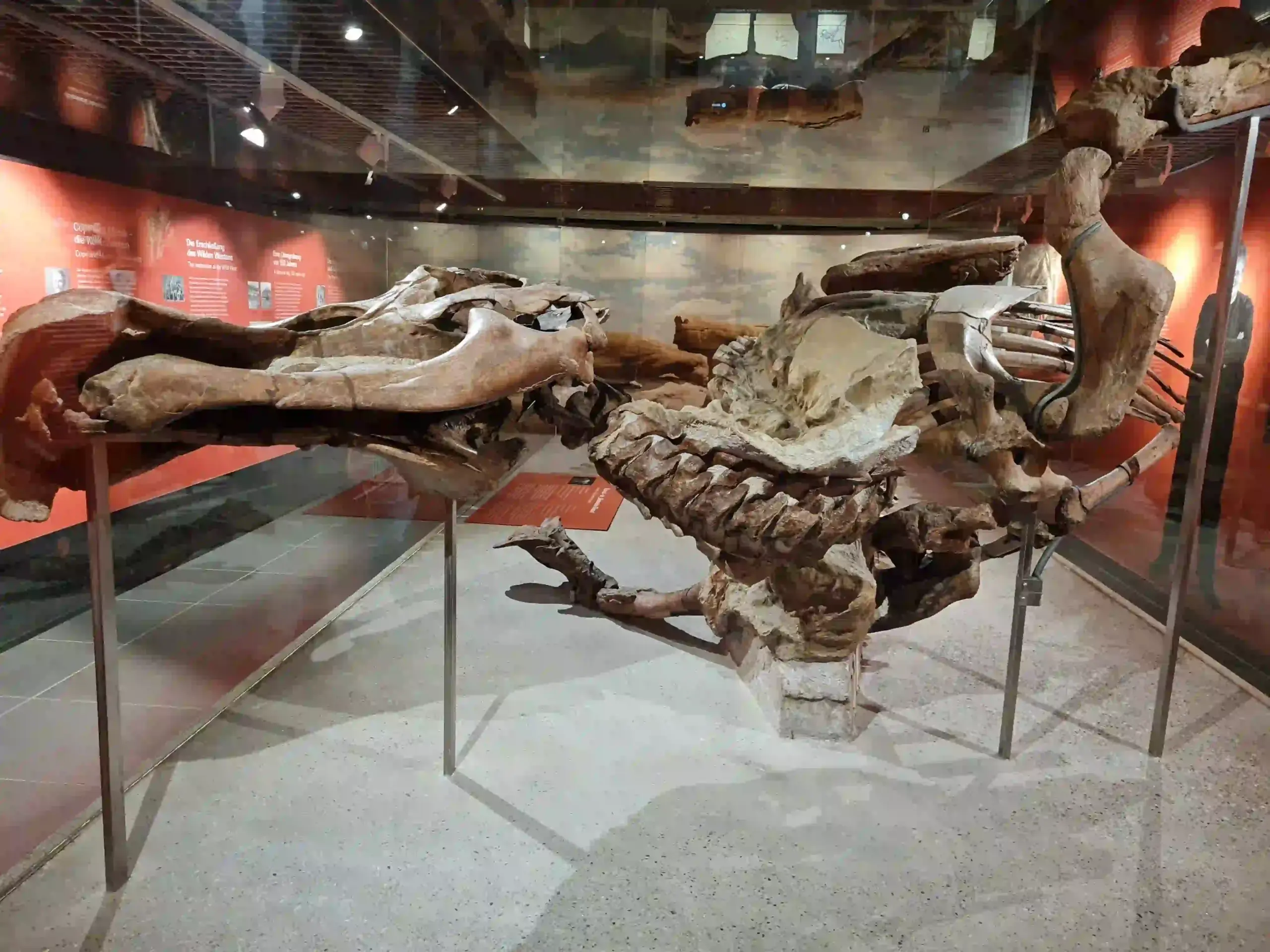
Paleobiological insights from Edmontosaurus fossils
Recent paleontological discoveries have provided remarkable insights into the biology and conservation of Edmontosaurus. The preservation of soft tissue in some Edmontosaurus fossils challenges traditional views on fossilization processes. A well-preserved Edmontosaurus "mummy" specimen features intact skin impressions and preserved nail-like structures on the feet, providing an unprecedented insight into the external appearance of these ancient animals.
These soft tissue preservations suggest alternative fossilization pathways that do not rely solely on rapid burial. Studying such exceptionally well-preserved specimens allows paleontologists to reconstruct Edmontosaurus' musculature, skin texture, and general body shape with greater accuracy. This information is critical to understanding the locomotion, thermoregulation and general biology of these fascinating dinosaurs.
Evolutionary biological significance of the Edmontosaurus
Edmontosaurus occupies an important place in the evolutionary history of hadrosaurs. As one of the last surviving members of its lineage, Edmontosaurus fossils reveal important adaptations that may have contributed to the success of hadrosaurs during the Late Cretaceous.
Comparative analyzes of Edmontosaurus with other hadrosaur genera help paleontologists reconstruct the evolutionary relationships within this diverse group of dinosaurs. The unique combination of primitive and derived features observed in Edmontosaurus makes it an important taxon for understanding hadrosaur phylogeny and patterns of morphological change over time.
Extinction and legacy of the Edmontosaurus
The extinction of Edmontosaurus coincided with the mass extinction at the end of the Cretaceous period about 66 million years ago. This global catastrophe, most likely caused by a massive asteroid impact, led to the extinction of non-avian dinosaurs and many other life forms. The disappearance of Edmontosaurus marked the end of a successful herbivorous dinosaur lineage that had dominated terrestrial ecosystems for millions of years.
Despite their extinction, Edmontosaurus continues to influence our understanding of prehistoric life. The abundance and quality of Edmontosaurus fossils have made this genus a model organism for the study of hadrosaur anatomy, growth, and paleoecology. Ongoing research on Edmontosaurus contributes to our knowledge of dinosaur diversity, ecosystem dynamics, and the evolutionary processes that shaped life in the Mesozoic.
Predators of Edmontosaurus
His greatest enemy was probably Tyrannosaurus Rex, whose fossils were also found in the large distribution area of Edmontosaurus.
Furthermore, it was probably another predator, Albertosaurus sarcophagus, that hunted Edmontosaurus.
Systematics
| Dinosauria |
| Ornithischia |
| Genasauria |
| Neornithischia |
| Cerapoda |
| Ornithopoda |
| Iguanodontia |
| Ankylopollexia |
| Styracosterna |
| Hadrosauriformes |
| Hadrosauroidea |
| Hadrosauromorpha |
| Hadrosauridae |
| Saurolophinae |
| Edmontosaurini |
Occurrence in time
| chalk |
| Upper Cretaceous |
| late Maastrichtian |
Happen
| Area | North America |
| country | USA, Canada |
| region | Wyoming, Montana, South Dakota, North Dakota ?, Colorado, Alberta ?, Saskatchewan |
| formation | Lance, Hell Creek, Laramie, Scollard?, Frenchman |
Edmontosaurus profile
| length | 15 meters |
| Weight | 4 tons |
| locomotion | Four-legged / Two-legged |
| food | herbivores |
Image sources: Die Infografen UG (limited liability), CC BY-SA 4.0 https://creativecommons.org/licenses/by-sa/4.0, via Wikimedia Commons
Ballista at en.wikipedia, CC BY-SA 3.0 http://creativecommons.org/licenses/by-sa/3.0/, via Wikimedia Commons
Size comparison: Hai Xing, Jordan C. Mallon, Margaret L. Currie, CC BY 2.5 https://creativecommons.org/licenses/by/2.5, via Wikimedia Commons
Juvenile and adult Edmontosaurus: Evolutionnumber9, CC BY-SA 4.0 https://creativecommons.org/licenses/by-sa/4.0, via Wikimedia Commons