Diplodocus
“double beam”
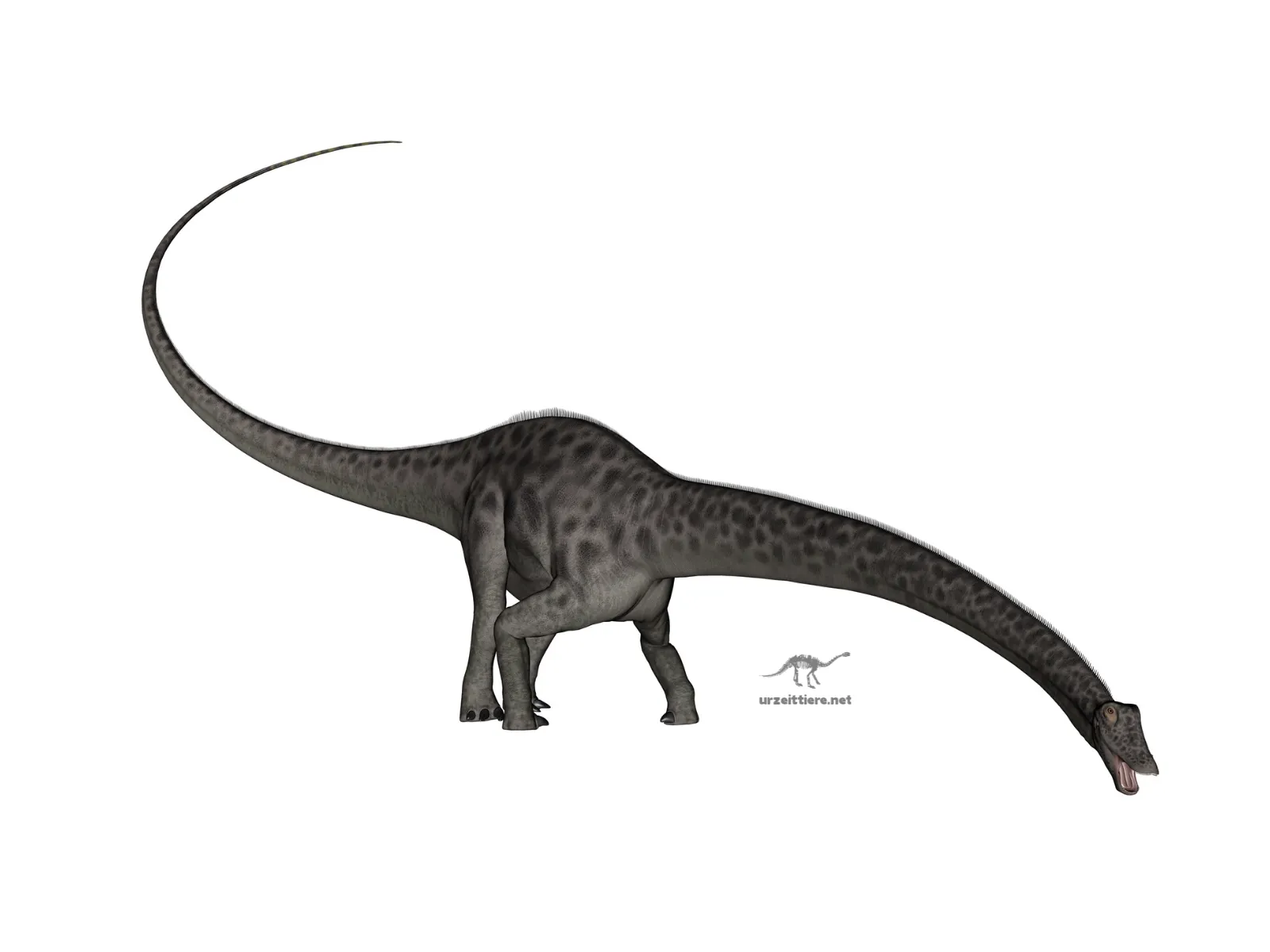
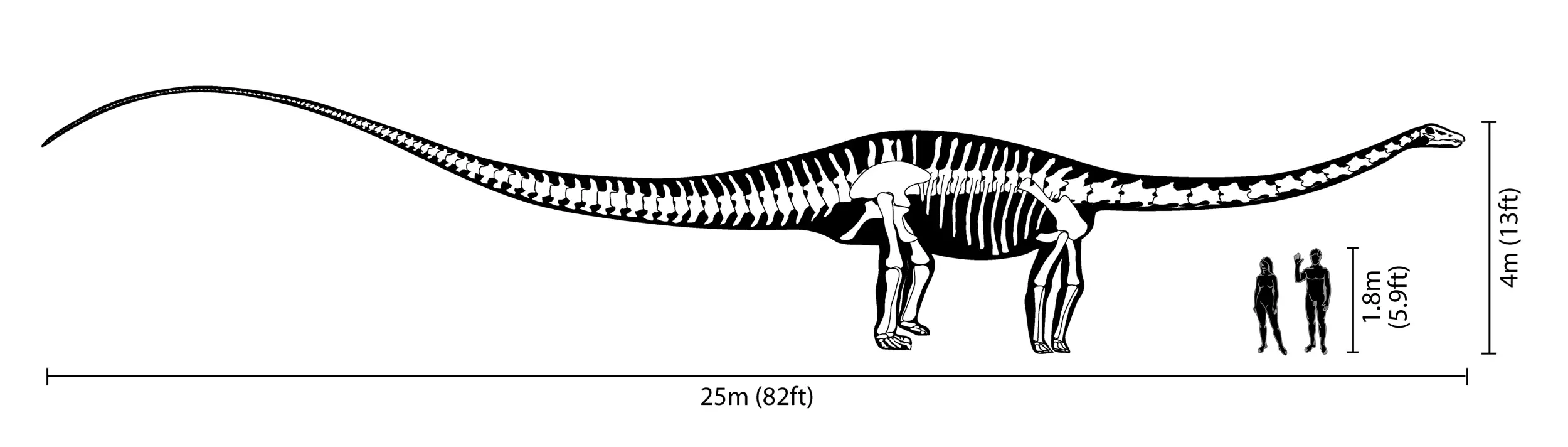
Diplodocus was a long-necked giant. It was up to 27 m long. Its neck alone measured 8 meters and its whip-shaped tail was up to 14 meters long. Only his head was puny in relation to his body. It was just 60 cm long.
He had forward-facing teeth. These were cone-like and clustered at the front of its mouth and were probably used like a rake to strip leaves and soft plant parts from branches.
The following Diplodocus profile clearly summarizes the most important key data on the size, weight, era and locations of this long-necked dinosaur:
| Profile | Diplodocus |
|---|---|
| epoch | Upper Jurassic (Kimmeridgian to Tithonian) 157.3 to 145 million years |
| Order | Lizard-pelvis dinosaur (Saurischia |
| Subordination | Sauropodomorpha |
| Family | Sauropods (Sauropoda) |
| group | Diplodocidae |
| genus | Diplodocus |
| Art | D. longus, D. carnegii, D. hayi, D. hallorum |
| Height | 5 meters |
| length | 27 meters |
| Weight | 13 – 15 tons |
| Locations | Alberta (Canada), Utah and New Mexico (USA) |
In 2004, a study appeared in the journal Organisms Diversity & Evolution showing that Diplodocus, like other sauropods, probably grew very quickly. He probably grew in size throughout his life. The researchers assume that he reached sexual maturity at the age of 10.
species
Currently 4 species of Diplodocus are recognized:
- D. longus
- D. carnegii,
- D.hayi
- D. hallorum
Named after businessman and philanthropist Andrew Carnegie, Diplodocus carnegii is one of the longest dinosaurs ever found, with its long, flexible neck and tail.
anatomy
In pictorial representations, the long-necked dinosaur is often shown with a high neck. It was assumed that it got its food primarily from treetops.
However, this swan-like neck position is questioned by some scientists.
Two researchers from Northern Illinois University and the University of Oregon, J. Michael Parrish and Kent Stevens, examined the skeletons of Diplodocus and Apatosaurus.
They created computer models of Diplodocus' cervical spine and examined different neck positions.
They discovered that Diplodocus could hardly have raised his head above the level of his back. An S-shaped neck position would also not have been possible due to the anatomy of his cervical vertebrae. They concluded that Diplodocus could only keep its head one to one and a half meters above the ground when its neck was relaxed.
Another problem that the researchers raise is the blood supply to the brain when the head is in a swan-neck position. The heart would have had to be huge to pump blood to the brain, which in this position would have been more than ten meters above his body.
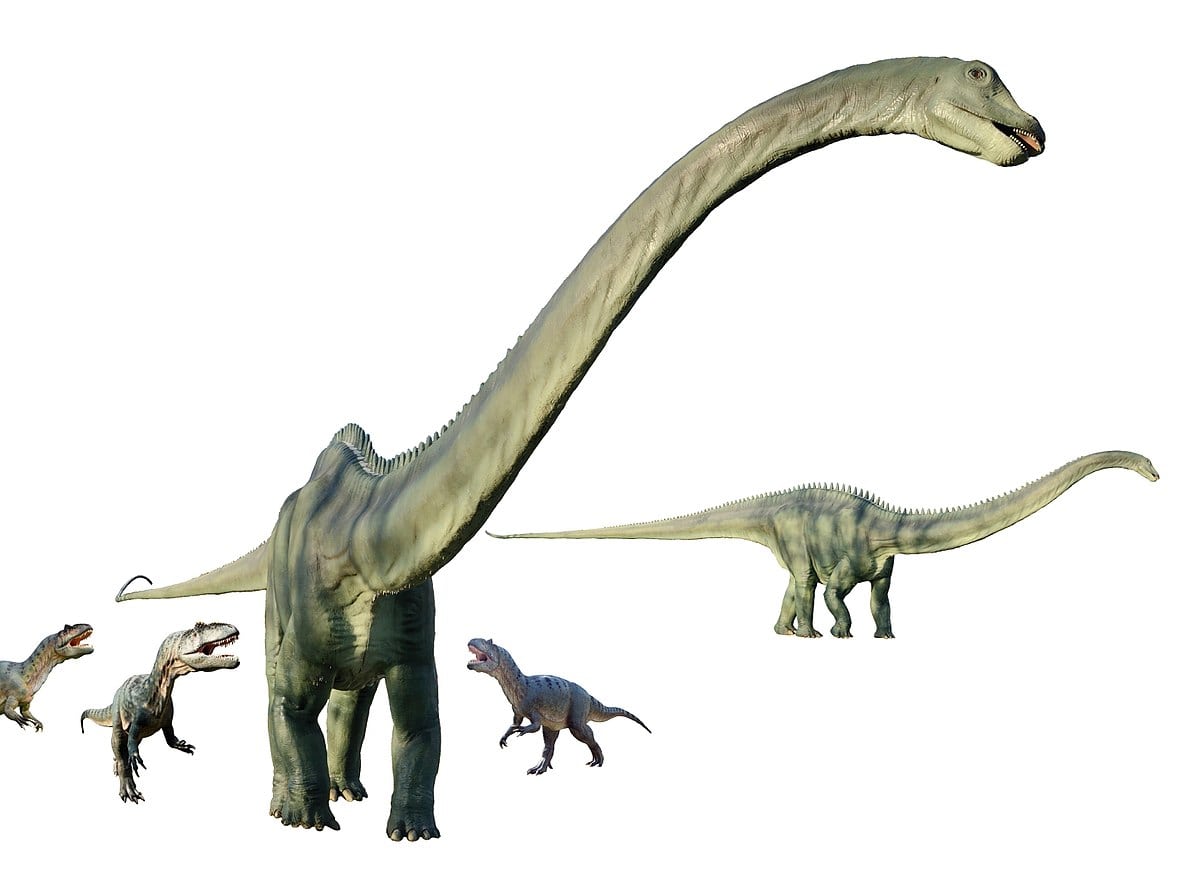
If Diplodocus held its neck at a 45° angle most of the time, it can be deduced that it fed primarily on ferns and other low vegetation. This food was also most likely more nutritious than the canopy vegetation (pine needles) at that time.
This posture now suggests that his center of mass was very far back. This suggests that Diplodocus couldn't run very fast. However, the rear center of gravity would have enabled it to stand on its hind legs.
Thus, due to its sheer size, it could easily reach the top of tall trees to graze on leaves.
Diplodocus's nostrils were located high on its forehead rather than at the end of its snout. Because of this, some scientists suspected that Diplodocus might have had a trunk. However, a 2006 study published in the journal Geobios concluded that Diplodocus did not have the requisite brain anatomy.
Diplodocus compared to Brachiosaurus
Diplodocus and Brachiosaurus are often confused, but they differ significantly anatomically. While Brachiosaurus had a steeply upright posture with its neck carried high thanks to its longer forelegs, Diplodocus had its forelimbs shorter than its hind legs. This resulted in an almost horizontal posture, similar to a suspension bridge made up of neck, torso and tail.
The body structure also differed: Diplodocus was slimmer overall and had a significantly longer, whip-shaped tail up to 14 meters long - in Brachiosaurus the tail was comparatively short. Brachiosaurus was bulkier and probably heavier than Diplodocus.
Nutrition
According to a 2013 study, Diplodocus had a short tooth replacement rate per tooth of just 35 days. This tooth replacement rate suggests that this dinosaur ate abrasive food, such as: B. ate plants covered with sand or gravel from the ground or ingested parts of plants that contained silica.
Herd behavior and social structure
Fossil sites with several Diplodocus individuals of different ages suggest that the animals moved in loose herds. Whether there was extensive brood care or whether nests were created cannot be determined from the previous fossil findings.
Given its size, Diplodocus had to consume large amounts of plant food every day - estimates suggest several hundred kilograms of greens per day. This required a living environment with vegetation available all year round, as was the case in western North America at the time (today's states of Colorado, Utah, Wyoming and Montana).
Diplodocus in the video game ARK: Survival Evolved
Diplodocus is one of the largest tamable sauropods in the survival game ARK: Survival Evolved. Players primarily use it as a mobile platform, as saddle platforms with several construction sites can be built on its back. Compared to other long-necked dinosaurs in the game, it scores points with its high carrying capacity and solid defense against smaller carnivores.
Unlike the real fossil find, the game gives the Diplodocus additional abilities, such as a melee tail attack. If you want to tame the Diplodocus, you should pay attention to the distance it travels from predatory dinosaurs, as despite its size it only has a limited escape speed.
Image sources: Fred Wierum, CC BY-SA 4.0 https://creativecommons.org/licenses/by-sa/4.0, via Wikimedia Commons
Debivort at en.wikipedia, CC BY-SA 3.0 http://creativecommons.org/licenses/by-sa/3.0/, via Wikimedia Commons
Jakub Hałun & Taxiarchos228, CC BY-SA 3.0 http://creativecommons.org/licenses/by-sa/3.0/, via Wikimedia Commons