Diabloceratops
Diabloceratops: The “devil horn face” from Utah
Description (physical characteristics)
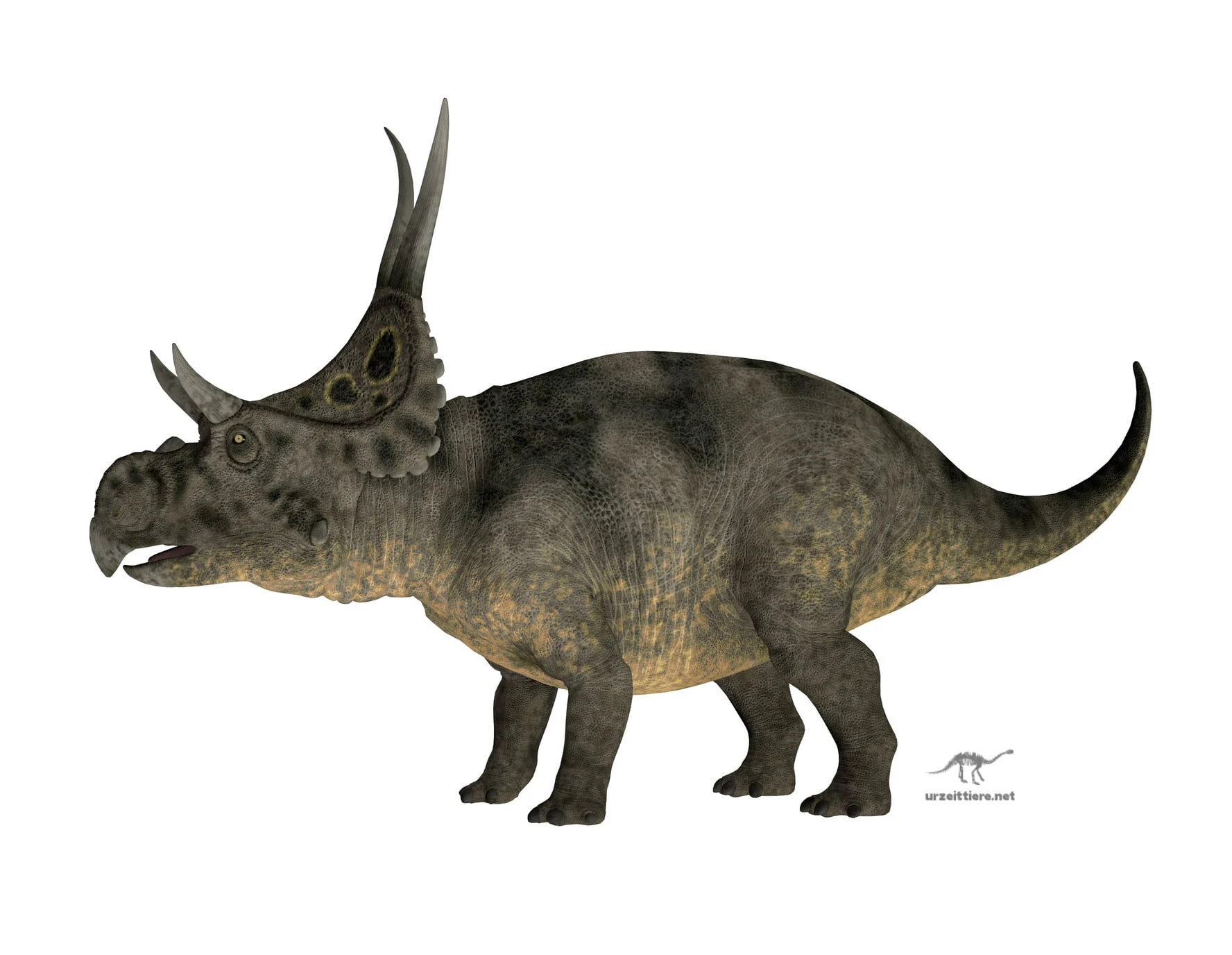
Diabloceratops eatoni was a four-legged herbivorous dinosaur. Like other ceratopsians, it had a strong, heavy build.
The animal was around 4.5 meters long and weighed around 1.3 tons. This made it much smaller than the famous Triceratops, which reached a length of 8 to 9 meters.
The dinosaur's body sat low to the ground on thick legs. These strong limbs supported his weight and allowed him to move around his environment. The forelimbs were shorter than the hindlimbs, a common feature in ceratopsian dinosaurs.
Skull and horns
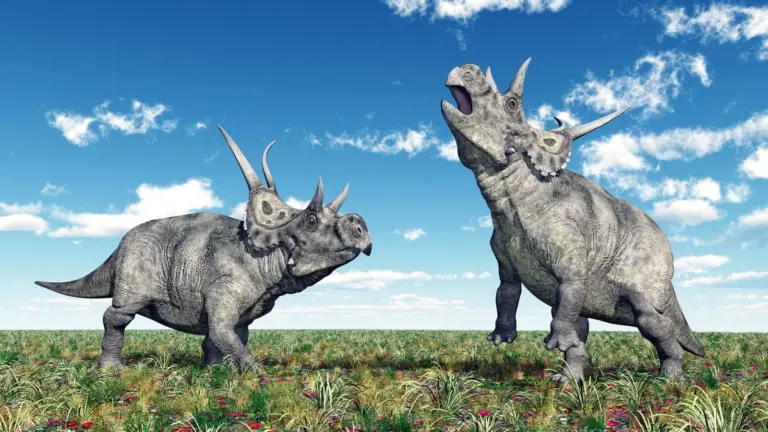
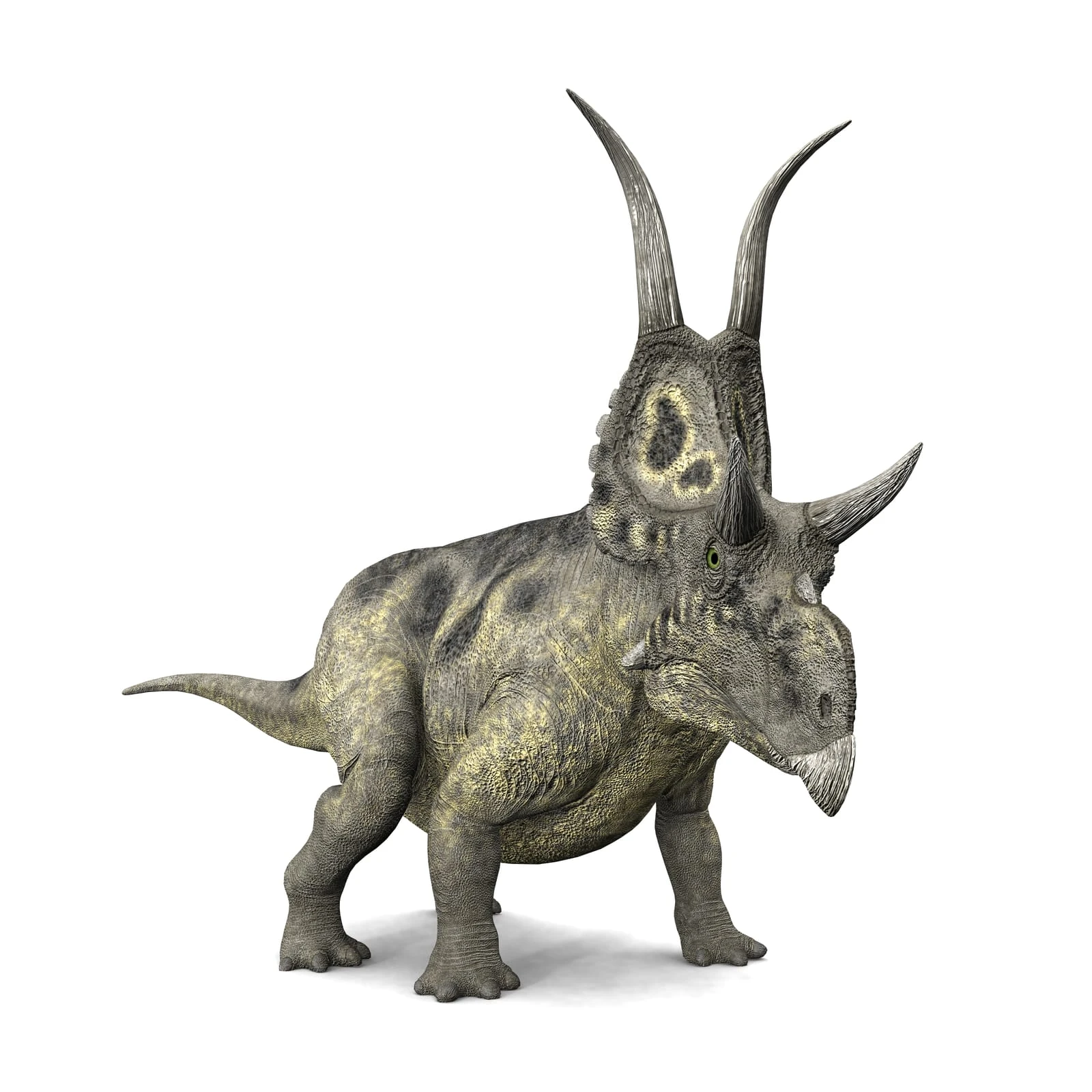
The Diabloceratops skull had several unique features. Long horns grew above each eye. These horns were unusual for a centrosaur dinosaur. Most members of this group had short forehead horns. The long frontal horns made the Diabloceratops more similar to the chasmosaurs.
There was a short horn on the nose. Some researchers suspect that a second, smaller horn may have grown in front of the nasal horn. The fossil evidence remains unclear on this point.
The “devil horns”
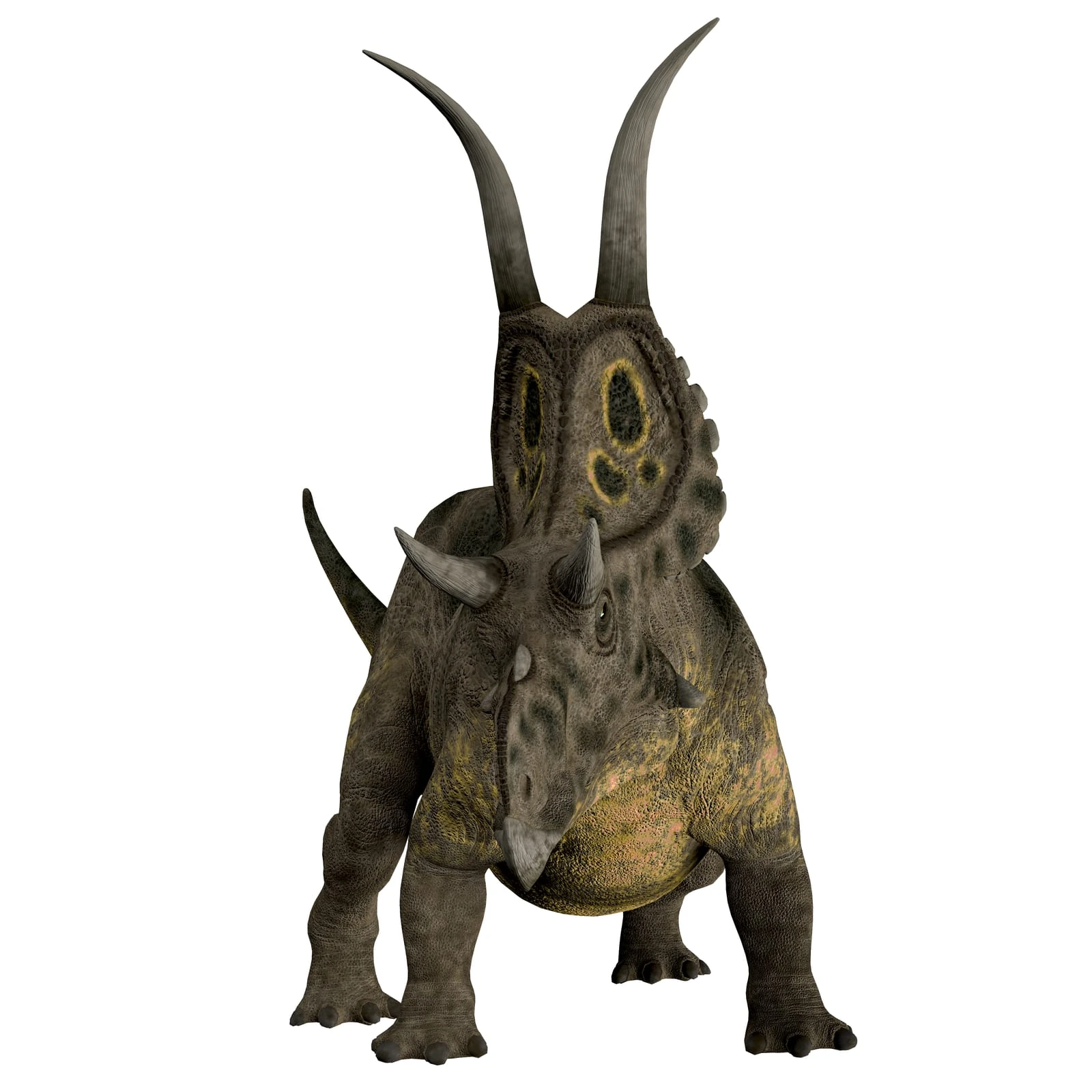
The most striking features were two large horns on the back of the neck shield. These horns were curved upwards and to the side. They resembled devil horns, which inspired the dinosaur's name. The Spanish word “diablo” means devil. The Greek word “ceratops” means horned face.
The collar itself was made of bone. It stretched from the back of his head to his neck. The collar had a deep profile and was relatively short compared to other centrosaurs.
Skull openings
The skull had an additional opening behind the eye. This feature appears in early ceratopsians but disappeared in later forms. The presence of this opening in Diabloceratops indicates that it was a basal or early member of its family.
The profile of the snout was deep but relatively short. This made the face look different than other centrosaurs from the same time period.
Quick info about Diabloceratops
The scientific name is Diabloceratops eatoni. The second part of the name honors paleontologist Jeffrey Eaton. The animal lived during the Late Cretaceous in the Campanian. That was around 81 to 79.5 million years ago.
Diabloceratops belonged to the family Ceratopsidae. Within this family it was part of the subfamily Centrosaurinae.
This puts it in the same group as dinosaurs such as Styracosaurus and Pachyrhinosaurus.
Only a few skull fossils have been discovered. This makes Diabloceratops one of the rarer ceratopsian dinosaurs. Due to the limited fossil finds, much about this animal is still unknown.
Diabloceratops
| scientific name | Diabloceratops eatoni |
| Estimated size | Length: 4.5 meters Height: 1.5 meters Weight: 1.2-1.3 tons |
| geological era | 81.4 – 81 million years |
| Locations | Wahweap |
| Order | Ornithischia |
| Subordination | Neornithischia |
Physical characteristics
| anatomy | Four-legged ceratopsid, approximately 4.5 m long, weighing 1.2–1.3 tons, with a large neck shield. |
| Special features | Long eye horns, short nose horn, two large upward/sideways curved “devil horns” on the neck shield. |
| locomotion | Four-legged |
| Skin texture | Probably scaly like other ceratopsians; no known fossil evidence. |
| Coloring | Unknown, not preserved as a fossil; Reconstructions vary (often earth or camouflage colors). |
discovery
| Explorer | Kirkland & DeBlieux |
| Discovery date | 2010 |
| Meaning of the name | “Devil horn face” or “face with devil horns” due to the curved neck shield horns. |
| Significant fossil finds | skull |
In paleontology, the ratio of brain to body size, the so-called Encephalization quotient (EQ), used as a rough guide to relative intelligence.
| Intelligence (EQ) | Presumably similar to other ceratopsians: moderate, comparable to modern cattle or rhinos; no EQ data. |
| Social behavior | Presumably herd builders with horns for intraspecific communication and show fights. |
| Predators | Large theropods such as Lythronax or tyrannosaurids from the Wahweap Formation. |
Discovery and fossil finds
The first find
The first Diabloceratops fossil was found in 2002. Don DeBlieux discovered it in the Last Chance Creek area of southern Utah. The fossil comes from the Wahweap Formation within the Grand Staircase-Escalante National Monument.
The type specimen was given the catalog number UMNH VP 16699. It consists of a partial skull with fragments of the lower jaw. The right side of the skull was better preserved than the left side.
Scientific description
James Kirkland and Donald DeBlieux described the species in 2010. They published their findings in a scientific volume on horned dinosaurs. The fossil was embedded in an intraclastic sandstone layer. Dating methods gave the rock an age of around 81.27 million years.
A second skull, possibly belonging to Diabloceratops, has been identified. However, scientists have not yet fully confirmed this specimen. Due to the rarity of fossils, every new find is important to understanding this animal.
Significance of the find
At the time of its description, Diabloceratops was the oldest known ceratopsid. This made it valuable for researching the evolution of this family of dinosaurs. The fossil fills a gap between earlier ceratopsids and later, more specialized forms.
Origin and meaning of the name
The name Diabloceratops comes from two languages. “Diablo” is Spanish for devil. It can also be traced back to Latin roots. “Ceratops” combines Greek words for horn and face. This naming is common among horned dinosaurs.
The name refers to the two distinctive horns on the collar. These horns are curved upwards and outwards. They look like the horns often seen on devils in art and stories. Despite its fearsome name, Diabloceratops was a peaceful herbivore.
The species name “eatoni” honors Jeffrey Eaton. He worked as a paleontologist and made important contributions to the understanding of prehistoric life in Utah.
Habitat and environment
Geographical location
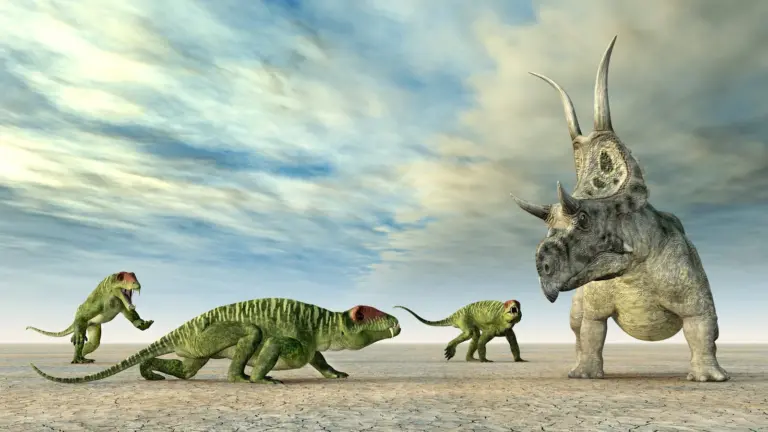
Diabloceratops lived in what is now southern Utah. During the Late Cretaceous, this area was part of Laramidia. Laramidia was a landmass that formed the western part of North America. The Western Interior Seaway divided the continent in two.
The Wahweap Formation preserves the ancient environment. This rock formation shows evidence of river floodplains and swamps. The climate was warm and humid, which encouraged dense plant growth.
The Wahweap Formation ecosystem
The area had many rivers and streams. These waterways created floodplains where plants grew thickly. In many areas, ferns covered the ground. Conifers and early flowering plants also grew there.
Other dinosaurs shared this habitat. Large predatory dinosaurs hunted in this region. Early mammals scurried through the undergrowth. Insects, molluscs and other invertebrates lived in this area.
The lush vegetation supported many herbivorous dinosaurs. Different species ate different types of plants. This allowed multiple herbivores to live in the same region without competing too much for food.
Nutrition and eating behavior
Adaptations to plant nutrition
Diabloceratops fed exclusively on plants. Its mouth formed a beak-like structure at the front. This beak was made of bone and covered with a horn-like covering. The beak worked like scissors to cut plants.
Behind the beak, rows of teeth lined up along the jaw.
These teeth were designed to cut through plant material. When the teeth wore down, new ones grew to replace them. This constant exchange allowed the animal to eat throughout its life.
Food sources
The dinosaur probably fed on low-growing plants. Ferns may have been an important source of food. There were many species of ferns in the Wahweap Formation. Cycads and other primitive plants also grew in this region.
The short snout suggests that Diabloceratops fed near the ground. It may also have eaten bushes and low branches. His strong jaw muscles allowed him to process tough plant material.
His posture kept his head relatively close to the ground. This meant he could easily get to low vegetation. The animal probably spent much of its day eating to fuel its large body.
behavior and lifestyle
Social behavior
Many ceratopsian dinosaurs lived in herds. Diabloceratops may have done the same. Herds provide protection from predators. Groups can recognize dangers more easily than individual animals.
Living in groups also helps in the search for food and water. Young animals can learn from older ones. However, there is little direct evidence that Diabloceratops lived in herds. This assumption is based on the study of related species.
Defense mechanisms
The horns and collar served multiple purposes. They helped protect against large predators. An attacking Diabloceratops could use its forehead horns as weapons. The collar protected the sensitive neck area.
The horns also played a role in social interactions. Males may have used them in fights over females or territory. The horns on the collar could send signals to other members of the species. Brighter or larger horns may have signaled health and strength.
The exact function of each horn remains uncertain. Scientists develop hypotheses by comparing Diabloceratops with living animals with horns. Today's animals use horns for fighting, display and defense.
Movement and activity
Diabloceratops moved around on all four legs. The strong limbs supported his weight efficiently. Because of its size and stature, the animal could not run fast. Instead, it relied on its weapons and armor for protection.
The short legs suggest slow locomotion. The dinosaur probably lived in areas with good food supplies. If there were plenty of plants nearby, he didn't have to travel long distances.
Classification and evolution
Taxonomic position
Diabloceratops belongs to the order of Ceratopsia. All horned dinosaurs belong to this group. Within the Ceratopsia it is part of the family of Ceratopsidae. This family includes the largest and most developed horned dinosaurs.
The Ceratopsidae are divided into two subfamilies. To the Centrosaurinae include dinosaurs with short collars and often elaborately designed nose horns. The Chasmosaurinae include forms with long collars and prominent forehead horns. Diabloceratops belongs to the Centrosaurinae, but shares some features of the Chasmosaurinae.
Evolutionary significance
Diabloceratops was a basal centrosaurine. This means that he split off early in the group's history. It exhibits a mix of primitive and advanced features.
The additional skull opening is a primitive feature. Early ceratopsians had this opening, but later forms lost it. The presence of this opening in Diabloceratops shows how this feature gradually disappeared over the course of evolution.
The long frontal horns are more developed. They resemble features found in later Ceratopsidae. This combination of old and new features helps scientists understand how Ceratopsidae have changed over time.
Regional development
The dinosaur lived in Laramidia in a time of great diversity. Different Ceratopsia species lived in different regions. Each area had its own forms adapted to local conditions.
Diabloceratops shows how ceratopsids evolved distinct regional populations. The animal's characteristics match its specific environment and time period. His study helps reconstruct how these dinosaurs spread and changed across the continent.
Comparison with related species
Diabloceratops vs Triceratops
Triceratops is the best known ceratopsid. It was much larger, measuring 8 to 9 meters long. Diabloceratops was only 4.5 meters long. Triceratops had two long forehead horns and a nasal horn. Its collar was large and massive, without the dramatic spikes seen on Diabloceratops.
Triceratops lived later, at the end of the Cretaceous period. It came from a different subfamily than Diabloceratops. The two animals represent different branches of the ceratopsid family tree.
Diabloceratops vs. Cosmoceratops
Kosmoceratops also lived in Utah during the Late Cretaceous. It was 4 to 5 meters long, similar to Diabloceratops. Cosmoceratops however, had a much more elaborate collar. Its collar had more spikes and decorations than any other known ceratopsian.
The frontal horns of Kosmoceratops were short and directed downward. This distinguishes it from the long, upward-pointing horns of Diabloceratops. Kosmoceratops belonged to the Chasmosaurinae, the other subfamily of the Ceratopsidae.
Diabloceratops vs. Utahceratops
Utahceratops also came from Utah. It was larger and heavier than Diabloceratops. Like Kosmoceratops, it belonged to the Chasmosaurinae. His collar was long, following the pattern of his subfamily.
All three ceratopsians from Utah show how diverse they are Dinosaurs had become. Each species had unique horn and collar patterns. These differences helped each species recognize its own kind.
Unique features
Diabloceratops stands between the typical centrosaurines and chasmosaurines. It has the short collar of a centrosaurine. But its long forehead horns resemble the characteristics of chasmosaurines. The devil horns on the collar are unique to this species.
This mix of features shows that Diabloceratops was an early experimental form. Evolution tested different combinations of traits. Some characteristics spread to later species. Others remained unique to this dinosaur.
Museum exhibitions and popular culture
Where to see Diabloceratops
The Natural History Museum of Utah (NHMU) houses the original fossils. The museum displays information about the dinosaur and its surroundings. Visitors can see the partial skull that defines the species.
The museum provides background information on the Wahweap Formation. The exhibits show what southern Utah looked like 80 million years ago. In addition to the Diabloceratops, other fossils from the same region can be seen.
Media and models
Diabloceratops appears in documentaries about prehistoric life. The podcast “I Know Dino” dedicated an episode to this dinosaur. Various instructional videos explain its unique features.
Toy manufacturers have developed Diabloceratops figures. CollectA has released a detailed model of the animal. These figures help people imagine what the living dinosaur looked like.
The NHMU website provides additional information and images. Other reputable dinosaur websites offer 3D reconstructions. These resources will help students and enthusiasts learn more about Diabloceratops.
Frequently asked questions
Was Diabloceratops dangerous?
Diabloceratops was not aggressively dangerous to other dinosaurs. It ate only plants and did not hunt. However, he was well equipped to defend himself. The horns and collar protected it from predators. A threatened Diabloceratops was able to injure an attacker.
Why did Diabloceratops have so many horns?
The numerous horns served different purposes. The forehead horns were used for defense and fighting with rivals. The collar horns were probably mainly for display. They helped the animal to communicate with other animals. The combination of these features shows the importance for both combat and social communication. Scientists base these assumptions on the study of modern horned animals and related dinosaurs.
How rare are Diabloceratops fossils?
Diabloceratops fossils are quite rare. Only a few skull remains were found. No complete skeleton has yet been discovered. This scarcity limits what scientists can understand about the animal. Every new fossil discovery provides important information. The rarity makes Diabloceratops particularly interesting for researchers.
Is Diabloceratops related to Triceratops?
Yes, both dinosaurs belong to the Ceratopsidae family. However, they come from different subfamilies. Diabloceratops was a centrosaurine while Triceratops was a chasmosaurine. They have a common ancestor but evolved differently. Diabloceratops lived earlier and was much smaller than Triceratops.
What we learn from Diabloceratops
Diabloceratops combines an unusual appearance with scientific significance. The animal represents an early stage in the development of ceratopsids. Its mix of primitive and advanced features shows how these dinosaurs changed over millions of years.
The fossil comes from southern Utah during a time when there was a wide variety of dinosaurs. Regional differences led to many specialized forms. Diabloceratops shows how ceratopsians have adapted to specific areas within Laramidia.
The additional skull opening shows how anatomical features can disappear over the course of evolution. The long forehead horns testify to experiments with various defense and imposing strategies. Every detail of the skeleton tells a part of the larger story.
Future discoveries could reveal more about Diabloceratops. A more complete skeleton would answer many questions about his body structure. More skulls could show how much the individuals varied. More fossils from the Wahweap Formation may reveal other species that lived alongside it.
Understanding Diabloceratops helps scientists reconstruct the entire Late Cretaceous ecosystem. The dinosaur was part of a complex network of plants and animals. Each species played a role in its environment.
Research into Diabloceratops continues to this day. Researchers compare it with newly discovered species. New analysis techniques reveal details missed by previous methods. Every technological advance reveals new information from ancient fossils.
For students and enthusiasts, the Diabloceratops offers a glimpse into the past. The dinosaur lived in landscapes that no longer exist today. Knowledge of him connects us to a world that disappeared millions of years ago. The more we learn about animals like Diabloceratops, the better we understand how life changes over time.
Explore more articles about Utah's dinosaurs to learn more about Diabloceratops' neighbors. Explore other ceratopsians to see how this family has diversified. Study the Wahweap Formation to understand the entire ancient ecosystem.