Apatoraptor
“Deceptive thief”
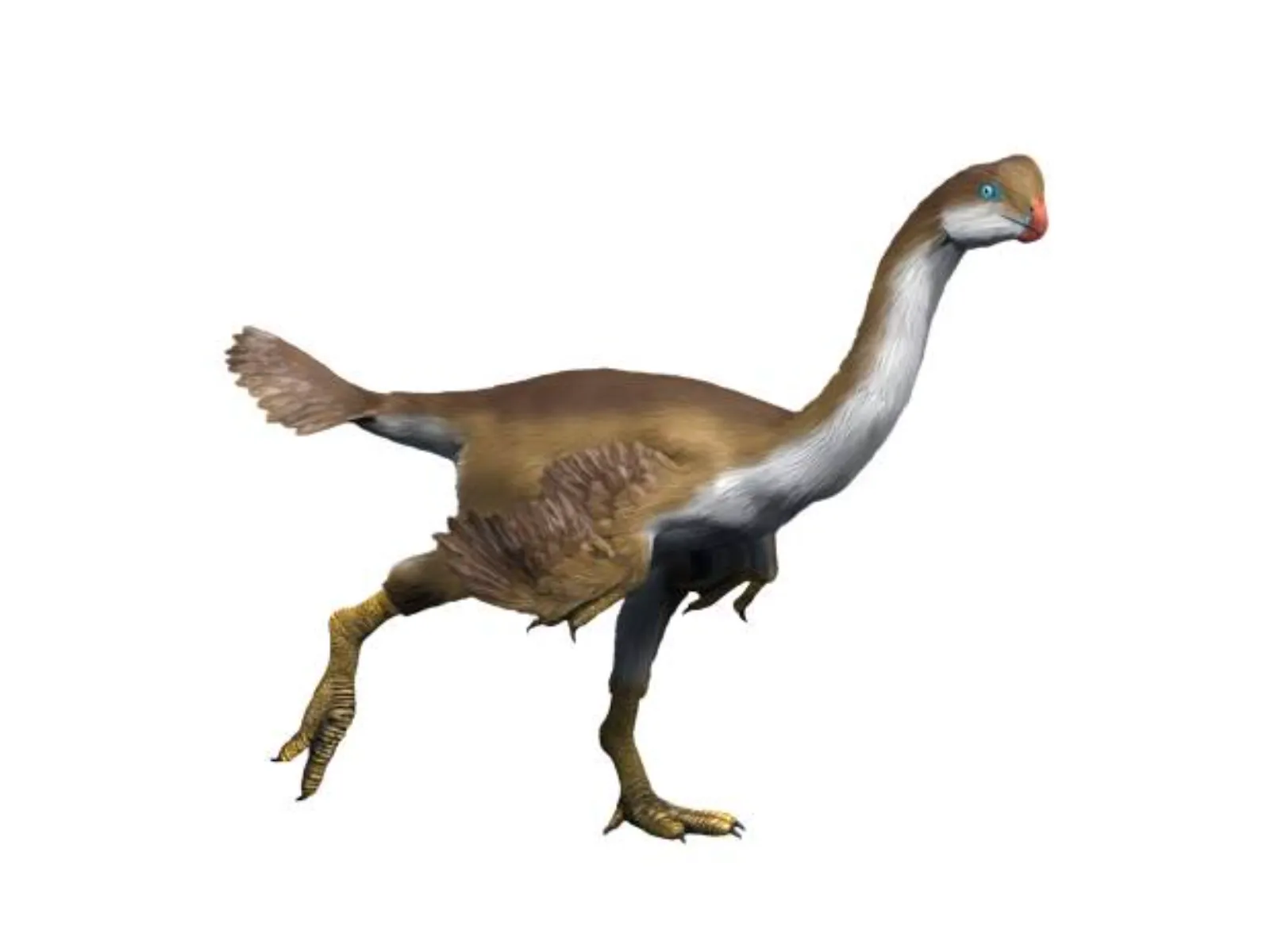
The “deceptive thief” Apatoraptor pennatus, was an approximately 2.5 meter long, bird-like dinosaur from the Upper Cretaceous of what is now Canada. It was characterized by a prominent head crest, long tail feathers and feathered, well-muscled arms called pennibrachia. These features were probably for sexual display rather than flight.
Appearance and characteristics of Apatoraptor
Body type and size
Apatoraptor was a bipedal, bird-like dinosaur, but significantly larger than a human. With an estimated length of 2.5 meters, a height of 0.9 meters and a weight of around 55 kilograms, it was relatively large for an oviraptorosaur of its kind. Its body structure included a long neck, consisting of at least 11 well-pneumatized cervical vertebrae, and a long tail that served for stabilization.
Plumage and special adaptations
Presumably it was Apatoraptor Feathered all over the body, similar to Beipiaosaurus. Particular attention is paid to his arms, which are interpreted as pennibrachia. Ulnar papillae were found on the ulna, indicating the anchoring of springs. These feather-bearing arms, despite their name as pennibrachium, were not adapted for flight or gliding. Instead, similar to the long tail feathers and the distinctive crest on its head, they are interpreted as structures for sexual display and to impress other birds, which is reminiscent of the courtship behavior of today's birds.
In addition, a toothless lower jaw was another characteristic feature that indicates a special diet. This feature distinguished it from many other theropods.
Pennibrachium: A Detailed Explanation
The term pennibrachium (from Latin “penna” = feather and “brachium” = arm) describes a forelimb that is at various extinct coelurosaurs occurs. Although not optimized for flight, it sported long, typically stalked feathers that formed a wing-like surface. In contrast to the flight feathers in birds, which fulfill an aerodynamic function, the feathers of the pennibrachium served Apatoraptor probably not the buoyancy. Instead, the well-muscled arms are believed to be it Apatoraptor enabled them to actively move their feathers to give visual signals, for example to demonstrate fitness or to differentiate themselves from rivals. This was supported by evidence of unusual arm muscles on this dinosaur's forearms. Comparisons with the flight muscles of modern birds show a functional divergence here: While birds developed muscles for powerful wing flaps, Apatoraptor optimized its muscles for precise and conspicuous control of its display feathers.
Habitat and ecosystem details
Apatoraptor pennatus lived during the Late Cretaceous (Campanian, about 80 to 72 million years ago) in the moist, water-rich areas of what is now southern Alberta, Canada, particularly in the Horseshoe Canyon Formation. At that time, this region was characterized by extensive swamps, rivers and densely forested riparian areas that formed a rich ecosystem. The wet conditions of the habitat may have played a role in the preservation of the fossils, resulting in the exceptional completeness of the type specimen Apatoraptor contributed.
In the ecosystem of the Horseshoe Canyon Formation divided Apatoraptor the habitat with a variety of other dinosaurs. These included large, herbivorous hadrosaurs such as Edmontosaurus and Parasaurolophus, ankylosaurid dinosaurs like Euoplocephalus, as well as horned dinosaurs like Pachyrhinosaurus and Anchiceratops. Larger theropods such as came as predators Albertosaurus in question, although there is direct evidence of attacks Apatoraptor missing. The presence of such top predators suggests that Apatoraptor Despite its size, it could have been an object of prey.
The specific adjustments of Apatoraptor Its swampy habitat is not fully understood, but its relatively slender build and agile legs may have helped it move efficiently in dense undergrowth and on soft ground. The toothless beak may have taken advantage of a food source that was abundant in this moist environment, possibly plant material, small animals, or eggs.
Pennibrachium
Pennibrachium is a term from zoology and paleontology. It describes a forelimb found in various species of extinct coelurosaurs. Although it is not suitable for flying or gliding, it still has long, typically stalked feathers that form a wing-like surface.
Apatoraptor
| scientific name | Apatoraptor pennatus |
| Estimated size | Length: 2.5 meters Height: 0.9 meters Weight: 55 kilograms |
| geological era | Upper Cretaceous |
| Locations | Horseshoe Canyon |
| Order | Saurischia |
| Subordination | Theropoda |
Physical characteristics
| anatomy | Bipedal, bird-like, about 2 meters long, 0.9 meters high, weighing 180 kg, long neck and tail |
| Special features | Distinctive crest on the head, long tail feathers, feathered arms (Pennibrachium) |
| locomotion | Two-legged |
| Skin texture | Probably feathered all over the body |
| Coloring | Presumably sex-dependent plumage coloring like today's birds |
discovery
| Explorer | Funston & Currie |
| Discovery date | 2016 |
| Meaning of the name | Deceptive feathered robber or deceptive thief |
| Significant fossil finds | Partial skeleton with fragmentary skull. |
In paleontology, the ratio of brain to body size, the so-called Encephalization quotient (EQ), used as a rough guide to relative intelligence.
| Intelligence (EQ) | Not exactly known, but as a caenagnathid it is probably relatively intelligent for dinosaurs |
| Social behavior | Probably showed feathers to impress and impress partners |
| Predators | Not directly known, but probably large theropods of its time |
Origin of the name Apatoraptor and history of discovery
The scientific name Apatoraptor pennatus means “deceptive feathered robber” or “deceptive thief”. This designation refers to the long time span and difficulty in correctly classifying the fossil. The type specimen was found over 23 years ago and sent to the Royal Tyrrell Museum in Alberta, Canada. Due to the enormous amount of fossil resources in Alberta and the need to set priorities, the fossil initially remained in storage and was not examined further.
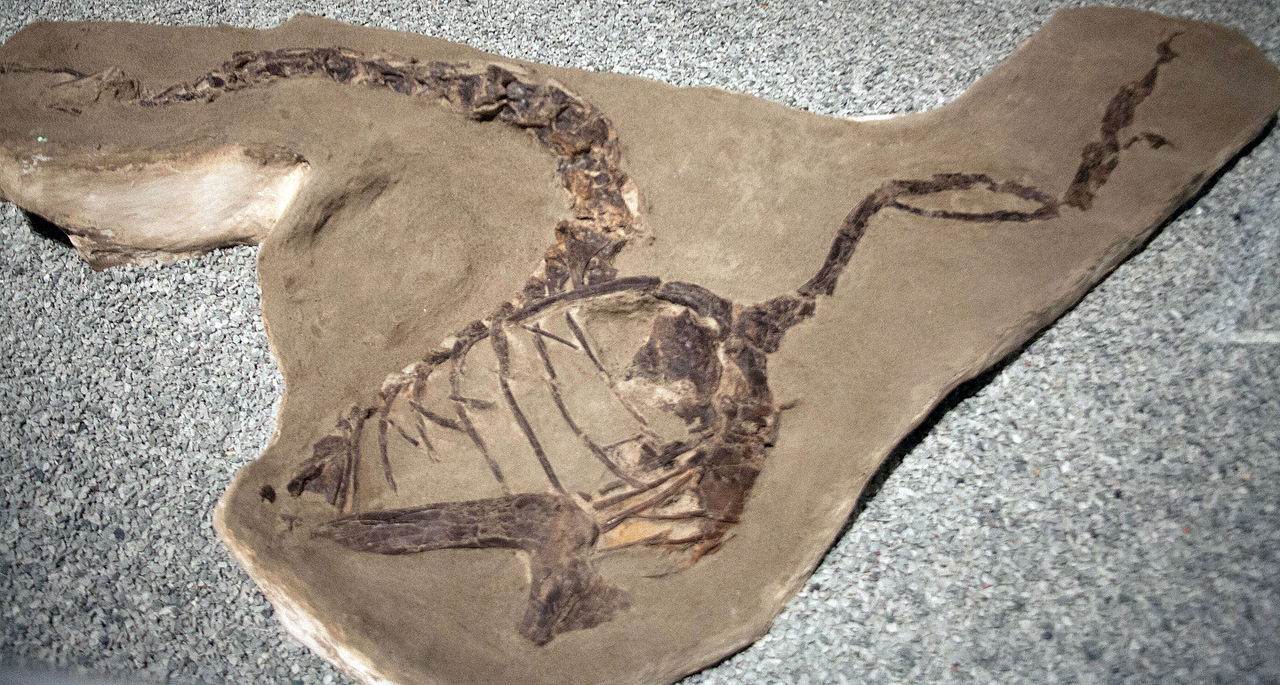
For a long time the remains were thought to be those of a better-known ornithomimid. It wasn't until 2008 that research on this particular fossil resumed. It was recognized that this was a new species to science and should fill an important gap in the understanding of the Caenagnathidae family. Gregory Funston named and described Apatoraptor finally in 2016. The fossil is considered by far the most complete Caenagnathidae skeleton from Canada (Alberta) and at the time of its description was the first articulated Caenagnathidae skeleton in the world - meaning the bones were still in their original anatomical position, which is invaluable for detailed studies.
Most important statistics about the find:
The Apatoraptor pennatus fossil, scientifically described in 2016 by Gregory Funston and Philip J. Currie in the Journal of Vertebrate Paleontology (Vol. 36, No. 4, e1160910), represents the most complete skeleton of the Caenagnathidae ever found in Canada. At the time of its description, it was also the world's first coherent skeleton of a Caenagnathidae ever discovered, providing unprecedented insight into this dinosaur family.
Intelligence (EQ) and social behavior
The encephalization quotient (EQ), which describes the ratio of brain size to body size, serves as a rough guide to the relative intelligence of dinosaurs. Although the exact EQ for Apatoraptor Although it is not exactly known, it is assumed that, as a caenagnathid, it had a relatively high intelligence for dinosaurs. Recent research on other caenagnathids has supported this assumption by implicating complex behaviors that require some cognitive prowess.
With regard to social behavior, it is assumed that Apatoraptor pennatus used its conspicuous feathers - the head crest, the tail feathers and the arm feathers - to attract mates and to impress rivals. These behaviors are common among modern birds and suggest similar social dynamics within this dinosaur group.
-The animal's bones are still in the same position as at the time of death -
“Because these animals are far too large to fly, they probably use their feathers for display.”
Greg Funston
Classification and phylogeny
Scientific classification
Type: Apatoraptor pennatus
Rich: Animalia (animals)
Tribe: Chordata (chordates)
Class: Sauropsida (reptiles)
Order: Saurischia (lizard-pelvis dinosaur)
Subordination: Theropoda (Theropods)
Superfamily: Oviraptorosauria
Family: Caenagnathidae
Genus: Apatoraptor
Classification within the Caenagnathidae
Apatoraptor pennatus belongs to the family Caenagnathidae, a group often described by scientists as “notoriously enigmatic,” with many species known only from fragmentary remains. The exceptionally complete skeleton of Apatoraptor is therefore crucial to understanding this family. It provides detailed information about the anatomy, biology, and evolutionary relationships within the Oviraptorosauria group. Compare with other caenagnathids like Caenagnathus and Anzu “Hell Chicken” wyliei, particularly in relation to the skeletal structure and the pennibrachium, allow researchers to better define the characteristics of this group and trace their evolution. Apatoraptor in particular helps to better understand the variations in size and morphological adaptations within the Caenagnathidae and to clarify the phylogenetic relationships between the different genera.
Significant fossil finds
The most important find is the partial skeleton with a fragmentary skull, which serves as a type specimen. Its articulation - the bones were preserved in their original anatomical position - is particularly valuable as it allows detailed insights into the entire skeletal structure and soft tissue attachments. This fossil is the most complete Caenagnathidae skeleton in Canada and the first articulated one in the world. It forms the basis for all current knowledge about Apatoraptor.
Sources
- Funston, G. F., & Currie, P. J. (2016). A new caenagnathid (Dinosauria: Oviraptorosauria) from the Horseshoe Canyon Formation of Alberta, Canada, and a reevaluation of the relationships of Caenagnathidae. Journal of Vertebrate Paleontology, 36(4), e1160910. [Link to paper if available]
- Longrich, N. R., Currie, P. J., & Zhi-Ming, D. (2010). A new oviraptorosaur (Dinosauria: Theropoda) from the Late Cretaceous of Mongolia. Canadian Journal of Earth Sciences, 47(8), 1145–1167. [Relevant paper for the context of Oviraptorosauria]
- Lautenschlager, S. (2013). Cranial anatomy of Caenagnathus collinsi (Dinosauria: Theropoda) from the upper Campanian of Alberta, Canada. Journal of Vertebrate Paleontology, 33(3), 670–682. [Relevant paper for the context of Caenagnathidae]
- [Other relevant scientific papers and publications, preferably in English, could be added here.]
Bildquellen: Nobu Tamura email:[email protected] http://spinops.blogspot.com/ http://paleoexhibit.blogspot.com/, CC BY-SA 4.0 https://creativecommons.org/licenses/by-sa/4.0, via Wikimedia Commons
Roland Tanglao from Vancouver, Canada, CC BY 2.0 https://creativecommons.org/licenses/by/2.0, via Wikimedia Commons