
Ambopteryx
Physical characteristics
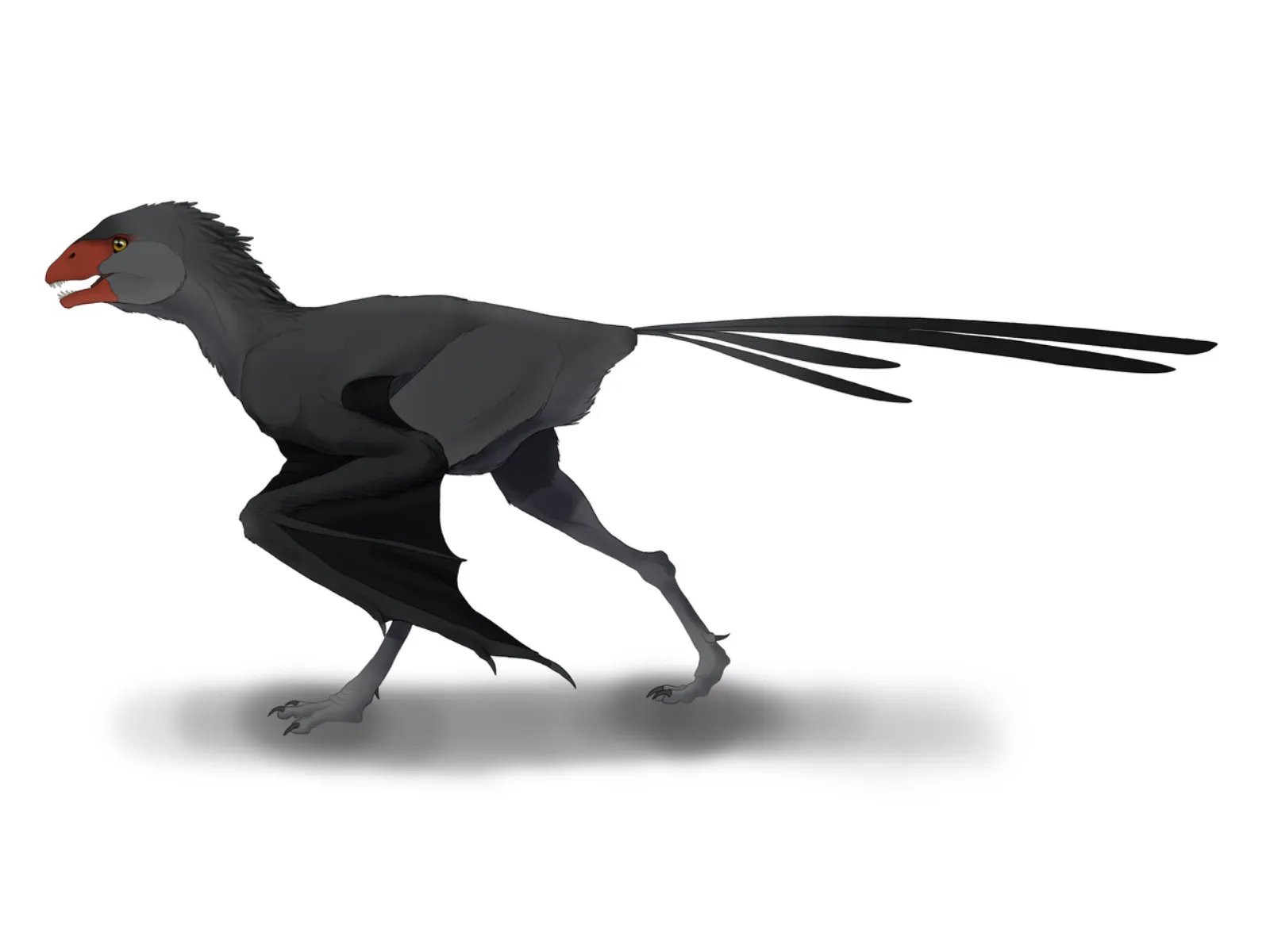
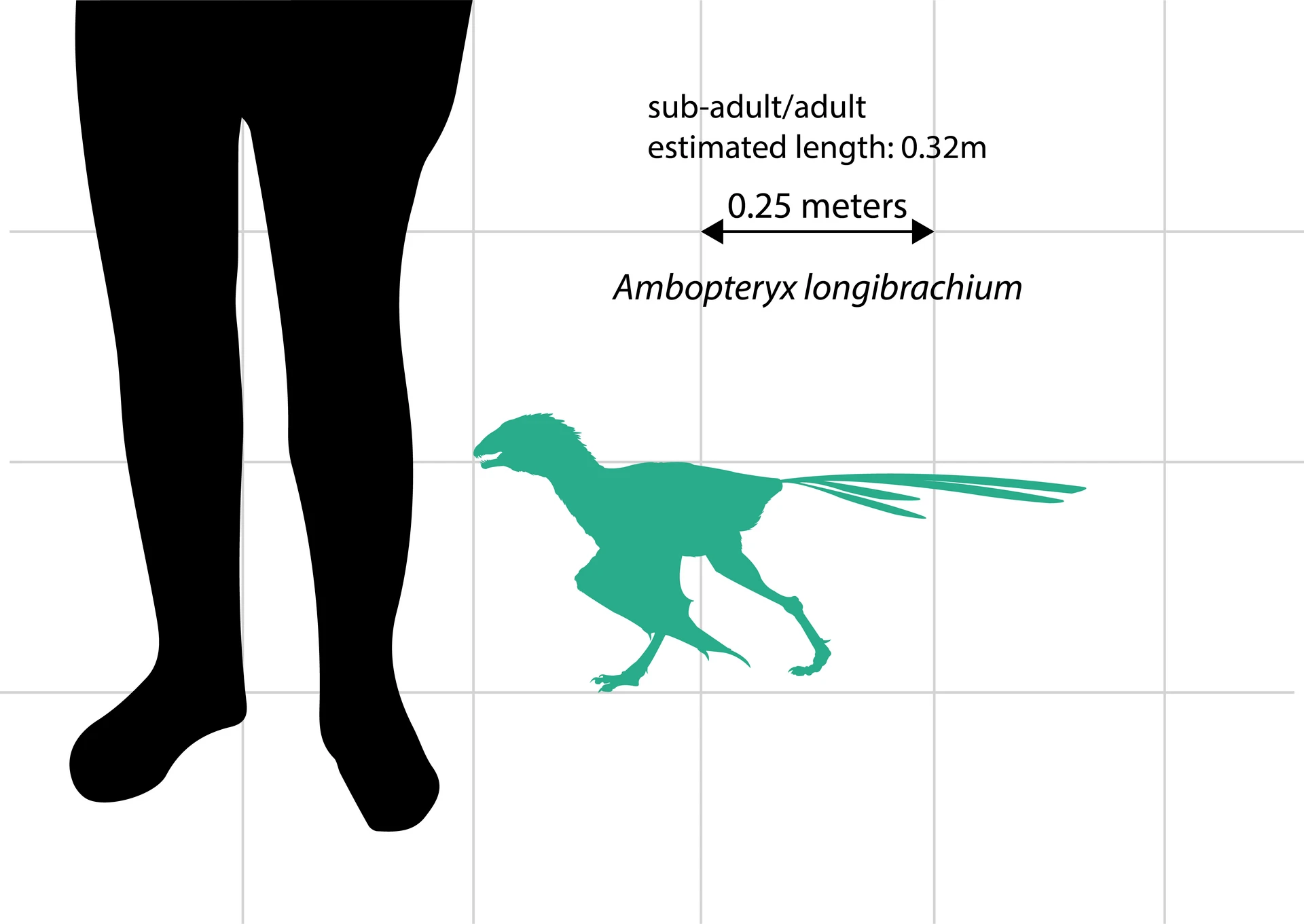
Ambopteryx longibrachium was 32 centimeters long and had a shoulder height of 11 centimeters. This small theropod weighed between 300 and 306 grams. The dinosaur moved on the ground on two legs, but spent a lot of time climbing trees. Its most striking feature was its membranous wings, similar to those of modern bats.
Habitat and locomotion
Ambopteryx lived during the Late Jurassic, about 163 million years ago. The dinosaur combined walking on the ground with the ability to to climb trees. The dinosaur had membranous wings, similar to those of bats, supported by a rod-like wrist bone. Its membrane wings allowed it to glide between trees, a unique flight adaptation among dinosaurs.
Nutrition
Analysis of the holotype revealed one mixed diet (omnivorous), it fed on both plants and small animals. Scientists found gastroliths (stomach stones) and bone fragments in the fossil's stomach area, suggesting an opportunistic diet. These stones helped grind the food in his digestive system.
Special features
The most notable feature of Ambopteryx was its bat-like wing membrane, which was supported by a specialized wrist bone.
This structure is only found in pterosaurs and flying squirrels, making Ambopteryx highly unusual among dinosaurs. The dinosaur also had a pygostyle - fused caudal vertebrae typically found only in birds and a few other dinosaur groups.
Classification
Ambopteryx belongs to the family Scansoriopterygidae within the order Theropoda. This small family of arboreal, non-flying dinosaurs represents one evolutionary branch separate from birds The only other known membrane-winged dinosaur, Yi qi, is its sister taxon.
discovery
A farmer discovered the Ambopteryx fossil near the village of Wubaiding in China's Liaoning Province. In 2017, the specimen was handed over to the Institute of Vertebrate Paleontology and Paleoanthropology in Beijing. Careful dissection over a year revealed its distinctive dinosaur features, including long, splayed fingers.
The Ambopteryx specimen is considered that most complete scansoriopterygid fossilthat has been found so far. His discovery confirmed the existence of bat-like membranous wings in dinosaurs, previously known only from fragmentary Yi-qi remains.
Ambopteryx
| scientific name | Ambopteryx longibrachium |
| Estimated size | Length: 32 centimeters Height: 11 centimeters Weight: 300 grams |
| geological era | Upper Jurassic |
| Locations | Haifanggou Formation |
| Order | Saurischia |
| Subordination | Theropoda |
Physical characteristics
| anatomy | Small, light bipedal climber (~32 cm, ~306 g) with proportionally very long forearms and short tail |
| Special features | Bat-like flight skin wings, supported by a unique rod-shaped stylifor element on the wrist, as well as a pygostyle (fused tail vertebrae) |
| locomotion | Two-legged |
| Skin texture | Head, neck and shoulders densely covered with feathers; Wings made of a membranous flight membrane (patagium) |
| Coloring | Eumelanosomes (pigment-producing organelles) were detected in the neck feathers and flight membrane, indicating a black to dark brown coloration |
discovery
| Explorer | Wang et al. |
| Discovery date | 2019 |
| Meaning of the name | Ambo (Latin “both”) + pteryx (Greek “wing”) → “Both wings”; longibrachium = “long arm” |
| Significant fossil finds | A well-preserved, almost complete skeleton with associated soft tissue preserved on a plate and a counterplate. |
In paleontology, the ratio of brain to body size, the so-called Encephalization quotient (EQ), used as a rough guide to relative intelligence.
| Intelligence (EQ) | Not explicitly measured; as a small Maniraptora probably in the middle range (~0.5–1.0), comparable to other small Coelurosauria |
| Social behavior | Not fossilized; As a small arboreal it probably lived solitary in trees |
| Predators | No directly documented predators known; Larger theropods and early mammals from the Upper Jurassic come into question as potential predators |
Image sources:
Post image: Audrey.m.horn, CC BY-SA 4.0, via Wikimedia Commons
Size comparison: User:Audrey.m.horn Creative Commons Attribution-Share Alike 4.0 International